
What do high-performing email platforms offer in 2026?
Explore the best email marketing platforms in 2026, backed by real data, research, and insights into the features driving better performance.


Explore the best email marketing platforms in 2026, backed by real data, research, and insights into the features driving better performance.


There is no shortage of email marketing platforms on the market. Most marketers will try a few over their career, and quickly realise they’re not all created equal.
Some platforms are built for simple email marketing, where the focus is on sending campaigns and managing basic contact lists. Others are designed for teams that want advanced features like the ability to build automated journeys and personalise each message using AI.
As more businesses adopt these advanced tools, expectations are rising across the board. Yet 51% of marketers still say their campaigns feel generic. This, combined with AI filtering out your emails before they even make it to the customer, makes the landscape trickier to navigate than it was a year ago.
To help you overcome these challenges, we’re going to break down the features that you can expect from a high-performing email marketing platform and how you can use them to get more out of your campaigns.

Email marketing has been around for decades, with the first commercial mass email sent in 1978. In the past, email marketing was simple: Write a message to prospects and wait for them to respond (and hopefully the sales to pour in).
Despite how much email marketing has changed, we found that 68% of consumers still view email as the best way for brands to communicate with them.
However, while customers still engage with emails, the bar to get their attention has risen. A key reason for this is personalisation. When an email feels relevant and targeted, it feels like a helpful message, but when it’s generic, people mentally categorise it as spam.
The uptick in personalisation isn’t because teams suddenly have larger teams tailoring every message; it’s because they have access to AI agents. These agents can analyse behaviour, segment audiences, and personalise messages at scale.
AI & Email Marketing: Everything You Need to Know | Salesforce Explained
To expand on this, let’s look at the top features you can expect from a marketing platform today that weren’t possible five years ago.
The tools that supported teams historically have either adapted to support modern marketing tactics or are now holding teams back.
Teams using more advanced platforms are able to use AI agents and connected data to personalise faster, test more, and optimise 24/7. Those without these capabilities are relying on static campaigns that are harder to improve.
Below, we’ll walk through the key features to look for in 2026, and how each one helps improve open rates, click-through rates, and reduce unsubscribes.
| Feature | What it helps with |
|---|---|
| Agentic automation workflows | Adjusting journeys in real time |
| AI content and testing | Testing copy to increase opens and CTR |
| Deliverability and authentication | Ensuring emails reach customers' inboxes |
| List hygiene and fraud detection | Protecting sender reputation |
| Predictive personalisation | Sending more relevant messages |
| AI-friendly email structure | Improving visibility in inbox summaries |
| Interactive email experiences | Increasing engagement |
| Embedded commerce | Supporting email to conversation pathways |
| Privacy and consent management | Reducing unsubscribes and complaints |
This is the more advanced version of traditional drip campaigns. Instead of following a fixed path, the journey your customer is sent on is adapted in real-time based on their actions.
This means your emails can change based on behaviour (such as engagement, purchase intent, or inactivity) without needing manual updates.
For example, if someone clicks into a pricing page from your email but doesn’t convert, AI agents can recognise that this is a high-intent action and follow up with a tailored email that addresses common objections for customers in the same segment.
Many teams do A/B testing but don’t have a way to store or use the data they gather to improve future campaigns. AI agents can take messages from real content marketers and continuously test and tweak them to get the best results from each audience segment.
This means your emails can continue to improve over time without needing manual setup for every test. Instead of running one-off experiments, the platform can learn what works and report back to your team.
This directly impacts open and click-through rates. As AI adoption increases, the baseline for performance is rising, with 72% of high-performing marketing teams already using generative AI to improve their campaigns.
It’s frustrating to hear from a customer that your perfectly crafted email ended up straight in their spam inbox.
Email providers decide whether your email lands in the inbox or spam based on how much they trust the sender. Part of that comes down to technical checks that confirm your email is coming from your business and hasn’t been altered along the way.
This is where terms like SPF, DKIM, and DMARC come in. They are verification signals that tell inbox providers your emails are legitimate. If these aren’t set up properly, your emails are much more likely to be filtered out before anyone sees them.
Email Trust and Antispoofing: DKIM, SPF, and DMARC [New Version Linked in Description]
To avoid your efforts going to waste, you’ll want to use a platform like Salesforce Agentforce Marketing that can manage this setup while also monitoring your sender reputation in real time. This includes things like bounce rates and spam complaints.
List quality has a direct impact on deliverability and engagement. If you're sending your email to everyone and anyone, it might feel productive to reach a lot of people, but you’re diluting the ability for your message to reach the right people.
High-quality platforms will help you avoid this by automatically removing inactive users, suppressing risky contacts, and detecting fake or low-quality sign-ups before they affect your campaigns.
This keeps your audience clean, improves engagement rates, and reduces the likelihood of unsubscribes or spam complaints.
Instead of relying on static segments, platforms can now use behavioural data to predict what a customer is likely to do next. This allows you to send more relevant, timely emails with content that aligns with intent.
Currently, 78% of marketers say they need more personalised content than they can currently produce, yet many teams still struggle to execute it, with 51% of marketers saying their campaigns feel generic.
All the major email providers are now giving customers an option to summarise emails before they even open them. This means your email needs to be structured clearly, with a strong message, clear hierarchy, and obvious intent so that the AI can properly express your message to the reader.
For example, if your email clearly leads with a headline like “20% off laptops” followed by a short explanation and a clear call to action, the summary will reflect that offer accurately. However, if your message is buried in long paragraphs or unclear copy, the summary might miss the key point entirely, which reduces the chance of someone opening the email.
Some platforms now support interactive elements inside emails, such as forms, surveys, or product selections. This reduces friction by allowing users to take action without leaving their inbox.
For example, instead of clicking through to a website to book a demo, a user can select a time directly within the email. This can help you connect your email efforts directly with your conversions. Overall, marketing teams are reporting a more than 20% increase in marketing ROI from AI use.
Email is becoming more transactional, and advanced platforms allow users to do things like browse products and send them to their cart without needing to visit your website first.
This shortens the path to conversion and helps capture intent while it is still high. For example, a user could view a product, select a size, and add it to their cart – all without leaving the email.
As privacy regulations evolve, managing consent properly is becoming more important. In Australia, this includes complying with the Spam Act 2003 , which requires clear consent, accurate sender identification, and a visible unsubscribe option in every email.
Strong platforms help you stay compliant by tracking consent clearly and allowing users to control what emails they receive. This reduces unsubscribes and helps maintain long-term engagement.

Explore 50 proven best practices to improve email ROI and create smarter, more personalised customer journeys.
Let’s talk through the metrics that can indicate that your email marketing is performing. While some of these will feel familiar, the way you might interpret them has changed.
Now that we’ve covered what metrics matter, the next step is choosing a platform that helps you measure them.
Below is a shortlist of email marketing platforms worth considering in 2026, which we selected based on their ability to help teams produce professional emails and optimise their results.
Each option on this list has a rating of at least four out of five on Capterra and is based on actual customer reviews.
| Platform | Best for | Pricing | Strength |
|---|---|---|---|
| Agentforce Marketing | Growing mid to large teams | $1,750/mo | AI agents |
| Brevo | Small businesses | $9/mo | Simple interface |
| Mailtrap | High volume mid to large teams | $15/mo | High deliverability |
| ActiveCampaign | Small to mid teams | $23/mo | Workflows |
| Moosend | Small teams on a budget | $9/mo | Easy setup |
| Klaviyo | Small to mid-sized ecommerce teams | $45/mo | Personalisation |
| MailerLite | Small teams of beginners | $7.50/mo | Simplicity |
| Mailchimp | Small to mid teams | $30/mo | Templates |
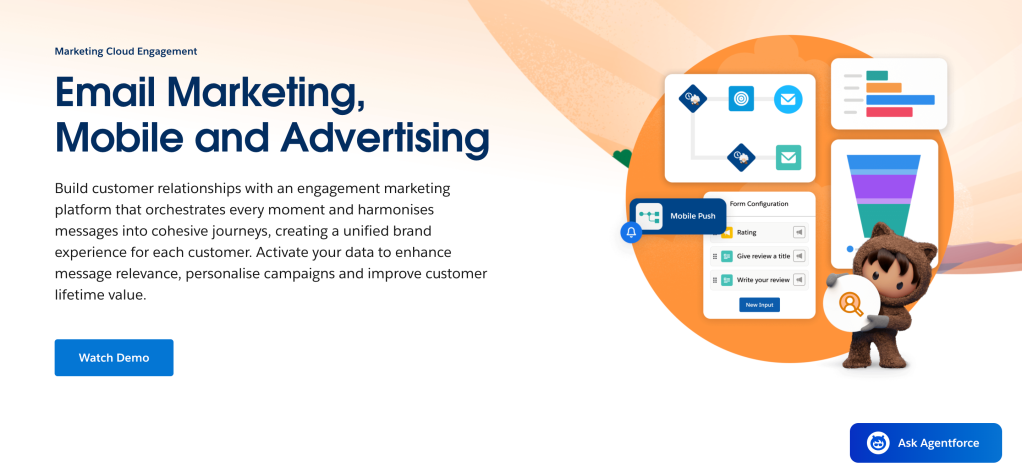
Salesforce’s Agentforce Marketing gives teams the tools to build, personalise, and automate email campaigns with real-time data from within their CRM. The platform supports large-scale content creation and AI-driven journey optimisation so teams can run more targeted campaigns with less manual setup.
Source: Salesforce
The platform is powerful, but it costs more due to its advanced features. Smaller teams may also need time and support to set everything up correctly.
If you want to explore how the AI agents and automation work in practice, you can try it for free for 30 days.
Brevo is an all-in-one marketing platform designed for small businesses that need an affordable but capable way to manage email, SMS, and simple CRM activity. It supports automated campaigns, segmentation, and A/B testing without requiring complex setup.

Source: Brevo
Templates and CRM features can feel limited for teams that need deeper customisation or more advanced customer data tools.
Mailtrap is a modern email platform built for product and marketing teams that care about high deliverability, reliable infrastructure, and deep analytics. Tailored for high sending volumes, Mailtrap combines email marketing, transactional email, and bulk sending.

Source: Mailtrap
The interface can feel more technical than traditional marketing platforms.
ActiveCampaign is focused on providing marketing with automation. They also offer a basic CRM that allows you to collect first-party data and use it to segment your audience. They have strong workflow automations, so you can do things like put leads into automated nurture campaigns or re-engage campaigns for customers who are showing signs of dropping off.

Source: ActiveCampaign
Some users say the platform can feel a bit restrictive when setting up more detailed campaigns.
Moosend is an affordable email platform built for teams that want simple, yet powerful, automation. It includes AI writing support, a drag-and-drop editor, ready-made templates, and basic behavioural triggers.

Source: Moosend
Direct integrations are limited, and some users find advanced options harder to find.
Klaviyo is a data-driven email marketing software that is flexible and tailored specifically for ecommerce businesses. It offers integrations with platforms like Shopify and Magento to help you use real-time customer behaviour and purchase data for highly personalised campaigns.

Source: Klaviyo
The platform is powerful, but some users find the learning curve steeper than expected.
MailerLite is an easy-to-use email marketing solution that focuses on simplicity while still offering powerful features. With a drag-and-drop editor, over 150 email templates, advanced automation options, and built-in customer support tools, it's good for businesses looking for a user-friendly platform that can help them lift their engagement.

Source: MailerLite
More advanced automations and design customisation can feel limited for teams needing deeper control.
Mailchimp is one of the most well-known email marketing platforms that’s been around since 2001. It offers a platform that’s simple enough for even small business owners to jump in and do the job of an email marketer.
One example of this is that they offer a simple drag-and-drop functionality so anyone can rearrange the layout of an email. They also have more than 300 integrations, so it’s an easy option to plug into what you already use.

Source: Mailchimp
Pricing can increase sharply as your audience grows, and some advanced automation features are limited to higher plans.
Selecting the right email marketing platform requires careful consideration of your business needs and future growth. Here are the key steps to guide your decision-making process:
Before choosing a platform, define your email marketing objectives.
Are you focused on lead nurturing, ecommerce sales, customer retention, or brand awareness? Clarifying your goals will help you to identify the features and capabilities that matter most.
Most email marketing software options offer free trials or demo sessions.
Take advantage of these opportunities to explore usability, automation capabilities, and analytics tools. Testing the platform firsthand helps you to assess whether it aligns with your workflow and marketing strategy.
Research user feedback and case studies to gain insights into real-world performance.
Look for reviews that highlight ease of use, automation efficiency, deliverability rates, and customer support quality. Success stories from businesses similar to yours can also provide a valuable perspective.
In our recent State of Marketing report, we found that high-performing teams are 1.5x more likely to be engaging with customers through email and messaging.
Your email marketing needs will evolve as your business grows. Currently, 48% of marketing teams say they still haven’t figured out how to adapt to AI in practice. This is often less about team capability and more about choosing a platform that integrates AI in a way that feels natural and genuinely useful.
To achieve this, you can choose a platform that offers AI agents, plus scalability, allowing you to handle increasing email volumes and personalisation expectations without compromising on performance.

Sign up for our newsletter to get the latest research, industry insights, and product news delivered straight to your inbox.
While most email platforms are focused only on templates and send times, Salesforce Agentforce Marketing offers a more holistic approach to email marketing.
We help teams gather the first-party data, then put it into action with our AI agents to continuously personalise and optimise. The result is less work for your team and better results from your campaigns.
Some of the key reasons our customers chose us are that we offer:
So how does this play out in real life? These are the kinds of results customers are seeing:
R.M.Williams achieved 3.5x higher open rates and 2x higher conversion rates by offering more targeted campaigns.
R.M.Williams Offers Experiences as Bespoke as Its Products | Salesforce
If your goal is to improve performance over time, not just send generic emails, this is where Salesforce Agentforce Marketing can help.
Choosing the right email marketing platform comes down to how well it can grow with your business, personalise at scale, and optimise campaigns in real time.
If you’re ready to move beyond generic email campaigns, watch our Salesforce Agentforce Marketing email marketing demo to see how agentic AI can turn your emails into a revenue-driving powerhouse.

While you focus on strategy, Campaign Agent acts as your digital campaign manager — creating assets, prioritising sends, and optimising budgets based on your team’s direction.

See the latest in Marketing Cloud. Learn all about Contentful, Palmata, Campaign Agent and so much more.

Contentful is the headless CMS that lets you reuse structured content, manage the content lifecycle, and deliver content anywhere.

Learn how top brands are navigating the era of agentic marketing and what they see as their biggest priorities and challenges.

Uncover where pipeline is actually lost, between intent and response, and what high-performing teams do differently.

Connecting agents to Marketing Cloud helps you move faster than ever. Discover practical use cases to see how you can get started and find success with headless marketing.

Join our Marketing Cloud AI product leaders to discover how Marketing Cloud transforms AI insights into tangible actions, driving real enterprise value.

Discover how to enhance personalisation and optimise marketing strategies through the partnership between Meta and Salesforce, leveraging innovations like the Data 360 and Meta Conversions API.

Learn how to leverage data for personalised customer engagement through customer stories focusing on data activation and personalisation strategies.

See how Flexo Concepts transformed their B2B Marketing with Salesforce Account Engagement.
Get hands on with next-gen marketing, where humans & agents work together to spark customer conversations.
Technically, yes, but it’s not built for business use. This means your data isn’t protected, it lacks the context of each customer, and switching between tools can slow your team down. For business use, it’s safer and more productive to use a platform with built-in, secure generative AI that works directly with your data.
No, email marketing is about people sharing messages between each other. Without humans, there is no one to create unique messaging and no one to purchase what is being sold. AI is a tool that can help marketers get the right message to the right people, similar to other technologies.
Salesforce offers advanced AI agents that continuously optimise your messages based on real customer behaviour. This is how R.M.Williams achieved 3.5x higher open rates and 2x higher conversion rates.


