


The complete guide to digital marketing in the age of AI
Learn how digital marketing works in 2026, how customer needs have evolved, and how AI can elevate your strategy and the customer experience.


Learn how digital marketing works in 2026, how customer needs have evolved, and how AI can elevate your strategy and the customer experience.


Digital marketing is the practice of promoting your products, services, and/or brand through online channels. Several disciplines can be involved, such as search engine optimisation (SEO), content marketing, social media marketing, email outreach, and paid advertising. Increasingly, AI-focused marketing techniques, like answer engine optimisation (AEO) and generative engine optimisation (GEO), are also elements of modern digital marketing strategies.
The goals of digital marketing are the same as traditional marketing: reach more customers and drive more sales. For many businesses, however, digital marketing is now the centrepiece of their overall marketing strategy. As an example, Australia’s internet advertising market reached $18.4 billion in 2025 . That’s up 11.5% year on year and the second straight year of double-digit growth.
While AI has added several new elements to digital marketing strategies, it’s also impacting how digital marketing is created and managed. That’s why we developed this guide. It explains what digital marketing means today, how it continues to evolve, and how AI is changing the way marketing teams work.
Put simply, digital marketing covers every method you use to reach and engage customers online, rather than through traditional offline channels. That includes search engine optimisation (SEO), content marketing, social media marketing, email marketing, and paid advertising. Your digital marketing strategy, along with any tools you use to achieve your goals, ties it all together.
For most of the 20th century, businesses could only reach customers through one-way channels, such as billboards, print ads, radio, and television. It’s fair to say that the internet represented a revolution in the marketing space. Suddenly, businesses could initiate a two-way conversation using email outreach, and they could start tailoring their messages to what people were actually searching for.
Social media platforms took the two-way interactive concept even further, and this was swiftly followed by the introduction of smartphones, which meant that customers were reachable more than ever before.
To demonstrate the point, the Australian Communications and Media Authority (ACMA) reports that almost 100% of Australians used a device to access the internet in the past six months. Ninety-seven per cent access it using their mobile phone, and 91% of them do that multiple times each day.
Unsurprisingly, Australian businesses are using digital channels to reach customers more than ever before. IAB Australia’s Internet Advertising Revenue Report reveals that the internet advertising market grew 11.5% year-on-year in 2025, with video up 19.8%, search up 11.5%, and classifieds up 5%.
Those figures only tell part of the story, because the tools businesses are using to achieve their goals are also changing, largely driven by the latest evolution in the marketing space: artificial intelligence. Next, we’ll explore the different strategies being employed by digital marketing teams, while also exploring how AI is changing the way that Australian marketing teams work.
You can use dozens of digital marketing channels to carry out your strategy, including social media sites, SMS, and more. The sheer number of options can be overwhelming.
Below, we’ll explain six basic types of digital marketing: social media marketing, search engine optimisation (SEO), content marketing, native advertising, pay-per-click (PPC) advertising, and email marketing. We’ll also take a look at how AI can support each to help businesses build faster, more engaging, and more connected customer experiences.
Remember, digital marketing is customisable and easy to change. If a strategy isn’t as successful as you’d like, rethink your plan, change platforms or tactics, and try something new.
Social media marketing leverages platforms like Facebook, X, LinkedIn, TikTok, and Instagram to build connections with potential customers and drive leads or sales.
B2C digital marketing often uses social media platforms like Instagram and Pinterest to attract customers directly and speed up the buyer journey. In comparison, B2B marketers might use social platforms like LinkedIn to find leads, engage decision-makers, and build trust over a much longer sales cycle.
There are two main types of social media marketing to be aware of:
Nearly every business, from small ecommerce brands to large enterprise organisations, can use social media to drive customer engagement, leads, and sales. Here are the main benefits of social media marketing:
AI can elevate these benefits by helping teams manage social engagement in real time.
For instance, an agent within Marketing Cloud could spot a spike in comments on a product post and flag it to your team so they can capitalise on the opportunity. Or, if a customer asks a question on Instagram, the agent could respond instantly, continue the conversation over DMs, and pass the lead to a rep when the prospect is ready for a sale.
Agentic workflows like these help brands meet modern customer expectations while giving marketers more bandwidth to focus on one-to-one interactions.
SEO is the strategy of helping your website appear in results when users look up a word or phrase in search engines like Google and Bing. It combines a few key tactics, like:
Seems simple enough, but there’s a caveat here. The rules are now a bit different.
Today, AI overviews (AIOs) often appear at the top of search results pages to answer concerns faster. Think of them as snapshots that provide key information and links for users to dig deeper. They can shape what a user sees before they ever scroll down.
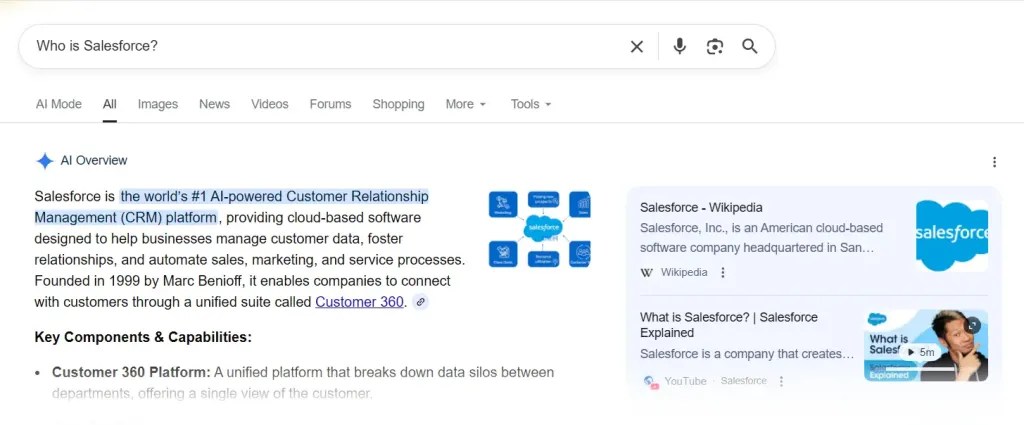
Source: Google
This changes how far consumers will hunt for information, and that presents a challenge. According to Pew Research , users who encountered an AI summary clicked on a traditional search result link in 8% of all visits. In contrast, those who didn’t encounter an AI summary clicked on a standard website link 15% of the time.
This shift is spreading beyond Google, too. LLMs, like ChatGPT and Gemini, let users search in a more conversational way and get answers without having to click a blue link.
Thinking of hanging up the SEO gloves? Hang on a second. There is an opportunity.
AI overviews and LLMs still rely on published web content that they can interpret and cite. They also link their sources directly within answers, so businesses that are included in AI answers will be the first port of call when a customer needs to learn more.
The solution? When you’re building out your SEO strategy, add a fifth component:
Eighty-eight per cent of marketers say they’re now in the process of optimising for AI-driven search experiences. When you can make your content easier for AI-driven search to use, you give your brand a faster way to win customer attention and get those early conversations moving.
And if you’re wondering how AI itself can help with this process, see how AI for SEO can help you transform your strategy and get your business in front of more customers, faster.
Content marketing is the practice of creating and sharing valuable, relevant content, such as blog posts, videos, guides, and infographics, to attract and engage an audience without directly advertising a product or service. Rather than making a hard sell or interrupting a customer, the goal here is to earn their attention by being genuinely useful.
Common formats include:
Done well, content marketing builds brand awareness and trust over time, supports both SEO and AEO, and gives you something to share through other channels, like social media and email. It’s rarely the fastest way to a sale, but it does a lot of important work behind the scenes that pays dividends in the long run.
Content is where AI is making some of the biggest waves, as it can help teams develop content at scale that previously would have taken much longer. For example, an agent within Marketing Cloud can help repurpose a single piece of content across channels, suggest topics based on what customers are actually asking, and personalise how that content is served to different audience segments, all while freeing up time for the strategic and creative work behind it.
Native advertising is paid marketing that looks like organic content. It aims to fly under the radar, seamlessly blending in with surrounding content so it fits in with what the user is already asking or doing. See the sponsored results below for an example.

Source: Google
Native ads aren’t deceitful. They still make their paid status clear with labels like “promoted” or “sponsored”. But because they match the format or content of the platform around them, they can feel less disruptive than a pop-up or cold call. Types include:
When done well, native advertising can cut through the noise by providing customers with a better user experience, one that blends in with what they’re already reading or watching rather than distracting them from it. This is crucial today, when customers want organic, two-way engagement rather than one-way messaging.
What makes a good native ad? It’s all about creativity and relevance. Here are four tips:
AI can strengthen this further by helping teams tailor native ads in real time based on live customer data. For instance, with Marketing Cloud, an agent could spot which audiences are engaging most with your ad and suggest an adjustment to the messaging in flight, all while routing high-intent prospects into a personalised follow-up journey.
PPC refers to using paid ads to reach a highly targeted audience. For example, you could create an ad campaign targeting potential customers who visit your favourite news site. You might also use Google Ads to target users who search for a specific term like “buy a new [brand name] laptop” or “best climbing shoes for bouldering”.
Unlike billboard or radio ads, where businesses pay up front, you only pay for PPC if a user clicks on your ad. Some platforms do charge by impression or view, but they’re rare. There are also several other benefits to consider:
The key to successful PPC ads is personalisation and optimisation over time. That starts with building unified customer profiles so you can target advertising with richer, more trusted first-party data.
From there, AI can step in to offer additional support. Using your connected customer data as a foundation, agents can track ad performance over time, recommend ways to tweak campaigns, and even pause ads that aren’t making enough impact.
Again, the benefit here is efficiency. Teams no longer need to spend their days manually tracking ad performance. AI handles the monitoring, so teams can spend more time in conversation with customers.
Email marketing is still one of the most effective digital marketing channels because it gives businesses a direct way to have conversations with their customers. This comes with a few key benefits, like:
To make your strategy a success, focus on two-way interactions. The age of “do not reply” is over. What customers want now are conversations that feel real and personal.
Of course, this is easier said than done. Only 55% of marketers say they frequently reply to customer emails. This reveals the gap between the kind of responsiveness customers want and what most teams have the bandwidth to deliver.
This is one area where AI agents can be truly revolutionary. With Marketing Cloud, agents can draft email content based on live signals, answer questions by pulling business context, tailor recommendations across channels, trigger journeys automatically, and hand off to a human whenever the moment is right.
Essentially, it’s like an always-on, behind-the-scenes collaborator. This is more than marketing automation. It’s a way to ensure every customer, whatever their journey, gets an experience that feels personal, all the time. As Salesforce Product Marketing Manager Daisy Han put it at our 2026 Agentforce World Tour in Sydney:
Digital marketing is still the most powerful way for businesses to connect with customers and personalise experiences online. Compared with the one-way channels of the past, digital channels let marketers:
Here’s the challenge: Many marketers now need to do this at a scale and speed that was once hard to imagine. Teams are working harder than ever, but the old process of gathering CRM platform data, then tweaking the campaign, wasn’t designed with today’s customers in mind.

Eighty-three per cent of marketers say that customers increasingly want two-way conversations instead of one-way messages, and 69% say they struggle to keep up with customer and prospect inquiries. It’s no longer just about getting in front of the right audience. It’s about hyper-personalisation, real-time responses, and connected journeys.
This leaves teams in a bind. Customers want faster and more personal interactions, but marketers only have so many hours in the day. It’s time for a new strategy.
For many teams, that strategy is embedding AI and, more recently, AI agents into marketing workflows. These agents can handle workflows autonomously, spot patterns sooner, personalise interactions, and keep customer experiences moving in the background, even when marketers lack the time to handle every interaction themselves. This delivers a bunch of exciting benefits:
Digital marketing helps brands personalise messaging based on customer behaviour, interests, and engagement history. AI pushes this further by helping teams segment audiences faster, see intent sooner, and create personalised experiences without building every variation by hand.
Responding in real time to customers across channels can be hard to scale. AI can help by surfacing real-time signals that help reps respond faster with more relevance. AI agents can even use live data to engage customers with two-way, cross-channel conversations, keeping leads warm between human touchpoints.
Small and midsize businesses often struggle to compete with big brands. Digital marketing with AI helps level the playing field. With a clear digital marketing strategy, businesses can use AI to target more precisely and get more from every dollar they spend, even with a small starting budget.
One of digital marketing’s biggest strengths is that you can test campaigns and improve the results, but modern marketers need to know what’s happening in real time. AI can bridge this gap by surfacing issues sooner, recommending changes, and helping teams refine messaging on the fly, well before a report comes in.
In the past, sales and marketing often worked in silos, connected by handoffs and service level agreements (SLAs). But with unified data, shared dashboards, and AI agents that can carry context across departments, teams can align on the same customer signals and create smooth journeys from first interaction to post-purchase.
One of the biggest benefits of digital marketing AI is the time it frees up for your teams. Automation and AI agents handle the admin and reporting, so marketers get more time to focus on creative strategies and delivering magical customer moments.
Seventy-five per cent of marketers use at least one form of AI. And while only 13% of marketers currently use AI agents, high-performers are 1.9x more likely to do so than underperformers. The teams getting the most from their marketing are those using AI agents to move faster, personalise smarter, and claim back time for high-value work.

The goal of an online marketing strategy today is to help you engage customers on the right channel at the right time. There are many ways to achieve this with advanced tactics, but despite everything, the basic foundation has never changed.
Here’s a simple seven-step guide to defining who you want to reach, where you want to market, and what you want your campaigns to achieve.
What do you want to accomplish? For example, do you want to increase traffic to your website, get more leads, increase sales, or launch a new product next quarter? Use the SMART framework to make these goals more actionable, timely, and relevant.
Your objectives will inform everything that follows, from the channels you use to the metrics you track. For instance, a strategy built to increase brand awareness will look very different from one designed for retention.
The next step is understanding who you want to reach and what they actually need from you. What kind of channels are they frequenting? Where do they tend to engage? What kind of content are they going to enjoy?
Build an ideal customer persona (ICP) that outlines the types of people or businesses you want to reach, including their needs, pain points, and preferred channels.
It’s okay not to have all the answers at this stage. The beauty of a digital marketing strategy is that you can continue to gather more data about your ideal customers over time.
Use your goals and target audience to choose the most effective channels to engage on.
For example, a B2B company might lean more heavily on LinkedIn, email, and a well-polished business website, whereas a retail brand might drift toward Instagram, SEO, paid ads, and influencer marketing. The goal is to choose the platforms where your audience is already paying attention.
How will you know that your campaign is reaching your goals? KPIs help marketers turn data into actionable insights. For example, if your goal is to drive traffic to a blog through an email campaign, you could use traffic acquisition on your blog or email click-through rates to see how effective your strategies and campaigns are.
At this point, you’re ready to start creating content that supports the journey. This might be educational blog posts backed by keyword research, social media content on your audience’s preferred channels, live email campaigns that encourage replies, or paid ads to build rapid brand awareness.
In reality, you’ll often use a blend of all of these approaches. What matters is that everything you build has a purpose and is tailored to your audience’s needs.
Next, track the performance of your digital marketing strategy based on the KPIs you set earlier. Look for signs of what your audience is responding well to, what they aren’t, and which channels are performing best.
Tools like Google Analytics can help you track where traffic is coming from and whether visitors are converting once they arrive. Alternatively, Salesforce’s marketing analytics tools can give you more comprehensive insights into every aspect of your campaign performance, along with actionable recommendations to improve results.
Lastly, use the insights you’ve gathered to refine your strategy over time. That could mean testing new channels, adjusting your targeting, or even just trying new content styles.
Remember that digital marketing only gets better with time. It’s a good idea to try new avenues to see what works. The more data you collect, the easier it is to refine your approach in the future.

Sign up for our newsletter to get the latest research, industry insights, and product news delivered straight to your inbox.
A strong digital marketing strategy should bring together content, email, social media, organic search, and paid media in a way that matches your audience and goals.
That bit has never changed, and it likely won’t for a long time. But what matters now is how you connect these touchpoints. Digital marketing is no longer a list of tactics and channels, each with its own approach. Marketers need to think about how customers travel across the entire journey and how each interaction can pick up where the last one left off.
Here’s how you can elevate your digital marketing strategy to make this possible.
Currently, only 60% of marketers in Australia have access to sales data, 59% to service, and 55% to commerce. This is a big hurdle for many businesses because it limits the data marketers have available to power real-time, connected experiences.
For this reason, your first major priority should be to join up all of these touchpoints. When browsing behaviour, purchase history, service interactions, and campaign engagement can all work together, marketers get a clearer view of what customers need and a stronger way to make every interaction feel personal and connected.
Salesforce’s Customer Data Platform, built into Marketing Cloud, can help you connect your data across teams, build unified customer profiles, and activate that data in real time, where your teams already work.
This gives marketers the insight they need to personalise every interaction, sales and service teams the details required for a smooth handoff, and agents the foundation they need to take action based on live customer context. It’s a win no matter how you look at it.
Unified customer data is the start. The next step is turning that context into action while giving marketers enough time to focus on the moments that need a human touch.
Platforms like Marketing Cloud are built to make this goal achievable. With our solution, AI agents can help marketers:
The biggest benefit here is time. High-performing teams are using AI agents to reclaim eight hours a week, with many reporting more time for strategic work, experimentation, and developing deeper customer insights.
This is what agentic digital marketing is all about. Marketers get the context they need to meet customers where they are. Sales and service get the data to make every conversation count. Everyone gets more time to focus on the tasks that matter.
To learn more, see how Fisher & Paykel uses unified data and Agentforce to build long-lasting customer relationships.
Digital marketing still starts with the basics. Set clear goals, find the right channels, create valuable content, and refine your approach over time.
But in 2026, the strongest strategies go above and beyond to meet evolving customer expectations. Bringing trusted customer data and AI agents together gives marketers the context, tools, and time to make every conversation more personal and connected.
Marketing Cloud helps teams unify customer data, personalise at scale, build responsive campaigns, and turn “do not reply” into two-way experiences. Watch the demo today to see what’s possible.
And if you’d like to find out more about the stats in this guide, access our 10th State of Marketing Report in full , where we surveyed 4,500 marketers worldwide. It reveals the trends that are reshaping how marketers strategise in the AI era.

While you focus on strategy, Campaign Agent acts as your digital campaign manager — creating assets, prioritising sends, and optimising budgets based on your team’s direction.

See the latest in Marketing Cloud. Learn all about Contentful, Palmata, Campaign Agent and so much more.

Contentful is the headless CMS that lets you reuse structured content, manage the content lifecycle, and deliver content anywhere.

Learn how top brands are navigating the era of agentic marketing and what they see as their biggest priorities and challenges.

Uncover where pipeline is actually lost, between intent and response, and what high-performing teams do differently.

Connecting agents to Marketing Cloud helps you move faster than ever. Discover practical use cases to see how you can get started and find success with headless marketing.

Join our Marketing Cloud AI product leaders to discover how Marketing Cloud transforms AI insights into tangible actions, driving real enterprise value.

Discover how to enhance personalisation and optimise marketing strategies through the partnership between Meta and Salesforce, leveraging innovations like the Data 360 and Meta Conversions API.

Learn how to leverage data for personalised customer engagement through customer stories focusing on data activation and personalisation strategies.

See how Flexo Concepts transformed their B2B Marketing with Salesforce Account Engagement.
Get hands on with next-gen marketing, where humans & agents work together to spark customer conversations.
Digital marketing is the use of online channels, such as search, social media, email, paid ads, and business websites, to reach and engage customers. It includes tactics like content marketing, social media marketing, and email marketing to build brand awareness, support the customer journey, drive sales, and encourage customer loyalty. Today, digital marketing also involves using AI and AI agents to speed up processes and make conversations feel more personal.
The role of a digital marketer is to promote a company’s services or products online. This might include content creation for social media, blogs, and websites, managing online advertising campaigns, SEO and keyword research, email marketing, and general customer communications. It often involves data analysis for campaign optimisation as well.
Digital marketing is a very diverse field. Core skills include a mixture of creative and analytical skills, as well as strong writing, communication, and organisation. Aside from that, knowledge of SEO, data, and AI is also valuable. Trailhead offers free online digital marketing courses if you need somewhere to get started.
A digital marketing strategy is a plan for reaching your audience on the channels they frequent with messages they’re likely to engage with. It helps businesses decide on their goals and how best to achieve them.
The most profitable type of digital marketing is the one that gives you the best return on investment (ROI). This means optimising costs as much as maximising revenue. There isn’t one single channel that’s always most profitable. Many businesses now use AI because it can automate workflows and optimise campaigns faster, both of which are ideal for maximising ROI.


