to really think deeply about
things that haven't been working,
to have the courage to challenge
the workflows that need to be disrupted,
a team that needs to transform.
Find the problems that are
really, really, really hard
and then think creatively
about how AI can materially
affect change in those problems.
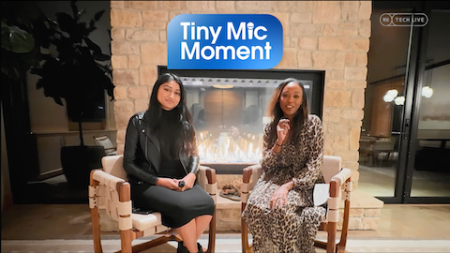
to this episode of Tiny Mics.
and I lead our Executive Partnerships
and today I am joined by...
I lead our AI Marketing team
And we are in Napa, California,
at The Wall Street Journal
thank you for joining us today.
So good to have you here.
Yeah, thanks for having me.
So, we're on Day 2 of the event.
I know you've been meeting with
while you've been on-site.
great mainstage speakers,
a lot of great programming
during the course of the couple of days.
What are some of the key takeaways
that have really made you think
these are some good aha moments
Yeah, I think the biggest aha is actually
a very relatable one, which is that
everyone is still confused about
what they think I can and can't do.
And I think they're really eager
to just learn from other people,
be a little bit vulnerable
and sharing what they don't know,
and they're just looking to see
what their peers are doing
which I think is actually pretty inspiring
high-caliber audience here.
You have C-levels that are just
trying to learn and shape
their businesses in new ways.
We just wrapped up your session,
which was a masterclass on
how do you build an AI agent
and how do you get value from that?
and also the CTO from OpenTable,
and I think that there's still
some people that are a little bit,
what's the difference between
a chatbot versus an AI agent?
How can you get more value?
Tell us, what were some of
and takeaways that you got?
Yeah, I mean, we started out
just by defining what is an agent
with any new and cool technology,
people think that they can use it
for everything and that they should.
Agentic AI is specifically meant
So think about all the jobs and things
that you can't complete in a day,
which I'm sure there's a lot.
If you only had an AI agent
that could be an extension of you,
or an extension of your team,
what would that agent do?
What would their role be?
What would the data that they need
to do that role look like?
Where would that data live?
What do you want the agent
to be able to do, and act on?
And so we really talked about
the definition of an agent,
and some of the key use cases
that we're seeing deliver a ton of value
both at Indeed, OpenTable,
So it was really, I think,
eye-opening for folks to see
thinking about it differently.
from OpenTable and Indeed
shared so clearly is that they’re
embracing a culture of experimentation
because you don't necessarily
know everything of what's coming
for the technology to mature.
Also during this session,
we heard a lot of great examples,
from OpenTable and Indeed.
I'm actually curious to hear
because I think a lot of people learn
actually using the product
and how are they using the tools?
how is your team using Agentforce?
Yeah, in a variety of ways.
I think there's the employee-facing
And then there's also how we use
that are available externally.
So internally, just on our phones,
a ton of Agentforce agents
The one that I really love is
our Wellness Reimbursement Agent.
I recently asked if I could get reimbursed
in case you're wondering.
But it's great for wellness and benefits.
it's really great to have an agent that
can be there to answer your questions.
It's also something that's regulated
in terms of what you're beholden to
and what's available at Salesforce.
It's something that I use all the time.
our main uses of Agentforce
have actually changed the way
the team operates in the sense.
So we have an agent on our website,
That agent is fed, so to speak,
And so my website manager
When we launch new products,
he will test the agent to make sure
it can handle different types of questions.
We look at all the different types of
questions that our customers
So it’s turned some of my marketers
which is a pretty interesting thing
that's just happened organically.
Agentforce, silently behind the scenes,
marketing operates at Salesforce.
And I know that the CIO from Indeed was,
you know, he mentioned a lot about
how he encourages his team
And I know obviously we're in this era of
everybody going out and testing AI,
and really leveraging and using
the product and the tool.
when you get to a certain point of,
oh my gosh, this is working,
or should we greenlight this project.
How do you know at what point
with a certain project, or do you axe it?
Yeah, I think it's just really important
to continue measuring success
and checking your own biases
on what you think might be happening,
because it's easy to say,
we're going to use an AI tool for this thing.
You got the budget for it,
oh no, that was a failure.
We need to do something different.
courage to call out what's not working,
to track the metrics that
you think are important at the outset,
and then see how those metrics
Any other project we would do,
that you would measure, right?
You wouldn't hire a new person,
then never ask them how they're doing,
or evaluate their performance.
It's the same thing with agents.
stay honest with ourselves
about these implementations.
So, we obviously know that an AI agent
is going to help with a lot
of those repetitive tasks.
And then what's really going to be left
is opportunity for employees to really
be focused on that deep focus work
the strategic parts of their jobs.
So talk to us about what will
the future state of your workday look like.
Yeah, I think it's important,
that people have of agentic AI,
like any other technology.
totally disrupt everything,
and the disruption is real.
But I actually think it could be
a good thing if we let it be,
post-pandemic, we totally lost our minds
when it came to the workday, right?
We felt that it was normal
to wake up as early as possible
and just start working from our homes.
And who's to say when the workday ends,
and when it bleeds into your evening.
my hope for agent AI is that it
brings us back to equilibrium
in terms of our work lives
that we can actually start to
reject the notion that it's okay to
be in meetings from 7 a.m. to 7 p.m.
a proper work-life balance
with time to actually think,
swivel charing across people,
meetings, about meetings, about meetings.
And we can really reach our
full potential if we let AI
do all of that other task,
You recently said in an interview,
you can either really lean into AI,
or be threatened to be left behind.
Tell us, or give us some advice on
I mean, you can't get away from
these changes in technology,
but the thing you can control
is learning about things, right?
Thinking about the use cases
really, really impactful to your business.
You know, a lot of what came up
on the panel today actually was,
well, what if you have a mandate
coming top-down that you have to use AI.
That's the wrong question.
We should have a technology
Find the problems that are really,
really, really hard in your department,
and then think creatively about
how AI can materially affect change
And sometimes it can be small.
filling out RFPs in some way, shape, or form,
whether it's for a customer,
And we have amassed an incredible
amount of material on our own products.
Agentic AI can help us fill out a future RFPs.
It sounds like the most boring
but it's going to bring time back.
My people will be happier.
If it's going to bring back
2 hours in their day that they can
spend with their kids, or take a load off,
and go for a walk, or a hike,
that is worth it, because
happy employees are going to
just be a happier workforce,
and better ROI at the end of it.
And actually, that just goes back to
obviously us all getting back to
hopefully just a regular 9 to 5,
as opposed to pandemic living.
All right. So tell us about
some of the things that you've heard
from customers that you've just been
interacting with over the past
So, I had a really interesting conversation
with the CEO of Black Girls Code,
who's here for the event as well.
The conversation was actually
You would think that, you know,
Black Girls Code, they're thinking about
coding skills in specific.
And it was actually about all of
the surrounding skills that we need
and how we need to teach people
that coding things, vibe coding,
you can do things faster than ever before.
But you know what we can't replace is
the strategy of what are you
Right? You might be able to vibe code
an application using agentic AI,
if no one uses that application,
did you really do anything that great?
And so what she and I were
talking about were the surrounding,
the softer skills that you need to bring,
and the ideas around creativity
that you can bring to these technologies,
to make them more useful,
and to just make the burgeoning workforce
that is growing up right now
to make them feel that they can
really create an impact in the workforce,
with what they're learning about AI.
Before we move on, I want
to throw a slide up here.
Let's pause really quickly
I think this organization is so cool
because we are always thinking
and reskill our employees,
is preparing the next generation
They're ensuring that we have a pipeline
of technologists, engineers,
This is more than bridging the gap.
It's investing in the future
of innovation, starting with
And they're making a huge impact.
through their workshops in 2025 alone.
quality tech education with their free
YouTube Code Along series too.
Code Along is geared toward
introducing young learners to coding.
they've grown to more than 161,000
They average 30,000 viewers per month,
YouTube Silver Creator Award,
and the host of the series,
Young Artist Academy Award.
I encourage you to check them out.
Head to their website to find out more.
what is a surprising way that you are
actually using AI in your personal life?
Okay, this is going to sound...
But I will send myself voice notes
I will send myself a voice note.
The great thing about voice notes
fully transcribed automatically.
I just have all these ideas,
or all of these things I have to do,
start a conversation with myself.
I will record a voice note.
turn it into action items
So I'm fully doing that in Slack.
It is really, really, really helpful for me.
It's just like a little hack.
Actually our Head of Product
for Agentforce taught it to me,
so I can't take that much credit.
Yeah, I mean hello productivity, right?
That is an incredible way to multitask.
what keeps me up at night is
what's the next new thing
and totally make all of this irrelevant?
I mean, agentic AI came out of nowhere,
and changed every business.
And that's just the nature
So it's not that it keeps me up at night,
but it definitely stresses me out
when I think too hard on it.
So I have to just look at
Well, we definitely don't want you stressed.
I know we've got a big job here, but yes.
Okay, so give us your famous
How are you advising folks
that are on their AI journey?
What are you telling folks?
I don't know if it's famous,
but the advice that I would give is that
if you don't know everything
There's so few people that
deeply understand these systems.
And I think, more than ever,
really think deeply about things
that haven't been working,
that need to be disrupted,
and to use that business language,
whether it's a KPI that needs to change,
or a team that needs to transform,
agentic AI as an accelerator
to get to your business goals
and check out this new study of
over 150 CEOs from the U.S., and Canada.
We commissioned this from IDC,
and it's called The Voice of the CEO
It's no surprise that most top executives
say digital labor will have
a greater impact on their business
than the internet in cloud computing.
But what is surprising is that CEOs
are building new roles in the workforce,
rather than simply eliminating workers.
CEOs expect nearly 80% of employees
to be augmented by AI agents,
existing roles supported,
or by being reassigned to new teams.
I strongly encourage you to
read the full report to find out more
about where we're heading
straight from the mouth of the CEO.
Use the QR code to get the full report.
Thanks so much for joining us today!