Salesforce Agentic Enterprise Index: Agent Deployments More Than Double Year over Year

An analysis of Agentforce usage among businesses consistently leveraging agents from February 2025 to April 2026 shows how different industries deploy AI agents while building trust and recognizing ROI.
Quick stats:
- Organizations increased activated agents by nearly 3x by the end of this fiscal year and reduced the average creation time by 53%.
- Agents are becoming highly versatile, and their skill set can expand by up to 350% to handle complex tasks during peak demand.
- Deploying agents resulted in 4x higher retail online sales growth.
- Trust is deepening, with weekly employee usage tripling and customer escalation rates holding steady even at massive scale.
Salesforce has released its 2026 Agentic Enterprise Index, which analyzes aggregated AI usage data from the Agentforce platform to uncover how businesses are deploying, using, and getting value out of AI agents.

The results this year show a tale of two rollouts, a bifurcation in the global business landscape in which an industry’s operational DNA and business needs can dictate how its digital workforce is deployed.
High-volume, task-specific deployments: Most common among consumer-facing sectors, this approach leans into high volume and speed to tackle immediate customer needs.
Versatile, multistep deployments: Seen in more operationally complex and heavily regulated fields like manufacturing and public sector, this strategy prioritizes building agents capable of taking on a wide variety of tasks that require cross-functional business logic.
Each type of rollout deepens trust and results in ROI, but the future of agentic AI rests on the coexistence of both deployment models — delivering fast, large-scale impact while mastering increasingly complex tasks across all industries.
- Financial Services blends speed and regulation: The financial services industry deploys some of the most sophisticated agents yet deploys them at the massive scale more typical of consumer sectors, proving that deep complexity and high-volume automation can coexist, especially during peak periods like tax season.
- Retail ramps up complexity on demand: Agents in consumer-facing sectors may focus on more simple tasks but expand their depth and increase the number of actions they execute during intense holiday rushes.
Dive deeper:
Businesses, particularly consumer industries, are deploying more agents at speed
The average number of agents activated per organization increased nearly 3x over the past year. Once provisioned, businesses start creating those agents within an average of two days. And that number is decreasing month over month, down 53% across the whole analysis period.
More Agents Are Being Activated and Put to Use
Average number of agents per organization increased nearly 3x over the fiscal year
is the average time from agent creation to use
But are these agents taking meaningful action? To gauge this, Salesforce has developed a metric called the Agentic Work Unit (AWU). An AWU is one discrete task accomplished by an AI agent — the point at which raw intelligence is converted into real work.
As of April 2026, Agentforce agents’ AWU output is increasing by a 15% CMGR (compound monthly growth rate).
Consumer-facing industries, especially those with high volumes of customer interaction, are demonstrating the most aggressive AWU output. Yet despite that high output, retail AI agents typically remain narrowly focused, averaging one to two actions per agent most of the year, which suggests high volumes of routine, task-specific work.
Retail and Travel Dominate AWU Volume
Retail
represents 22% of total
monthly output
Travel
represents 10% of total
monthly output
Trend in action: Pandora, the global jewelry brand, faces dramatic surges in customer inquiries during peak shopping seasons like holidays and Valentine’s Day. To maintain its high-touch, personalized experience during these high-volume moments, Pandora deploys Gemma, an AI concierge powered by Agentforce. Gemma instantly resolves routine customer inquiries (from order status and shipping tracking to jewelry care FAQs) while offering personalized gift recommendations based on customer preferences.
By connecting directly to back-end order systems and product catalogs, Gemma delivers fast, personalized support at scale. During peak traffic, Gemma handles 60% of routine support requests while driving a 10% increase in Net Promoter Score (NPS), enabling human reps to focus on high-touch, complex interactions.
Agents become more versatile, particularly during moments of high demand
Most routine work requires agents to perform one or two simple skills, such as looking up record details or answering a customer question. But agents are increasingly tackling more complicated tasks. Today, the average agent can act on six skills, up from two at the beginning of 2025.
Agents Triple Their Skill Set
Average number of unique skills that each agent is able to act on rose from an average of two at the beginning of the year to six by the end of 2025.
Agents become even more capable during moments of high demand. During peak shopping season, the average retail agent was able to act on nine skills, a 350% increase that suggests they are deployed to handle more complex, multistep customer needs as holiday demand surges.
The data also shows agents are increasingly taking on actions across different cloud domains. For example, rather than just answering customer questions, service agents are also surfacing sales records and providing personalized recommendations, expanding the versatility of what they can do for customers and businesses.
Share of Agents’ Secondary Functions Is Increasing
This ability to act across disparate cloud systems underscores the practical necessity of a headless architecture. By decoupling the agent’s logic from traditional front-end user interfaces, agents can process tasks, execute actions, and trigger workflows anywhere.
Regulated and operationally complex industries tend to consistently prioritize agent complexity
Trend in action: Siemens sells thousands of hardware and software products across seven siloed business units and 18,000 sellers. With 2,800 unqualified inbound leads per week and no visibility into budget, authority, or timeline, sellers wasted time chasing the wrong leads while others went untouched. In an industry defined by long, technical, multi-stakeholder sales cycles, Agentforce broke qualification into a coordinated multi-agent workflow where one agent engages and nurtures the lead and a second gathers missing data, runs it through qualification rules, and routes it with full cross-division context. That orchestration let Siemens handle a complex process end to end, 24/7.
To gauge the complexity of agent usage across industries, we established a Sophistication Index by mapping all agent actions into five progressive tiers of cognitive complexity:
- Levels 1–3 (Read, Coordinate, Synthesize): Standard, low-risk capabilities like looking up records, drafting emails, and summarizing documents
- Levels 4–5 (Write, Analyze, Parse): High-complexity capabilities like updating database fields or programmatically extracting nested parameters from raw user inputs
By evaluating how many of these complexity levels agents in each industry actively use, the Sophistication Index highlights who is leveraging agents to take on a variety of complex tasks rather than just automating high-volume tasks.
Manufacturing, financial services, and HLS build more advanced agent networks than traditional AI front-runners (e.g, technology and retail). They are deploying agents across the full spectrum of work — from retrieving and summarizing data to drafting communications and updating records directly.
Complex and Regulated Industries Lead Agent Complexity
These industries are delivering more modest AWU volume, but they are growing significantly. The AWU output of public sector and HLS have grown 227x and 19x, respectively.
Regulated Industries Are Seeing Demonstrable Growth
Public Sector
represents 0.5% of total monthly output
HLS
represents 0.4% of total monthly output
Manufacturing
represents 0.3% of total monthly output
Financial Services
represents 10% of total monthly output
Financial services is an example of a regulated, operationally complex industry deploying AI agents at scale — representing a similar share (10%) of total monthly agent AWU output. This activity is driven by seasonal consumer surges, like Tax Day, which increases demand for agentic support.
Trend in action: PenFed operates in a heavily regulated environment. As a federally chartered credit union serving military members and their families, it must navigate strict compliance, security, and verification standards across every member touchpoint. Moving beyond traditional, rule-based chatbots required robust risk controls and cross-functional legal and compliance oversight.
To deliver seamless, automated service at scale, PenFed deployed an agent called Ace. Secured behind online banking logins, Ace acts as an intelligent assistant capable of evaluating account balances, checking loan application statuses, transferring funds, and delivering grounded answers from a curated knowledge base. Another agent, Echo, extends these multi-action capabilities to the voice channel, designed to entirely replace legacy interactive voice responses (IVR) and automated teller systems.
By pairing robust governance with our unified platform, we’ve safely deployed multi-action agents like Ace and Echo that perform real, complex banking tasks — turning our goal of a truly connected, AI-enabled credit union into a reality.
Shree Reddy, CIO, PenFed
“Our vision has always been to use AI in a trusted, practical, and meaningful way to serve our members seamlessly across every channel. Bringing that vision to life meant going beyond simple chatbots to build sophisticated agent experiences with trust baked in. By pairing robust governance with our unified platform, we’ve safely deployed multi-action agents like Ace and Echo that perform real, complex banking tasks — turning our goal of a truly connected, AI-enabled credit union into a reality.” — Shree Reddy, CIO, PenFed
Deploying agents results in increased efficiency and higher sales growth
Across all industries, AI agents are shifting from simple conversation to execution. Agents are taking more actions (like triggering background workflows and business logic) compared with text generation. That action-to-output ratio is growing at a 15% compound monthly growth rate. For example, a service agent doesn’t just draft a reply about a customer’s order; it looks up the record, applies the business rule, and then issues the refund or rebooks the appointment.
Agents Talk Less, Do More
is the compound monthly growth rate (CMGR)

An action call allows the agent to step outside its chat window and trigger a real-world digital action.

An output token is a unit of text generated by the model.
Businesses that leverage AI agents also see stronger sales growth compared with those that don’t. This trend is particularly strong in retail and consumer industries during holiday shopping.
The Shopper Agent Advantage
Retailers that deployed AI agents during the holiday shopping season saw a 4x higher sales growth rate.
growth rate
YoY Sales Increase
(With AI Agents)
YoY Sales
Increase
(Without AI Agents)
“Whether you're spinning up agents to operate at massive scale or orchestrating them through deep, multistep pipelines, the bottom line is they’re shipping real value.” said, Joe Inzerillo, Salesforce President of Enterprise AI and Technology. “That ROI isn't just showing up on the top line in sales numbers but execution efficiency. We are moving from passive chatbots and predictive models to execution-driven agents that actually roll up their sleeves and drive real value.”
Trust is deepening — employees are using agents more and service agents are having more conversations with customers without compromising quality
The average employee engaged with an agent 300% more often per week across the analysis period over the course of the year, an indicator of trust. Slack agents average 67 sessions per week, up 3x in April from February.
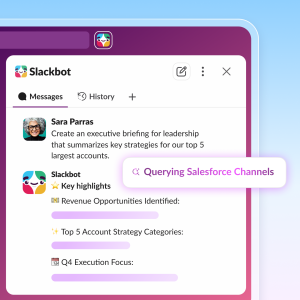
Customer Zero: Slackbot at Salesforce
Salesforce’s AI agent in Slack — Slackbot — is the fastest-adopted tool in Salesforce history. With 83% of the company using it regularly, it saves the average employee up to five hours of work a week. Salesforce employees use Slackbot directly within Slack to streamline daily tasks, from summarizing missed threads and drafting content to assembling briefs by aggregating metrics and files across various channels and apps.
Customers trust agents too. Over the past five quarters, agents handled 170 times more customer service chats than previous years and consistently solved 7 out of 10 of them without needing human help.
Escalations Steady as Conversations Rise
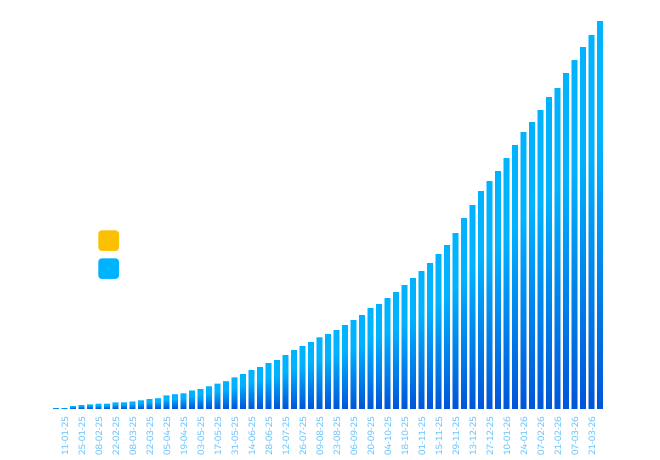
Escalation rates from AI agents to human agents are holding steady at
In fact, a recent study found that 77% of shoppers who engaged with onsite, branded shopper agents felt more confident with their purchase than those who didn’t.
In customer service organizations, agents are making the biggest impact on customer satisfaction — more than service rep productivity, average handle time, customer retention, and first-response time.
Looking ahead
As the enterprise digital workforce matures, businesses won’t need to choose between agents that deploy quickly or tackle complex tasks. They will eliminate the trade-off entirely, scaling output quickly to meet surges in demand while maintaining the deep, cross-functional logic required to handle complex workflows.
Methodology:
Powered by Agentforce and other Salesforce products, Salesforce analyzed and aggregated usage data of a cohort of businesses to uncover the true story of agents in the workforce. Looking at trends from February 2025 to April 2026, The Salesforce Agentic Enterprise Index analyzes the activity and engagement of real businesses leveraging the power of AI agents to drive ROI. To qualify for inclusion in the dataset, businesses needed to have activated agents in production every month across the analysis period. These results are not indicative of Salesforce performance.