New Salesforce research shows finance leaders are taking charge of AI strategy, and seeing positive returns, as they manage more revenue models and channels than ever.
Finance leaders are managing more than they were a year ago, with nearly three-quarters saying their role expanded this year. The biggest reason? Managing AI use and expansion, with these finance leaders naming this ahead of every other driver they were asked about, including revenue complexity. Half of these finance leaders also say they are now the primary decision makers on their company’s AI strategy.
The complexity they’re managing is also growing. Released locally at the AIforce World Tour Essentials event in Sydney today, the CFO Priorities Report found that 65 per cent of finance leaders now manage multiple revenue models, and 71 per cent sell through more channels than they did a year ago.
Nearly nine in ten also say their company plans to add more consumption-based products. It’s an evolving challenge. Consumption-based revenue depends on what customers actually use, so finance has to reconcile usage data with contracts, pricing, billing, and revenue recognition, often across systems that don’t talk to each other. For finance leaders, that’s a complexity tax: growth that also brings more transactions to reconcile and more assumptions to forecast.
The manual work behind the complexity
Many finance teams are still working by hand to keep up. About 67 per cent of finance leaders say their team completes at least one in five workflows manually, often in spreadsheets. They see an opportunity to automate as much as 40 per cent of their team’s work.
“Finance leaders are being asked to do more than ever — not just report on financial results but expand to new business models, enable more distribution channels, and now deliver an AI strategy for their company,” says Sam Chung, Chief Customer Officer, Agentforce Revenue Management.
“What’s striking is that many are turning to AI, not because it’s the next shiny technology but because they need a way to manage complexity without requiring more headcount. The opportunity is significant, but so is the risk. Finance leaders need AI they can trust, govern, and connect directly to the business outcomes they’re accountable for.”
Gordon Squire, CFO at Australian speciality retailer dusk, agrees that the CFO role has changed dramatically over the last few years and points to the importance of foundational data work to better support AI implementation.
“When I joined dusk, one of my priorities was building a stronger, more connected foundation for how we manage customer data. This research shows many finance teams are still running a lot of work manually, and that matches what I saw.”
For Squire, having unified data is essential for providing the insights the business needs to understand customer shopping habits and trends, while allowing the team to execute faster.
“Moving to a connected platform has made us more confident in our data, and it’s why we can now start thinking about agentic AI. For CFOs weighing up AI, I’d say getting your data and controls in order is the first step, and the AI conversation follows from that.”
AI is paying off but trust remains central
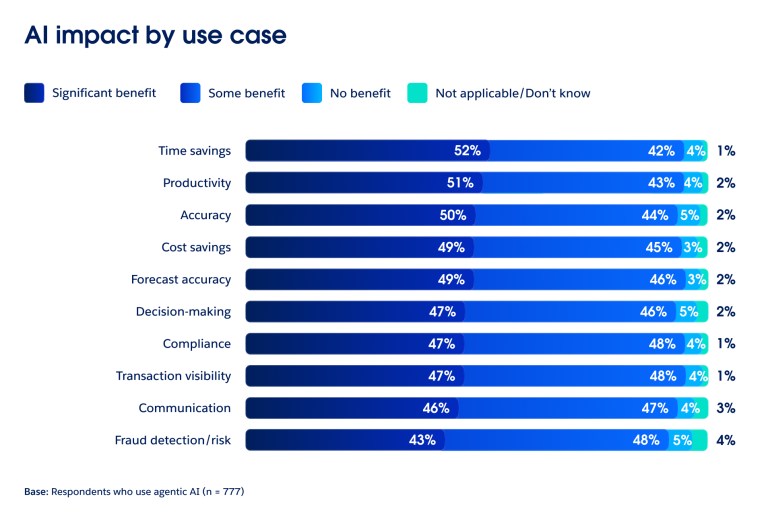
For those already using AI, the returns are clear, with 90 per cent of finance leaders who use AI reporting a positive ROI. Among those using AI agents specifically, more than 90 per cent report benefits in time savings, productivity, cost savings and forecast accuracy, and roughly half say these gains are significant.
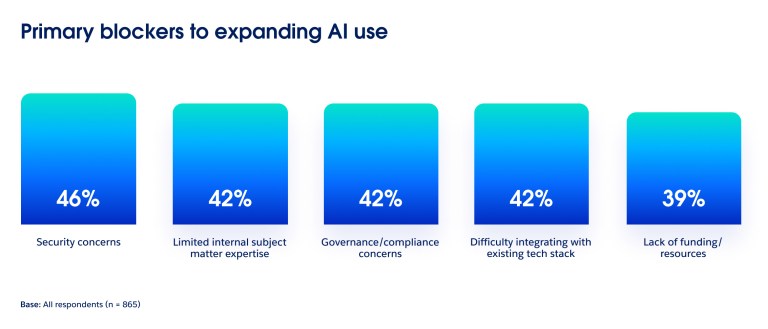
However, confidence in AI is not yet universal. Up to 46 per cent of finance leaders name security as a top blocker to expanding AI, and 42 per cent cite governance and integration with existing systems. Many also point to limited internal expertise.
From spreadsheets to automation
Finance leaders expect the pressure to keep building. With consumption-based models set to grow, reconciling usage, pricing and billing across systems will only get harder. The CFOs seeing the biggest gains are pairing automation with strong governance from the start.
“CFOs now own the AI conversation, and the question has shifted from whether to use agents to whether they can be trusted with the numbers,” notes Hamish Miles, AVP Enterprise Strategy, Salesforce. “That’s why reasoning has to be paired with deterministic rules, data and permissions, so agents act on the business’s own context, not guesswork.”
“Finance leaders across ANZ who build on that foundation will be in the best place to turn spreadsheet work into trusted automation.”
More information
- Read more about how dusk is using Salesforce to deliver exceptional customer experiences
- Access the full CFO Priorities Report
- Get all the details about AIforce World Tour Essentials Sydney
About the research: Salesforce surveyed 865 finance leaders, including CFOs, chief accounting officers and finance EVPs and VPs, between May 4 and 15, 2026. The double-blind survey covered France, Germany, Japan, the UK and the US.