

Key Takeaways
- Customers increasingly expect brands to support back-and-forth conversations, according to 83% of marketers in Australia and New Zealand
- Yet just over half of Australian marketers and around seven in 10 say they’re able to reliably reply to email and SMS/text communication
- 84% of marketers in Australia and 80% in New Zealand would trust AI to respond to customers to help scale efforts, but are being held back by disjointed or irrelevant data
Customers today want brand interactions to feel like interacting with an LLM: instant, conversational, and personalised. Yet 72 per cent of marketers in Australia still struggle to promptly respond to customers and 83 per cent confess to running generic campaigns. New Zealand shows a similar reality, with 62 per cent struggling to promptly respond to customers and 90 per cent still running generic campaigns.
These insights are according to nearly 4,500 marketers for Salesforce’s Tenth Edition State of Marketing report, including 250 from Australia and 100 from New Zealand.
“We’ve reached a point where having the best AI doesn’t matter if you’re just using it to send more one-way spam, faster. Customers in Australia and New Zealand are over it, as they now expect an actual back-and-forth conversation with a brand,” said Kevin Doyle, Regional Vice President, Agentforce & Data Cloud ANZ, Salesforce.
The research suggests the culprit isn’t lack of effort: it’s lack of usable data. Siloed systems and poor data quality remain the top barriers to the promises of AI-driven personalisation.
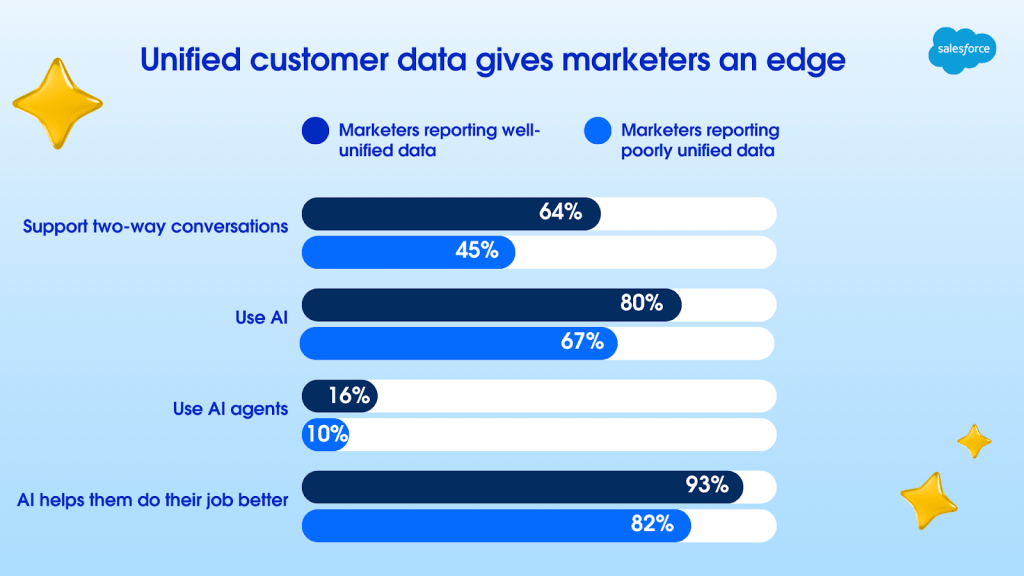
The good news is: globally, marketers with unified customer data have an early advantage over those with disjointed data sources. Marketing teams who’ve satisfactorily unified their data are 42 per cent more likely to regularly respond to customers compared to those who aren’t fully satisfied with their data underpinnings. They’re also 60 per cent more likely to use AI agents to help scale their efforts.
One organisation already bridging that divide is Australian retailer Amart.
“At Amart, we’ve recognised that to close the gap between digital browsing and in-store shopping, we had to move past fragmented systems and 24-hour data delays.” said Taylor Murray, Head of Customer, Amart.
“By implementing a universal customer ID through Data 360, we have shifted from slow, manual processes to real-time, automated execution. You can’t give a customer a personalised reply if you don’t actually know who they are. It’s time to stop just speaking at customers and start truly engaging with them.”
“The work Taylor and the Amart team are doing is the perfect blueprint for fixing this. By killing off those 24-hour data delays and getting their tech and people on the same page, they’ve stopped just ‘broadcasting’ and started actually engaging,” adds Kevin Doyle. “That’s how you turn a generic marketing campaign into a real relationship that actually grows the business.”
We’ve reached a point where having the best AI doesn’t matter if you’re just using it to send more one-way spam, faster. Customers in Australia and New Zealand are over it, as they now expect an actual back-and-forth conversation with a brand.
Kevin Doyle, Regional Vice President, Agentforce & Data Cloud ANZ, Salesforce
Dig deeper
Data is the biggest personalisation bottleneck
- Cross-departmental silos strand marketers in one-way communications.
- 83% of marketers in Australia and New Zealand say customers now expect two-way conversations — the ability to reply to a marketing message and get an actual response. But 62% of New Zealand and 72% of those in Australia struggle to respond promptly because they can’t access the context they need.
- Only 59% of marketers in Australia have complete access to service data, 60% to sales data, and 55% to commerce data. In New Zealand, only 63% have access to service and sales data, and 57% to commerce data.
Doyle continues, “You simply can’t give a customer a helpful, real-time recommendation if your systems don’t actually know who they are or what they bought yesterday. The biggest winners right now aren’t the ones with the flashiest AI; they’re the ones who have fixed their data foundation so they can act in the moment, rather than guessing.”
- Marketers look to AI to scale personalisation efforts.
- Up to 80% of Australian marketers say they need more personalised content than they’re able to produce and nearly as many (72%) are turning to AI to help close the gap. Perhaps unsurprisingly, their top AI use case is personalising content.
- In New Zealand, 70% recognise the need for more personalised content while 91% is already relying on AI for that.
- AI can help scale personalisation efforts, but the research shows most marketers are still getting tripped up: 97% of marketers in Australia and all of those in New Zealand hit barriers to personalisation, and data issues are the most common culprits.
- The top barriers for marketers in Australia include too much data to process, siloed data across channels and lack of overall strategy.
- For New Zealand, siloed data across channels is listed as the top barrier, followed by difficulty scaling quality control and lack of overall strategy.
- High performers have narrowed this gap.
- A notable exception: marketers using AI agents report higher satisfaction with cross-functional data access. Whether that’s because deploying agents forced them to unify data first, or because the agents themselves improved connectivity, isn’t clear.
- 76% of APAC marketers with AI are satisfied with their ability to connect touchpoints compared to 55% of those without AI.
- High-performing APAC marketers are 1.7 times more likely to use customer data to create relevant experiences and 1.7 times more likely to have unified their data sources.
- A notable exception: marketers using AI agents report higher satisfaction with cross-functional data access. Whether that’s because deploying agents forced them to unify data first, or because the agents themselves improved connectivity, isn’t clear.
AI rewrites the rules of discovery and engagement
- Marketers are caught between old playbooks and new realities.
- In Australia, nearly two-thirds (72%) say they’re struggling to keep up with changing customer behaviours, and 49% haven’t figured out how to adapt their strategies to the widespread use of AI.
- While in New Zealand, 62% can’t keep up with changing customer behaviour and 53% haven’t figured out how to adapt their strategies to the widespread use of AI.
- Customer behaviors – and expectations — are already measurably different thanks to AI.
- Half of all Google searches now feature AI summaries that bypass brand websites entirely — shrinking the top of the marketing funnel — while customers increasingly consult LLMs for purchase decisions.
- This holiday season alone, AI and agents drove 20% of global orders — $262 billion in sales — signaling a significant shift in how people discover and shop.
- In Australia and New Zealand, 88% of marketers have observed that AI is raising customer expectations, with 83% noting customers increasingly expect two-way conversations across all channels.
- Spotlight: Answer Engine Optimisation (AEO): the two-way conversation consumers are already having.
- The majority (86% in Australia and 71% in New Zealand) of marketers say AI is reshaping their SEO strategy, while 92% in Australia and 89% in New Zealand have already begun optimising for AI-generated responses for places like ChatGPT and Google’s AI Overview.
- Intriguingly, while it’s harder for marketers to capture attention when AI synthesises answers from multiple sources, the resulting customer engagement is more personalised and specific, signaling high intent.
- High-performing marketers — those who get the highest returns on their marketing spend — are 2.2 times more likely than underperformers to have optimised for AI search.
“The old playbook of ‘click these ten blue links’ is changing fast. Between AI summaries and digital assistants, the way people in ANZ shop and find information has fundamentally shifted.” Doyle noted.
“We’re moving into an era of ‘Answer Engines,’ where discovery is compressed into just a few seconds. To stay visible, businesses have to move beyond manual processes and embrace agents that can handle the heavy lifting. It’s a shift from just speaking at your customers to finally being able to listen and respond at scale, 24/7.”
Explore Further:
- Access the full State of Marketing report
- Read Salesforce’s Agentforce Marketing CMO sharing five hard truths from the report findings
- Learn how to act on every customer message in real time with Agentforce Marketing
- Read more Agentforce World Tour Sydney news
Methodology:
Data in this report are from a double-anonymous survey conducted from October 8 to November 17, 2025. The survey generated 4,450 responses from marketing decision makers across North America, Latin America, Asia-Pacific, and Europe.
Performance levels referenced in the report were determined as follows: high performers reported complete satisfaction with the overall outcomes of their marketing investments. Moderate performers reported high satisfaction with the overall outcomes of their marketing investments. Underperformers reported moderate or less satisfaction with the overall outcomes of their marketing investments.
For more demographic information, please refer to the report.