Key Takeaways
- Customers increasingly expect brands to support back-and-forth conversations, according to 83% of marketers
- Yet just over half of marketers say they’re able to reliably reply to email and SMS/text communication
- 81% of marketers would trust AI to respond to customers to help scale efforts — but are held back by disjointed or irrelevant data
Customers today want brand interactions to feel like interacting with an LLM: instant, conversational, and personalized. Yet 69% of marketers still struggle to promptly respond to customers and 84% confess to running generic campaigns, according to nearly 4,500 marketers for Salesforce’s Tenth Edition State of Marketing report.
“We are using the most powerful technology in history to send more one-way spam, faster,” said Bobby Jania, Salesforce Agentforce Marketing CMO. “You can’t give a customer a personalized recommendation or reply if your AI doesn’t actually know who they are.”
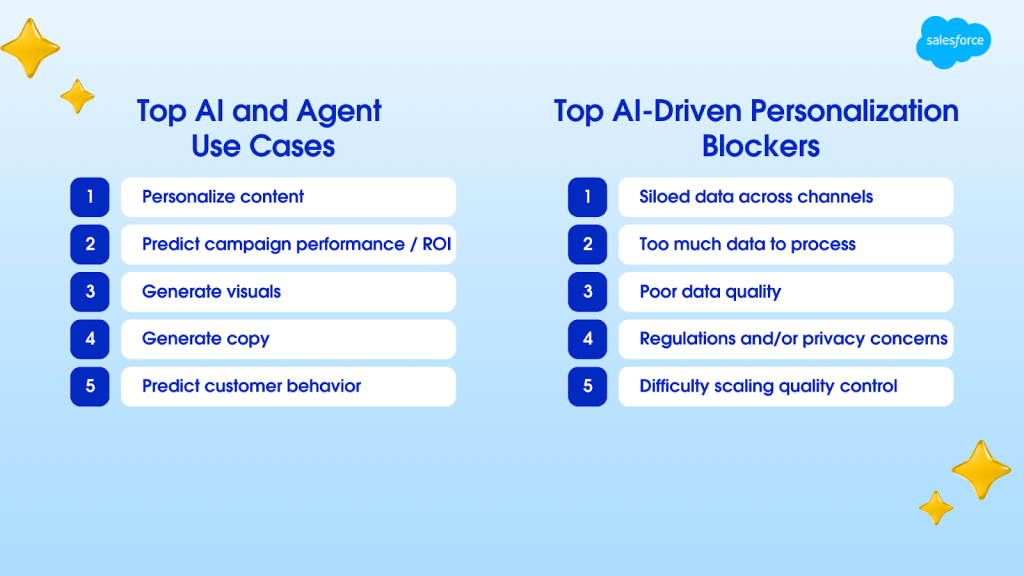
The research suggests the culprit isn’t lack of effort: it’s lack of usable data. Siloed systems and poor data quality remain the top barriers to the promises of AI-driven personalization.
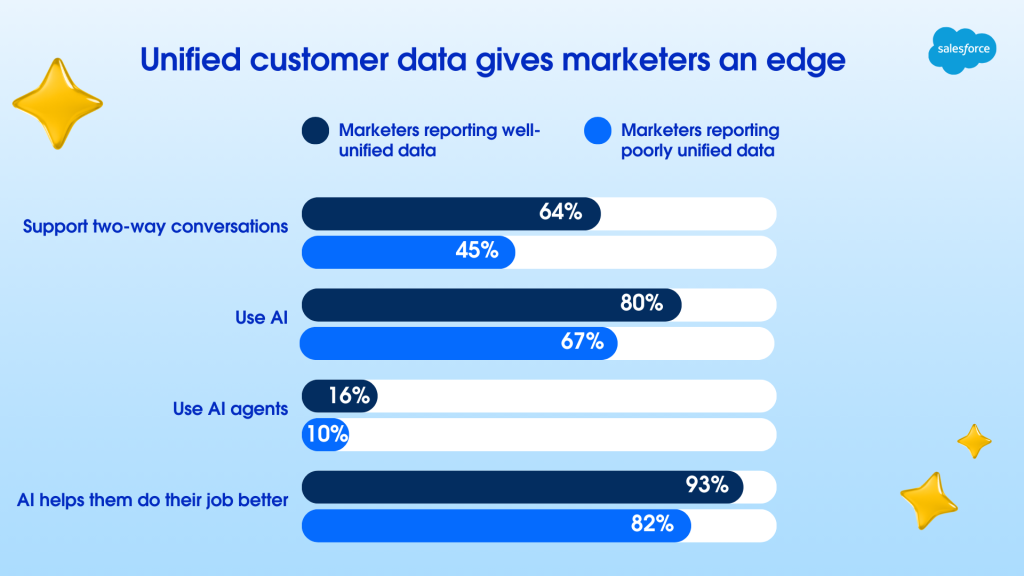
The good news is: marketers with unified customer data have an early advantage over those with disjointed data sources. Marketing teams who’ve satisfactorily unified their data are 42% more likely to regularly respond to customers compared to those who aren’t fully satisfied with their data underpinnings. They’re also 60% more likely to use AI agents to help scale their efforts.
“Every marketer has access to the same AI models. So what separates the winners? Relevant context,” said Jania. “Being able to harness the right context is the difference between an AI that automates the status quo and an agent that actually grows your business.”
Agentic marketing is the next great evolution in our field: marketing that stops speaking at customers and starts engaging with them.
Bobby Jania, Salesforce Agentforce Marketing CMO
Dig deeper
Data is the biggest personalization bottleneck
- Cross-departmental silos strand marketers in one-way communications.
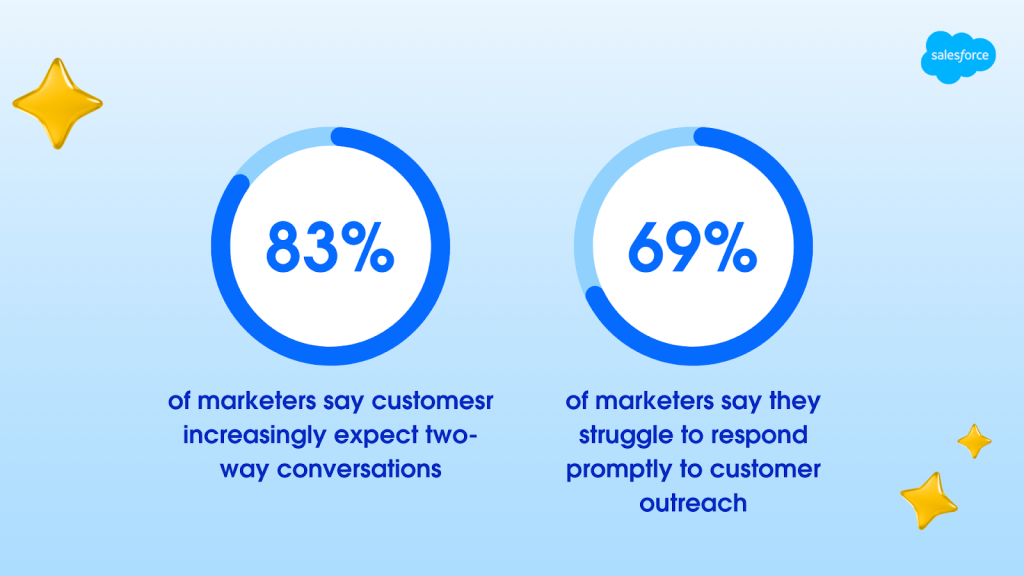
- 83% of marketers say customers now expect two-way conversations — the ability to reply to a marketing message and get an actual response. But 69% of marketers struggle to respond promptly because they can’t access the context they need.
- Only 58% have complete access to service data, 56% to sales data, and 51% to commerce data.
Per Jania, “the gap between what we do (campaigns) and what they want (conversations) has never been wider. But for the first time, we have the technology to close it.”
- Marketers look to AI to scale personalization efforts.
- 78% of marketers say they need more personalized content than they’re able to produce and nearly as many (75%) are turning to AI to help close the gap.
- Perhaps unsurprisingly, their top AI use case is personalizing content.
- AI can help scale personalization efforts, but the research shows most marketers are still getting tripped up: 98% of marketers hit barriers to personalization, and data issues are the most common culprits.
- High performers have narrowed this gap.
- A notable exception: marketers using AI agents report higher satisfaction with cross-functional data access. Whether that’s because deploying agents forced them to unify data first, or because the agents themselves improved connectivity, isn’t clear.
- 75% of marketers with AI are satisfied with their ability to connect touchpoints compared to 60% of those without AI.
- High-performing marketers are 2.8 times more likely to use customer data to create relevant experiences and 2.4 times more likely to have unified their data sources.
- A notable exception: marketers using AI agents report higher satisfaction with cross-functional data access. Whether that’s because deploying agents forced them to unify data first, or because the agents themselves improved connectivity, isn’t clear.
“Agentic marketing is the next great evolution in our field: marketing that stops speaking at customers and starts engaging with them,” said Jania. “Because if we don’t deliver that, consumers will find a brand that will.”
AI rewrites the rules of discovery and engagement
- Marketers are caught between old playbooks and new realities.
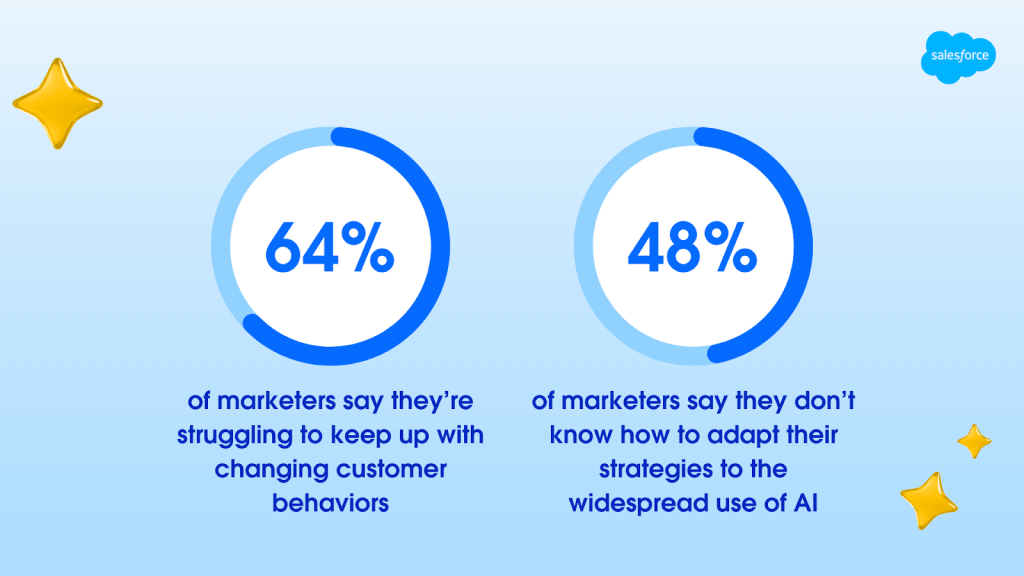
- Nearly two-thirds (64%) say they’re struggling to keep up with changing customer behaviors, and 48% haven’t figured out how to adapt their strategies to the widespread use of AI.
- Customer behaviors – and expectations — are already measurably different thanks to AI.
- Half of all Google searches now feature AI summaries that bypass brand websites entirely — shrinking the top of the marketing funnel — while customers increasingly consult LLMs for purchase decisions.
- This holiday season alone, AI and agents drove 20% of global orders — $262 billion in sales — signaling a significant shift in how people discover and shop.
- 86% of marketers have observed that AI is raising customer expectations, with 83% of marketers noting customers increasingly expect two-way conversations across all channels
- Spotlight: Answer Engine Optimization (AEO): the two-way conversation consumers are already having.
- The majority (85%) of marketers say AI is reshaping their SEO strategy, and 88% have already begun optimizing for AI-generated responses for places like ChatGPT and Google’s AI Overview.
- Intriguingly, while it’s harder for marketers to capture attention when AI synthesizes answers from multiple sources, the resulting customer engagement is more personalized and specific, signaling high intent.
- High-performing marketers — those who get the highest returns on their marketing spend — are 2.2 times more likely than underperformers to have optimized for AI search.
“The old playbook of “broadcast and pray” is broken. Customers have moved on,” Jania noted. “They aren’t clicking ten blue links on Google anymore; they are getting answers from AI. And as AI-driven interfaces compress discovery into fewer moments, brands have fewer chances to earn attention. That’s why if you aren’t optimized for this “Answer Engine” world, you’re invisible.”
Explore Further:
- Read the full State of Marketing report for the latest perspectives on AI, data, and personalization
- Salesforce’s Agentforce Marketing CMO shares five hard truths from the report findings
- Learn how to act on every customer message in real time with Agentforce Marketing
- Discover how customers like PepsiCo use Agentforce to power personalized marketing across their many brands
- See how UChicago Medicine’s marketing team uses Agentforce to run targeted campaigns that help save lives.
Methodology:
Data in this report are from a double-anonymous survey conducted from October 8 to November 17, 2025. The survey generated 4,450 responses from marketing decision makers across North America, Latin America, Asia-Pacific, and Europe.
Performance levels referenced in the report were determined as follows: high performers reported complete satisfaction with the overall outcomes of their marketing investments. Moderate performers reported high satisfaction with the overall outcomes of their marketing investments. Underperformers reported moderate or less satisfaction with the overall outcomes of their marketing investments.
For more demographic information, please refer to the report.