Salesforce Expands Agent Fabric to Automatically Stop Runaway Costs and AI Agent Failures Before They Impact Customers

New Agent Evals gives leaders the confidence to scale more agents into production by continuously evaluating agent performance and costs, no matter what platform the agent is built on.
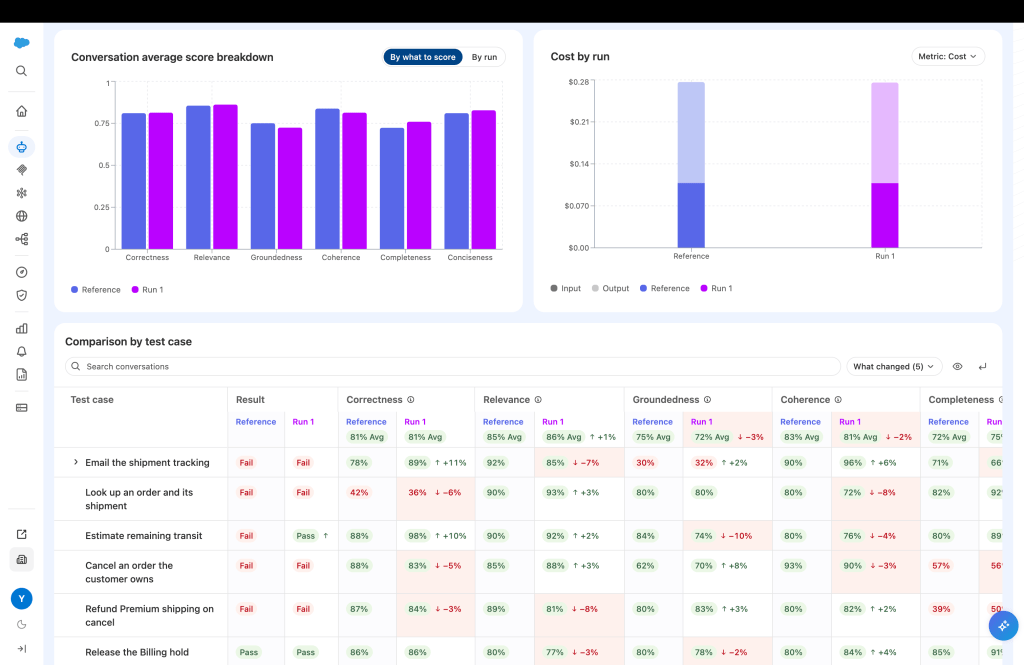
Today, Salesforce announced Agent Evals, API Evals, and advanced cost controls for Agent Fabric, its AI control plane for managing and governing agents across platforms. As enterprises scale AI, agents can fail silently, delivering wrong answers and racking up costs before anyone notices.
CIOs and AI leaders can now catch problems before they turn into customer complaints or runaway costs, with automated interventions when quality slips and hard spending limits that cap usage at budget.
With over 1.2 billion requests handled daily, Agent Fabric brings proactive control to enterprise AI at scale.
“What excites us most about Agent Evals is that it doesn’t stop at telling us something is wrong. When an agent’s quality drops, Agent Fabric can step in automatically, alerting the right owner or pulling the agent offline before a small issue becomes a widespread customer problem. That’s the missing piece for running agents at scale, and it will give us the confidence to keep expanding AI across our business. We are excited to partner with Salesforce and help shape Agent Evals Beta.” – Poonam Deshpande, Director of Engineering, Digital Commerce at ASICS Digital
As the models, APIs, costs and systems underneath agents evolve, issues can silently surface. Catching them proactively means building, maintaining, and evaluating performance continuously. Yet today fewer than half of organizations with agents evaluate them on live traffic. Once issues are uncovered, resolution means tracking down the owner and getting approval to restrict the agent while it keeps producing harmful results and racking up token spend. With 96% of enterprises running agents on more than one platform and out-of-the-box agents like Fin on the rise, the need for oversight keeps growing.
Moving from “cross-your-fingers AI” to continuous control
To address these challenges, Salesforce is bringing continuous evaluation and automated intervention into the same control plane that enterprises already use to manage and govern their AI agents:
- Agent Evals: Automatically generate tests before deployment, then evaluate agents, LLMs, and MCP servers in production against defined quality thresholds. When results fall short, they trigger predefined interventions — including the Agent Kill Switch — with approval where the team’s policy requires it.
- API Evals: Agents fail when the APIs they depend on change. API Evals automatically generates functional and performance tests from API specifications, catching breaking changes before they reach production.
- Advanced cost controls: The FinOps Dashboard and Model Wallet give budget owners one view of AI spending and hard limits that stop requests before costs exceed budget, while Cost Optimization Policies cut token usage by up to 75% (based on test scenarios) through semantic caching, payload compression, and response trimming.
Together, evaluation and governance help teams assess whether agents complete tasks correctly, use the right tools, operate efficiently, and follow security policies. Connecting those findings to predefined responses reduces the manual work required to oversee agents across platforms and helps enterprises keep them operating as intended after deployment.
“Enterprises can only scale agents as fast as they can keep them accurate and on budget. Today, spotting a wrong answer or a spending spike is one job, and stopping it is another. Agent Fabric unifies them, bringing evaluations, cost controls, and intervention together so teams can contain issues instantly and scale agents with confidence.” — Andrew Comstock, SVP & GM, MuleSoft & Agent Fabric
Here’s what proactive control looks like in practice. Consider a retailer that is looking to reduce the costs of a live order-support agent:
- Scenario: A retailer switches its order-support agent to a lower-cost AI model to reduce operating costs.
- Detection: After the model change, Agent Evals automatically runs scheduled tests and detects that the agent is providing inaccurate information about delayed orders.
- Resolution: Agent Evals automatically flags the quality issue and requests approval to quarantine the agent, based on their preference to keep a human in the loop. Once approved, the agent is quarantined while the team refines the agent’s instructions on how to handle delayed orders. They rerun the evaluation on the lower cost model using the new instructions to confirm it’s performing as expected before returning it to production.
- Result: The retailer can pursue AI cost savings with confidence, knowing that quality issues can be automatically detected and intervention initiated when needed. This helps protect the customer experience while giving the business greater control over its AI agents.

Going further across the platforms and gateways you already use
Agent Fabric already automatically discovers and governs agents across major AI platforms. Two updates extend that further, to agents running in internal and third-party environments, and to APIs managed on gateways from other vendors:
- Custom Agent Scanner: Extend Agent Fabric’s automated discovery to internal environments, systems behind firewalls, and third-party platforms beyond its out-of-the-box support. Build custom scanners to discover and catalog agents, models, MCP servers, and APIs in the Agent Registry — without registering each asset manually.
- Open Policies for Federated API Gateways: Discover, enforce, and track API policies across gateways from Azure, Apigee, and Kong, applying a policy such as IP allowlisting or rate limiting across all of them in one action instead of one at a time.
Perspectives
“Our customers rely on us to run critical services every day, and AI agents are increasingly becoming part of those operations. Agent Fabric gives us a central AI control plane to govern agents at scale, while Agent Evals will help us validate that agents are performing against clear business and service outcomes. Together, these capabilities will help us orchestrate AI agents alongside our operational experts, ensuring that automation is deployed responsibly, that the right human intervention is available when needed, and that we continue to deliver the trusted outcomes our customers depend on.” — Tiina Stephens, Director of AI Engineering, Capita
“A lot of what’s going on in big organizations with AI today involves one-offs, lacking governance or visibility. With Agent Fabric, we now have that single control plane where we can see our agents, who built them, and shut them down if something goes wrong. That’s how you move from experiments to real enterprise scale with trust.” – Adam Jones, Executive Director of Enterprise Transformation, GE Appliances, a Haier company
“As we bring AI agents into customer service, we want to be sure we can guide and oversee them every step of the way. With Agent Fabric as our secure AI control plane, Newell Brands is building an agentic enterprise where every agent across every brand is visible, governed, and accountable. That’s how we’re scaling intelligent service globally without compromising customer trust.” — Steve Sigrist, Vice President, Global Customer Service, Newell Brands
Availability
- Agent Evals: Beta in November 2026. Generally available January 2027.
- API Evals: Beta in November 2026. Generally available January 2027.
- Custom Agent Scanner: Beta today. Generally available January 2027.
- Agent Kill Switch: Generally available today. Triggered-Agent Kill Switch generally available January 2027.
- Open Policies for Federated API Gateways: Generally available today.
- FinOps Dashboard, Model Wallet, and Cost Optimization Policies: Generally available today.
This article may include references to services or features that are still in development and are unreleased. Customers should make their purchase decision based on fully released and available features.
Learn More
- Get an overview of Agent Fabric and how it serves as your enterprise AI control plane.
- Discover how to control AI costs and eliminate silent token spikes.
- Explore how Agent Fabric unifies AI agents into a governed network.