
Key Takeaways
- Nearly three-quarters of finance leaders say their role expanded this year — and managing AI is the biggest reason why.
- Rising revenue complexity is straining finance teams: 65% now manage multiple revenue models; 71% sell through more channels than a year ago.
- AI is one place finance leaders are finding relief: 90% who use it report ROI, but adoption stays cautious, with security, governance, and cost as top-named blockers.
Salesforce’s new CFO Priorities Report, based on a double-blind survey of 865 finance leaders across three continents, finds the role in the middle of a shift. Financial oversight is still the job. But advanced AI has become part of it in two ways at once: managing a new tool to improve finance workflows and monitoring ROI as AI rolls out across the company.
“Finance leaders are being asked to do more than ever — not just report on financial results but expand to new business models, enable more distribution channels, and now deliver an AI strategy for their company. What’s striking is that many are turning to AI, not because it’s the next shiny technology but because they need a way to manage complexity without requiring more headcount. The opportunity is significant, but so is the risk. Finance leaders need AI they can trust, govern, and connect directly to the business outcomes they’re accountable for. — Sam Chung, Chief Customer Officer, Agentforce Revenue Management
The CFO role is expanding, driven in part by AI
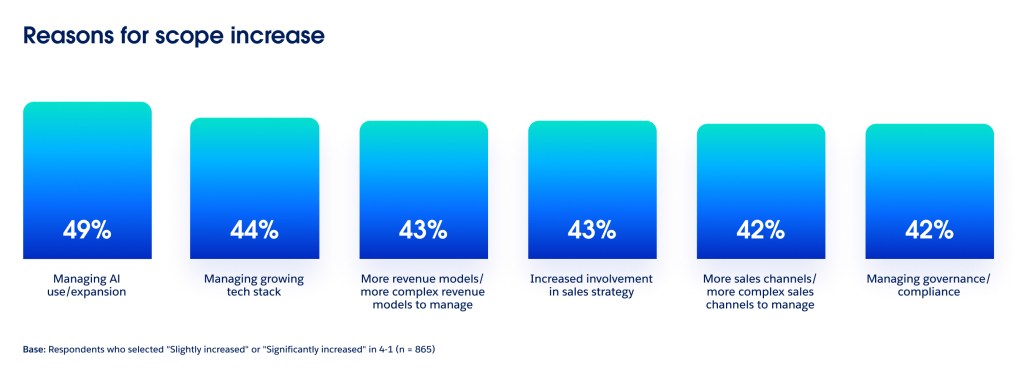
Almost three-quarters of finance leaders say the scope of their role increased in the last year — and managing AI use and expansion is the top-cited reason, ahead of every other driver they were asked about, including revenue complexity.
Half of finance leaders now say they are primary decision makers in their company’s AI strategy. That represents a new kind of remit: Finance is no longer just reporting on the business. It’s increasingly helping determine how the business adopts AI, where it creates value, and how that value should be measured.
For CFOs, that means AI governance is more than just a technology question. It’s increasingly a financial one. Decisions that once sat primarily with IT — where AI should be deployed, what data it can access, what controls should surround it, and how its impact should be measured — land on finance, too, because they carry financial, control, and audit implications.
“AI decisions don’t reach finance as budget requests anymore — they reach us as questions about risk, control, and accountability. The CFO has moved from signing off on AI to being answerable for it.” — Sam Chung, Chief Customer Officer, Agentforce Revenue Management
Revenue complexity is straining finance teams
The expansion of the CFO role is happening against a business environment that is becoming harder to track and forecast. Seventy-one percent of finance leaders say their company now sells through more channels than it did 12 months ago. While direct sales still account for the largest share of revenue, web-based self-service, indirect/partner sales, social media, and mobile apps all now contribute meaningfully to the mix.

Revenue models are diversifying, too. While finance teams historically focused on one-time sales, 65% now track deals across more than one revenue model. Subscription or recurring products, professional services, consumption/usage-based, and hybrid models are all common. In other words, finance teams aren’t simply tracking more transactions. They’re managing more ways for revenue to be generated, priced, billed, collected, and recognized.
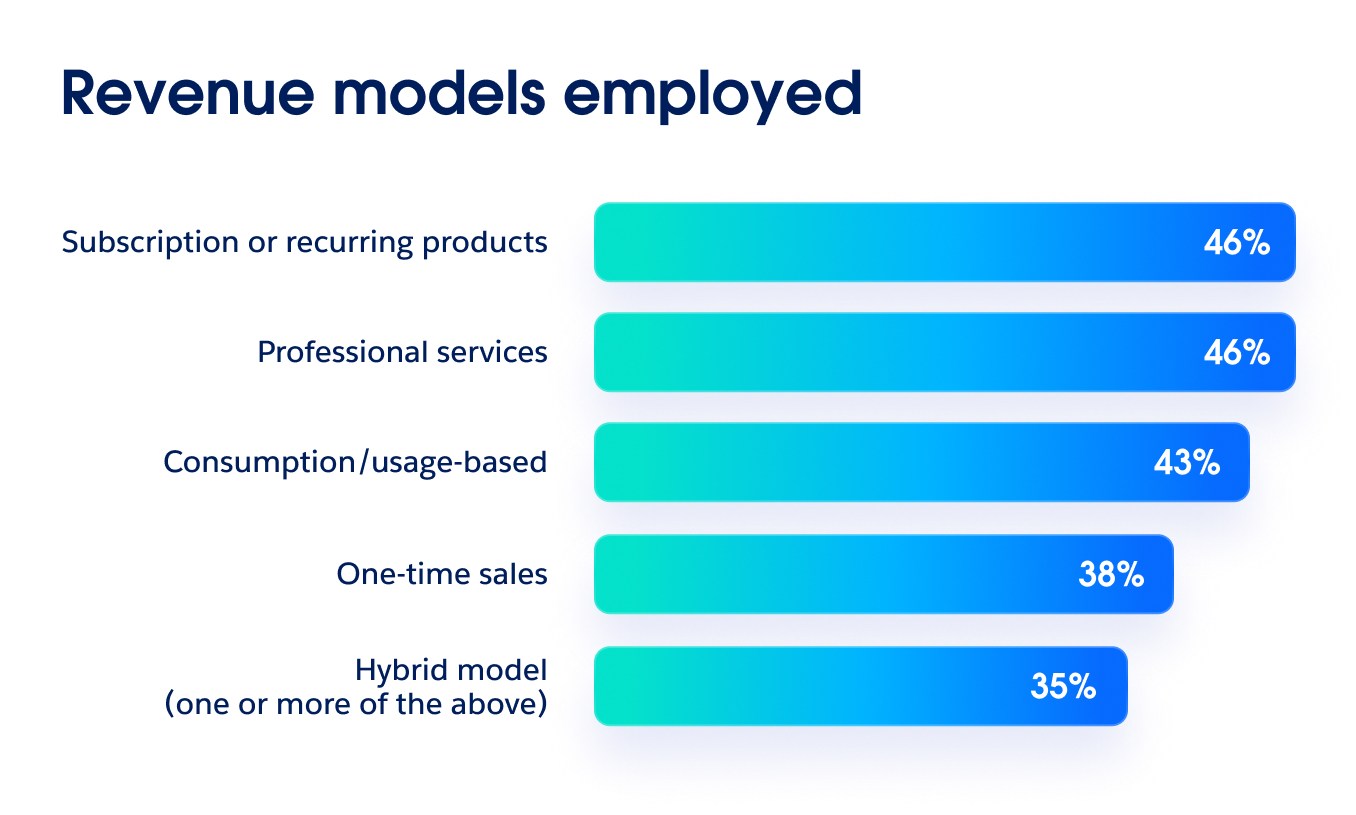
For finance, more channels and ways to sell can mean more ways for revenue data to become fragmented. A transaction may begin in one channel, involve a partner or another selling motion, and ultimately need to be reconciled across multiple systems before finance has a complete picture of the business.
Consumption-based pricing adds another layer of complexity
Consumption-based models illustrate just how different today’s revenue environment can be from the traditional one-time sale.
87% of finance leaders say their company plans to add more consumption-based products in the future.
Nearly 9 in 10 finance leaders say their company plans to add more consumption-based products in the future. Unlike a one-time transaction, where the financial event is relatively straightforward, consumption-based revenue depends on what the customer actually uses over time. That can require finance teams to reconcile usage data with contracts, pricing rules, billing records, and revenue recognition — often across systems that weren’t designed to work together seamlessly. For finance leaders, that creates a complexity tax. A new revenue stream may create growth for the business, but it can also create another set of transactions to reconcile, contracts to monitor, and assumptions to incorporate into the forecast.
Manual work opens the door to modernization
The more complex the revenue lifecycle becomes due to the diversification of sales channels and revenue models, the more costly manual work can become. Approximately 7 in 10 finance leaders (67%) say their team still completes at least one in five workflows manually, often via spreadsheets — work that consumes countless hours every week and introduces risk. Finance leaders see an opportunity to automate as much as 40% of their team’s work. They just need the right foundation, and often additional support, to get there.
AI — and specifically agentic AI — is one place leaders are finding relief
That opportunity is already showing results. Among finance leaders using AI, 90% report positive ROI. Among those using AI agents specifically, more than 90% report benefits in time savings, productivity, cost savings, and forecast accuracy — with roughly half calling those gains significant.
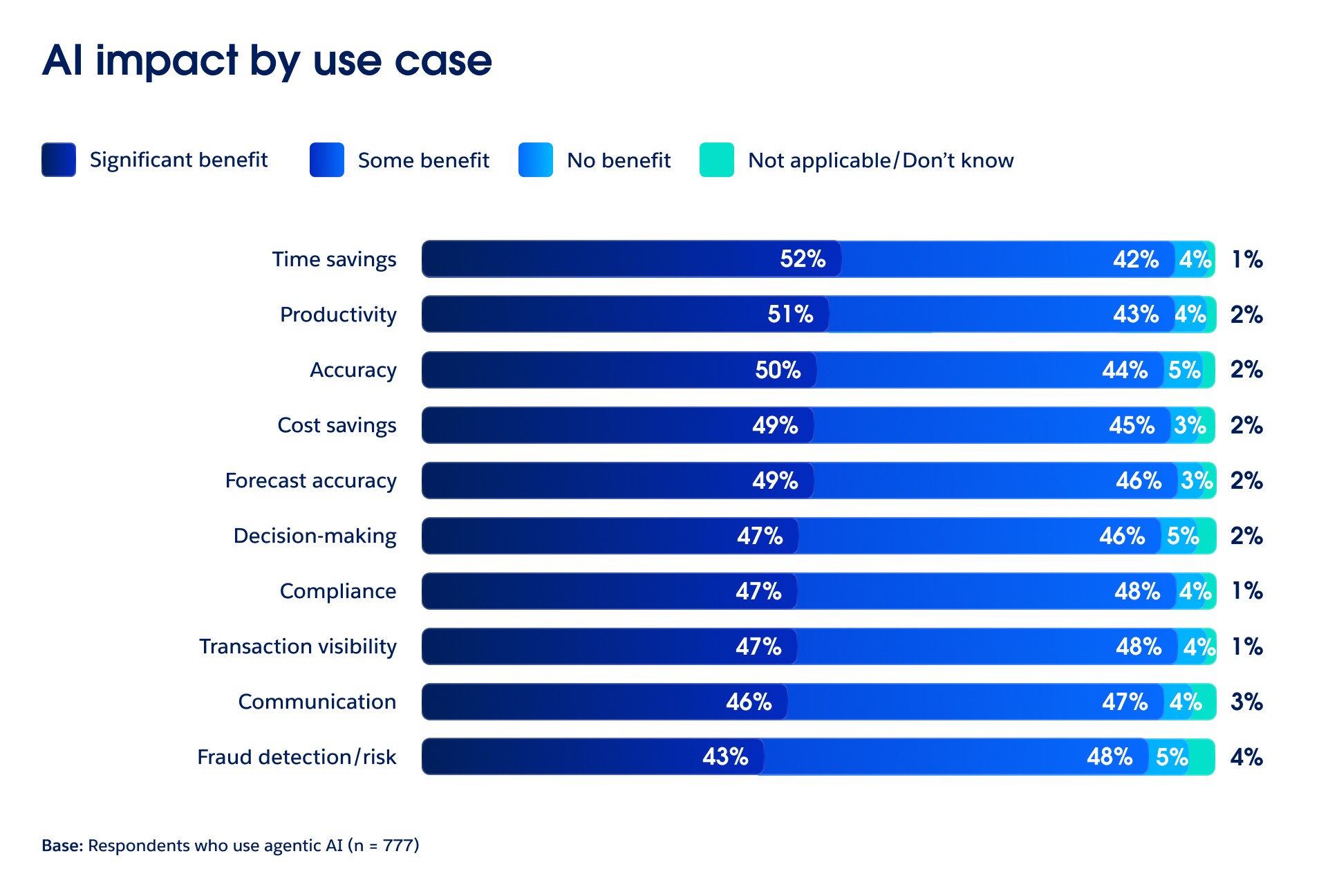
Many of these benefits can be found in high-volume, rules-based work that has traditionally required manual intervention. PwC reports that agentic AI is already cutting the time it takes an invoice to move from receipt to cleared by up to 80%, among other tasks.
Beyond allowing finance teams to tackle existing work faster, it can also give teams the ability to ask what happens next, for example, rapidly modeling how a pricing change or shift in channel mix would move their forecasts. AI can help surface those questions earlier, while finance remains accountable for the decisions that follow.
CFOs are still working through the challenges
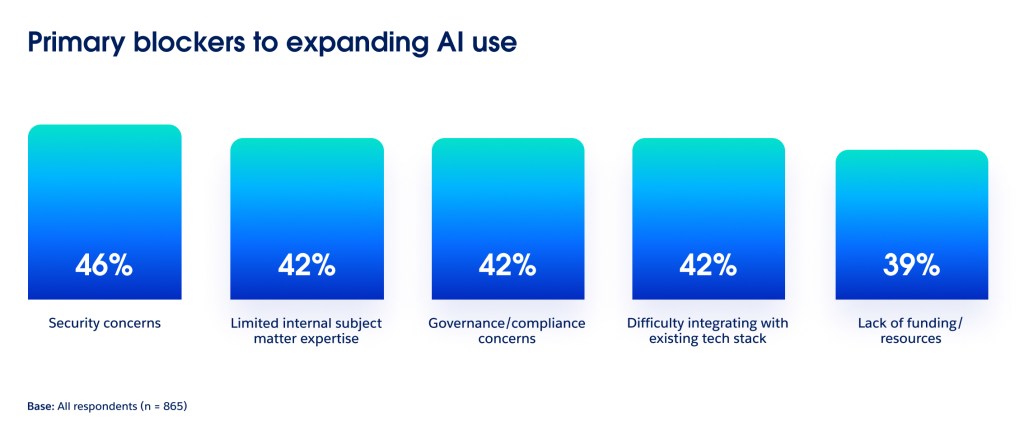
The benefits haven’t eliminated the barriers. Nearly half of finance leaders (46%) name security as a top blocker to expanding AI use, with governance concerns and integration with existing systems following close behind at 42%. For finance leaders, AI security and governance aren’t abstract. It comes down to controls, auditability, data access, and accountability. Just as many leaders also point to limited internal subject matter expertise, a notable gap for a function that’s simultaneously being asked to help lead the company’s AI strategy.
The next phase of the CFO role
Finance leaders are being asked to do two new things at once: govern AI’s rollout across the business and lean on it to manage complexity their own teams haven’t fully modernized for. The data suggests they’re approaching both with a clear eye on business value. AI is delivering returns for many of the finance leaders already using it, with room to expand impact and scale. For finance, the job has quietly doubled. It’s using AI to keep pace with the business and answering for how well that AI is governed, usually at the same time.
Explore further:
Methodology
Data in this report are from a double-blind survey conducted May 4–15, 2026. The survey generated 865 responses from CFOs, chief accounting officers, EVPs in finance, EVPs of accounting, and VPs of finances across France, Germany, Japan, the United Kingdom, and the United States. Respondents didn’t know that Salesforce had commissioned the survey, and Salesforce doesn’t know the identity of respondents beyond their qualification criteria. For more demographic information, please refer to the full report.