At first glance, it’s a little bit of a head-scratcher: A Salesforce survey of more than 1,500 desk workers spanning four continents found that American workers are 43% more likely than the average global worker to be skeptical of AI. That skepticism, however, isn’t necessarily a warning, but a roadmap. For enterprise leaders, understanding what’s driving this wariness is a blueprint for accelerating adoption and building the kind of trust that turns AI pilots into enterprise-wide transformation.
The Salesforce survey asked respondents whether they thought of themselves as an AI skeptic or an AI advocate. Fifty-three percent of people in the U.S., U.K., and France said they were skeptics, compared with just 26% in Mexico, for example. And, unsurprisingly, more “skeptical” countries were also slightly less likely to have adopted AI as a core part of their work.
AI Skepticism and Adoption at Work
American workers are 43% more likely than the average global worker to consider themselves AI skeptics.
Kingdom
States
Average
Source: Salesforce Agentic Workplace Study, 2025
It’s a finding that’s echoed in Stanford’s 2026 AI Index: Countries like India exceeded 80% in trust and consistent AI usage, while the U.S. hovered at around 50% on both metrics.
Why more optimism in developing countries like Mexico than advanced economies like the U.S. and France? One clue lies in a KPMG study that found that 90% of people in emerging economies expect to benefit from AI applications. For them, it’s a tool for upward mobility rather than a driver for job displacement. They also say that, for them, AI has led to improved fairness, creativity, and other positive outcomes.
Emerging Economies Are More Likely to Expect Benefits from AI
In some regions, AI is a tool for upward mobility rather than a driver for job displacement.
- Emerging Economies
- Advanced Economies
Source: KPMG
While AI hesitancy could potentially hold American workers back, leaders can take concrete steps to reverse this trend and drive AI adoption.
The reasons for American skepticism
While job loss is a concern for workers in developed countries, the data shows that American skepticism isn’t just about employment. It may be about the AI experience leaders are providing their staff. American workers say their AI pilots don’t work out because the tools they’re working with deliver untrustworthy, generic outputs — a sign that the underlying data infrastructure of their tools hasn’t delivered a good experience. The quality of their experience is a direct reflection of the platforms and data foundations enterprise leaders choose to invest in.
Top Reasons for an Unsuccessful AI Tool or Pilot Among American Workers
- 1 Generic outputs
- 2 Insufficient training
- 3 Low trust in outputs
Source: Salesforce Agentic Workplace Study, 2025
The data reveals a nuance: unsuccessful pilots alone don’t explain the divide – it’s what happens next. The Salesforce study also asked respondents whether they have ever experienced unsuccessful AI pilots. The data points to a meaningful difference in mindset: workers in the highest-adoption markets were more likely to report working through unsuccessful AI pilots before reaching consistent usage. Iteration — not perfection — appears to be the path to graduation. Leaders who drive AI adoption don’t just deploy tools — they build the conditions for experimentation to thrive.
Experience with Unsuccessful
AI Pilots and AI Adoption
Active AI users report more setbacks with past pilots than non-adopters
Kingdom
States
Average
Source: Salesforce Agentic Workplace Study, 2025
This tension around pilots, paired with a lack of institutional trust and heightened data privacy and security concerns, suggests that many enterprise environments aren’t offering the right tools to foster consistent, daily usage and graduate to full enterprise rollouts.
The productivity upside of AI is real, but only for those who actually use it.
The antidote: A better experience
The Salesforce study identified over 500 workers who did successfully graduate from AI pilots, that is, workers who’ve moved past experimentation and now use AI as a consistent or core part of their workflow. It provides an illustration for what happens when businesses get it right with their workers.
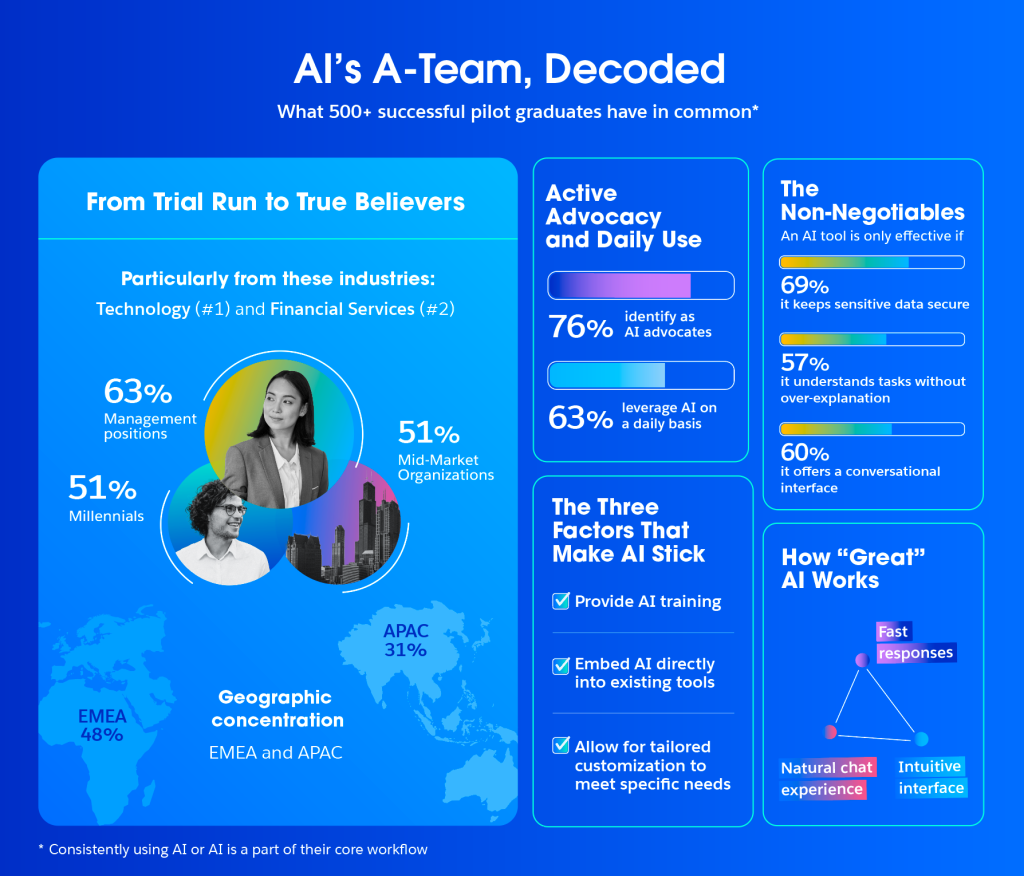

These workers, or “AI’s A-team,” share some key characteristics.
- Training: They receive training to improve how they leverage the technology.
- Experience: AI is embedded directly into the tools they already use. To them, “great AI” is natural, conversational, and intuitive.
- Trust: AI that is secure and context-aware is considered “nonnegotiable.”
- Customizable: They want AI that can be tailored to their specific role.
The result? Seventy-six percent of those workers become active AI advocates, and 63% use it daily.
“When we get AI fluency right, AI moves from a technology innovation into a workforce advantage. It’s the difference between deploying tools and actually changing how work gets done,” said Nathalie Scardino, President and Chief People Officer at Salesforce.
At Agentic Enterprises like Asymbl, for example, AI is thoroughly folded into daily use, with agents tailored to hundreds of different roles, resulting in millions of dollars of ROI.
For leaders, the lesson is straightforward: Workers don’t need to be told AI is good for them. They need the training, experience, and security to use it in a way that builds trust and keeps them coming back. Build the right conditions for that resilience and trust, and even setbacks become a feature of progress.
Salesforce Survey Methodology: In partnership with YouGov, Salesforce conducted a double-blind online survey among over 1,500 desk workers, defined as workers who consider their day-to-day job primarily mental labor over manual or task-based labor and were required to have at least minimal familiarity with AI, in Australia, India, Japan, Singapore, France, Germany, Italy, Netherlands, Spain, United Kingdom, Mexico, United States, and Canada. The survey was conducted from December 2025 to January 2026. The sample is representative across job roles, industries, and business size.