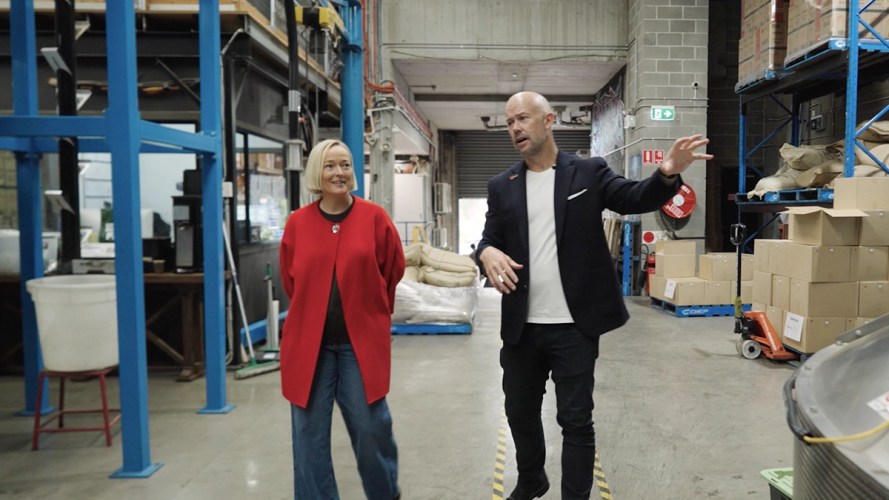


When people think of Salesforce, they often picture the Fortune 500. The sprawling enterprise. The hundred-seat CRM rollout. It’s a perception that Coffee Supreme Group CEO Andrew Low knew well — and chose to challenge head-on.
Let’s call out what the stereotype is and then why we saw through it. The product, when built well, is exceptional. And I got very attached to saying: why do only big businesses get it? Why don’t we get best-in-class and bring it to our small business?
That question has led Coffee Supreme to become one of the most compelling examples of food and beverage digital transformation in the ANZ market. Here’s how we did it.
The Challenge: Is Salesforce Too Big for a Small Business?
It’s one of the most searched questions among SMB owners right now: Is Salesforce too big for my small business? It’s a fair ask. For years, the honest answer was complicated. Salesforce implementations required large teams, specialist engineers, expensive scoping engagements, and ongoing maintenance costs that made sense for enterprise but felt out of reach for a founder-led coffee company.
Coffee Supreme was founded in Wellington, New Zealand in 1993. It started as a happenstance story: a supplier’s roastery burned down, so the founder simply took over. Thirty years later, that decision has grown into a multi-site wholesale roasting business with cafes, machine technicians, training rooms, and direct-to-consumer operations across three countries. Deep brand heritage. Genuine customer love. And a scaling problem that a lot of small businesses know well: the systems hadn’t kept pace with the ambition.
So much about what I worry about with small business is: I’m too busy, I don’t have time, tech’s not my thing, this is going to be hard and I’ll just balls it up. Even if you do know what you’re doing, those pressures get in the way.
The question wasn’t whether Coffee Supreme needed better technology. It was whether technology existed that could be implemented quickly, affordably, and sustainably — without requiring an enterprise-sized team to maintain it.
The turning point came when the Salesforce product suite moved to a unified 360 architecture. Things were re-platformed, things became very modern. It’s fundamentally cheaper over time to integrate through a best-in-class layer than to pay third-party developers to maintain single APIs across five or six products.
For businesses weighing up Salesforce SMB pricing vs. complexity, that shift matters enormously. The equation changed. Enterprise-grade technology became genuinely accessible.
The Solution: Four Products, One Unified Customer Journey
What makes Coffee Supreme’s story so useful for other small businesses is the way we thought about the rollout. We didn’t try to do everything at once, we picked the right products, tested them in small bursts, and expanded from there, getting what we needed quickly, cheaply, and sustainably.
Here’s how each product solved a specific business problem.
Salesforce Commerce Cloud: From Nice-to-Have to Non-Negotiable
Commerce isn’t a nice-to-have anymore, it’s a must-have. Your customers expect a digital ordering experience. In SMB, your customers are consumers: every day they shop online for their groceries, shop online for their clothes. Why can’t they shop online for their coffee?
For Coffee Supreme’s wholesale customers — the cafes, offices, and hospitality businesses that rely on them for their daily supply — a seamless digital ordering experience isn’t a luxury. It’s a baseline expectation. Salesforce Commerce Cloud delivered that, while also driving measurable commercial outcomes. We know that pictures sell more, your average order value goes up, your cart size goes up, and you get your ROI just from that experience.
MuleSoft: Solving Coffee Supreme’s Data Silos
One of the defining challenges of food and beverage businesses at scale is operational fragmentation. Roasting schedules, dispatch logistics, inventory, wholesale accounts, and customer service all generate data. But in disconnected systems, that data sits in silos, invisible to the people who need it most.
MuleSoft solved Coffee Supreme’s data silo problem by acting as the integration layer connecting their ERP, order management, inventory, and customer data into a single accessible view. The practical impact shows up in our vision for AI-powered operations: an agent that can query the ERP for stock availability, check whether a truck has departed, update a customer order, and notify the account manager automatically. That kind of real-time operational intelligence is only possible when your data flows freely. MuleSoft is what makes the plumbing work.
Data Cloud 360: One View to Run the Business
Get your data in one area. It sounds simple. For a business operating across Australia, New Zealand, and Japan, with wholesale customers, direct-to-consumer channels, machine technicians in the field, and a training academy, it’s anything but.
Data 360 brought Coffee Supreme’s customer, operational, and commercial data into a unified profile layer. That unified data enables smarter segmentation, more personalised customer experiences, and the kind of proactive service that turns a missed cut-off into a seamless resolution. It’s also the foundation on which AI agents are built. Without clean, connected data, agents are guessing. With it, they can make decisions which feel like they “never happened.”
Slack Enterprise: Keeping a People-Led Organisation Connected
Coffee Supreme is, at its heart, a people business. “Unreasonable hospitality” is our guiding philosophy and it demands that the human touch is never lost, even as process and technology scale around it. Slack Enterprise provides the connective tissue for a distributed team: the roastery staff in Chatswood, the drivers on the road, the sales team, marketing, ops, and dispatch — all in real time, with context, without the friction of siloed inboxes.
For a tech-enabled coffee company operating across multiple cities and time zones, Slack isn’t just a messaging tool. It’s the operational heartbeat of a modern, people-first culture.
The 12-Week Implementation: How Coffee Supreme Did What Most Businesses Think Is Impossible
In B2B technology, implementation timelines are one of the biggest pain points a decision-maker faces. Months of disruption, ballooning scope, and costs that spiral beyond the original budget – these are the stories that keep SMB owners up at night, and that feed the “Salesforce is too big for us” narrative.
Coffee Supreme’s 12-week go-live is a direct rebuttal to that. Here’s how we made it work.
Step 1: Choose the right implementation partner.
There are organisations out there like FulCRM that work with us – that think nimbly, understand that our budgets aren’t the same as enterprise, and are focused on the work to hit the best outcome in the shortest amount of time. Choosing a partner who understood the SMB context wasn’t optional. It was the foundation everything else was built on.
Step 2: Build internal accountability.
Coffee Supreme hired a dedicated internal project lead, Will, who came from a SaaS background. His job was to keep the business accountable to avoiding scope creep, and to hold FulCRM accountable to delivering within the agreed scope and timeline. We delivered on time and under budget and that is a very rare thing for a business that’s not done this before.
Step 3: Design for small tests, not big bangs.
Rather than trying to boil the ocean, we designed the architecture around small, focused experiments. Testing components before committing to them. Getting early wins that built internal confidence and board buy-in. Doing them in really small tests meant I could get the products I wanted quickly, cheaply, sustainably, and build on them over time.
Step 4: Get stakeholder buy-in early — even when it’s hard.
The board and CFO were sceptical. Their job is to say: “this is a big decision. Wouldn’t you rather put in a new coffee roaster? Wouldn’t you rather hire another person?”. But we stayed anchored to a long-term vision. I was very, very attached to setting the business up to be an agentic organisation of the future and you’ve got to start somewhere.
The result? On time. Under budget. And a platform ready to grow.
What’s Next: The Agentic Coffee Company
Coffee Supreme isn’t done. The 12-week implementation was always the beginning — the foundation on which something much bigger gets built.
Our vision for the next phase centres on AI agents working alongside the team, not replacing them. He describes a scenario where a wholesale customer misses the morning order cut-off, reaches out to an agent, and within moments the agent has checked stock availability in the ERP via MuleSoft, confirmed the truck hasn’t left, updated the order, and notified the account manager – all resolved before anyone starts their day.
For me, that’s pretty exciting. Get your data in one area, build your protections, build your products, build your agents, and build your control layer. That’d be my advice to any SMB.
It’s a vision that reframes what a tech-enabled coffee company can look like. Not a business that’s adopted technology despite its culture, but one that has used technology to scale its culture. The hospitality is still unreasonable. The coffee is still roasted fresh every day. The systems are just finally ready for what comes next.
The Takeaway for SMB Leaders
Coffee Supreme’s story is one of the most instructive examples of food and beverage digital transformation to come out of the ANZ market in recent years. It answers the question thousands of small business owners are searching for right now:
Is Salesforce too big for my small business?
My answer is a flat no. The product has matured. The pricing has shifted. And the partners who understand your budget and your timeline? They exist. What used to be reserved for the enterprise – a unified customer view, a digital commerce engine, a data platform built for AI, a connected team – is now within reach for any founder willing to back themselves.
The coffee was always world-class. Now the tech is too.
The agentic CRM built for your ambition. Get started for free with Salesforce.














![What is a brand strategy for small business? Let's dig in. [Image: Adobe]](https://www.salesforce.com/au/blog/wp-content/uploads/sites/4/2025/04/Branding-vor-SMB-1.jpeg?w=128&h=96&crop=1&quality=75)


