Agentic Search Surges As 91% Of Australian Commerce Leaders Face Rising Customer Expectations

Key Takeaways
- Agentic search is quickly becoming the first step in the purchase journey, growing 200% year on year globally.
- Commerce teams are feeling the squeeze: 91% of leaders in Australia and 84% in New Zealand say AI is raising customer expectations, while 55% (and 50% in NZ) say meeting them is harder than ever.
- Business adoption trails consumer behaviour: While 24% of commerce organisations in Australia, and 38% in New Zealand, use agentic AI today, more than half (54% in Australia, 50% in New Zealand) plan to adopt it within the next six months.
- Adopters aren’t waiting: Among Australian organisations already using agentic AI, only 6% are still focused on piloting, while 24% are prioritising scaling across functions and teams.
More consumers now start their shopping journey with a question to an AI, be it a large language model (LLM) conversation or in an AI assistant on a retailer’s own site. According to Salesforce’s Fourth Edition State of Commerce report, the use of agentic search as the first step in the shopping journey grew 200 per cent year on year.
The report draws from a survey of 3,450 commerce professionals, including 250 across Australia and New Zealand, and supplemented by an additional survey of 4,690 consumers alongside behavioural data from more than 1.5 billion global shoppers.
The results highlight that businesses are feeling the squeeze from both directions. Ninety-one per cent of commerce leaders in Australia and 84 per cent in New Zealand say AI is raising the bar for customer expectations, and their teams are being asked to meet that bar with less. Against that backdrop, implementing or expanding AI now ranks as commerce leaders’ #1 priority for the year ahead. It’s also their #1 anticipated challenge.
“AI is remaking commerce from both directions. Customers are discovering products in places brands don’t control — AI assistants, social feeds, delivery apps — and expecting the same personalised experience everywhere they go. At the same time, AI is changing how commerce teams themselves work: how they merchandise, how they fulfil, how they scale. The difference is speed. A customer can adopt AI overnight. A business has more to get right: trusted data, connected systems, teams ready to use them. The ones getting that right now are the ones that will keep pace.”
Caila Schwartz, Director, Industry Insights, Salesforce
AI is rewriting product discovery
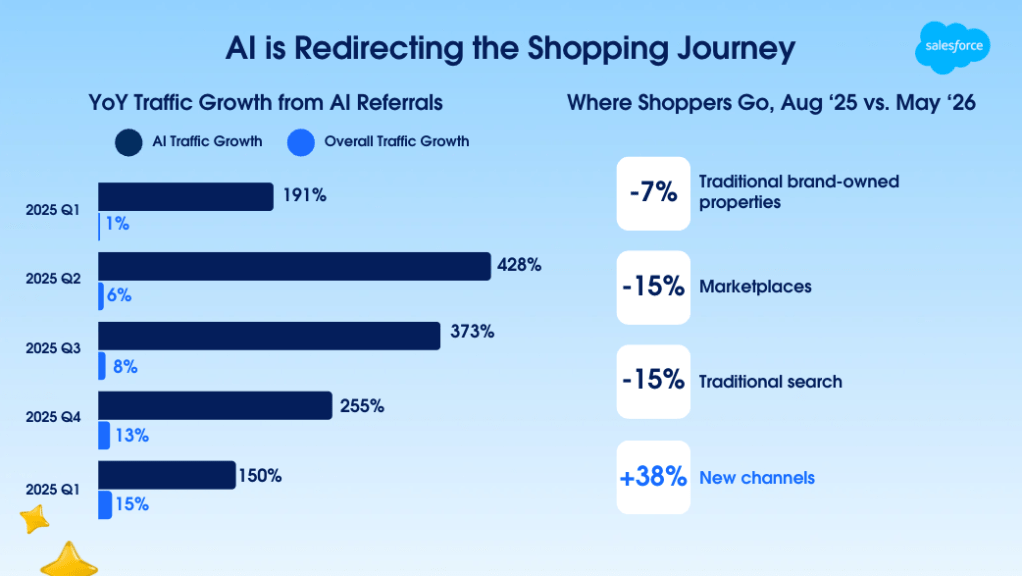
The clearest behavioural signal: actual activity from 1.5 billion shoppers across global commerce sites. Traffic referred from AI chats grew between 150 per cent and 428 per cent year on year in every quarter measured, while overall traffic grew in the single to low double digits.
Consumers tell the same story. Between August 2025 and May 2026, the rate of shoppers discovering products through brand-owned properties fell 7 per cent and traditional search fell 15 per cent, while the rate of consumers choosing new channels — AI assistants, social media AI, delivery apps — grew 38 per cent.
Commerce leaders across ANZ see where this is heading: 91 per cent in Australia and 84 per cent in New Zealand agree that LLMs will be essential to product discovery within the next year. Australian organisations are already responding. The most common actions are improving product content quality (43 per cent), optimising content for conversational queries (42 per cent), submitting data feeds to AI search platforms (40 per cent), and optimising product descriptions for natural language (42 per cent), the kind that surfaces when a shopper asks an AI to ‘find me a waterproof hiking boot under $150.’ The shift is playing out first in discovery — where the journey begins — even as fully autonomous purchasing remains early.
“Australian shoppers have already moved on,” observes Timothy Waters, RVP, ANZ, Salesforce. “They’re asking an AI what to buy before they ever land on a retailer’s site. We’re seeing this play out across ANZ and the businesses winning right now aren’t chasing the AI conversation after the fact, they’re building the agents that take part in it. That’s the shift from pilot to production we’re seeing across commerce.”
Agentic AI adoption is climbing, and adopters are scaling fast
Fewer than a third (24 per cent) of Australian organisations surveyed say they currently use agentic AI, but the shift is underway. More than half (54 per cent) of Australian non-adopters, and 50 per cent of those in New Zealand, plan to deploy within the next six months, and 80 per cent of Australian respondents agree that scaling across channels isn’t viable without AI.
Among organisations already using agentic AI, the experimental phase is over. Just 6 per cent of Australian leaders say they’re still primarily piloting use cases, while the largest share (24 per cent) are scaling AI across functions and teams, from service and IT to merchandising.
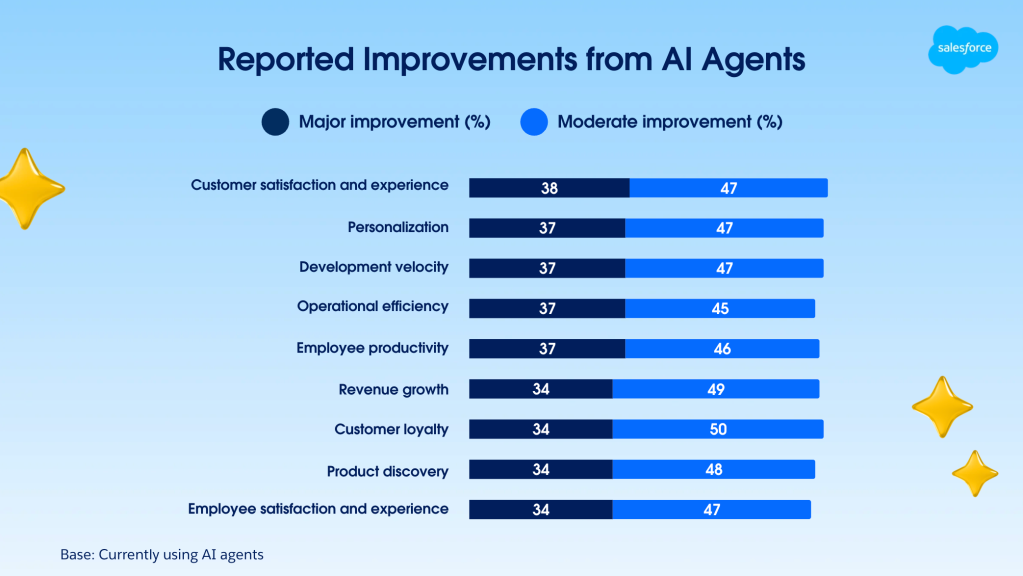
Adopters also report measurable improvements. Customer satisfaction leads, followed closely by personalisation, development velocity, operational efficiency, and employee productivity.
One finding cuts against the momentum: only 32 per cent of organisations globally have fully defined AI success metrics and KPIs. Organisations are reporting wins before agreeing on what winning means, and without defined metrics, it’s difficult to know which investments are driving results and where to double down.
Inside organisations, complexity is compounding
Part of the reason: The scaling push is landing on infrastructure that was already strained. More vendors, fragmented customer data, and channels that don’t talk to each other mean commerce teams are being asked to deploy AI on top of systems that already struggle to work together.
- Eighty per cent of Australian commerce leaders – and 88 per cent of those in New Zealand – say their vendor count has grown over the past two years.
- Only 24 per cent of Australian organisations say their customer data is fully unified across sales, service, marketing, and commerce, though New Zealand organisations are slightly better equipped (32 per cent).
- Among those in Australia with fragmented data views, 49 per cent admit to slow or ineffective responses to customer issues; 43 per cent struggle to measure the impact of their commerce investments; and another 39 per cent say they pay a high cost to maintain disconnected systems.
- Omnichannel breakdowns are near-universal: Of all Australian multichannel organisations, none report no significant failure points. The most common: inventory not synchronised in real time (46%) and inconsistent pricing and promotions (38%).
The store makes the same point in miniature. Even in physical retail — still the top holiday shopping destination for 77 per cent of consumers — the journey is digital: 79 per cent of shoppers use their phones while shopping in store, and 12 per cent ask an AI assistant for purchasing advice in the aisle. Customers experience every channel as one brand; 88 per cent of B2C respondents agree customers expect the same personalisation in store as online.
The organisations with unified data report a payoff
Among the 43 per cent of Australian organisations that have moved toward data unification, the most commonly reported benefits are directly tied to growth: better alignment between sales, marketing, and commerce teams; improved AI and automation outcomes; and improved customer retention and loyalty.
“It’s not the businesses running the most AI experiments that are pulling ahead, it’s the ones that unified their data first,” said Timothy Waters. “With less than a quarter of Australian organisations saying their customer data is fully connected, that’s the real opportunity sitting in front of most commerce teams right now, and it’s exactly where we’re helping them start.”
The customer perspective
For Andrew Low, Chief Executive Officer at trans-Tasman coffee business Coffee Supreme, the results confirm what they learned building their own data foundation.
“You can’t scale AI on top of fragmented systems. For us, this has meant unifying our data before implementing agents across the business, to ensure we meet rising customer expectations head-on. Consumers can’t or won’t distinguish between channels; they just expect us to know them, whether they’re buying a bag of beans over the counter, as a cafe owner, or online. Unifying our data is why we can now deliver that same experience everywhere Coffee Supreme shows up.”
“The fix wasn’t about adding another platform on top, but by connecting what we already have. That’s exactly what MuleSoft and Data 360 did for us—they turned scattered systems into one system of context we can actually build agents on. By the end of this year, we expect to have an agent-augmented customer experience across Australia and New Zealand.”

Explore further
- Read the full State of Commerce report
- Learn more about our latest innovations for Agentforce Commerce
- Learn how to prepare your site for LLM-powered search
Methodology
Data in this report are from a double-anonymous survey conducted April 10–June 4, 2026. The survey generated 3,450 responses from commerce professionals across 20 countries and 13 industries, including 250 from Australia and New Zealand.
These findings are supplemented by a Salesforce analysis of platform shopping behaviour from more than 1.5 billion global shoppers across 37 countries between Q1 2024 and Q1 2026, as well as a consumer survey of 4,689 consumers shoppers across eight countries from May 12–18, 2026. For more demographic information, please refer to the report.