


A practical look at why AI gets stuck in isolated pilots and how Indian manufacturing companies can deploy it enterprise-wide.
Key takeaways
- While 6 in 10 manufacturing organisations are already using AI for efficiency and automation, only 1 in 10 have deployed it at enterprise scale. That’s a significant PoC-to-production gap.
- According to the 400+ industry leaders we surveyed, the blockers aren’t the models themselves. They’re messy data, unclear ownership, and skill gaps.
- Scaling AI demands outcome-first thinking, FAIR data, strong guardrails, and teams trained to manage AI agents — and the enterprises succeeding are already seeing big ROI.
India has the ambition and the policy backbone to scale AI in manufacturing. The sector is growing at a CAGR of 58.96%, with revenue projected to reach ₹12.59 billion by 2028. Plus, the India AI Mission has also committed over ₹10.3 billion to transforming the country’s AI ecosystem in five years.
Given these developments in policy and market growth, it’s only to be expected that organisations are moving fast — six in ten are already using AI for efficiency and automation. So why is only one in ten actually running it at enterprise scale?
Most organisations know AI works. You’ve probably seen it in your own pilots. The problem is what comes next. Scaling means bigger decisions, bigger risks, and bigger investments. Suddenly, everyone has an opinion, and nothing moves. That’s strategy paralysis in action, and it’s where most AI ambitions get stuck.
The upside of scaling: What you get when AI stops being a pilot
Breaking through the PoC ceiling changes what your business can actually do. And the 1 in 10 who’ve done it are experiencing that firsthand. Let’s start with the operational wins:
- Predictive maintenance: AI can monitor equipment around the clock, tracking aspects like temperature, vibration, and energy consumption, and flag issues before they become failures.
- Supply chain optimisation: AI simulations let you test workflows, predict bottlenecks, and optimise layouts before anything changes on the floor. And when procurement, routing, and demand forecasting work in sync, you cut waste and manage delivery exactly as needed.
- Better dealer and customer experience: AI connects the entire distribution network — automating order routing, improving forecasting, and personalising downstream interactions. And when customers are ready to buy, faster SKU presentation and product visualisation get them there quicker.
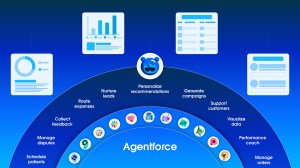
Some of the manufacturers we work with are already seeing this in action. Using Agentforce for Manufacturing, they’re tapping into 200+ pre-built industry actions — connecting maintenance, supply chain, and dealer operations without having to build from scratch.
Moreover, the Agentforce Command Centre provides teams with real-time visibility into how AI agents affect human productivity. So every decision is backed by data — and scaling no longer feels like a risk.
But operational autonomy is just the beginning.
India’s shop floors are already onboarding one robot every 62 minutes, and the next wave goes far beyond automation. Gen AI is simulating multiple design iterations in hours — not weeks — which means products get to market faster.
Smart energy systems are also adjusting consumption on their own, helping factories hit their ESG targets. And then there are digital twins. Some of the biggest manufacturing companies in India are already on this path. They’re running live virtual replicas of their plants so every major decision gets stress-tested before it touches the factory floor.
AI readiness gaps: Why clean AI pilots fail on messy factory floors
And now, for the bigger question — why do so few enterprises get to experience the benefits of AI? We asked 400+ leaders across manufacturing, automotive, and energy, and these were their most common bottlenecks:
- Lack of high-quality data
- Regulatory uncertainty
- Shortage of skilled people
And that’s probably why even some of the more lightweight use cases aren’t making it past experimentation. Look at auto-summarisation and drafting (a pretty lightweight use case) — 48% of organisations explored it, but only 7% have deployed.
That’s what you’d call the Garbage Can Reality of running a business. Pilots are built for success. They get the cleanest data, the most capable people, and a controlled environment. Your actual organisation runs on tribal knowledge, shifting priorities, and unwritten rules that live in people’s heads.
Bring AI into that environment, and you’re stuck on three — really big — questions:
- Can we trust the data?
- Who’s accountable if it goes wrong?
- Do we have the skills to run this at scale?
Most organisations don’t have these answers yet. And that’s why the pilot stays a pilot.
Your playbook to go from disconnected pilots to ensemble agents
Scaling AI is as much of an organisational decision as it is a technology one — and it requires you to rethink how work gets done. The goal is to redesign workflows so humans and AI agents operate side by side, each doing what they’re best at:
- AI brings speed, consistency, and pattern recognition
- Humans bring judgment, context, and exception handling
That division of labour is what unlocks real ROI, and makes enterprise-scale deployment viable. Here’s how you can get there:
1. Start with outcomes, not use cases
Most AI initiatives begin the same way: someone picks a process, maps out every step, and asks AI to replicate it. Unfortunately, you’ve just automated your inefficiency. Computer scientist, Rich Sutton, calls this “The Bitter Lesson” — and most organisations implementing AI workflows are still learning it.
Every process in your organisation carries years of workarounds, shortcuts, and unwritten rules. The eccentricities that make it work for your people, in your context. When you hand that to AI as the blueprint, you’re just giving it baggage. And AI can’t run on baggage.
The better brief isn’t “automate our 12-step maintenance workflow.” It’s “zero unplanned downtime.”
Give your AI agent the goal, give it the data, and let it find the most efficient path — even if that path looks nothing like what your team does today. Especially if it doesn’t.
2. Build the brain before delegating the work
Setting the goal is the first step. But before you pass on anything to AI, it needs the full picture, and that starts with your data. Most organisations have plenty of raw data. What they don’t have is context.
And that’s where we come to the FAIR data principles. Give AI data that is:
- Findable: Your maintenance logs, sensor data, and production records need to be tagged and structured so AI can actually locate what it needs
- Accessible: Data sitting in separate systems that don’t talk to each other is data that doesn’t exist for AI. It needs to flow across IT and OT without barriers.
- Interoperable: A temperature reading from one machine should mean the same thing as one from another. Standardised formats, common language across systems.
- Reusable: Data collected for one purpose — say, a quality audit — should be usable for predictive maintenance, demand forecasting, and beyond.
Once the data is right, then you define the guardrails — not to tell AI how to get to the goal, but to define what it’s allowed to do along the way.
On governance and bias management
Guardrails only work if someone owns them. That means deciding upfront who has the authority to override an AI decision, what happens when they do, and where delegation stops entirely.
Every override is a signal that tells you where the model is wrong, where context is missing, or where human judgment still has to lead. Without that feedback loop, your guardrails are just guidelines nobody enforces.
Delegating the right work to AI
Here’s a framework from Ethan Mollick, associate professor at Wharton, that you might find helpful when deciding what to delegate:
- Human Baseline Time: How long does a person take? (H)
- Probability of Success: How likely is AI to get it right? (P)
- AI Process Time: How fast can AI do it? (A)
Where H is high, P is strong, and A is fast — that’s your delegation sweet spot. Where P is low, or H is low, that’s where your team stays in the loop, stepping in before AI gets it wrong.
This also means your people need to shift from doing the work to managing the agents that do it. That takes deliberate upskilling like AR/VR-based training, governance programs, and hands-on AI literacy. And you’ll need to plan for that when scaling AI as well.
3. Give your AI agents a role in the assembly line
AI insights only matter if someone can act on them. That means bridging both information technology (IT) and operational technology (OT) — your sensor data and your work orders need to talk to each other, or AI just flags problems nobody gets to solving.
For example, with Agentforce 360, the autonomous agents work alongside both your teams and your IoT systems. Instead of simply remaining a dashboard or reporting layer, they become an active participant in how work gets done.
That’s the only way to build your “Agentic Enterprise,” where AI is embedded in your operations, rather than being bolted on top of it.
It’s time to break the PoC ceiling
The manufacturers who are breaking through the PoC ceiling aren’t just investing in better technology. They’re investing in better data, clearer governance, and people who know how to work alongside agents, not just around them.
As Sridhar Hariharasubramanian, Senior Director at Salesforce, puts it: “Now is India’s moment to lead with AI — not just by adopting the technology, but by doing so in a way that inspires trust.”
Ready to move from strategy paralysis to AI at scale?
Read what 400+ manufacturing, automotive, and energy leaders across India shared about where AI is stalling, and what they’re doing differently to operationalise AI across the enterprise.