


There is a moment every growing healthcare organisation quietly dreads.
A patient calls. She has visited before, shared her history, built a relationship with a care coordinator. But this time, the person on the other end of the line has no record of any of it. She repeats herself. She feels like a number. She finds another provider.
This moment: invisible on a balance sheet, devastating to a brand, happens thousands of times a year at healthcare organisations that have grown faster than their patient experience infrastructure. And as India’s healthcare sector accelerates through one of its most significant expansion phases in decades, this is becoming one of the industry’s defining challenges.
Growth Is Not the Problem. Intimacy Is.
India’s healthcare market was valued at $638 billion in 2025 and is projected to reach $1.5 trillion by 2030, driven by rising incomes, greater health awareness, and a rapidly expanding middle class. Organised chains are scaling aggressively by adding centres, entering new cities, hiring fast. But scale introduces a structural tension that does not exist in most other industries: in healthcare, anonymity doesn’t just hurt experience, it hurts outcomes. Patients who feel unknown are less likely to follow treatment plans, less likely to disclose symptoms accurately, and less likely to return.
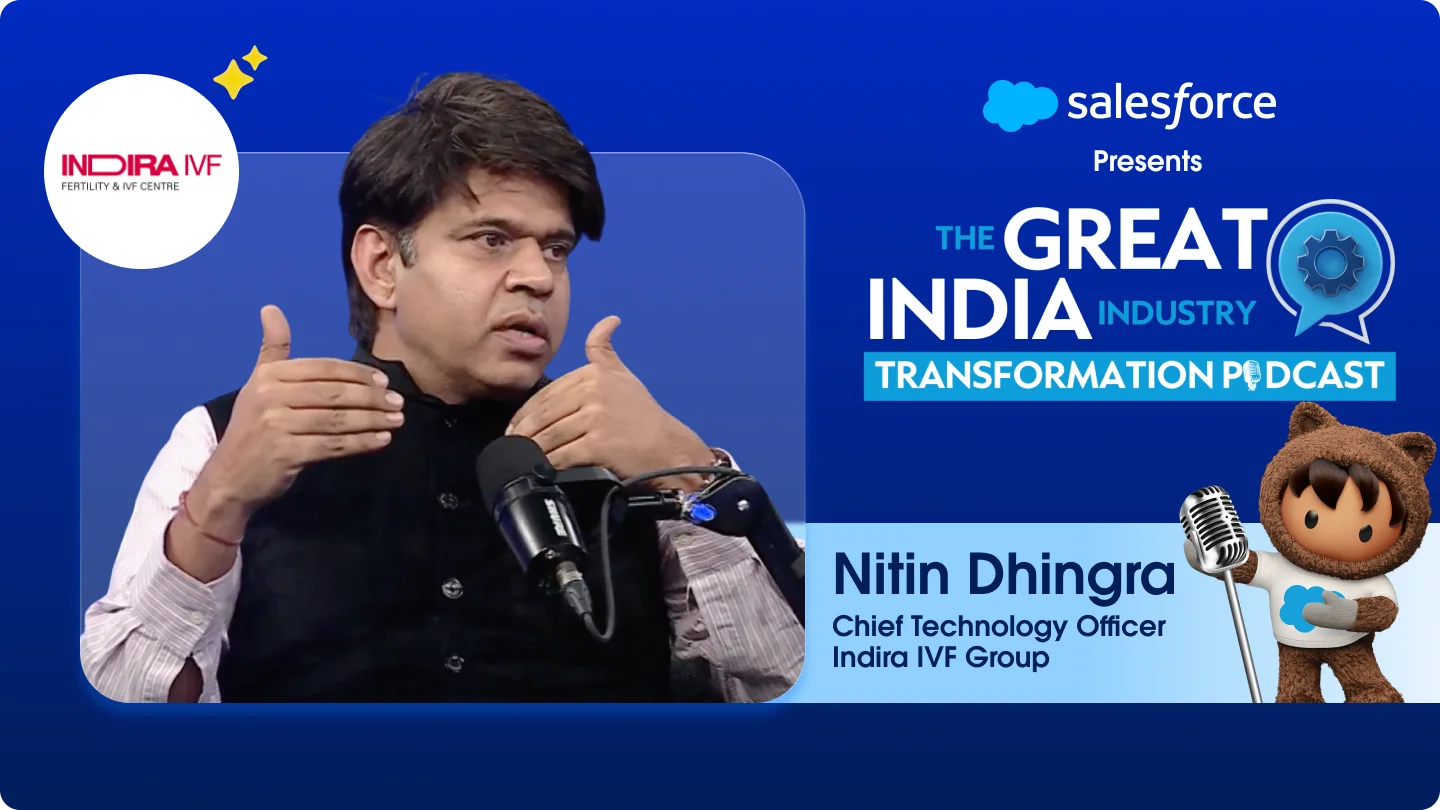
Nitin Dhingra, CTO of Indira IVF Group, speaking to Vishaka Mittal, Regional Sales Director, Salesforce India in the Great India Industry Transformation podcast, pointed out that fertility care illustrates this with particular sharpness. He was A patient undergoing IVF may interact with a provider across 15 to 16 touchpoints over months or years, pause mid-treatment, and return expecting the clinic to remember exactly where she left off, emotionally and clinically. But fertility is not an outlier. Oncology patients, chronic disease patients, post-surgical patients: all live in the same gap between the care they were promised and the experience they actually receive at scale.
As Mittal puts it: “People don’t want to be a case that has to be solved. They want to have a deeper connection with the healthcare provider.”
Contextual Personalisation: The Framework That Changes Everything
The answer is not generic automation. Sending the same appointment reminder to a first-time consultation patient and a patient returning after a failed treatment cycle is not personalisation but the illusion of it, and patients notice the difference.
What leading healthcare providers are building instead is what Salesforce describes as contextual personalisation: standardised processes with dynamically delivered outcomes. The protocols: clinical steps, communication cadences, escalation triggers, are consistent across every centre. But the how of every patient interaction is shaped by where that individual is in their journey, what they have been through, and what they need to hear right now.
Mittal frames it clearly: “We define the ‘whats’ but the ‘hows’ we leave to the triggers coming from clinical information. The messaging for someone who’s had a failed first cycle and is coming in for the second time differs from someone coming for a first consultation.”
This distinction matters operationally. Organisations that try to personalise by customising every system end up with fragile, slow-moving infrastructure. Organisations that build configurable platforms where the framework is fixed but the output is contextual, can scale without sacrificing relevance.
Dhingra puts it in terms his team lives by: “Configuration, not customisation. Tools like Salesforce bring in the flexibility to configure the solution; when it becomes customisation, the cycle time is more and you miss the bus by the time you implement.”
The Role of a Unified Patient View
The prerequisite for contextual personalisation is data coherence. A patient’s history cannot be used to personalise their experience if that history lives in five disconnected systems — an EMR here, a CRM there, a call centre log somewhere else.
Agentforce 360 for Healthcare addresses this by giving healthcare organisations a longitudinal view of the patient: a single, unified record that captures clinical history, communication preferences, treatment stage, and interaction context. When a care coordinator picks up a call, they are not starting from scratch. They know this patient. They know what matters to her.
This capability becomes even more significant in the context of India’s Digital Personal Data Protection (DPDP) Act, which is expected to significantly tighten consent requirements for sensitive health data. Organisations that build unified, consent-aware data infrastructure now are not just preparing for compliance, they are building patient trust at a structural level. In a sector where trust is the conversion layer between inquiry and treatment, that is a material business advantage.
AI That Protects the Human Moment
The next frontier is intelligent automation, not replacing clinical judgment, but protecting the time and attention of the people who exercise it.
Salesforce’s Agentforce enables AI agents to handle the routine, high-volume interactions that currently consume care coordinator capacity: appointment reminders, post-procedure follow-ups, medication queries, billing questions. These interactions are important to patients but do not require human judgment to execute. The principle holds across healthcare: AI does not replace the difficult conversation. It ensures the person having it has the time and context to have it well.
Dhingra is direct about where the boundary sits: “Whatever is done in healthcare always has a human in the loop. The person’s name is there. Their exact report is narrated. It’s a one-to-one conversation.”
The Providers Who Get This Right Will Define the Category
India’s healthcare sector is at an inflection point. The organisations that scale successfully over the next decade will not be the ones that grow the fastest. They will be the ones that figured out how to grow without losing the quality of human connection that made patients choose them in the first place.
Technology is not the threat to that connection. Deployed thoughtfully, it is the only thing that makes it sustainable at scale.
Watch the Great India Industry Transformation podcast episode featuring Nithan Dhingra, CTO, Indra IVF
To hear how Indra IVF’s leadership is navigating these challenges in real time, from data privacy to AI deployment to managing a 15-touchpoint patient journey.