


Enterprises depend on data for everything, from operations and analytics to automation and AI-driven decision-making. However, as data volumes increase and systems become more interconnected, maintaining consistent and reliable information becomes significantly more difficult. Duplicate records, inconsistent formats, missing values, and outdated information can quickly reduce the value of enterprise data.This is where data cleansing becomes essential. It helps organisations improve data accuracy, consistency, and usability across systems, enabling stronger governance and more reliable business outcomes. This guide explores the core processes, challenges, and technologies involved in building trusted enterprise data environments.
This is where data cleansing becomes essential. It helps organisations improve data accuracy, consistency, and usability across systems, enabling stronger governance and more reliable business outcomes. This guide explores the core processes, challenges, and technologies involved in building trusted enterprise data environments.
The Cost of Poor Data Quality in Enterprise Systems
Poor data quality creates operational inefficiencies across the enterprise. Teams often spend substantial time correcting records, reconciling reports, or validating information before they can act on it. Inaccurate data can also affect customer experiences, forecasting accuracy, compliance reporting, and strategic planning.
In large organisations, the impact extends beyond individual departments. Data inconsistencies between CRM platforms, ERP systems, analytics environments, and cloud applications can lead to conflicting insights and fragmented decision-making. When multiple systems define the same customer, product, or transaction differently, trust in enterprise reporting begins to erode.
The growth of AI and automation has further increased the importance of clean data. Machine learning models rely on structured, accurate, and governed datasets. If the underlying data is incomplete or inconsistent, AI outputs become less reliable and more difficult to scale confidently.
Where Enterprise Data Breaks Down
Enterprise data environments are inherently complex. Information flows continuously across operational systems, third-party platforms, cloud applications, data warehouses, and external data sources. As integration points increase, so do the opportunities for data degradation.
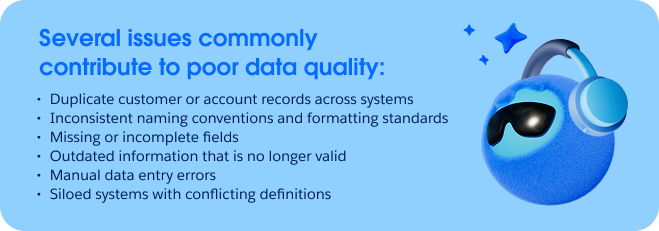
Mergers, acquisitions, and rapid cloud adoption often intensify these challenges. Different business units may follow separate data standards, creating fragmented data ecosystems that are difficult to govern centrally. Without structured data cleansing processes, these inconsistencies accumulate over time and become increasingly expensive to resolve.
Core Data Cleansing Processes
Effective data cleansing involves more than correcting obvious errors. It requires a structured approach to improving data quality throughout the data life cycle. The core processes that are typically a part of enterprise data cleansing initiatives include:
- Data Profiling: Data profiling analyses datasets to identify anomalies, inconsistencies, duplicates, and missing values. It helps organisations understand the current state of their data before remediation begins.
- Standardisation: Standardisation ensures that data follows consistent formats, naming conventions, and validation rules across systems. This improves interoperability and reduces ambiguity between teams and applications.
- Deduplication: Duplicate records are identified and merged to create a more accurate and unified view of entities such as customers, suppliers, or products.
- Validation: Validation rules confirm that data values meet predefined quality standards. For example, address formats, mandatory fields, and reference values can be verified automatically during data ingestion.
- Enrichment: Additional context can be added to datasets to improve completeness and usability. Enrichment often combines internal enterprise data with trusted external sources.
Together, these processes create a more reliable data foundation for reporting, automation, and analytics.
Automation and Real-Time Data Cleansing
Traditional batch-based cleansing approaches are often too slow for modern enterprise environments. Organisations increasingly require real-time or near-real-time data quality management to support operational agility. Real-time data cleansing is particularly valuable in customer-facing environments where inaccurate information can immediately affect service quality, personalisation, or compliance outcomes.
Automation plays a central role in achieving this. Modern platforms can continuously monitor data streams, apply validation rules, detect anomalies, and trigger remediation workflows automatically. This reduces manual intervention while improving consistency across systems. Automated quality controls also help organisations scale data operations more efficiently as data volumes continue to grow.
AI-driven data quality tools can identify patterns, detect anomalies, and recommend corrective actions with greater speed than traditional rule-based approaches alone.
Data Cleansing in Multi-Cloud and Integrated Environments
Most enterprises now operate across hybrid and multi-cloud environments. Data moves between SaaS applications, cloud platforms, legacy infrastructure, and external ecosystems, often in real time. This creates significant governance and integration challenges. Different platforms may store data in incompatible formats or apply different quality standards. Without alignment, organisations risk creating fragmented and inconsistent data landscapes.
Data cleansing, therefore, needs to function across the entire enterprise architecture rather than within isolated systems. Integration pipelines, APIs, and shared governance frameworks all play an important role in maintaining consistency across distributed environments.
A unified approach to metadata management, data lineage, and interoperability also helps organisations track how data moves and changes across systems. This visibility improves both operational efficiency and regulatory compliance.
Governance, Compliance, and Accountability
Data quality and governance are closely connected. Cleansing processes become difficult to sustain without clearly defined ownership, policies, and accountability structures.
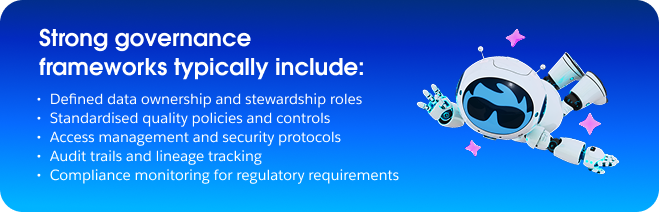
As regulatory scrutiny increases, organisations must also demonstrate how data is collected, processed, stored, and protected. Inaccurate or poorly governed data can expose businesses to operational, financial, and reputational risks.
Continuous monitoring is therefore essential. Data quality cannot be treated as a one-time project. It requires ongoing oversight as systems, business processes, and regulatory requirements evolve.
Aligning Data Cleansing with Data Modelling and Single Source of Truth
Data cleansing is most effective when aligned with broader enterprise data architecture initiatives, including data modelling and master data management strategies. Well-structured data models define how information is organised, related, and governed across systems. This creates a consistent framework for applying quality standards and validation rules.
Many organisations also aim to establish a single source of truth for critical business entities such as customers, products, and financial records. Achieving this requires consistent definitions, integration standards, and high-quality master data. Without clean and standardised data, a single source of truth becomes difficult to maintain. Conversely, strong data modelling and governance frameworks make enterprise-wide data cleansing more sustainable over time.
Continuous Data Cleansing for Enterprise Data Quality
Modern data platforms increasingly combine integration, governance, analytics, and automation capabilities within unified environments. This enables organisations to manage data quality continuously rather than through isolated remediation projects.
Advanced platforms can support:
- Automated quality monitoring
- Real-time validation and remediation
- Centralised governance policies
- Data lineage tracking
- Cross-platform interoperability
- AI-ready data preparation
These capabilities help organisations reduce complexity while improving trust in enterprise data. They also provide a stronger foundation for analytics, automation, and AI initiatives that depend on accurate and governed information.
As enterprise ecosystems continue to expand, continuous data quality management is becoming a core operational requirement rather than a secondary IT function.
Build Trusted, AI-Ready Data with Salesforce
As organisations modernise their data environments, the ability to unify, govern, and activate trusted data becomes increasingly important. Salesforce Data Cloud helps organisations connect and harmonise data across systems while supporting governance, security, and AI-readiness.
Built on the Customer 360 Data Model, Salesforce enables enterprises to create unified customer profiles and maintain consistent data across sales, service, marketing, and analytics environments. Native governance capabilities such as data classification, tagging, masking, and access controls help organisations manage data responsibly at scale.
By combining unified data management with AI-ready architecture, Salesforce supports continuous data quality management across complex enterprise ecosystems. This enables organisations to build more reliable analytics, improve operational efficiency, and establish a stronger foundation for trusted AI initiatives.