


Key Takeaways
India has 1.2 billion telecom subscribers, the second-largest 5G network in the world, and more than $19.5 billion invested in 5G infrastructure. And yet the economics don’t add up.
The industry is still expanding — industry forecasts put revenue growth at a 5.6% CAGR, but some of its biggest revenue streams are under pressure. Voice revenue is expected to decline by 2.4% annually, and data isn’t making up the difference. By 2030, the average Indian user is expected to use 58.9 GB of data a month (up from 25.7 GB today). That’s a lot more demand on the network, but not a lot more revenue to show for it.
That’s why many telecom operators are looking beyond connectivity as utility towards active intelligence. According to a KPMG report, 55% of Indian telcos had implemented AI at scale by 2025, with another 37% actively getting there.
But there’s still a gap between adopting AI and operationalising intelligence. Because, while 80% of Indian organisations are exploring autonomous agents, only 24% have deployed them.
Making that shift is what separates a telco from a TechCo. Here’s where you can start.
1. Go beyond AI automation to AI autonomy
Most telecom operators already use AI and automation in their day-to-day operations. Customer service bots handle routine queries, and tickets are routed to the right team without manual intervention. These systems are useful, but they still rely on predefined rules.
Autonomous AI agents take this further by reasoning across multiple systems, making decisions, and finally, taking action. With Agentforce, for example, you can deploy autonomous agents that work across customer, operational, and network data to resolve issues and complete tasks.
Consider a billing anomaly. An Agentforce agent can:
- Identify the issue
- Review the customer’s contract terms
- Determine whether a correction is required
- Apply the adjustment
- Notify the customer
And it can do all of this before a customer raises a ticket. This is what you’d call empathy at scale, where a problem gets resolved even before it becomes a ticket.
Human-in-the-loop vs human-on-the-loop
Autonomy doesn’t mean taking people out of the process. Rather, it changes the role they play.
- In a human-in-the-loop model, AI waits for approval before it acts
- In a human-on-the-loop model, AI acts within defined guardrails while people provide oversight
For most telecom workflows, the latter is what makes autonomy practical at scale.
Autonomy, however, depends on context. An AI agent can only act on the information it can see. But for most telecom operators, it’s a spaghetti stack — network, customer, and operational data sit in separate systems that were never designed to work together.
Industry estimates suggest that up to 65% of a telco’s data is dark data. Bringing that data into view is what makes autonomy possible. When BSS and OSS are unified, AI agents can reason across the full picture of the network, the customer and the business.
This is where Salesforce Data 360 plays a critical role. By connecting data across BSS and OSS environments through a zero-copy architecture, telecom operators can give Agentforce AI agents access to the context they need without moving or duplicating data.
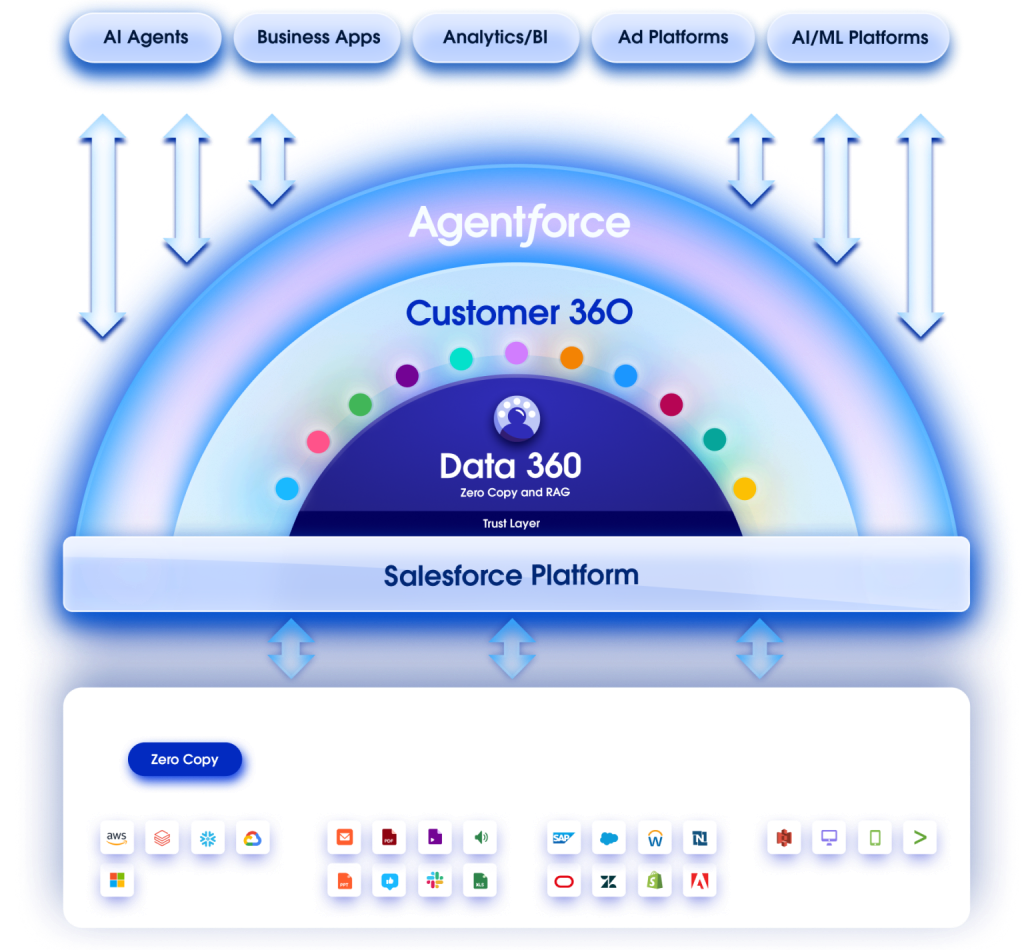
The result is simple: AI agents can make decisions based on the full picture, not just the small part of it that’s visible from a single system.
2. Deploy AI you can stand behind
Autonomy is only valuable if it can be trusted. India’s Digital Personal Data Protection Act and Telecommunications Act 2023 are stricter than many would expect.
For one thing, unlike GDPR, there’s no “legitimate interest” exemption. Every purpose for which sensitive data is used requires its own granular consent. For telcos running agents across vast customer datasets, that’s as much an architectural decision as a compliance one.
For Indian telcos, that means getting three things right:
- Data sovereignty: When an agent accesses customer records, network logs, and billing history, is that data staying within India’s borders and governed by Indian law?
- Transparency: When an agent denies a service request or resolves a billing dispute, can you trace the reasoning behind that decision and explain it to both customers and regulators?
- Responsibility: Is the AI fair, ethical, and governed? Who defines the boundaries of what it can and cannot do — and who answers when it crosses them?
At Salesforce, we built the Einstein Trust Layer to address this. For example, data is masked before it reaches any external model and deleted after the response is returned. Similarly, with BYOM, Indian telcos can run their own models within their own infrastructure. This ensures sensitive customer data is exactly where the DPDP Act requires it.
Finally, every Agentforce interaction runs within guardrails you define, and you get a full audit trail for every decision. And when a decision exceeds the AI agent’s scope, escalation paths kick in automatically.
3. Address the human side of the agentic TechCo
Getting the technology right is one thing. Getting every person who touches it to trust it is another. And digital comfort is not the same as AI comfort. Consider a single service interaction. A customer reports a connectivity issue at their office. A service agent receives the complaint and tries to resolve it. If they can’t, they schedule a field visit.
When you introduce AI into that workflow, all three need to be comfortable with it:
- The field technician needs to trust that the AI-guided steps are accurate, or they’ll fall back on instinct.
- The service agent needs to see AI as something that helps them, not as something that replaces them.
- The customer needs to trust that the AI interaction is genuine.
This comfort has to be designed into the deployment, and it doesn’t happen on its own. That means tools that meet each person where they are.
Take field technicians in tier-2 and tier-3 cities. They are often the least digitally equipped, and a complex interface is enough to kill adoption before it starts. So, pick AI tools that are intuitive enough to use on day 1. Agentforce Field Service and Operations, for example, lets technicians photograph an issue, and the AI interprets it. Running training sessions helps too, but they work better when the tool is intuitive enough to use — especially during those first few weeks of adoption.
For the service agent, the challenge is different. Service reps trained on legacy systems resist new ones, and the friction is real. So, layer AI on top of what already exists. You can also opt for a platform that integrates with existing BSS and OSS systems — like Agentforce Communications — so reps stay in familiar territory while AI works alongside them.
Redesign and empower middle management’s role before you deploy AI agents. Give them ownership of how the agents perform, where they escalate, and how they improve. That way, they’re not worried about AI taking over their job.
For customers, the dynamic is different again. AI still feels unfamiliar to many, and when in doubt, people default to calling a human. We suggest you graduate to autonomy as trust builds. Automate low-risk, routine interactions first — billing queries, outage updates, plan changes — and let customers experience AI as helpful before it becomes their only option.
The ROI of being a TechCo is too big to ignore
The numbers speak for themselves. Telcos that get agentic AI right can expect 15-20% cost savings through automation of the order-to-activation lifecycle, and 4-8% revenue uplift through AI-driven cross-sell and upsell recommendations. Globally, the industry stands to gain $250-350 billion by 2030.
But the bigger opportunity lies beyond efficiency or revenue gains. It’s a once-in-a-generation chance to redefine what a telco is worth. Agentforce for Communications is built for exactly that moment.
Want to go deeper on the agentic telco?
Read how Indian telecom operators are approaching the shift from connectivity provider to active intelligence and how the economics of the TechCo shift actually add up.