

Key Takeaways
- India has built a digital public infrastructure at an unprecedented scale. The next step is connecting data across departments.
- Connected citizen data helps governments answer cross-cutting policy questions, predict demand, personalise services, and measure outcomes across programmes.
- Salesforce can help public sector departments connect existing systems, build trusted citizen profiles, and turn connected data into AI-powered insights for policymaking and governance.
India has built one of the world’s most advanced digital public infrastructures (DPI). From identity and payments to direct benefit transfers, digital platforms have fundamentally changed how governments deliver public services. As the World Bank noted at the G20 in 2023: “In just six years, [the India Stack] has achieved a remarkable 80% financial inclusion rate — a feat that would have taken nearly five decades without a DPI approach.”
That progress is easy to see. Direct Benefit Transfer (DBT) now reaches more than 1.50 billion non-unique beneficiaries across 321 central schemes.
At the same time, citizen data is still spread across departments. As NITI Aayog notes in its 2025 Data Imperative Report, India’s next challenge is improving the quality and interoperability of government data to support better policy decisions and public services.
We’re already seeing this happen in individual sectors. The Ayushman Bharat Digital Mission has connected over 104 crore health records to 93 crore Ayushman Bharat Health Account (ABHA) accounts. Now imagine extending that approach beyond healthcare, so that departments can work with a connected view of the citizen rather than separate programme records.
This can help departments design better policies, coordinate service delivery across agencies, and use real-time insights to improve programmes over time. Here is a roadmap for how this can be achieved:
Step 1: Turn siloed department data into connected Citizen 360 profiles
State government and public sector departments already have access to vast amounts of citizen data through platforms like Ayushman Bharat, PM-KISAN, and state service portals. The opportunity now is to connect that data across systems, so it can support policy decisions, welfare execution, and overall governance.
Telangana’s Samagra Vedika platform shows how that works in practice. In Siddipet district, it matched every housing scheme application against six government databases — electricity connections, vehicle registrations, land records, ration cards, pension schemes, and prior housing benefits — before a single house was allocated. The exercise found that 38.2% of applicants were clearly ineligible.
The same programme also shows why connected data has to be accurate. During the implementation of a food security scheme, the system confused a rickshaw puller named Syed Ali with a car owner named Syed Hyder Ali. The error led to Syed Ali’s widow, Bismillah Bee, losing her family’s food security card.
The Indian government sees this as a critical step towards its vision of Viksit Bharat@2047, where evidence-based policymaking is driven by “credible, high-frequency, and granular data”.
As recently as April 2026, MoSPI organised a national workshop on moving states from “data silos to data synergy.” Especially as governments are increasingly asking questions that no single department can answer alone:
- Are malnourished children also out of school?
- Which beneficiaries are enrolled in multiple schemes?
- Which districts have high vaccination coverage but poor health outcomes?
Some states have already begun laying the groundwork for this shift. Three states have created State Resident Data Hubs by connecting 13 departmental databases and deduplicating citizen records. Together, they estimate savings of US$580 million over three years.
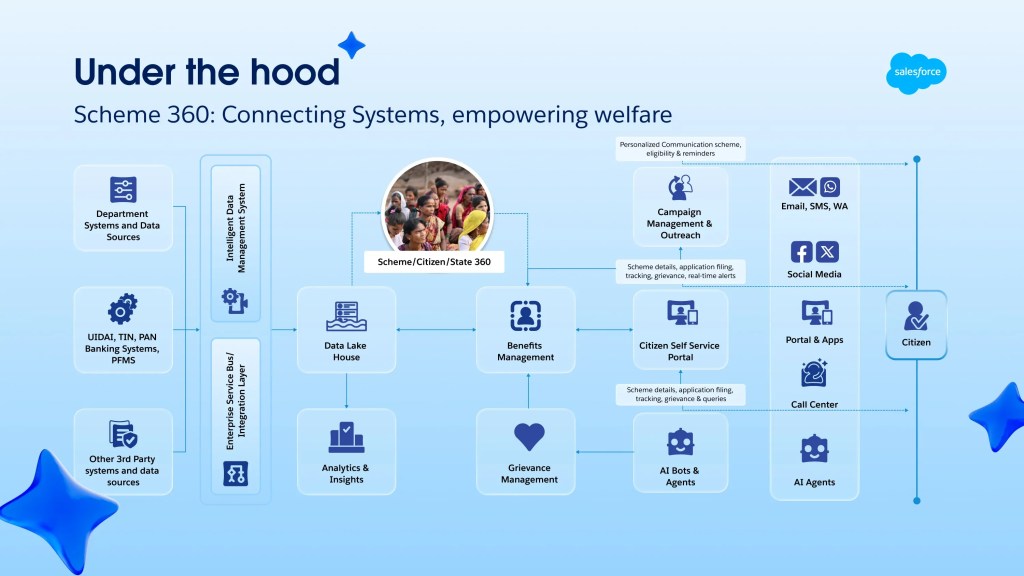
If you’re looking to build a State Resident Data Hub of your own, you’ll need to bring together three capabilities: connected systems, trusted citizen profiles, and secure governance across data, workflows, and decisions.
Here’s how Salesforce brings these pieces together:
- Connected systems: MuleSoft integrates legacy systems, UIDAI, PAN, and departmental databases through an API-first architecture, allowing departments to share data without replacing existing applications.
- Identity resolution framework: Data 360 harmonises records from every connected source into a single, trusted profile using a zero-copy architecture that avoids unnecessary data movement and duplication.
- Governed data: Salesforce’s Public Sector Solutions provide the case management, workflows, and audit trails that keep welfare delivery compliant, auditable, and secure.
Step 2: Use connected data to drive better policy and governance decisions
You can think of connected citizen data as the foundation for every government decision. Once departments have a trusted view of the citizen, they can use it to anticipate demand, deliver services proactively, and measure what worked.
Model demand patterns before launching policies
Governments make thousands of planning decisions before a policy or programme reaches citizens. Connected citizen data makes it possible to answer those questions before implementation begins.
Australia, for example, used machine learning on data that welfare caseworkers already had to predict which recipients were most likely to need long-term support. The result was a 22% improvement in targeting accuracy.
India has been exploring predictive policymaking for several years. As far back as 2018, NITI Aayog proposed using AI to combine satellite imagery from ISRO, weather data from IMD, and Soil Health Card information to predict crop yields and share timely advisories with farmers. As more government data becomes connected, the same approach can be applied across departments:
- Welfare agencies can estimate how many citizens are likely to qualify for a scheme
- Health departments can anticipate disease hotspots
- Education departments can forecast enrolment and scholarship demand
- Agriculture departments can identify regions that may need targeted advisories or support
The result is a more proactive approach to policymaking, where decisions are driven by evidence rather than assumptions.
Drive last-mile delivery with personalised outreach
Knowing who needs help before they ask is only half the work. The other half is reaching them. According to a recent survey, 100% of Indian constituents surveyed said they would use an AI agent to interact with the public sector, and 86% expect the government to proactively offer more relevant services.
India already has some strong services moving in that direction:
- Kisan e-Mitra is an AI-powered voice assistant that helps farmers access PM KISAN and other schemes in their own language.
- myScheme lets citizens enter their details and discover every scheme they’re eligible for across 321 central schemes.
- Aarogya Setu 2.0 lets citizens access health records, book appointments, and manage healthcare services from a single app
These services make it easier for citizens to access government programmes. But they still rely on them taking the first step. A farmer has to know to call Kisan e-Mitra, or a citizen has to know that Aarogya Setu exists. Neither is proactive.
A connected citizen profile flips that model. With Agentforce, departments can set up AI agents that:
- Run personalised outreach across channels like WhatsApp, SMS, email, and voice
- Answer citizen questions about eligibility, documentation, and application status 24/7
- Automate routine follow-ups and reminders for appointments, renewals, or missing documents
- Escalate complex cases to government staff with the full context of the interaction
And with Data 360 keeping citizen profiles current and accurate, outreach is based on where things actually are, not where they stood months ago.
Make data-driven decisions with connected operational data
Governments need more than reports at the end of a programme. They need real-time visibility into how policies are performing while they’re still being implemented.
India’s welfare ecosystem illustrates this well. Through DBT Bharat, governments can see how much money has been transferred and where it has gone. Running a scheme requires a different view. Departments need to know how many applications are pending, where processing is slowing down, which grievances remain unresolved, and which districts need attention.
That’s where connected citizen data makes a difference. By bringing every citizen interaction into one place, departments can understand how programmes are performing and respond before small issues become bigger ones.
For example, a health department can create a custom dashboard using a data visualisation tool like Tableau to monitor patient outcomes, service utilisation, and district-level trends in real time.
Another idea is to combine forecasts with operational and demographic data. This can help you compare trends over time, identify emerging hotspots, and plan resources before demand peaks.
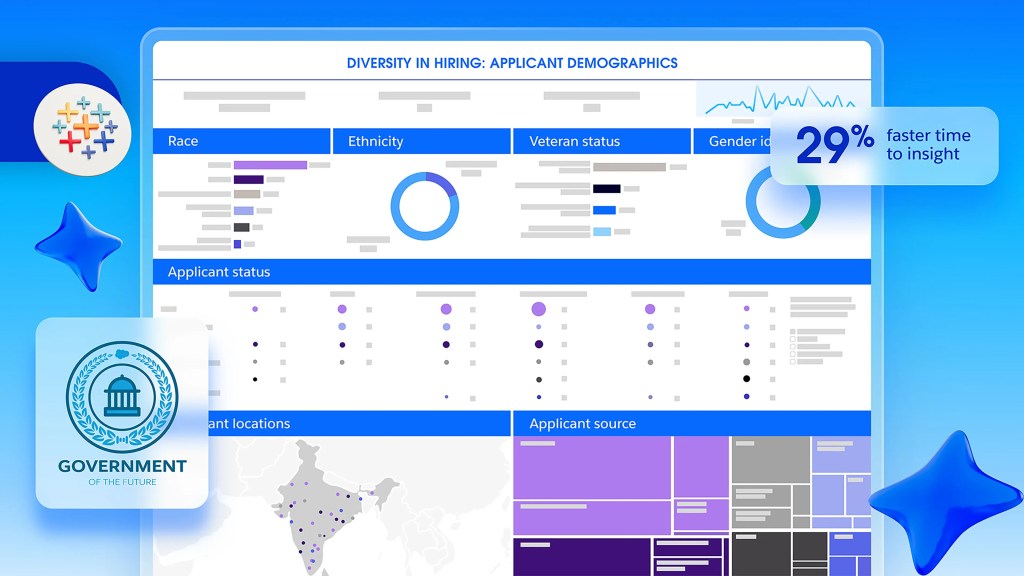
Organisations using a data-driven approach have reported a 33% increase in insight-driven decision-making. Better visibility into operations has also tripled service delivery speed and resulted in a 74% reduction in operational costs.
India has everything it needs to get data-driven governance right
India has already laid much of the groundwork for data-driven governance. States are also increasingly connecting data across departments to improve planning and delivery. The next step is to bring those efforts together into a connected, interoperable data ecosystem that supports every stage of policymaking and governance.
That’s also the direction the Government of India is moving towards. In its roadmap for Viksit Bharat@2047, MoSPI ask governments to think of administrative data as “a strategic national asset.” Because when data is connected, governed, and AI-ready, it becomes possible to design better policies and continuously improve public services.
Salesforce brings together the technologies needed to support that shift — from securely connecting data across departments to creating trusted citizen profiles, enabling AI-driven engagement, and giving policymakers the real-time insights they need to make data-driven decisions.
Start building a more connected approach to governance
Your departments already have the data. Our team can show you how Salesforce helps connect it, govern it securely, and turn it into insights that improve policymaking, programme delivery, and citizen services.