



Key takeaways
- India’s PSUs manage more compliance obligations than almost any other type of organisation, and most still handle them through fragmented systems and manual workflows.
- At the same time, PSU capex commitments for FY27 stand at ₹12.2 lakh crore. More projects mean more vendor workflows and more compliance obligations.
- End-to-end vendor management automation gives PSUs governed workflows, real-time compliance tracking, and AI-driven vendor decisions that are explainable and audit-ready.
India’s PSUs are as much enterprises as they’re instruments of societal change, and we’re seeing the results. In FY 2025-26, 68% of Government e-Marketplace (GeM) orders (₹2.36 lakh crore) went to MSMEs. That’s up 20% year on year.
A lot of this progress has been driven by digitisation. GeM brought public sourcing onto a single, trackable platform. The Comptroller and Auditor General of India (CAG) is now digitising audits and incorporating AI to sharpen oversight. And with Mission Karmayogi training more than 1.5 crore officials so far, for a digital-first environment, the direction is clear.
Vendor relationship is the last mile of this transformation. The government’s push for end-to-end digitisation — MSME sourcing mandates, SC/ST sub-vendor requirements, full process transparency — all of it converges on how PSUs manage their vendors.
Let’s explore how India’s PSUs can digitise the vendor relationship process, and why now is the right time to do it.
The multiple obligations every PSU must meet
To understand why vendor management is so complex for PSUs, it helps to look at who they’re actually answerable to. India’s PSUs answer to several authorities simultaneously, and no single set of rules satisfies all of them. Researchers call this the multiple principal problem, and procurement is where it shows up most.
Take the government protocols already in place:
- GFRs 2017: Every procurement decision must follow documented procedures, meet tender thresholds, and comply with the code of integrity.
- GeM mandate: PSUs must procure specified goods and services through GeM. Utilisation targets are mandatory and reported quarterly.
- MSME Public Procurement Policy: PSUs must source a minimum of 25% annually from MSEs, with 4% from SC/ST-owned and 3% from women-owned ones.
- Delegation of Authority: Every PSU must route approvals through the officially designated authority for that procurement value. If a lower-ranked officer signs off on something that should have gone higher up, it’s a violation.
- RTI Act 2005: Any citizen can request the reasoning behind any vendor decision under the Right to Information Act.
And to make things even more complex, these rules don’t operate independently:
- PSUs can face MSME delayed-payment liability after 45 days, even when internal compliance processes slow the payment cycle.
- Similarly, meeting MSME targets does not automatically protect a procurement decision from a value-for-money audit.
Now add to this the scale of what’s ahead. India’s PSUs are committed to ₹12.2 lakh crore in capital expenditure in FY27 alone. More projects mean more vendors, more contracts, and more obligations running simultaneously. A CSEP working paper on India’s capex framework mentions how procurement delays and poor coordination are already among the primary reasons allocated funds go underutilised.
Manual processes aren’t built for this scale, and neither are the legacy systems running beneath them.
The cost of managing vendor relationships — and compliance — manually
The consequences of fragmented systems and heavily manual workflows are already showing up in audit findings.
CAG has flagged cases where reserved items were procured from non-MSE vendors simply because ERP systems couldn’t automatically identify them. And while PSUs collectively crossed the 43.58% MSME sourcing threshold in FY 2024-25, the aggregate number masks how many individual PSUs are still falling short. Reporting delays and incomplete disclosures make it harder to even know by how much.
Annual accounts tell a similar story. In Jammu and Kashmir alone, 35 PSUs and corporations had 139 accounts in arrears, some pending for up to 12 years.
This is what happens when the volume of obligations outpaces the systems meant to track them. The solution: end-to-end vendor management within a single operational workflow.
When procurement, compliance, and vendor workflows live on the same platform, accountability is built into decision-making, rather than reconstructed later during audits or escalations.
What the right vendor relationship management infrastructure makes possible
Legacy ERP systems were built for a different era of linear processes, back-office functions, and straightforward transaction records. They weren’t designed for the kind of multi-authority, compliance-heavy environment India’s PSUs operate in today.
Salesforce, on the other hand, is built differently. It connects procurement, vendor governance, compliance tracking, and AI-driven decision-making in one place — and works with existing ERP systems rather than replacing them. For PSUs juggling GeM obligations, MSME mandates, and CAG audit requirements, that’s what makes it possible to meet every obligation without slowing procurement.
Here’s what that looks like in practice:
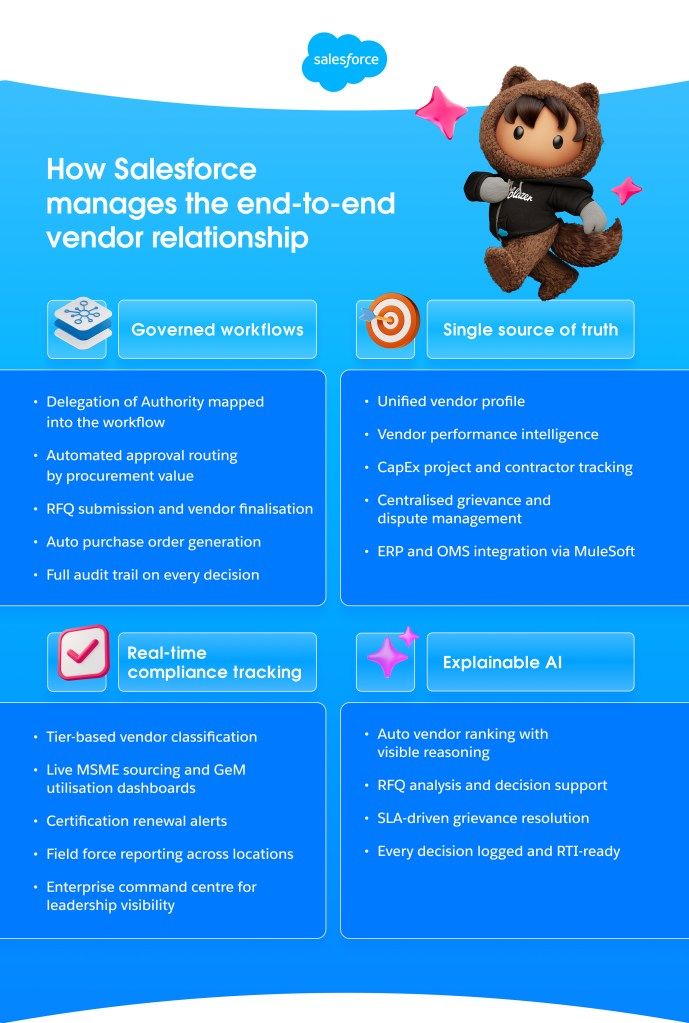
Governed workflows
In most PSUs, approval workflows exist on paper. In practice, they’re managed through emails, phone calls, and institutional memory. A procurement officer has to know who needs to sign off, at what value, and in what order — and when that knowledge is missing, or the process is skipped, it shows up as a CAG finding.
Salesforce maps the Delegation of Authority matrix directly into the workflow. Every vendor decision — from onboarding and RFQ submission to purchase order approval — automatically passes through the appropriate authority based on procurement value.
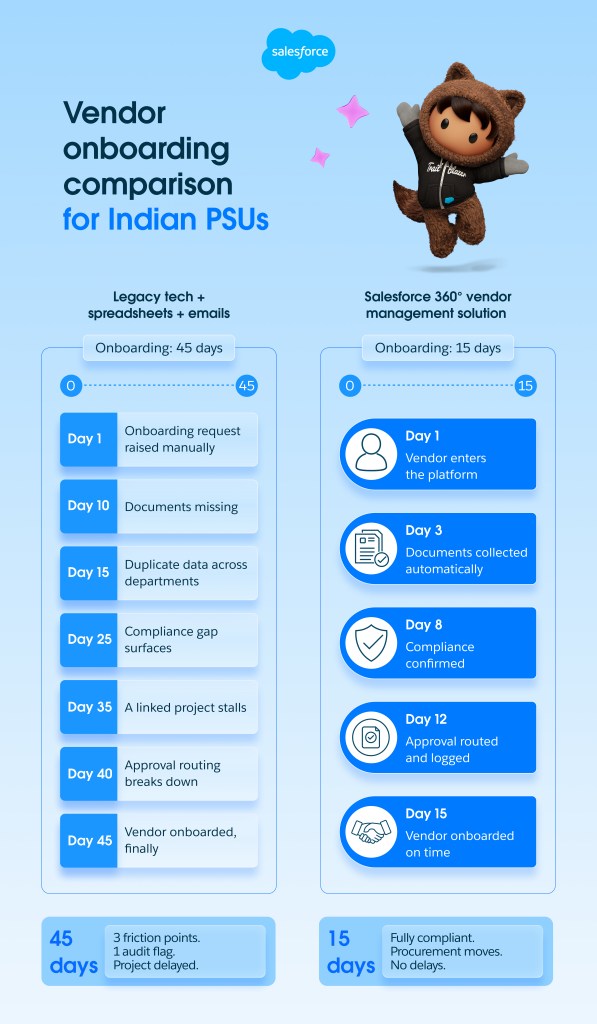
At the same time, invoice capture, evaluation, and approval all integrate with existing ERP systems, so nothing falls outside the audit trail. This means onboarding timelines can drop from 45 days to under 15, and audit preparation time can be reduced by as much as 70%.
The impact on onboarding and audit-readiness
- Onboarding timelines drop from 45 days to under 15, freeing procurement teams for strategic sourcing.
- Audit preparation time drops by 70%, and RTI responses are ready on demand.
Single source of truth
In most PSUs, vendor data lives in multiple places: onboarding documents in one system, performance records in another, and compliance certificates in someone’s inbox. When a dispute arises or an audit comes in, pulling the full picture together takes days. And without a consolidated view of vendor performance, there’s no reliable way to spot an at-risk vendor before they become a project problem.
With Salesforce, you can maintain a unified vendor profile that captures everything in one place. This includes onboarding history, purchase orders, certifications, and communications. Moreover, every department works from the same record. So, when a grievance comes in from a vendor, it gets resolved in half the time because the full context is already available.
You also get live dashboards that show procurement spend, vendor diversity metrics, performance scores, and risk alerts in real time — this means issues get flagged before they become problems.
Also, as PSUs begin adopting AI for procurement decisions, the underlying data layer becomes even more important. For example, when AI starts informing vendor selection, it’s working from data that’s complete and current — not whatever happened to be recorded last.
The impact on vendor performance and satisfaction
- Procurement cycle costs come down by 15-20% when manual rework stops being part of the process.
- Grievances can get resolved almost 50% faster because whoever picks it up already has the full picture.
Real-time compliance tracking
The compliance environment PSUs are operating in today is more demanding than it was two years ago, and it will be more demanding two years from now. GeM procurement targets are escalating every year, while MSME and SC/ST sourcing requirements are being enforced more strictly.
Periodic reporting wasn’t designed for this. By the time a sourcing gap appears in a quarterly review, the window to correct it has already closed.
Modern vendor management platforms like Salesforce can help you track MSME sourcing percentages, GeM utilisation, and certification renewals in near-real time. For example, tier-based vendor classification automatically identifies MSE, SC/ST, and women-owned vendors, so compliance isn’t dependent on someone remembering to check.
In the same way, when a certification is about to lapse or a sourcing target starts drifting, the system flags it while there’s still time to act.
The impact on compliance outcomes
- PSUs can consistently hit 95%+ on-time compliance across GeM reporting, MSME sourcing mandates, and certification renewals.
- Real-time MSME and SC/ST tracking means sourcing targets get managed throughout the year.
Explainable AI
Every vendor selection a PSU makes is a public decision. It can be questioned by a CAG auditor, challenged through an RTI request, or reviewed by a parliamentary committee. That’s why “the algorithm recommended it” is not an acceptable answer in a PSU context.
Salesforce’s vendor ranking shows its reasoning. When the system recommends a vendor, it surfaces the factors behind that recommendation — performance scores, delivery history, compliance certifications, and pricing. The procurement officer can see the reasoning, act on it, and have it on record if the decision is ever questioned.
That transparency is what makes AI usable in a public accountability context. Every decision has a paper trail — so when an RTI request comes in, the answer is already in the system
The impact on accountability and risk management
- Complete digital audit trails mean every vendor decision is defensible and RTI-ready on demand.
- Vendor SLA adherence improves by up to 40% when AI proactively flags performance gaps before they escalate.
The commitment was always there. Now, so is the infrastructure
With the right system, the operational impact becomes obvious. PSUs that have modernised their vendor management workflows are seeing it play out across the board — faster onboarding, grievances getting closed in half the time, and proactive compliance.
The good news is that getting here doesn’t mean starting over. India’s procurement infrastructure is already strong. GeM is live. The compliance framework is in place. ERP systems are running. Salesforce brings it all together on a unified platform for end-to-end vendor management — so everything that’s already been built starts working as a single system.
Want to see what 360° vendor management looks like for your PSU?
Talk to our team about how PSUs are cutting onboarding time, staying ahead of GeM and MSME mandates, and keeping audit trails RTI-ready — without overhauling what’s already working.