



India stands at an inflection point. The intersection of Digital India initiatives, massive IndiaAI Mission investments, and a booming startup ecosystem creates fertile ground for enterprise-grade AI to flourish.
According to a recent EY India survey, 36% of Indian enterprises have already allocated budgets and begun investing in generative AI, while another 24% are actively testing its potential. The question is no longer whether to adopt AI, but how to deploy it responsibly and securely.
For the modern CXO, the dilemma is about velocity vs trust: Generative AI can analyse, predict, and produce business intelligence faster than ever; but speed means nothing if the insights generated aren’t accurate or trustworthy.
Large language models (LLMs) are powerful interpreters, but without a well-governed and authoritative data feed, their outputs are prone to hallucination, compliance failures, and flawed decision-making. The cost of acting on erroneous AI-generated intelligence can quickly undermine any efficiency gain.
This is the gap filled by the Tableau Model Context Protocol (MCP) framework.
From passive reporting to agent-orchestrated decision-making
Simple conversational interfaces are rapidly giving way to agentic AI – autonomous systems that are capable of reasoning, acting, and collaborating across siloed business functions. The Digital Enterprise 2025 report notes that 27% of companies already have AI agents in production or at scale, with another 31% in proof-of-concept stages.
For executives, this shift represents a profound opportunity to engage with business intelligence in new ways. Instead of asking “What happened?” (a dashboard function), executives can focus on “What should we do next?” (an autonomous action).
Imagine an ecosystem where dedicated AI agents don’t just communicate with users, but also with each other, grounded in a single source of truth.
This empowers leaders to ask hyper-specific, strategic questions – and receive real-time, verified answers. No more struggling with manual data analysis, or latencies inherent in static dashboards.
Agentic AI delivers instant responses to questions like:
- “What is the net impact of our supply chain disruption on profitability in the western region?”
- “How does our marketing budget allocation need to shift tomorrow to optimise lead flow in Tier-2 metros?”
- “Based on current market sentiment and historical trends, what is the projected risk exposure if we delay a new product launch?”
The Tableau MCP framework: A governance guardrail
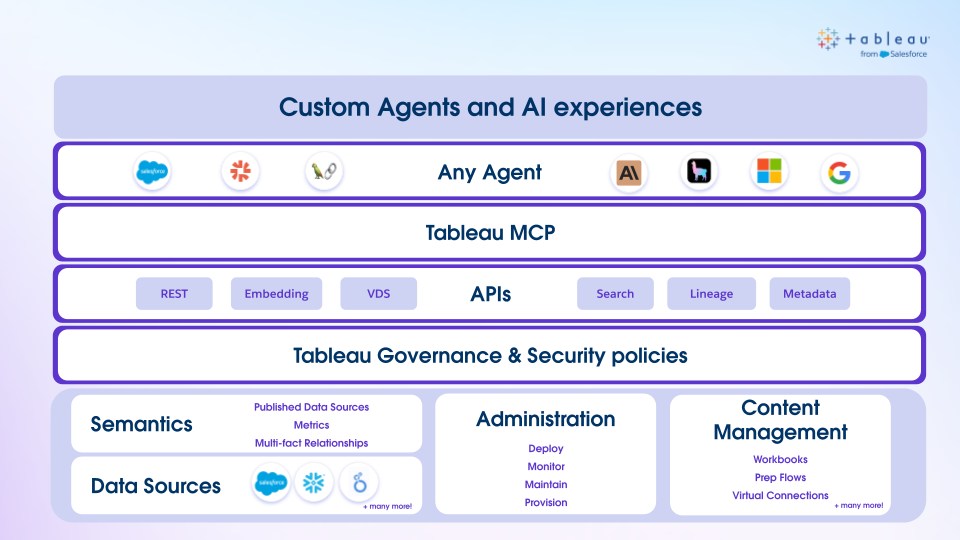
The Tableau MCP framework isn’t another data warehouse; it’s the governance layer that securely connects unconstrained LLMs to enterprise data assets in Tableau Cloud or Tableau Server.
The architecture of trust (LLM ↔ MCP ↔ Tableau data)
Here’s how Tableau MCP works:
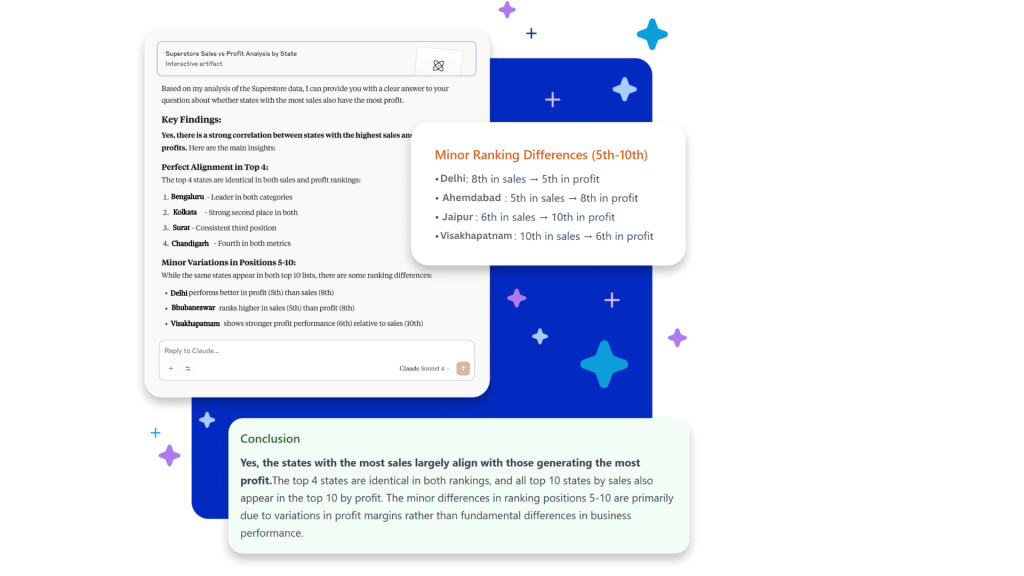
- Query interpretation: The user inputs a natural language query into their preferred LLM to pull out insights from their Tableau data. For example, a retailer asks the AI assistant, Claude, “Can you check whether the states with the most sales also have the most profit?”
- Context routing via the MCP: The LLM routes the interpreted request through the MCP layer. The MCP acts as the fiduciary intermediary, translating the open-ended AI query into a structured request that respects pre-defined data models and hierarchies.
- Data verification by Tableau: Tableau processes the structured request, automatically adhering to all established data governance rules, row-level security (RLS), and user permissions. This is the non-negotiable step that ensures data lineage and compliance.
- Actionable response: The verified data or visualisation is routed back through the MCP, which then structures the output for the LLM. The result? A contextual, verified response.
This architecture ensures that AI’s velocity is always kept in check by the enterprise’s accountability standards.
Speeding up decision-making with agentic AI
In high-stakes Indian sectors, the MCP framework fundamentally transforms decision-making by providing real-time responses to specific queries or commands:
| Sector | Legacy challenge | Benefits of agentic AI + MCP framework |
| BFSI | Waiting days for detailed risk reports on asset quality | Immediate risk flagging (Query example: “Identify all branch clusters where unsecured loan growth exceeds 15%, and has a historical default rate above 3%.”) |
| Retail | Slow insights into the localised success of promotional SKUs | Dynamic inventory optimisation(Query example: “Show me the five least profitable products currently being promoted in the Delhi-NCR market compared to last week.”) |
| Healthcare | Manually correlating patient readmission rates with operational bottlenecks | Actionable operational insights(Query example: “What operational changes correlate with a reduction in readmission rates across our Tier-A hospitals over the last six months?”) |
India’s data advantage: Localised intelligence
India’s digital public goods (Aadhaar, UPI, DigiLocker) have created a unique environment for hyper-localised, interconnected data. Enterprises operating in the country are expected to align their data governance practices with domestic regulatory frameworks, including data localisation and privacy mandates.
Tableau provides the compliance-ready backbone:
- Governed and auditable: It maintains a clear data lineage, crucial for demonstrating compliance with evolving Indian regulations.
- Scalable and hybrid: Tableau MCP seamlessly supports both Tableau Cloud (for agility) and Tableau Server (for regulatory-mandated, on-premise data localisation).
- Future-proof integration: The MCP enables IT teams to safely unlock their vast, verified Tableau data for consumption by AI models without exposing the raw database layer.
The convergence of agentic AI and Tableau’s governance framework enables Indian enterprises to move faster and with greater confidence than ever. Executives can responsibly balance AI agility with enterprise data accountability.
The mandate for modern CXOs
We’re moving past the AI experimentation phase into the AI deployment phase. Enterprise analytics in the future will be all about intelligent agents collaborating and reasoning, not just reporting facts.
The strategic mandate for today’s executive is clear: Ensure that every dollar invested in generative AI is grounded in an auditable, governed, and single source of enterprise truth.
If your organisation is building AI copilots, or moving toward agentic AI, the first priority must be to establish robust data governance mechanisms. This will ensure that your AI-generated insights are grounded in truth.
Start your AI governance journey with Tableau MCP
To explore the implementation and open-source capabilities of Tableau MCP — including code examples of how to integrate LLMs with governed data — visit the official Tableau MCP GitHub repository.
Connect your LLMs to your trusted data responsibly with the Tableau MCP Framework. Turn AI’s potential into a well-governed, competitive advantage.