



Key Takeaways
It’s Saturday evening when the WhatsApp message arrives. Rajesh, a Bangalore techie who recently exited his SaaS startup for ₹150 crores, says, “Just had dinner with three founder friends. They’re all putting 20% of their portfolios into Bitcoin. Am I missing out?”
Here’s what his wealth manager knows: Rajesh hasn’t completed his estate planning, his daughter’s overseas education fund is underfunded by ₹2 crores, and his equity exposure is already at 65%, aggressive for someone planning retirement in 12 years. Now he wants to add cryptocurrency speculation because three friends mentioned it over biryani.
This is India’s invisible wealth crisis. Not market crashes or bad investments, but the FOMO tax — the opportunity cost HNIs pay when they make emotionally driven decisions without comprehensive financial guidance.
The cost shows up in missed opportunities: sovereign gold bonds thatdelivered over 300% returns whilst holding physical gold, tax-inefficient allocations when complete capital gains tax exemption was available, andFOMO-driven crypto decisions driven by social pressure over strategy.
The wealth manager’s impossible equation
The FOMO tax exists because wealth managers face structural constraints. India’s UHNI count is projected to jump from13,263 in 2023 to 19,908 by 2028: 50% growth in five years.Twenty percent of millionaires are now under 40, expecting instant responsiveness.
Meanwhile, relationship managers operate with yesterday’s tools. CFA Institute research shows28% of financial advisors don’t have enough time to spend with customers, dedicating 41% more time to back-office tasks. The bottleneck isn’t administrative burden, it’s the gap between spotting planning gaps and acting before customers chase trends.
Back to Rajesh’s Saturday message. By the time traditional workflows pull together his complete portfolio, analyse planning gaps, and deliver recommendations, he’s moved ₹30 crores into crypto speculation. That timing gap is the FOMO tax in action.
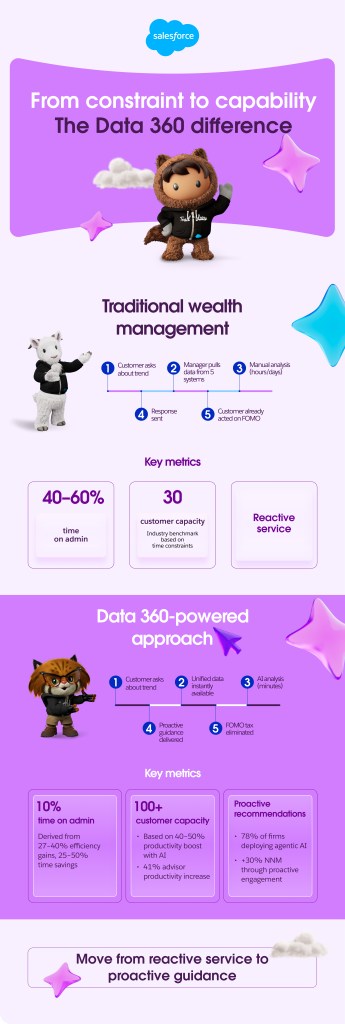
How Agentforce 360 for Financial Services removes the execution bottleneck
The solution isn’t working harder. It’s removing the constraint that creates the FOMO tax. Leading firms are deploying operating layers that industrialise fiduciary discipline — enabling judgment at UHNI scale without sacrificing quality. Agentforce 360 for Financial Services with Data 360 eliminates delays between insight and action.
Data 360 removes the context bottleneck. Customer information sits fragmented across portfolio systems, insurance platforms, property records, tax documents. When customers ask about Bitcoin on Saturday evening, wealth managers spend hours assembling the picture. Data 360 for Financial Services connects data from core banking, investment accounts, insurance, and external sources into unified profiles. Calculated insights automatically surface financial wellness scores, goal gaps, and portfolio risks before FOMO-driven conversations begin.
Einstein AI and Agentforce remove the decision bottleneck. Traditional systems surface information to managers who instruct teams. Einstein AI automates routine decisions whilst flagging issues needing human judgment. Agentforce handles queries 24/7 based on complete financial pictures. Any time customers ask about crypto allocation, Agentforce analyses portfolios against goals, risk tolerance, and planning gaps, then provides guidance grounded in actual situations.
Unified workflows remove the execution bottleneck. Insights live in dashboards while actions happen elsewhere. Agentforce 360 for Financial Services puts everything in one workflow. Wealth managers see complete customer pictures, AI-generated recommendations, and execute next steps without toggling platforms.
Consider how this eliminates the FOMO tax. When Rajesh messages about crypto Saturday evening, the system has already pulled his holdings from Data 360, run AI analysis identifying higher-priority gaps, generated recommendations showing crypto fits, drafted responses with supporting data, and prepared follow-up tasks.
The wealth manager adds some context, then responds within 15 minutes with comprehensive guidance, not weekend panic. Rajesh sees expertise backed by data.
How Data 360 transforms execution at scale
The difference comes down to intelligent relationship banking: unifying data, decisions, and execution so insights translate to action immediately.
For comprehensive guidance across asset classes: Data 360 connects equity portfolios, alternative investments, real assets, digital assets, andimpact investing. Instead of siloed discussions, wealth managers deliver complete strategies.
For wealth managers handling 50+ HNI relationships: Automated monitoring triggers alerts when rebalancing thresholds hit or market movements affect segments. Proactive outreach happens before customers hear trends at dinner parties. AI-generated summaries mean conversations start with full context.For firms losing customers to advisor attrition: When relationship managers leave, knowledge walks out. Data 360 captures preferences, communication patterns, portfolio rationale, and priorities in the system. New advisors inherit complete context. Research shows 46% of consumers (55% of high earners) stay with providers offering excellent experience even if rates increase.
The execution gap is the real constraint
The constraint isn’t access to data. It’s the delay between identifying what customers need and delivering it before FOMO-driven decisions. When Rajesh asks about Bitcoin, how quickly comprehensive guidance can be delivered matters. With Data 360, Einstein AI, and unified workflows, the answer is “immediately.”
See how leading wealth firms are turning behavioural risk into a competitive advantage in the Agentforce 360 for Financial Services demo below.
Why the FOMO tax is a balance-sheet risk, not a behavioural quirk for HNIs
Most wealth management firms treat FOMO as a customer psychology issue: something financial advisors manage through experience and persuasion. That framing underestimates the real cost.
At scale, the FOMO tax becomes systemic risk. Every emotionally driven allocation creates downstream consequences: portfolio drift increasing volatility beyond mandate, tax leakage from unplanned exits, liquidity mismatches when capital locks into ill-timed investments, and erosion of advisory credibility when outcomes disappoint.
More critically, firms absorb the cost even when customers don’t immediately see it. Research shows 10-15% of customers and5-10% of revenues are at high attrition risk at any time, with4-8 months of growth used just to break even from undesired churn annually. When advisors change firms,approximately 19% of customer assets are lost in addition to planned attrition.
The operational burden compounds: higher service intensity per customer, increased exception handling, compliance exposure from poorly documented advice, and attrition risk when trust erodes after trend-driven losses. FOMO doesn’t just hurt customer outcomes, it compresses margins and increases operational risk.
Leading wealth institutions are shifting their question from “How do we advise better?” to “How do we industrialise good judgment?” Agentforce 360 for Financial Services enables exactly that. By embedding data unification, AI-driven analysis, and execution into a single operating layer, firms move from reactive advice to system-level prevention of poor decisions. It also creates audit-grade consistency in how mandate adherence and suitability are enforced across advisors.
The result isn’t just satisfied customers. It’s lower cost-to-serve, fewer exceptions, consistent advice quality, and scalable defence against behavioural risk. When judgment scales, FOMO loses its power!
Explore Agentforce 360 for Financial Services today!