



Modern businesses rely on multiple applications for functions like enterprise resource planning, customer relationship management, supply chain logistics, and customer service. These operational tools often span both legacy systems and modern cloud platforms. Getting these different software solutions to communicate reliably is a major information technology challenge. Industry reports suggest the average enterprise manages 897 applications, yet only 29% of them are integrated. When applications are connected directly to one another, it creates a messy, tangled web of dependencies known as point-to-point integration.
This point-to-point approach relies heavily on custom code. It becomes incredibly fragile, expensive, and difficult to manage as a company grows. A much better strategy is to use a middleware framework that acts as a universal translator and traffic controller for your digital environment. By moving away from direct connections, businesses can achieve higher agility and reduce their time-to-market for new digital initiatives.
What Is an Enterprise Service Bus?
Instead of connecting every application directly to one another, an integration hub acts as a central communication layer. Individual systems need to connect only to this central network rather than to every other application in the organisation. This powerful architectural concept is known as decoupling. A primary advantage of this decoupled approach is that changing one application does not break the rest of your integrations. The middleware absorbs the complexity of translating data between different formats, enabling seamless, uninterrupted operations.
In essence, this architecture is a set of rules and principles designed to coordinate numerous applications over a shared, bus-like infrastructure. It ensures that data travels safely from one point to another, while the sender and recipient systems need not know the exact technical details or location of each other. This provides a robust foundation for building highly growable digital experiences, eliminating the “spaghetti code” that plagues older enterprise networks.
Enterprise Bus Architecture: Core Design Principles
Understanding modern enterprise bus architecture is critical for IT leaders seeking to grow their operations securely. The core focus of this framework is to decouple systems while allowing them to communicate in a consistent, manageable, and regulated way. Typically, the data that travels across the network is converted into a canonical format, almost always using Extensible Markup Language (XML) or similar widely accepted standard formats.
To achieve this, the architecture relies on several foundational integration principles. These include orchestration, which composes fine-grained, separate components into higher-order composite services, and transportation, which seamlessly negotiates protocols between different formats like Hypertext Transfer Protocol (HTTP) and Java Message Service (JMS).
The table below outlines the core functions of this middleware layer:
| Core Function | What It Does |
| Protocol Mediation | Converts data between different formats, such as Representational State Transfer (REST), Simple Object Access Protocol (SOAP), and JMS. |
| Message Transformation | Restructures data so it can be easily read by the receiving system without requiring developers to write custom code. |
| Content-Based Routing | Automatically directs messages to the correct destination based on their specific content and predefined business rules. |
| Centralised Security | Provides single-point monitoring, governance, and strict security oversight across all integrated platforms. |
How ESB Integration Works Across Enterprise Systems
To facilitate seamless data exchange, software adapters are placed between the application and the central messaging network. These adapters are responsible for talking to the backend system, capturing the output, and transforming the data from its native application format into the standard format understood by the central hub. They also handle crucial background activities such as message routing, transaction management, and error handling.
Once the data is standardised, it moves swiftly across the network. Because the central hub is generally stateless, the current state of any transaction is embedded directly within the messages passing through. This canonical message format acts as a strict, universal contract between disparate systems. By maintaining one consistent message structure, every application on the network can communicate with one another effortlessly. This allows applications to communicate asynchronously, sending messages and continuing their work without waiting for an immediate response from the receiving system.
ESB Implementation in Complex Enterprise Environments
As you migrate your workload to the internet, you must transform or replace your traditional, on-premises middleware. Modern iterations of this architecture are entirely capable of bridging the gap between local physical data centres and virtualised cloud environments. This hybrid capability is essential because very few large organisations can afford the risk and downtime required to move all their mission-critical systems to the cloud overnight.
By leveraging a hybrid integration platform, businesses can connect on-premises internal resources to external SaaS applications seamlessly. The central hub handles the complex security protocols, firewalls, and data encryption required to move sensitive consumer information safely across public networks. This ensures that even highly regulated industries, such as healthcare and finance, can safely adopt modern cloud applications without compromising their stringent compliance and data residency requirements.
Enterprise Service Bus Adoption in India: Use Cases and Considerations
In India, massive digital transformation initiatives are fundamentally reshaping how large businesses operate. With the rapid rise of digital public infrastructure and immense telecommunications growth, Indian companies are dealing with unprecedented daily transaction volumes. Legacy core banking software and older telecommunications billing infrastructure often struggle to keep pace with the real-time, high-speed demands of modern mobile applications.
To solve this pressing issue, Indian enterprises are increasingly investing in enterprise service bus technologies. By implementing these sophisticated solutions, they can effectively bridge the gap between ageing physical infrastructure and fast-paced digital front ends. This allows them to process millions of complex transactions daily, from unified consumer payments to mobile network recharges, without risking catastrophic system downtime. The centralised governance also helps regional companies to comply with strict local data protection regulations by monitoring all data flows from a single, secure vantage point.
How Salesforce Supports Enterprise Service Bus–led Integration Strategies
Salesforce offers incredibly powerful tools to support these complex integration patterns, primarily through MuleSoft Anypoint Platform, which features a lightweight, Java-based runtime engine known as Mule. This robust engine allows developers to connect disparate systems quickly and exchange data without being bogged down by the heavy, inflexible constraints of traditional middleware.
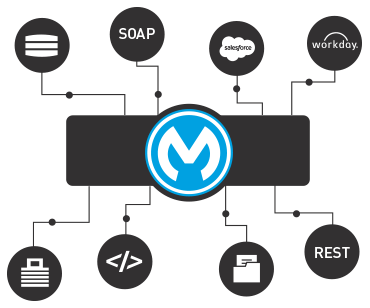
The platform features a powerful data language designed specifically for transforming and mapping information as it travels between systems. Rather than writing thousands of lines of custom, unmanageable code, you can use intuitive graphical interfaces to map data fields dynamically. It also provides comprehensive support for automated testing, meaning developers can create repeatable unit tests for their integrations directly on their laptops before pushing changes to the live corporate network.
ESB vs Modern Integration Approaches
As enterprise technology constantly evolves, new architectural frameworks have naturally emerged alongside traditional middleware. APIs, microservices, and integration platform as a service (iPaaS) solutions offer alternative, highly efficient ways to connect software. While smaller, agile companies might prefer lightweight API management, large global corporations often still require the heavy-lifting, orchestration capabilities of a centralised hub.
The table below compares various modern integration methods:
| Integration Approach | How It Works | Best Used For |
| Centralised Middleware | Centralises integration logic to orchestrate complex data flows and transformations. | Environments with heavy legacy infrastructure, complex orchestration, and strict governance needs. |
| API Management | Lightweight approach optimised for high-speed connectivity and cloud-native setups. | External-facing web integrations and fast, modern software architectures. |
| Microservices | Distributes integration logic across individual, independent services rather than centralising it. | Highly flexible environments that possess the technical maturity to handle increased governance overhead. |
| iPaaS | Offers cloud-native deployment with pre-built connectors and visual, low-code tooling. | Blending modern cloud setups with an easier, highly visual approach to integration management. |
Choosing the Right Enterprise Service Bus for Your Integration Strategy
Selecting the appropriate framework requires a deep, honest understanding of your current technology landscape and your future business goals. If your organisation manages a vast array of legacy applications, heavily regulated customer data, and incredibly complex orchestration requirements, a centralised hub remains an incredibly valuable investment.
The most effective, future-proof solutions on the market today are strictly vendor-neutral. This means they do not lock your IT department into using a specific application server or proprietary messaging format. By prioritising maximum flexibility, high availability, and lightweight runtime engines, you can build a stable foundation for the future. Ultimately, executing the right integration strategy will successfully eliminate corporate data silos, automate sluggish manual processes, and provide the overarching agility needed to respond to constantly changing market demands rapidly. The urgency of getting this decision right is clear: the 2026 MuleSoft Connectivity Benchmark Report found that 86% of IT leaders are concerned that agents will introduce more complexity than value without proper integration, and 96% agree that they face barriers towards using data for AI. The integration architecture an organisation chooses today directly shapes its capacity to adopt AI at scale tomorrow.