

A Five Question Playbook Deep Dive with Sugi Venkatesh
FY26 has been a defining year for South Asia at Salesforce. From accelerating talent readiness to embedding AI-led ways of working, Employee Success played a pivotal role in shaping how teams learn, lead and innovate. As the region steps confidently into a human plus digital era, clarity, adaptability and purpose are becoming as critical as skills.
To understand what shaped this year and what will define the next, we present the latest edition of The Five Question Playbook. For this edition, we spoke with Sugi Venkatesh to decode the shifts she witnessed firsthand and understand what they mean for the workforce of tomorrow.
Q. If you had to pick one cultural shift that defined South Asia this year, what would it be and why?
The move from doing digital to thinking agentic. For years, South Asia was the world’s “delivery engine” for digital transformation. This year, that identity shifted. Our teams moved from simply executing digital tasks to orchestrating autonomous AI agents.
Employees increasingly see AI (like Agentforce) as a partner that supports high-stakes decision-making and real-time problem-solving. This mindset shift acted as the real accelerator, turning our workforce from “implementers” into “architects of outcomes.
Q. What did the last year highlight about leadership in a time of constant change?
Leadership in South Asia has moved towards a triad of Clarity, Energy, and Psychological Safety. In a region as diverse and fast-moving as ours, “command-and-control” is obsolete.
• Clarity cuts through the AI hype to focus on value.
• Energy keeps teams resilient through rapid tech pivots.
• Psychological Safety allows our people to experiment with new AI-led workflows without fear.
We’ve seen that teams deliver exponentially more when they feel empowered, recognised, and supported—not just managed.
Q. Skills conversations are everywhere. Which three skills will matter most for Salesforce talent in 2026 and beyond?
As the ecosystem advances from manual workflows to autonomous agents, professionals have a brilliant opportunity to expand their impact far beyond technical execution. This shift empowers talent to rise as strategic leaders, focusing on these non-negotiable pillars:
1. AI Fluency and Collaboration: Beyond tools and processes, this is about mastering the ability to manage and work alongside enterprise-grade agents to amplify productivity. It is the capacity to shape a future where humans and AI co-create at scale, thinking strategically about where AI can unlock value, anticipating the next opportunities, and leading with purpose in an agentic enterprise. This is what separates a workforce that merely adapts from one that drives transformation.
2. Data Literacy as a Core Competency: Understanding that data is the “brain” of the agentic enterprise; if you can’t speak the language of data, you can’t direct the AI.
3. Empathetic Influence: As AI handles the logic, humans must handle the emotion. This skill is what turns technology into trust and raw insights into meaningful customer outcomes.
Preparing for a Human-Plus-Digital Workforce: Together, these pillars ensure Salesforce talent is ready not just to work with AI, but to define the future of work itself.
Q. As AI becomes more embedded in how we work, how is Employee Success preparing South Asia for a human plus digital workforce?
By embedding learning into the daily flow of work, we ensure our people don’t just “use” AI—they own the strategy behind it, driving intelligent growth that is both inclusive and sustainable.
We are building a future-ready workforce where talent, continuous reskilling, and ethical AI come together to amplify human potential. Initiatives like Yuva AI Bharat are training 100,000 students in agentic technologies, while learning is embedded into daily work so employees don’t just use AI—they shape strategy with it.
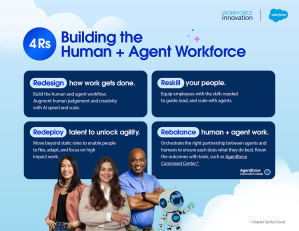
Our approach is guided by Salesforce’s 4R framework: Redesign workflows to pair humans and agents effectively; Reskill employees for the skills that matter in an agentic future; Redeploy talent into high-impact roles; and Rebalance work so humans and AI do what they do best. By living these principles, South Asia’s workforce is ready not just to adapt, but to lead in a human-plus-digital world.
Q. Looking ahead, what is one priority that will shape Employee Success in South Asia next year?
Turning wellbeing and clarity into performance multipliers. The next phase isn’t just about faster AI; it’s about the “human sustainability” of the tech era. We are focusing on creating environments where humans and AI can learn and innovate together without compromising balance or purpose.
When employees have clarity on their role and the mental space to be creative, wellbeing becomes the primary engine of high performance.