

Today, Salesforce is expanding its AI model cards with standardized environmental impact metrics. This update helps customers better understand the energy consumption and carbon emissions associated with AI models across their lifecycle. Since the era of predictive AI, Salesforce has published model cards to give customers a trusted reference for how each model works, documenting its intended use cases, evaluation results, and guardrails. By adding sustainability data, Salesforce reinforces its commitment to its trusted AI principles and ISO 42001-certified governance standards.
The Environmental Challenge of AI
AI systems rely on significant physical infrastructure, including data centers that consume energy and contribute to carbon emissions. As AI adoption accelerates, training and operating models can require substantial computational resources, intensifying the focus on AI’s environmental footprint.
“As AI adoption accelerates, transparency can’t stop at model performance alone,” said Orlando Lugo, Senior Product Manager, Responsible AI. “Organizations increasingly want visibility into how AI systems are built and operated, including their environmental impact. By integrating these metrics into model cards, we’re helping make sustainability a more measurable part of trusted AI.”
At Salesforce, we believe this moment calls for greater clarity, and we’re taking steps to strengthen our own transparency efforts.
Empowering Our Customers Through Transparency
Since 2020, Salesforce has been committed to providing transparency through model cards: “nutrition labels” for AI models that document information such as usage guidelines, performance data, and potential risks. The new Environmental Impact section is now available for select Salesforce models, including First Name Match, Account Match, and TextEval.
These disclosures estimate energy consumption and carbon emissions across pre-training, post-training, and inference. To calculate these figures, Salesforce uses the AI Energy Score methodology, an emerging industry framework the company helped develop. This framework standardizes AI energy reporting by analyzing hardware type, GPU utilization, runtime, and data center region.
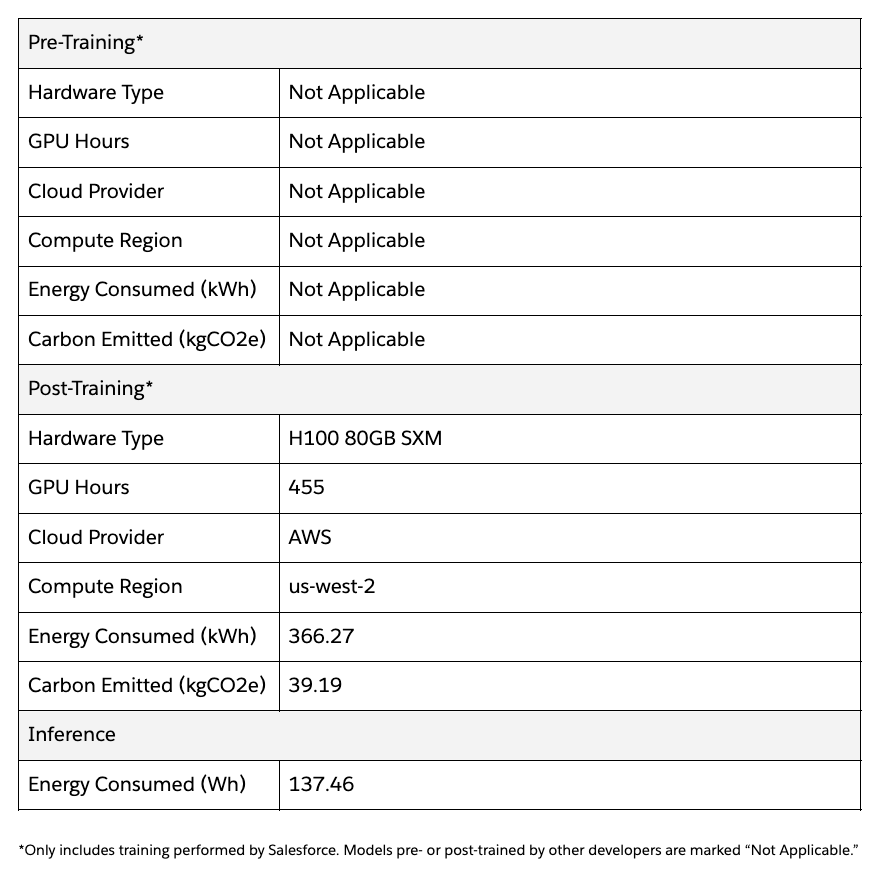
This novel section offers a window into the environmental footprint of an AI model. Integrating these disclosures into the existing model card workflow standardizes environmental reporting for Salesforce model builders, establishing a scalable practice. We are proud to be one of the first companies to publish model card disclosure with this information across these phases, and we hope that others join us in providing much-needed transparency.
Our goal is simple: to empower our customers to make informed choices about the AI they use — based on not just a model’s performance but also its impact on our communities and the planet, such as estimated energy usage and carbon emissions.
“Model cards work when they reflect what customers actually need to evaluate,” said Sarah Tan, Principal Research Scientist, Responsible AI. “Energy use and carbon emissions are increasingly part of that picture. This collaboration with Salesforce’s AI Research and Impact teams enabled us to operationalize these metrics alongside existing model performance and risk evaluations, making sustainability a measurable part of trusted AI.”
Historically, evaluating an AI model’s environmental impact required piecing together fragmented disclosures, with little data available for proprietary models. Now, customers can choose between several models that share similar performance markers but carry vastly different carbon footprints.
“Estimating an AI model’s energy use and carbon emissions takes real specificity, accounting for hardware, region, and lifecycle stage,” said Anne Do, who integrated this measurement framework into model cards during her internship at Salesforce. “By embedding it directly into our existing model evaluation workflow, environmental impact becomes a standard output for our developers, measured on the same footing as performance and other core metrics.”
Toward a More Sustainable AI Future
Sustainability isn’t a buzzword — it’s a crucial step toward mitigating the environmental impact of AI and ensuring its long-term success. Our vision for a more sustainable AI ecosystem goes beyond a single change. We are continuously exploring new ways to measure and reduce AI’s environmental footprint, recognizing that transparency is a critical first step.
Go deeper:
- Learn more about Salesforce’s new AI model cards
- Explore Salesforce’s trusted AI principles
- Read about the the AI Energy Score methodology