New Research: Field Service Leaders Face a Growing Talent Crisis and ROI Challenge Even as They Double Down on AI Investment

Key Takeaways
- AI is becoming standard equipment: 95% of field service organizations use AI, and 85% plan to increase investment over the next one to two years.
- Where it’s applied to scheduling and dispatch, it shows up in revenue: 57% of those organizations report higher revenue per job.
- Yet the workforce hasn’t kept pace: 66% report mobile worker turnover rose over the past two years, and insufficient training on new technology ranks as the top driver.
- Even trained workers lack context onsite: 61% say mobile workers have limited access to the customer data they need.
Field service leaders are investing heavily in AI to improve customer satisfaction, boost productivity, and increase revenue. But the pace of change is so rapid that organizations are also struggling to prepare their workforces. Salesforce’s new report, State of Field Service: The Road to Revenue in the Agentic Era, surveyed over 2,300 field service professionals across nine countries. It found that the biggest barrier to realizing AI’s full value isn’t the technology itself — it’s whether organizations can equip and retain the people who use it.
AI adoption has reached critical mass — and investments are accelerating
Nearly all field service organizations (95%) have deployed some form of AI, and the commitment is growing: 85% plan to increase their AI investments over the next one to two years. This isn’t a pilot phase anymore. AI has become a cornerstone strategy for many organizations.
Field service leaders are focusing their efforts on clear business priorities for the next 12 months: improving customer satisfaction (35%), improving mobile worker productivity (31%), improving safety (27%), and increasing revenue (25%). And they’re deploying AI strategically to address those goals.
Currently, 54% are using AI-driven tools for customer communication and 51% are using it to assist employees working in the field. The alignment is clear: Organizations are deploying AI to help their most important stakeholders — customers and employees.
AI is delivering measurable impact and ROI across the field service business
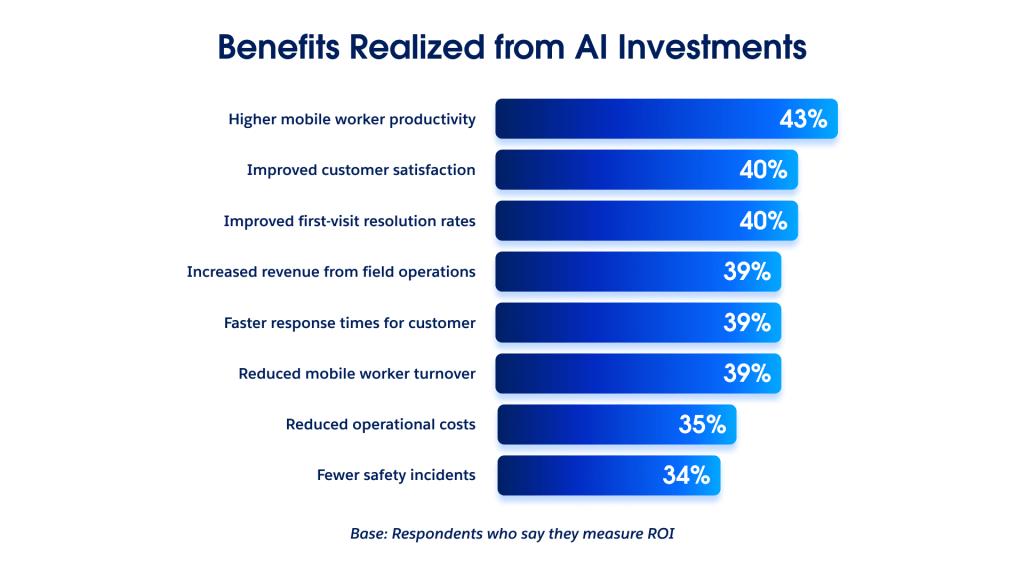
For organizations that have connected their systems and prepared their teams, AI is working. Eighty-five percent of leaders say they have measured the ROI of their AI investment — and the results align with their stated priorities:
- 43% report higher mobile worker productivity
- 40% report improved customer satisfaction
- 34% report fewer safety incidents
Nowhere is AI’s impact more concrete than in scheduling and dispatch. Fifty-seven percent of organizations using AI-powered scheduling and dispatch see higher revenue per job. The gains extend beyond revenue: 57% also report higher mobile worker productivity, 52% see reduced emissions, and 49% report lower labor costs.
Companies aren’t training their employees — so the employees are leaving
While leaders are investing aggressively in AI, a workforce crisis is emerging. Two-thirds of field service leaders say mobile worker turnover has increased over the past two years.
When asked what’s driving the increased turnover, leaders pointed to one issue above all others: insufficient training or support when new technology is introduced.
This finding reveals a fundamental tension: Organizations are deploying AI faster than they’re preparing their workforce to use it. The technology is scaling, but the people aren’t getting the support they need — and they’re leaving as a result.
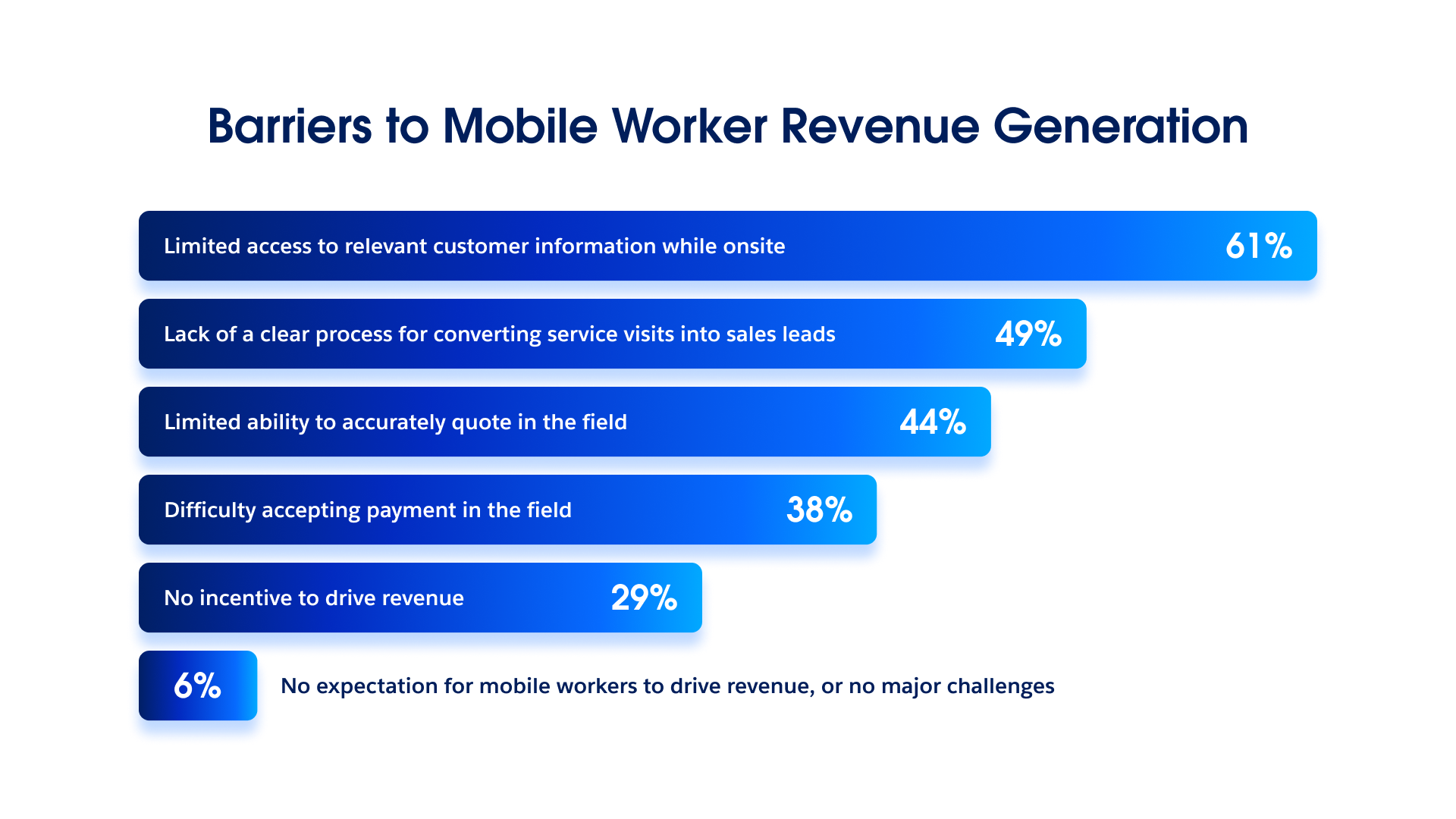
A data gap compounds the problem. Sixty-one percent of organizations say mobile workers have limited access to the relevant customer data they need — so even when workers are trained on new AI tools, they don’t have the information necessary to act on AI-generated recommendations.
Other barriers to using AI effectively:
- 49% lack a clear process for converting service visits into sales leads
- 44% have limited ability to quote in the field
- 38% struggle with accepting payment in the field
Disconnected systems prevent AI from scaling
The root cause of many of these challenges is fragmentation. Only 16% of organizations say their field and back-office technology are united on a single platform. For the vast majority, the customer data, schedules, and asset records that field teams need live in separate places.
Asset data reveals the scale of the fragmentation:
- 63% use mobile apps
- 63% use inventory management systems
- 59% use GPS trackers
- 58% have connected sensors
- 52% still use spreadsheets
- 43% still rely on manual or paper logs
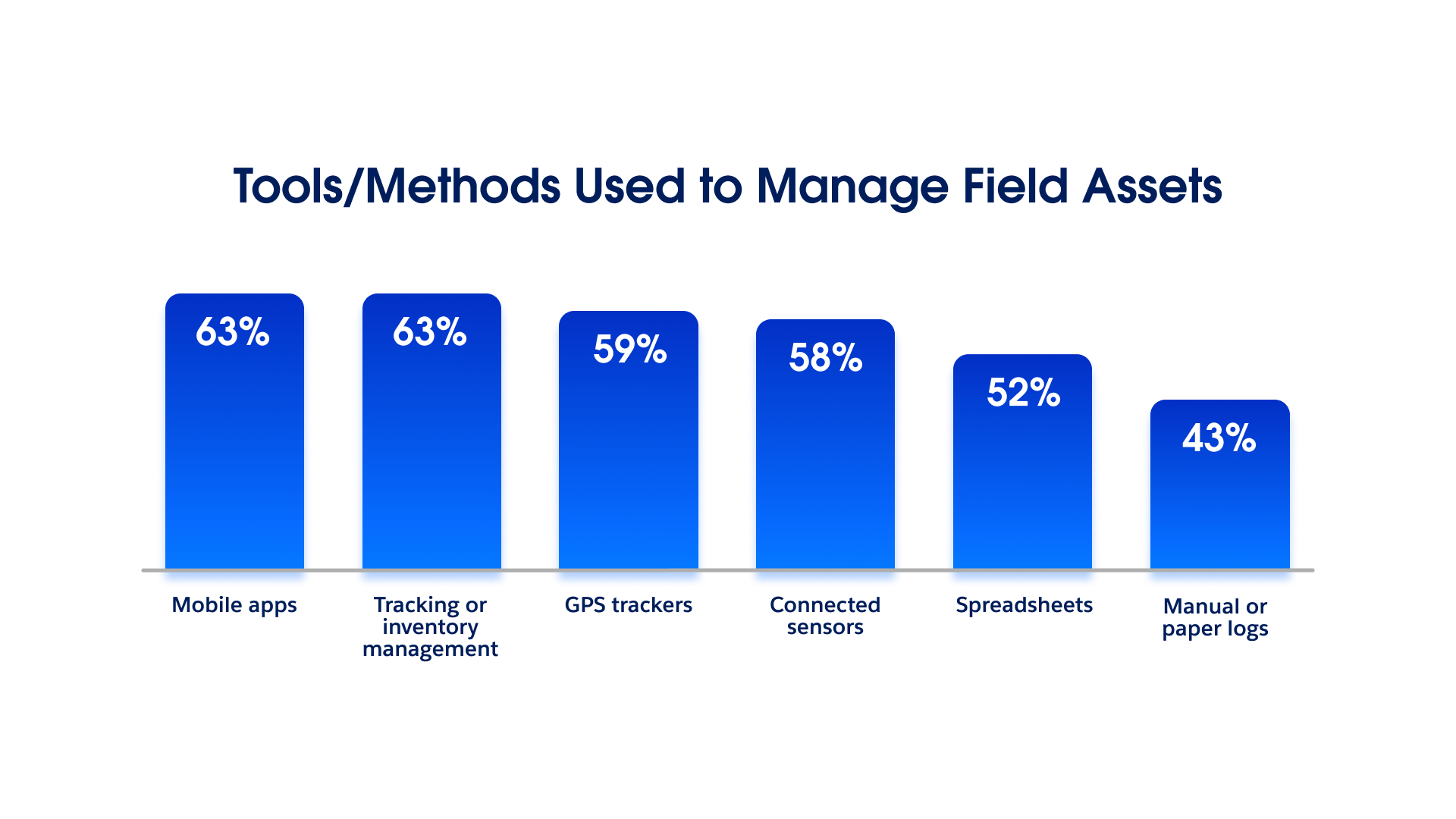
The measurement challenge reflects this fragmentation. While 85% of leaders say they’ve measured AI ROI, 40% say they struggle to measure whether AI is working. We also know that only 16% of leaders say their data is on a unified platform. When data lives across apps, spreadsheets, sensors, and paper, it’s hard to definitively know what’s most effective. The gap between deployment and proof creates uncertainty — and it carries into how organizations evaluate their next investments.
Leaders are investing carefully — and looking for partners who can support the journey
AI adoption is widespread, but it’s not unconditional. When selecting a partner for AI agents, organizations aren’t primarily focused on cost. Instead, they prioritize transparency into how AI makes decisions, data security and privacy practices, quality of ongoing support and service, and external validation.
Organizations understand that AI isn’t just a tool — it’s critical infrastructure. And they’re evaluating vendors with the rigor that decision demands. As noted at the start of the article, 85% of field service organizations plan to increase their AI investments over the next two years. They’re deploying at scale. But they’re also facing a talent crisis that threatens to undermine those gains. The organizations that win won’t just be the ones with the most advanced AI — they’ll be the ones that prepare their people to use it.
Explore further
- State of Field Service: The Road to Revenue in the Agentic Era
- Discover agent-first field service (Agentforce Field Service & Operations demo)
- Field service scheduling and optimization white paper
Methodology
Data in this report are from a survey conducted April 22–May 12, 2026. The survey generated 2,317 responses from field service professionals across nine countries on five continents. For more demographic information, please refer to the full report.