Tableau Unveils the Agentic Analytics Platform: Built on Trusted Knowledge
New agentic analytics platform enables analysts to become architects of enterprise knowledge, moving the enterprise from insights to action with confidence – in any app, on any surface.
SAN FRANCISCO — May 5, 2026 — For over 20 years, Tableau has defined how the world sees and understands data. Now, as organizations shift from viewing data to asking AI to act on it, raw data, on its own, is no longer enough.
In the traditional world of analytics, humans looked at dashboards and brought their own experience and context to the table to make a decision. Today, as we move into the agentic era, AI agents require that same level of “knowledge” to provide the trusted, accurate answers required to drive autonomous action.
The foundation of this shift is knowledge: not just giving AI access to more data but giving agents the business meaning they need to answer accurately and act reliably. That distinction matters. Data is the raw material; knowledge is data with context, definition, and intent. It combines verified data with human-defined meaning — metrics, relationships, semantics, business rules, and definitions — so an agent understands not just what the data says but what it means in the reality of your business.
Today, Tableau is unveiling its Agentic Analytics Platform. Trusted by 97% of the Fortune 100, this evolution transforms Tableau from an analytics tool into a high-scale knowledge and decision engine for the agentic enterprise. By unifying data, business logic, and metadata into a single, extensible platform, Tableau now enables AI agents to not just surface insights but take autonomous, trusted action across the enterprise–in any app, on any surface.
And this shift isn’t just a technical evolution. It’s a massive opportunity for analysts to expand their role and impact, moving from builders of visualizations to architects of the knowledge that powers decisions at scale.
“For more than 20 years, Tableau has defined how the world sees and understands data. But we’ve reached a turning point—seeing the truth is no longer enough. Organizations need to act on it instantly,” said Mark Recher, GM of Tableau at Salesforce. “As Tableau evolves into an agentic analytics platform, we’re elevating the role of an analyst into knowledge architects—turning trusted knowledge into decisions that drive action at scale.”
The Six Pillars of Tableau’s Reimagined Agentic Analytics Platform
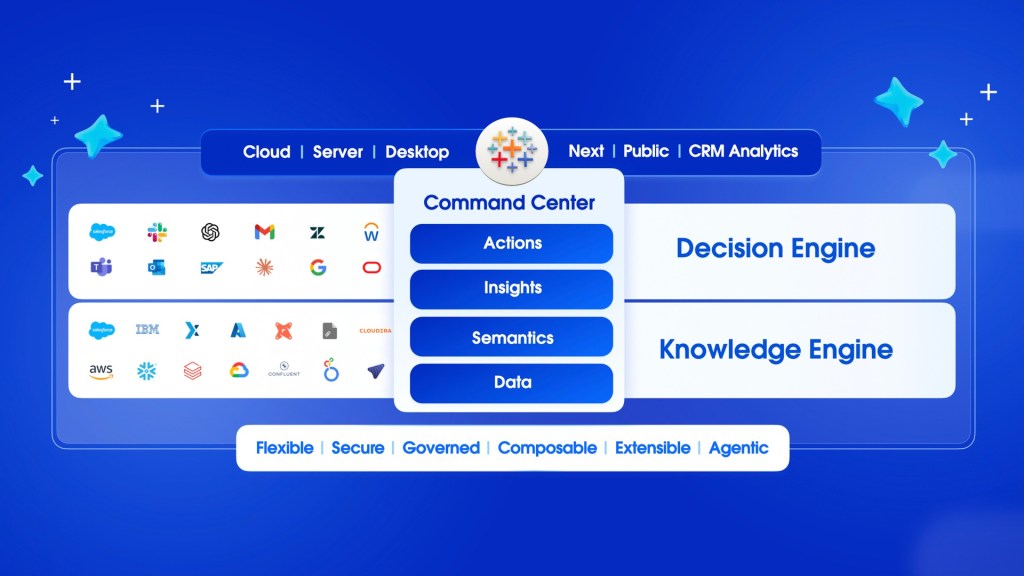
- Knowledge Engine: Turning a Decade of Human Intelligence into Trusted AI
Tableau’s AI doesn’t start from scratch — it starts from 33 million semantic models built by the DataFam over more than a decade. This trusted, unified knowledge base is the foundation of every agent, every insight, and every answer Tableau delivers. With open and extensible semantic models (e.g. Open Semantic Interchange, co-led with Snowflake and dbt Labs) that battle-tested knowledge extends across your entire data stack — so AI is always grounded in your business reality, not a best guess.- Use Case: A financial analyst asks Tableau Agent to explain a drop in quarterly revenue. Instead of surfacing a generic trend line, the agent draws on verified business logic built by the company’s own data team — delivering an answer the CFO can actually trust.
- Conversational Analytics: Your Data, in Natural Language
Ask a question the way you’d ask a colleague. Tableau’s conversational analytics brings natural language interactions to every product — Server, Cloud, and Next — so anyone can get answers without knowing SQL or building a dashboard. With seamless toggling between products, analysts and business users stay in flow, getting rich, contextual answers exactly where they already work.- Use Case: A supply chain manager on Desktop asks why fulfillment times spiked in Q3 and gets a conversational breakdown — no context-switching, no ticket to the data team required.
- Headless Analytics: Trusted Insights Wherever Work Happens
You no longer have to go to a dashboard to get the truth — the truth comes to you. Tableau’s open MCP server architecture delivers trusted, context-grounded insights directly into Slack, Salesforce, Microsoft Teams, Claude, ChatGPT, and any other surface where your teams work. Tableau meets users where their work is done and where decisions are made, not just where data lives.- Use Case: A regional sales director gets a proactive Slack alert from Tableau — pipeline coverage is at risk in the Southwest — with an AI-generated recommendation, all without ever opening a dashboard.
- Decision Engine: From Insight to Action in One Motion
Spotting a problem is only half the battle. Tableau’s decision engine turns insights into decision and actions, directly triggering workflows so every person and every agent can act on what the data is telling them. Whether creating a support case, alerting a team lead, or kicking off a remediation workflow, Tableau closes the loop between analysis and outcome at enterprise scale.- Use Case: A customer success manager sees customer satisfaction scores declining in a key account. Tableau automatically creates a Salesforce case and routes it to the right team lead — before the customer has to call.
- Command Center: Setting the Standard for Agentic Analytics Across the Enterprise
As AI agents proliferate, governance can’t be an afterthought. The Agentic Analytics Command Center is the central hub for managing your entire agentic analytics strategy, giving leaders the observability they need to see which agents are running, what data they’re accessing, and whether every automated insight is compliant with company policy. Easy to start, built to delight, and designed to win the analyst.- Use Case: An IT director uses the Command Center to audit all active agents accessing sensitive financial data, ensuring agentic analytics scales without compliance risk.
- Secure, Trusted, Governed: The Power of Tableau and Salesforce
Great analytics means nothing if you can’t trust it. Tableau is powered by the combined security and governance strength of Salesforce and Tableau — delivering stronger data protection, platform-wide controls, and the enterprise-grade reliability that regulated industries demand. This isn’t a bolt-on security layer. It’s security designed for your entire analytics platform, from the first query to the final action.- Use Case: A healthcare organization deploys Tableau Agent across clinical and operational teams, confident that every interaction is governed by role-based access controls and audit-ready logs — meeting privacy law requirements without slowing down insight delivery.
Real Outcomes: From Dashboards to Decisions
Tableau is now scaling trusted knowledge across the enterprise. Organizations are already seeing measurable shifts in how they operate, reclaiming thousands of hours lost to manual data retrieval and fragmented workflows.
“Tableau is the observability layer for our agents. Instead of standing up bespoke reporting for every new AI workflow, we plug agents into the same Tableau infrastructure the business already trusts—giving us instant, governed visibility into what our agents are doing and what they’re driving.”
— Demetri Salvaggio, VP, Customer Experience & Operations, Engine
“Over the years, we’ve built a lot of the business logic that lives inside Tableau — defining metrics, relationships, and descriptions to make the data interpretable and actionable for everyday users. What’s powerful now is that this context doesn’t just sit in dashboards. It’s being leveraged by AI wherever work happens to provide answers you can trust and supporting decisions at the pace of business today.”
— Will Sutton, Tableau Visionary
Availability
- Auto Knowledge Graph is generally available in June.
- Tableau Agent conversational analytics capabilities are generally available now, with new capabilities coming to dashboards in June.
- Tableau MCP servers are generally available for Tableau Next, Cloud, and Server.
- New integrations for Microsoft Teams, Slack, and Google Workspace are generally available starting today.
- The Agentic Analytics Command Center is generally available in the Fall.
Learn More
- Explore the Agentic Analytics Hub as a starting point for Tableau’s agentic capabilities.
- Read the blog and learn why agentic analytics is the new paradigm for business intelligence.
This article may include references to services or features that are still in development and are unreleased. Customers should make their purchase decision based on fully released and available features.