



Sales teams don’t have time for long meetings that don’t help them close more deals. For sales reps (and the businesses that employ them), time is money, so everything in their day needs to be purposeful. Despite this, meeting time has grown by around 10% every year for two decades; since hybrid work took off, the number of meetings has also tripled.
Part of this challenge is that more than half of all meetings still happen without an agenda, which means the time spent in them rarely leads to better outcomes.
In this article, we’ll look at why structured meetings matter, how to build an agenda that supports your team, using AI to get more out of your time together, and 10 practical tips for running sales meetings that improve performance.
What you’ll learn:
- What is a sales meeting?
- What is a meeting agenda template?
- How to find sales meeting agenda templates
- 10 tips for better sales meetings
- A simple sales meeting agenda
- Meetings that move your sales team forward
- FAQs
See the top trends in data, AI, and more — from nearly 5,000 marketers worldwide.


What is a sales meeting?
A sales meeting is a gathering of salespeople to discuss matters related to their role. This might be to learn about new products, get teamwide feedback, get company or strategy updates, or just to check in.
In contrast to an external-facing meeting, like a sales call or sales pitch, this meeting is for internal attendees only and meant to give sales team members the information they need to do their jobs well. Typically, sales leaders (sales manager, director or head of sales, chief revenue officer) run the meeting and sales reps will attend.
What is a meeting agenda template?
A meeting agenda template is a simple structure you can reuse to plan and run your sales meetings.
Most agendas will outline what will be discussed, who is responsible for each part and what outcomes you expect by the end of the session. Using a template helps your team stay on track from one meeting to the next, makes preparation easier and keeps the meeting’s conversation focused on what matters.
Using AI, teams can take this further by generating draft agendas, summarising past discussions and creating action items automatically, making follow-through more reliable.
How to find sales meeting agenda templates
Before you source your meeting agenda, it’s important to understand what you are looking to get from more structured meetings.
Choose the format that matches your meeting cadence
The right agenda template depends on how often your team meets and what each session needs to achieve. Some common options include:
Meeting Agenda Template Examples
| Type of meeting | Overview | Template example |
|---|---|---|
| Daily stand-ups | Check-ins that keep the team aligned without cutting into selling time | Daily stand-up template from Figma |
| Weekly syncs | KPIs, pipeline updates, priorities and current roadblocks | Weekly meeting agenda from Canva |
| Monthly or quarterly reviews | Deeper performance insights and pipeline health | Monthly review template from Tactiq |
Where to source templates
You can find sales-specific templates in the following places:
AI tools such as Gemini or ChatGPT can also generate templates tailored to your meeting purpose or team size.
How to take your templates to the next level
Once you have a base template, modern tools can help refine it. AI can draft agenda sections, suggest talking points and pull in relevant metrics automatically. Some platforms can pre-populate KPIs, pipeline updates or action items from previous meetings so you don’t have to start from scratch each time.
Tools like Agentforce Sales and CRM Analytics can surface real-time performance insights, deal risks and opportunity data that you can place directly into your agenda. This keeps every meeting grounded in the reality across your pipeline.
Support your sales team to do their best work with Sales Cloud
Give your team the tools, data, and AI insights they need to stay focused, build stronger relationships, and close more deals, all in one platform.


10 tips for better sales meetings
You’ll get the most out of your time together when using structured, focused meeting agendas to keep your team aligned. Here are our top 10 tips to help you turn meetings that could have been an email into moments that build your high-performing sales team.
10 Tips for Improving Sales Meetings
| Tip | Why it matters |
|---|---|
| Set clear objectives | Keeps the meeting focused with clear outcomes |
| Find the right frequency for your meetings | Helps teams stay in sync while protecting the time they need for selling |
| Troubleshoot tech in advance | Prevents delays and wasted time |
| Start and end on time | Builds trust and allows your team to book client meetings around internal ones |
| Brief the team on key updates | Ensures everyone is aligned before decisions are made |
| Open the floor for challenges and roadblocks | Brings to the surface issues that are slowing down the pipeline |
| Celebrate wins | Reinforces positive behaviour and lifts morale |
| Encourage collaboration and new ideas | Helps the team learn from each other. It also helps engagement to talk with the team, not at them |
| Clarify next steps and accountability | Makes follow-through easier and makes it clear who’s doing what |
| Motivate the team through highs and lows | Even in slow months, maintain your energy and hope to keep the team’s spirits high |
1. Set clear objectives
Make sure you and your team know what you’re meeting about in crystal-clear terms. For instance, is it a quick standup to discuss progress on a specific key performance indicator (KPI), or a critical end-of-quarter meeting to see who needs help closing deals?
Don’t call your salespeople together without a clear agenda and a few simple objectives. Pulling salespeople into a meeting takes them away from combing through leads, putting together emails and pitch decks and, ultimately, growing revenue.
Once you’ve developed your agenda and goals, decide who should speak to each topic. Work with the presenters in advance to answer these questions:
- Who will kick off the meeting?
- Who will present their screen, if needed?
- How will you handle transitions?
- Will you save questions for the end or answer them throughout?
- Is there a key call to action (CTA) you want every meeting attendee to take away?
Send the agenda to attendees ahead of every meeting. It can be a loose outline, but this will show everyone that you’re focused on making solid use of their time.
2. Find the right frequency for your meetings
Make every instance of your meeting count, or risk your team joking that they survived another meeting that could have been an email. Indeed, email can be an effective, concise way to communicate with your team when it comes to quick company updates or plan changes.
The timing and cadence for sales meetings are important. If you have a daily standup or other recurring meeting, consider pivoting to a less-frequent timeline if you notice you’re covering non-essential items.
Alternatively, don’t feel pressured to meet every time you initially planned to meet. If you cancel a meeting when you didn’t have important updates to share, those bonus minutes given back to the team will be applied to meaningful work. Tell your team why you’re cancelling — “There are no important items for discussion today and I’m sure you could all use this time productively” — and your team will appreciate that you’re not holding meetings just for the sake of it.
3. Troubleshoot tech in advance
Whether you’re presenting remotely or in person, work out any technological kinks in advance. Computer updates should be completed, software should be downloaded, and unnecessary programs or chats should be closed.
You don’t want glitches eating into your time and derailing your meeting, so ask meeting presenters to meet a few minutes early to test the full setup. That pre-work may only take 10 minutes, but it pays off. If it’s just you running the meeting, you can do the same thing on your own: test your equipment and go through the presenting motions just as you would during the real thing.
4. Start and end on time
Respect your team’s time by keeping the meeting on schedule. Sales reps meticulously plan their days so they can squeeze in the maximum number of customer calls and emails, so set the tone and make sure your meeting cadence reliably sticks to its time slot.
If you’ve noticed that previous meetings have tended to go over time, consider saving questions or comments for designated moments in the meeting or reducing the number of topics each meeting covers.
5. Brief the team on key updates
As the leader, it’s your job to update the team on anything you’ve learned that might not have been passed on to them yet, especially if it’s been a while since you last met.
Brief everyone on any pricing changes, sales forecasting updates, product news, leadership shifts, or other integral information that could affect how they sell. Follow up on any issues or questions from past meetings, too.
This part of the sales meeting can run the risk of taking up a lot of time. If a topic has the potential to run too long, consider having a special meeting to tackle it.
6. Open the floor for challenges and roadblocks
When you’re all together in a sales meeting, it’s often helpful to have everyone share what’s working and what’s not. Touch base on leads and accounts, how key conversations are going, and everyone’s overall status report regarding hitting their quotas and KPIs.
On top of progress, listen for any roadblocks. As a manager, if members of your team are hitting obstacles, you need to be aware of issues so you can help clear the path for success.
Once you know what’s going well and what needs additional focus, you can develop an action plan with individual team members or a larger group.
7. Celebrate wins
Did a team member close a big deal? Surpass their quota six months in a row? Set aside time in your sales meeting agenda specifically to give them kudos. Most people appreciate being recognised, and it’s good for the entire organisation.
Be specific in your praise, too. Saying you appreciate that someone took the time to onboard a client who needs more attention than usual will mean more than a generic “good job” and is far more instructive for other team members looking to improve their performance. Of course, not everyone likes being publicly singled out, so make sure you’re giving team members credit in the formats they prefer. You can vet this with each rep in one-on-one meetings.
8. Encourage collaboration and new ideas
Your sales meeting agendas should always include time to exchange thoughts as a group. These meetings aren’t only about what you want to communicate; they’re also a way for team members to learn from each other and build on each other’s best practices.
For example, you exchange ideas on:
- Better sales and marketing or sales and service alignment
- Remote selling tips
- New positioning of your products or services
- Partnering with other peers or vendors in your industry
- Your competitors and how they’re selling, marketing or pricing their products
- Shaping goals for the next quarter or year
Focus on topics that will be relevant to most salespeople in the meeting so they don’t start tuning out or attempting to multitask.
9. Clarify next steps and accountability
As you work through each item on your sales meeting agenda, clarify any action items and who’s responsible for following up on each. No one should leave the meeting feeling ambiguous about next steps.
Team members can be responsible for following up with their own prospects and customers. However, if there are other department-wide needs raised during the meeting, such as talking to the finance team about a new promotion or discussing a new lead-generation campaign with marketing, you should designate a point person. This way, important items won’t fall through the cracks. Make it clear which updates you want the team to bring to the next meeting.
10. Motivate the team through highs and lows
Sales can be hard. This profession requires patience; salespeople need to handle a lot of rejection, and mistakes will be made from time to time. Sometimes the market slows down, and prospects just aren’t biting. No matter the reason why times are tough, the team as a whole, or individual sales reps, will struggle sometimes.
During these times, it’s your opportunity as a leader to address issues head-on and communicate authentically with the team. If you share why you’re still inspired and motivated about the team’s work, others will be motivated, too. Carve out time in your agenda to do that when times get tough.
Even in easier times, fun and positive ways to motivate your team abound. You can introduce games and contests to celebrate what’s going well, and award unique prizes for different milestones.
However you’re going, remember this simple fact: tough times don’t last, but tough sales teams do.
For more advice and insights on sales leadership from the best in the business, download the 21 Pro Tips for Sales Leaders e-book and start transforming the way you sell.
A simple sales meeting agenda
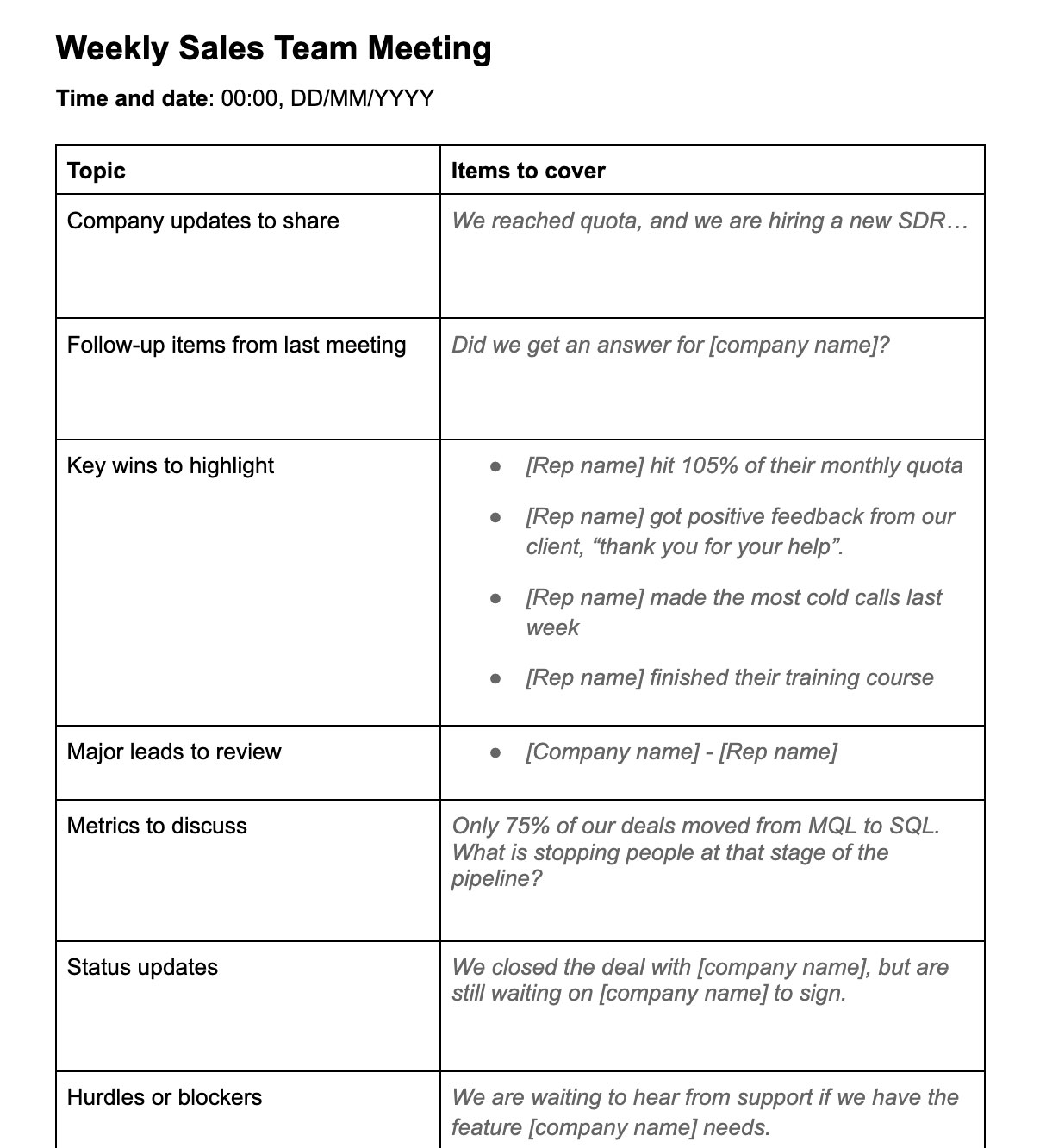
This example agenda outline is a good place to start. It’s packed with items, so you’ll need to make sure you’re disciplined in keeping to time.
Meeting details
- Meeting date and time
- Attendees
Brief the team (5 minutes)
- Company updates that affect the sales team
- Follow up on questions from the last meeting
Amplify key wins (5 minutes)
- Praise sales reps who appreciate public recognition, and make sure praise is for specific events
- Allow others to share appreciation
Team discusses their updates and obstacles: (10-20 minutes)
- Discuss major leads
- Break down current metrics
- Status report
- List potential hurdles
Invite ideas, questions and innovation (10-20 minutes)
- Exchange thoughts and ideas
- Motivate and encourage the team
Decide on next steps (10 minutes)
- Appoint individuals to take ownership of action points from the meeting
- Set expectations for the next meeting
Get the latest sales tips delivered to your inbox.
Sign up for the Salesblazer Highlights newsletter to get the latest sales news, insights, and best practices selected just for you.
Meetings that move your sales team forward
Productive sales meetings rely on structure, preparation and a clear agenda. When your team knows what to expect and has the right information at hand, discussions stay focused and the time spent together supports stronger performance.
Salesforce tools like Agentforce Sales and CRM Analytics can help by surfacing real-time insights and reducing the manual prep behind each meeting.
Explore our free demos to see how our products can improve your processes with actionable insights.
FAQs
How often should you have sales meetings?
Most teams run a short weekly meeting and a longer monthly or quarterly review. The right rhythm depends on how fast your pipeline moves.
How can I make sales meetings not boring?
Keep them focused, use a clear agenda and only cover topics that help reps sell. Shorter meetings with real data and open discussion work best.
Do sales meetings help teams close more deals?
Yes, when they’re structured. Good meetings surface any blocks, get priorities in order and give reps the information they need to move deals forward.
How long should a sales meeting be?
Aim for 30 minutes to one hour for weekly check-ins. Bigger reviews can run longer, but should still be tight and purposeful.