


Sales consultants are facilitators. They combine strategic thinking, product knowledge, and communication skills to reach the right customers with the right information at the right time.
However, customer expectations are changing. Buyers want even more relevant, timely information to help them make confident decisions, but sales consultants are increasingly short on time, spending around 60% of their week on non-selling work.
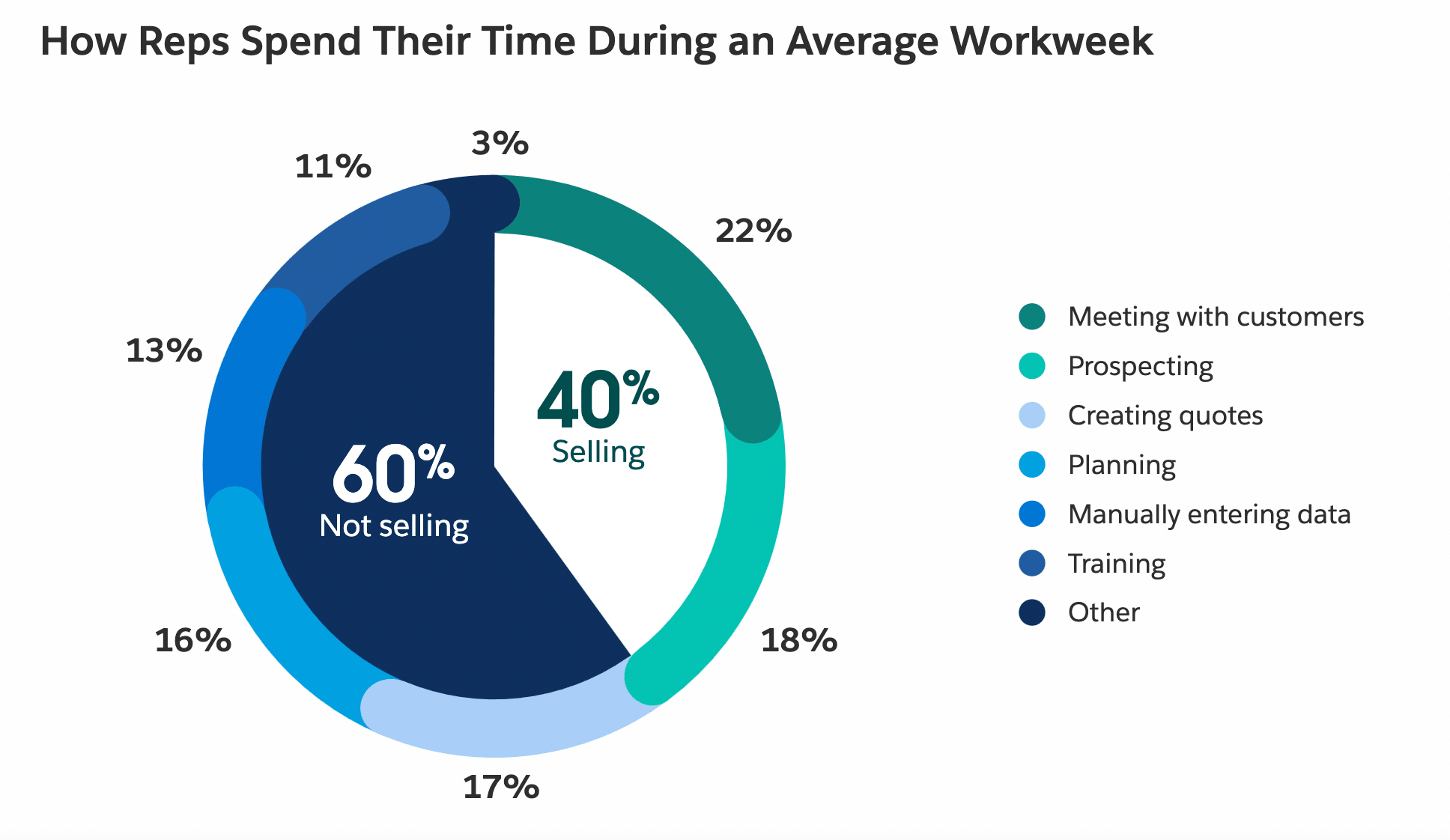
Source: Salesforce State of Sales Report (7th Edition)
To stay on top, sales consultants need support. This is where AI-powered sales software can help. Working with AI tools, sales consultants can summarise research, analyse lead data, plot follow-up scenarios, and more. The result? More time to engage with customers, which is what they do best.
In this article, we’ll explore the role of a sales consultant, how it’s changing, and how AI can help.
Key takeaways
- The sales consultant role is still essential, but it is evolving
- Customer expectations are rising faster than sales consultants’ capacity
- Working with AI can make sales consultants more efficient by taking on the busywork, allowing sales consultants to focus more on relationship building, commercial judgement and strategic decision-making
- A connected tech stack and the right AI tools are essential for peak performance
Discover top sales trends, AI agent use cases, and growth strategies — from over 4,000 sales reps worldwide.
What a sales consultant really does (and why it matters)
Sales consultants are experts in client relationships. They don’t simply pitch to customers and hope they take the bait. They identify customers, nurture relationships, build trust, provide insights and move customers through the sales cycle.
Whether working in-house or as an external specialist, a sales consultant solves problems – for the customer and the business. They act as an adviser, relationship manager and analyst, all while balancing many conversations, keeping deals moving, and adapting their approach as new information emerges.
Their responsibilities might include:
- Sales prospecting
- Cold calling
- Lead generation
- Qualifying leads to determine their viability
- Marketing to attract new clients
- Conducting outreach
- Managing customers at every step of the sales funnel.
It’s a complex role, made even more so by changing customer expectations.
In our 10th State of Marketing report, 85% said customer expectations are higher than ever, 69% said that customer acquisition is now harder, and 64% said that changing behaviours make it difficult to keep up.
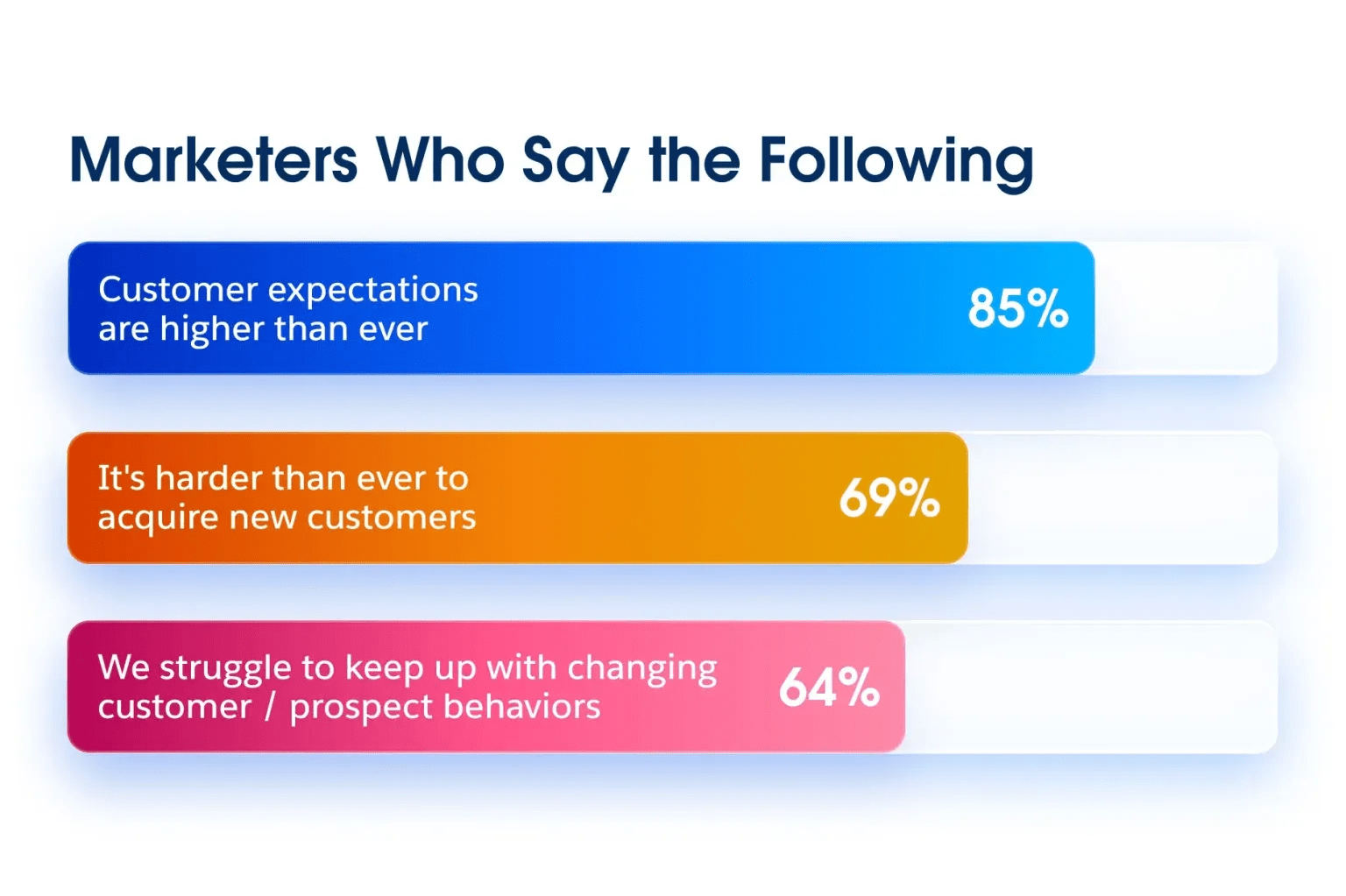
Source: Salesforce, State of Marketing (10th Edition)
This is where sales consultants’ in-depth knowledge of their customers, as well as their problem-solving skills, take centre stage. In a role where success is typically measured by hitting sales targets, long-term retention requires that the customer is genuinely happy with their product or service.
Sales consultant vs. salesperson: the key differences
They may sound similar, but sales consultants aren’t salespeople.
Traditional salespeople focus purely on selling. Sales consultants take a more diagnostic, customer-led approach. They work to understand the customer’s situation before recommending a solution that fits their needs.
| Sales consultant | Salesperson |
| Prioritises solution selling: understanding the customer’s needs and context | Prioritises closing deals and meeting short-term targets |
| Adapts the conversation to the customer’s goals and challenges | Follows a defined sales script or process |
| Recommends the most suitable solution based on what they learn from the customer | Presents products and pricing |
| Focuses on fit, educating the client in the product and long-term retention | Focuses on volume selling |
| Works alongside marketing and support to build a smooth customer journey | Works on individual opportunities |
| Builds trust to support a long-term partnership | Builds rapport to support the sale |
| Competes on insight, value and relevance | Competes on price and urgency |
This deep understanding of customers, coupled with communication skills and market knowledge, is the value sales consultants bring to the table. But the game is changing, and it’s more important than ever to meet these modern-day challenges head-on.
The personalisation paradox
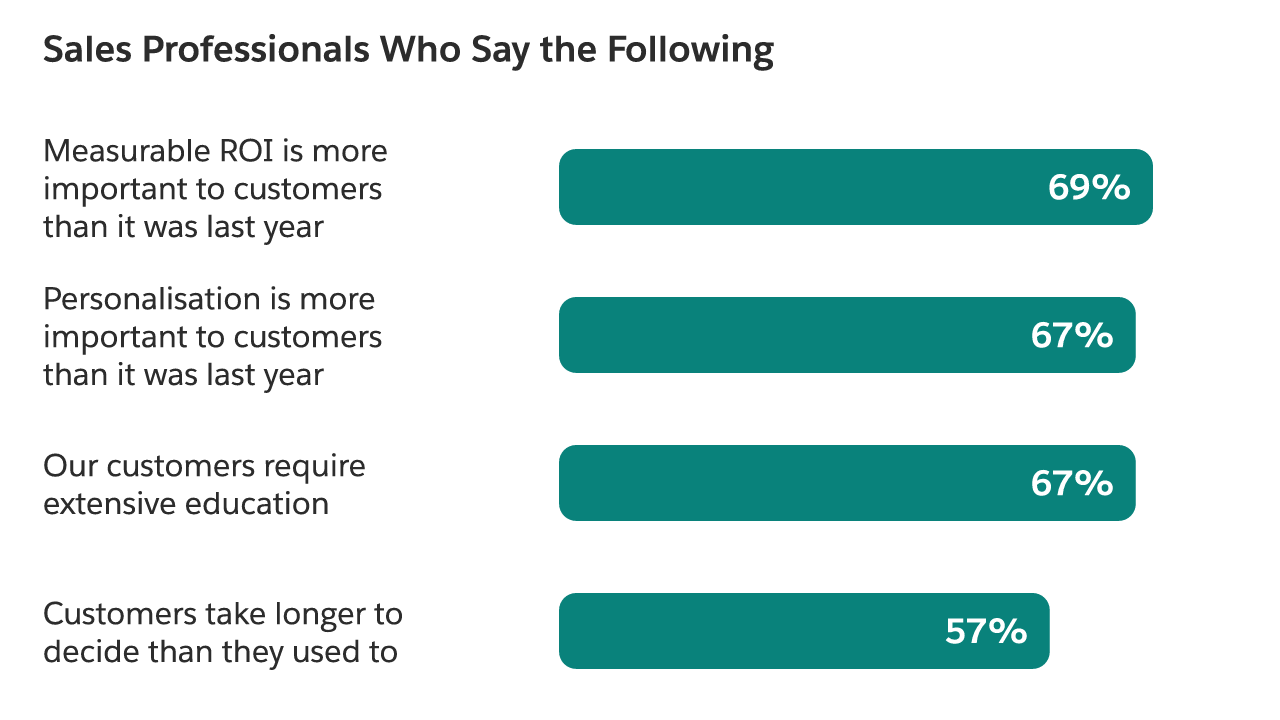
According to our latest State of Sales report, the number one challenge that salespeople have today is changing customer demands.
Reps Are Caught Between Customer Demands and Limited Time
Source: Salesforce State of Sales Report (7th Edition)
Think of this as the “personalisation paradox”. Customers want more information, attention and tailored interactions, while sales consultants don’t have enough time to keep up.
The solution starts with agentic AI that can create workflows that are more structured and efficient. Let’s take a look.
Support your sales team to do their best work with Sales Cloud
Give your team the tools, data, and AI insights they need to stay focused, build stronger relationships, and close more deals, all in one platform.
How AI is changing the sales consultant role
Think of it like this: If the customer is king, the sales consultant is a trusted adviser, and the AI agent is that adviser’s analyst. The agent completes the busy work, but it’s up to the trusted adviser to provide context and perspective to the information.
AI agents help handle admin work behind the scenes. This includes responding instantly to inbound enquiries, asking qualifying questions, capturing and enriching lead data, logging activity in your software, and identifying high-intent prospects for reps.
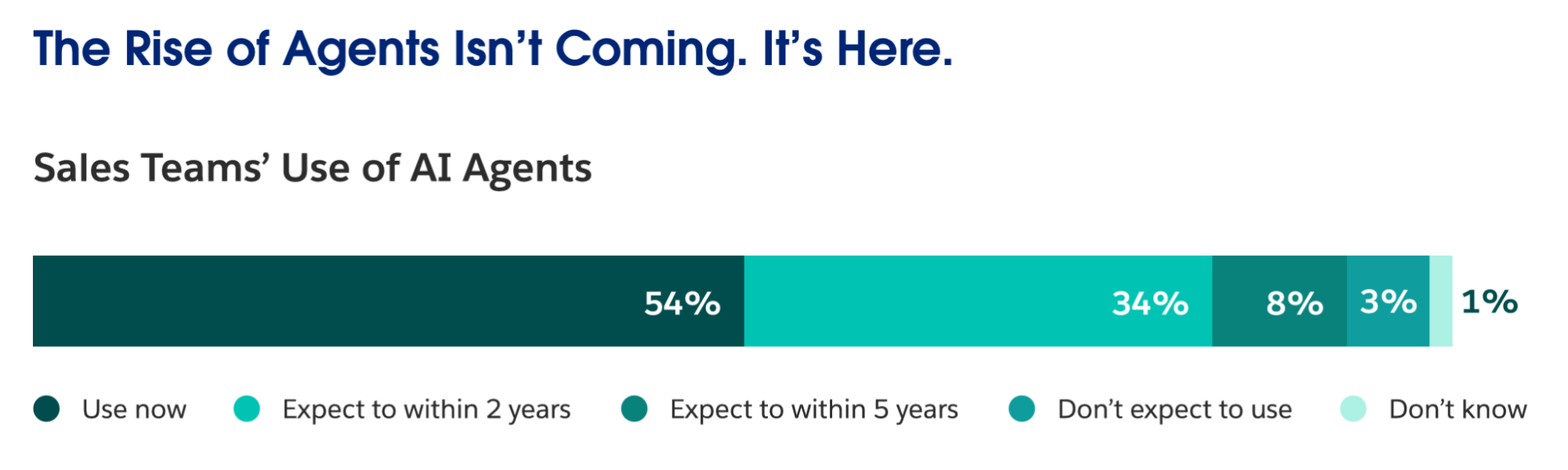
Eighty-eight per cent of teams already use AI agents or expect to within two years. Of those using agents, 94% say they’re critical for meeting business demands. Ninety per cent say using AI helps them understand customers better, and 88% say that it makes them more productive, increasing their odds of hitting sales targets.
Source: Salesforce, State of Sales (Seventh Edition)
As Salesforce’s Lead Solution Engineer, Simon Balmer, put it at our 2026 Agentforce World Tour in Sydney, this is how sellers “focus on quality time, on quality phone calls, not the busy work to get there”.
Let’s take a look at some of the key areas of a sales consultant’s work, and how the relationship with AI agents is actively transforming their role.
Prospecting and qualification
In the past, prospecting consumed a significant amount of a sales consultant’s time, and they’d often be working with incomplete information.
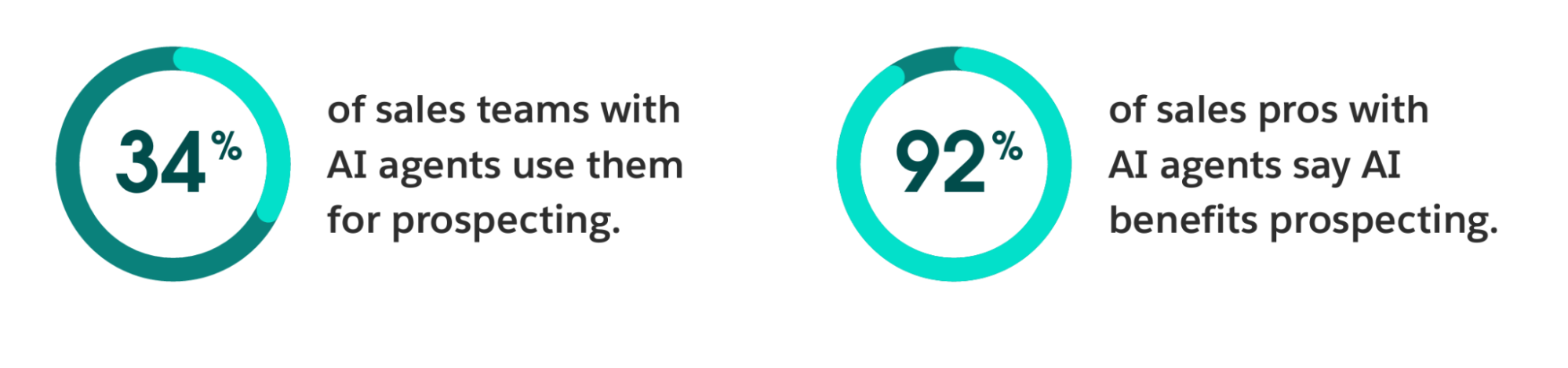
AI can now take on much of the preparatory work, such as analysing data, detecting patterns and qualifying leads, and sales professionals are already seeing the benefits.
Source: Salesforce State of Sales Report (7th Edition)
What AI can do: First-pass lead qualification, lead scoring, data analysis, and pattern identification.
What humans own: Choosing which leads to pursue based on strategic commercial judgment.
Personalisation and outreach
Customers want more personalisation – information that’s tailored to their unique needs. Sales consultants don’t have time to draft every message at every stage of the sales funnel. Now, AI can do much of that heavy lifting.
What AI can do: Drafting emails, repetitive outreach, and suggesting messaging.
What humans own: Determining tone, timing, and making sure the message is targeted correctly.
Forecasting
Forecasting has always been part science, part guesswork. Now, AI can identify trends much more effectively.
What AI can do: Pattern recognition, risk analysis, and creating forecasting models.
What humans own: Interpreting the signals, applying commercial context, and deciding on priorities.
Coaching and development
AI is also shifting the internal aspects of the sales consultant role. Effective training and sales coaching give new reps the guidance they need to dive into sales activities with confidence and find success quickly. For veteran sales professionals, training provides opportunities to sharpen their skills, increase their industry knowledge, and ensure their sales approach remains competitive and impactful.
AI agents can help. High-performing salespeople already recognise this, and they are 1.4 times more likely than underperformers to use AI agents for coaching.
What AI can do: Call analysis, generating feedback, and identifying skill gaps.
What humans own: Applying feedback, building confidence, and defining performance targets.
In summary, let AI save time on repetitive tasks like admin, data entry, summarising and first-pass qualification. This frees up the sales consultant to focus on the areas that can’t be automated – nuance, deal negotiation, trust-building, commercial judgment, and relationship-building.
The skills that define an AI-ready sales consultant
By AI-ready, we don’t mean writing code or understanding the computations behind large language models. It’s about knowing what the AI agents are doing and identifying where they can add value to the sales funnel. Being comfortable with using AI agents, CRMs, and automation features is necessary, but an AI-ready consultant brings much more to the table.
Interpretation
The ability to read the patterns and suggestions the tool is providing and then apply them to the customer situation is central to working with AI. An AI-ready sales consultant reads between the lines and compares the AI recommendations to what they know about the customer and makes their next move from there.
Critical thinking
Linked to interpretation, but more broadly applied, critical thinking brings a healthy scepticism to the table. You don’t take things at face value, however authoritative they may seem. This ability to question ensures you work with AI, not for it. For example, if an AI agent provides a suggestion for a follow-up email, you would always sense-check it against what you know of the client from your interactions.
Judgment
An AI-ready sales consultant relies on their judgment about what the customer needs next. They know when a slower approach might be more beneficial, and when to push for a resolution. They use AI suggestions to inform their understanding, but they decide what happens next.
Credibility
Customers are sceptical. They need to be won over. That transformation is built on a relationship with a sales consultant rooted in trust. Being credible (well-informed, responsive, honest, consistent, and not relying on AI to script every interaction) goes a long way to making a sales consultant a success.
That credibility also feeds into trust, which loops back to an understanding of the tech. Given that 64% of customers feel that companies are being reckless with their data, a good sales agent builds trust by explaining the security features of tools like Agentforce.
Accountability
Good sales consultants take ownership of their clients, their processes and their decisions. For all its help, AI is not accountable. The consultant is the one who decides what is sent and said, shaping how the customer experiences it – and stands by their actions.
The essential tech stack for today’s sales consultant
Sales consultants working with technology can become much more effective, but that’s only if the tech system they use is itself fit for purpose. Outdated tools or an overcomplicated CRM slow teams down and create errors. Only 35% of sales professionals trust the accuracy of their organisation’s data.
The goal is not more tools, but better-connected ones. You want a tech stack that makes the workflow, well, flow.
Let’s look at some of the essential elements of tech stacks for today’s sales consultant.
Core CRM
Here’s where it all starts, tech-wise. CRM software tracks relationships, manages deals and records activity. It provides clarity: where things stand, what’s already happened, and what needs to come next. A platform like Salesforce is essential as an operational hub for your sales team.
AI sales agent
Sitting over your CRM, an AI sales agent such as Agentforce Sales shifts the system from a passive repository to an active support system. It takes on a lot of the administrative burden, like surfacing information for consultants, rather than them having to search for it. That means they can spend more of their energies applying insight, instead of managing the system.
Unified data
Fragmented data – information spread across many tools, duplicated, or out of date – limits both human decision-making and the effectiveness of the AI agents. A unified data layer brings everything together: customer interactions, marketing engagement, service history, and deal progression. It’s the whole picture, rather than a series of snapshots. Cleaner data leads to better judgment and more reliable AI outputs.
Integration
In the tech stack, as in customer relationships, connection is key. Integration platforms like MuleSoft allow systems to communicate, automate workflows, and keep data in sync. With effective integration, your tech stack becomes less a bunch of tools and more of an ecosystem. If tasks such as updating records, moving deals through stages, or triggering follow-ups can happen in the background, your workflow gets a whole lot smoother.
A practical example
A good example of this in action is One NZ. Bringing together CRM, AI and integrated data, they were able to give their sales and service teams a more complete view of the customer. Consultants were no longer piecing together context manually. Instead, they had all of the information they needed right in front of them.
This resulted in fewer silos, faster access to information, and more consistent interactions across the business.
“Agentforce’s ability to access data in the moment is vital,” said Summer Collins, One NZ’s Chief AI and Data Director. “The agent is grounded in the right answers and can only look at the data that is relevant for each particular customer according to the rules we set for it. Having that data easily accessible within Data 360 means that can happen instantaneously.”
The real value: what a sales consultant brings to your business
A sales consultant uses their communication skills, sales strategy expertise and market knowledge to help your company close sales more effectively.
Helping customers make informed decisions
Sales consultants use their strong communication skills and market awareness to guide buyers through their decision-making. This keeps customers engaged with your business at a time when 86% of buyers are more likely to buy when their goals are understood.
Spotting issues in your sales process
A new sales consultant can bring a fresh view, highlighting gaps you may not see internally and introducing best practices that make it easier for your salespeople to close more deals. This kind of support matters right now, with 67% of salespeople expecting to miss quota and many facing longer, more complex sales cycles than ever.
Reducing low-value work
Experienced sales consultants will help your team focus on the work that moves deals forward, rather than busy work. We found that salespeople currently spend 60% of their week on non-selling tasks, which doesn’t leave much time for the conversations that influence revenue growth.
A sales consultant can work on automating parts of the pipeline (particularly through using AI agents) to reduce the admin load on your team.
Improving lead quality
One of the most practical benefits a consultant brings is stronger lead qualification. They look at your pipeline with a critical eye and help the team focus on prospects who are ready to progress. Using Agentforce, you can take this further by using the data in your CRM to score and prioritise leads based on behaviour and fit. This shows your sales team where their time and effort are most likely to pay off. Plus, it frees up more time for customer liaison.
Smoothing sales cycles with AI
A sales consultant understands how customers move from prospects to buyers. They know where conversations can get sticky and how the sales funnel can stall. Working with AI agents, they can target those critical junctures to help the sales team move prospects closer to completion. That could be anything from inserting AI insights into conversations to refining automated follow-ups to add more personalisation.
At its core, the sales consultant role helps your business sell better. With AI, they can focus more efficiently. When AI assists sales consultants, it sharpens their value to your business and makes their impact bigger.
7 signs you need a sales consultant
Still unsure whether a sales consultant would make a difference for your business? These signs can help you work out if the extra support is worth it.
1. High customer churn
If customers are leaving faster than you can replace them, it usually points to a poor transition from sales and account management. Customers can feel as though they are starting from scratch at each new touchpoint with the business. A sales consultant can map the handover process, ensuring all the key information and context are passed on, so the customer experiences a seamless journey through to competition.
2. Low sales team productivity
Teams often lose time on the wrong tasks or chase leads that will not convert. A consultant can refocus the team on high-value work, clarify who they should be putting effort into, and integrate AI tools into the team to automate administrative tasks – and free up more time.
3. Weak lead quality
If your sales pipeline is full but your conversion stats are low, you are either attracting or prioritising weak leads. Performance – and morale – suffers as the team spends too much time pursuing deals that won’t close. A sales consultant can work with AI tools to refine qualification metrics and focus the team on leads that have the most potential to go somewhere.
4. Unpredictable results
When deals stall, disappear or move through the funnel without a clear pattern, it is a sign that your process is not consistent. Consultants help identify the points where opportunities fall away and rebuild a structure that gives you a reliable forecast and a robust sales funnel process.
5. Inconsistent messaging
If every salesperson tells a different story, the value of your products gets lost. Customers can lose confidence and trust, and sales stall. A sales consultant can make sure your messaging is aligned, defining it for customers across every channel.
6. Slow follow-up
With only so much time in the day, opportunities can go cold, not because of a lack of interest, but because momentum gets lost within competing demands. The result? Customers exit your sales funnel for a faster, more consistent competitor. A sales consultant can create a structured follow-up approach – informed by AI-driven suggestions, drafting tools and calendar reminders – so each customer gets the appropriate message at the right time.
7. No clear path to growth
We found that 82% of sales professionals feel confident in their growth strategy, but still face increasing pressures. That can mean performance is reactive rather than planned. A sales consultant can define clear sales processes, roles and priorities, so you have a repeatable, consistent model to support expansion.
Working smarter with Salesforce
The role of the sales consultant is important – and it’s evolving.
Consultants are still responsible for building trust, navigating complexity and guiding customers towards the right decision. Now, however, they can work with AI agents to focus their efforts where they make the most difference.
AI is removing the busywork from the sales consultant’s desk. It takes on tasks like admin, data entry, first-pass qualification and repetitive outreach. That frees up the sales consultant to focus on higher-value work, such as customer liaison, credibility building and strategic decision-making.
By partnering with AI, the role of the sales consultant is actually becoming more human. The right tech stack is what can make this happen.
With a connected platform like Salesforce that brings together CRM, AI, automation and unified data, your team is not just working faster, it’s working smarter. They have the context they need, the workflows that support them, and the tools to focus on what actually drives revenue.
To see the software in action, watch our Agentforce Sales demo here.
Frequently Asked Questions (FAQs)
A sales consultant is a specialist who combines commercial acumen, product knowledge, and relationship-building skills to guide clients through buying decisions. Rather than simply push for a quick sale, they seek to understand a customer’s needs and recommend the right solution.
Nothing can match human interactions when it comes to customer relationships. However, to maximise their efforts, sales consultants can use all the tools at their disposal. Working with AI agents is the cutting edge of that relationship. Replace the role? No. Enhance it? Definitely.
You name it, a sales consultant can work in it. Retail. SaaS. Finance. Real estate. Automotive. Telecommunications. Professional services. If something needs to be sold, sales consultants will have opportunities.
Early career consultants often focus on data collection and market analysis to support customer acquisition. With promotion, they will oversee complex projects and take on more client-facing responsibilities. In time, they may move into management, business development and training. The good news is that 82% of sales reps working with AI agents say that knowing how to use AI provides better career prospects.