Top 30 small business tools to try today

Find out which small business tools can help you unlock your business’s potential. Learn how these tools can increase your success and what features to look for.

Running a business is complicated, no matter the size or industry. With dozens of moving parts, hundreds of tasks to complete, and constantly shifting trends, there’s a lot to juggle. That’s why employees need the right tools and platforms to do their jobs successfully.
For example, in the first hour of their workday, an employee may need to respond to emails, assess the previous day’s sales stats, and check their calendar to confirm upcoming meetings, all while responding to video call requests on their preferred instant messaging platform. That’s four activities and four tools, all before coffee.
Having the most effective tools at your disposal is essential for productivity. To make things a little easier, we’ve put together this list of the top 30 small business tools that will help you save time, reduce errors, and increase your bottom line.
What you’ll learn
- The best small business tools at a glance
- Why small business tools are important
- Key features to look out for in small business tools
- 30 tools for small business efficiency
- How small business tools drive growth
- Think big with small business tools from Salesforce
- FAQs
The best small business tools at a glance
There are hundreds of tools available on the market, each offering small and medium-sized businesses (SMBs) a way to make their operations as easy and efficient as possible.
So, where do you find the best ones? To get started, let’s look at a list of all the tools we’ll be mentioning. We’ll give you an idea of the areas you’ll want to invest in and the best options available.
Top 30 Small Business Tools for 2026
| Tool | Category | Best For |
|---|---|---|
| Agentforce | AI and data | Autonomous agentic AI |
| Tableau | AI and data | Data analytics |
| Midjourney | AI and data | AI image creation |
| WRITER | AI and data | Generative AI |
| Drift | AI and data | Conversational messaging |
| Slack | Communication and collaboration | Instant messaging |
| Dropbox | Communication and collaboration | Cloud storage/file sharing |
| Google Workspace | Communication and collaboration | Google integration |
| Zoom | Communication and collaboration | Videoconferencing |
| GoTranscript | Communication and collaboration | Human-powered transcription |
| Asana | Project management | Work management platform |
| Smartsheet | Project management | Report creation |
| Trello | Project management | Project collaboration |
| Wrike | Project management | Task automation |
| Coda | Project management | Flexible customisation |
| SendPulse | Marketing | Marketing automation |
| BrightEdge | Marketing | SEO tools and optimisation |
| Optimizely | Marketing | Increased website traffic |
| Marketing | Marketing | |
| DemandBase | Marketing | Account-based marketing |
| Canva | Marketing | Graphic design creation |
| DaVinci Resolve | Marketing | Video editing |
| Accounting Seed | Accounting and sales | Financial data integration |
| Agentforce Commerce | Accounting and sales | Enhanced customer journey |
| QuickBooks | Accounting and sales | All-in-one accounting |
| Conga Contracts | Accounting and sales | Automated contract creation |
| Sales Dialer | Accounting and sales | Call management |
| Ambition | Accounting and sales | Sales metrics & reporting |
| Record keeping evaluation tool | For Australian businesses | Record keeping evaluation |
| Superannuation guarantee contributions calculator | For Australian businesses | Employee super contributions |
Why small business tools are important
The sophistication of modern tech has helped businesses achieve incredible things, and there’s no sign of things slowing down. There’s now a tool for almost everything you can think of, from project management and data analytics to accounting and content creation.
Here are some of the key benefits that effective small business tools can offer:
Automation
While automation solutions have always been essential for small businesses, artificial intelligence (AI) has made many of these tools far more effective.
AI can automate routine tasks such as invoicing, inventory management, email marketing and generating insights for decision-making. Aside from supporting faster, more accurate workflows, this frees up vital hours for employees to spend on dynamic tasks, such as strategy and sales.
Increased productivity
Some small business tools can significantly boost productivity by streamlining daily operations. For example, you can use project management tools to enhance collaboration and keep everyone on the same page. And with AI predictive lead scoring, sales reps are able to target hot leads much more effectively.
More detailed data analytics
Data analytics and reporting tools can provide valuable insights for your business. You can use sophisticated analytics to keep a close eye on your finances, get a better understanding of consumer behaviour and maintain dashboards to keep track of key performance indicators (KPIs).
Improved communication
Communication tools, such as instant messaging and videoconferencing platforms, give businesses the ability to connect instantly with customers, clients, and fellow employees.
These tools reduce the delays caused by traditional email and help you stay connected no matter where you are. Remote, hybrid and onsite teams can operate more smoothly and respond to customer needs quickly.
Integrated customer journeys
For sales and service teams, a customer relationship management (CRM) platform is an essential addition to any business toolkit. Business CRM software offers a comprehensive view of customer data, providing a single source of truth for your business and allowing for more strategic, data-driven decision-making and personalised engagement.
Grow fast with the #1 CRM for small businesses.
Get started and scale fast with the #1 AI CRM for small businesses in any industry. Connect marketing, sales, service, and commerce on one platform. Save time with simple setup and built-in guidance. Set the foundation for growth with unified data and AI.


Key features to look for in small business tools
As with any crowded marketplace, some options are always better than others. Before you decide on any tool to use, focus on these key features for each application or software:
- User interface (UI): Make sure the tools you choose have a clean appearance and are easy to use. Some tools have a steep learning curve, whereas others are more intuitive.
- App integrations: Look for tools that can integrate seamlessly into your wider network of programs and applications, particularly your CRM.
- Automation: To save time and reduce human error, choose tools that can automate repetitive tasks. This will free up your workforce to focus on more critical tasks that require a human touch.
- Customisation: Ideally, tools should be flexible enough to offer customisation for dashboards, reports and workflow processes. Check for white label products and tools if you want to apply your own branding to them.
- Scalability: Make sure your tools can meet your needs as your business expands. They should be able to handle an increase in data, user numbers and overall complexity with ease.
- Security: Data breaches are serious and ever-evolving problems, even for small businesses. Look for enhanced security measures, such as data encryption, secure access controls and automatic backups, to keep your sensitive data protected.
- Analytics: Look for tools that offer advanced analytics. This will produce data-driven insights that you can use to make informed decisions and plan strategies.
- Customer support: Each tool you choose should have a strong level of customer support, as well as, if possible, dedicated forums populated by other users.
Also note that some tools have terms and conditions stating that the platform can access users’ content and data by manual or automated processes. This is something to think about if your company deals with proprietary products or sensitive materials.
30 tools for small business efficiency
Choosing the right tools will have a massive impact on your efficiency and productivity. Get it right, and you won’t have to spend excess time worrying about functionality and disruption or the tech letting you down.
Each of the tools we’ve listed is well-regarded within its specific field or niche. There are dozens of business operations to tackle, so we’ve ensured that our list covers a broad range of tasks and objectives.
Additionally, many of them integrate seamlessly with the Agentforce 360 platform, letting you create a truly cohesive ecosystem for all of your business operations.
AI and data
First, let’s tackle AI and data. Here are five tools you can use to unify data, amplify it with AI and leverage it for smarter decision-making.
- Agentforce: Agentforce is the bedrock of our AI-driven solutions. It powers all applications and tools within the Agentforce 360 product portfolio, enabling businesses to build integrated AI-powered solutions for everything from marketing and sales to analytics and process automation. For any business looking to get the most out of AI, no solution does it better.
2. Tableau: Tableau integrates your data, surfaces high-quality insights, and then visualises trends and recommendations within smart, user-friendly dashboards. This lets you make decisions based on evidence over instinct. Think of it as a way of turning raw information into easy-to-interpret insights you can act on.
3. Midjourney: Midjourney allows you to create tailored AI images that you can use to help with promotional and marketing efforts. It has a huge range of styles and aesthetics to suit multiple brands and sectors.
4. WRITER: This tool gives businesses the power to embed generative AI into any business process. WRITER removes complexity so you can focus on AI-first workflows, offering an end-to-end platform designed specifically for collaboration.
5. Drift: Using prospect engagement data directly from your website, this tool helps with creating nuanced conversational messaging and hyper-personal chat functions. It also offers detailed analytics on conversation history to help identify high-performing strategies and approaches.
Communication and collaboration
Next, let’s tackle five apps that will help you communicate and collaborate effectively.
6. Slack: Slack continues to be the go-to instant messaging app for many businesses. It supports real-time communication and file sharing, and it integrates with various productivity tools. It’s the perfect central hub for team collaboration.
7. Dropbox: This well-established cloud storage tool offers file sharing, synchronisation, and collaboration with team members. It also integrates with Salesforce, helping teams stay organised and share important documents without tedious manual processes.
8. Google Workspace: When synced with your CRM, Google Workspace tools help to streamline productivity. For instance, you can automatically log your email and calendar to Salesforce, speeding up your daily workflow.
9. Zoom: With the rise in remote work, Zoom has become an indispensable videoconferencing platform that offers online meetings, webinars and collaboration capabilities. Integration allows you to start and schedule meetings directly in your CRM.
10. GoTranscript: This is an excellent transcription tool that delivers accurate speech-to-text summaries and full accounts of online conversations. It’s available in over 140 languages and provides enterprise security features.
Project management
We’ll now move on to tools that will optimise and streamline your next project.
11. Asana: Asana is a work management platform that allows for streamlined sales and service workflows. Linking Asana with Salesforce helps teams organise, track and manage their work efficiently from the same unified view.
12. Smartsheet: This tool lets you create reports and dashboards for greater visibility over your projects and workflows. As well as aligning your teams, you can also use Smartsheet to keep customers in the loop, which is ideal for client-facing deliverables.
13. Trello: This collaboration software tool helps teams organise their projects by breaking complex tasks down into easily digestible stages through virtual bulletin boards. Integration with Customer 360 allows you to pull leads, contacts and opportunities directly within the platform.
14. Wrike: This is an excellent piece of project management software that helps to streamline processes using automation, allowing teams to collaborate more efficiently.
15. Coda: Coda acts as a one-stop shop for project management, with additional functionality for collaborative write-ups and live editing. It offers integration with a number of leading platforms, making it a very versatile addition.
Marketing
Next, let’s take a look at seven brilliant marketing tools that will help you level up your campaigns.
16. SendPulse: SendPulse is an all-in-one marketing automation software that connects businesses and customers through social media chatbots, SMS and WhatsApp campaigns, all managed from a single dashboard. SendPulse’s built-in CRM for small businesses, with email marketing, makes it ideal for startups and growing brands.
17. BrightEdge: This SEO solution provides marketers with real-time keyword research, recommendations and rankings. It reveals search query intent, shows top-ranking competitors, helps guide content creation and optimisation decisions and monitors content performance.
18. Optimizely: Use recommendations from your email content to encourage customer engagement on your website. This tool can also facilitate A/B testing to uncover insights and create high-performing websites.
19. LinkedIn: You can target buyers and companies that are a good fit for your products and services. LinkedIn also gives you the ability to engage buyers with personalised outreach and save time by making sure everything is captured in your CRM.
20. DemandBase: This is an account-based development tool that gathers marketing, sales and support teams into one interface for seamless cross-department collaboration.
21. Canva: Canva is a market leader in producing compelling marketing material through smart graphic design. And when it’s integrated directly into Salesforce, you can populate your eye-catching designs with data pulled straight from your CRM.
22. DaVinci Resolve: Create outstanding promotional video material for your business with this powerful video editing platform. It combines industry-standard tools and a smart user interface to give your marketing material limitless potential.
Accounting and sales
Small business accounting tools will help you manage finances with confidence. Here are six tools we like best:
23. Accounting Seed: This fully customisable tool eliminates the need for manual accounting. It’s scalable, and it seamlessly connects financial data across your company.
24. Agentforce Commerce: This core component of the Agentforce Product Portfolio houses all of your business sales operations under one roof, from ecommerce and order management all the way through to point of sale (POS). Boost sales and ensure a smooth customer journey across every touchpoint.
25. QuickBooks: This highly respected accounting software helps SMBs with bookkeeping, payroll and financial management. CRM integration lets you share data between sales and accounting in areas such as customer information, sales orders, expenses and invoicing.
26. Conga Contracts: A handy tool for everything related to contract management, Conga Contracts allows businesses to close deals faster with automated contract creation, controlled negotiations, eSignatures and streamlined reporting.
27. Sales Dialer: This tool within Agentforce Sales helps you more easily manage both your inbound and outbound calls, allowing your teams to communicate with prospects and customers more effectively.
28. Ambition: This sales management tool creates transparency around key metrics, improving visibility and simplifying reporting.
For Australian businesses
Lastly, let’s touch on two tools that are particularly useful for Australian SMBs:
29. Record keeping evaluation tool: This tool provides businesses with an evaluation report on how effectively they maintain their records. It offers guidance on what records need to be kept, and it’s useful for ensuring long-term accountability.
30. Superannuation guarantee contributions calculator: Australian businesses can use this calculation tool to help work out how much to pay in terms of superannuation guarantee (SG).
Take the first step with Starter Suite.
Discover the all-in-one CRM for small businesses. Starter Suite brings marketing, sales, service, and commerce tools together, so you can grow your business with one easy-to-use suite.
How small business tools drive growth
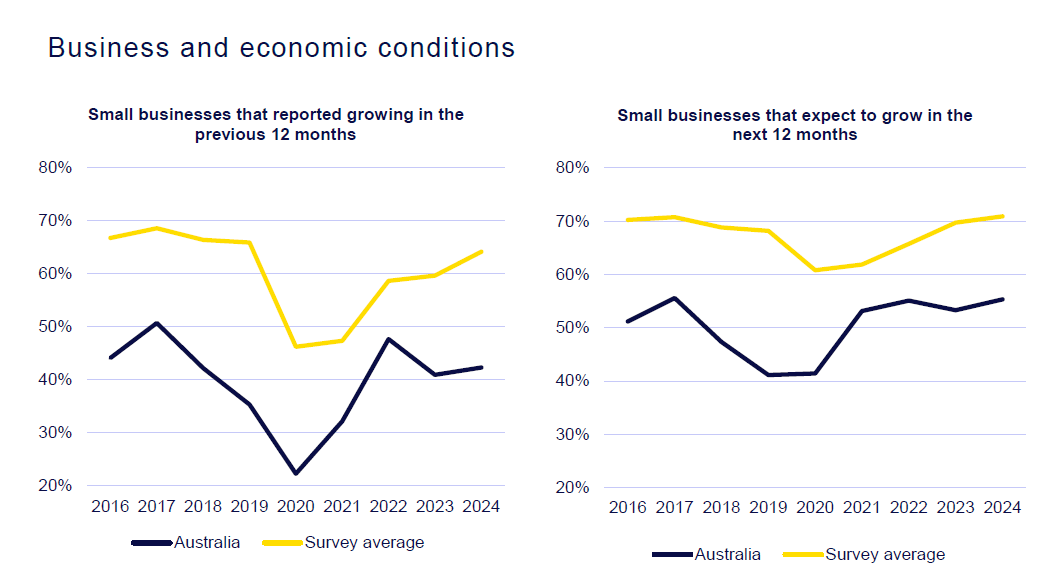
Australia is currently in a delicate phase of business expansion. According to CPA Australia, only 42% of Australian SMBs showed evidence of growth in 2024, compared to an Asia-Pacific average of 64%. However, this same report also showed signs of optimism, with 70% of business owners under age 40 expecting their businesses to grow throughout 2025.
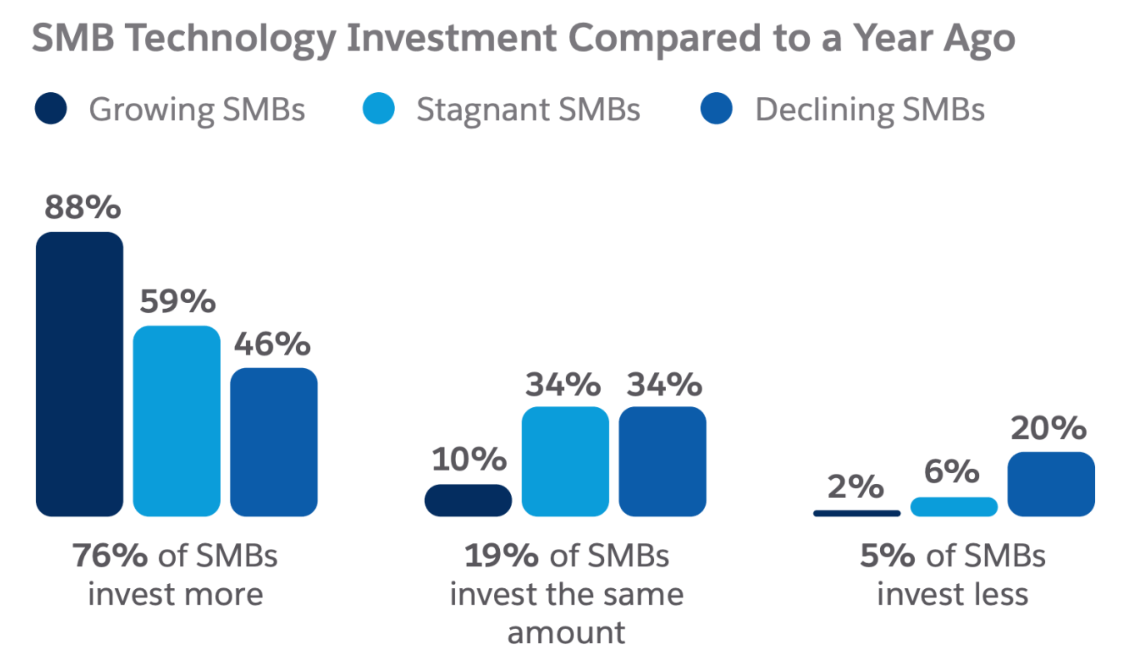
This is likely thanks in no small part to the increased investment in essential software and technology by many small businesses. As per our Small & Medium Business Trends Report, 76% of SMBs are increasing their spend on digital tools. Of those companies, 88% are considered to be growing SMBs.
How do digital technologies fuel business growth? Some of the main catalysts include:
- Enhanced collaboration: Many tools improve team collaboration with features like real-time communication, task tracking and project management.
- Accurate analytics: Reporting tools use data to generate tables, graphs and other easy-to-understand visualisations that provide insights into customer behaviour, sales trends and operational performance. Business leaders can then act on these insights.
- Market expansion: Ecommerce platforms can help businesses reach clients all over the world. These tools can help build a customer base and strengthen customer relationships by creating targeted marketing campaigns and managing a company’s social media presence.
- Cost savings: When you implement the right tools, you reduce the need for manual labour and minimise human error, helping your business save money. These savings can then be applied to other areas, such as product development or marketing.
All of this works together to help you operate smarter and accelerate your business growth.
Become an Agentic Enterprise: A Step-by-Step Guide
Get a practical roadmap for transforming AI potential into business reality.
Think big with small business tools from Salesforce
Small business tools are essential for today’s businesses to stay productive. These digital tools have revolutionised the workforce, enhancing efficiency through automation. And as technology continues to grow and become more standardised and integrated, it won’t be long before all businesses are benefiting from intelligent operational ecosystems.
Salesforce gives small businesses all the tools they’ll ever need to operate smoothly and kickstart their expansion. As well as the products mentioned in our list, our Starter Suite portfolio is perfect for businesses just starting out. It’s our all-in-one CRM that will help your organisation develop effective lead generation, collaborate seamlessly and deliver personalised customer journeys, all driven by powerful artificial intelligence (AI). Start your free 30-day trial today.
FAQs
Are small business tools expensive?
Most leading business tool providers will offer tiered packages when it comes to pricing. However, as with most things, the higher-quality tools from more reputable providers will be more expensive. Make sure you budget within your means when selecting your options.
Will these tools require technical knowledge?
All new tools will require some getting used to and will have some form of learning curve. However, most providers understand that many of their customers aren’t going to be tech experts, so they’re generally designed to be as user-friendly as possible.
What types of tools do small businesses need?
SMBs will need tools to cover core operations. These are departments that all businesses will have, regardless of sector or industry. They’ll typically include things such as accounting and invoicing tools, CRMs, marketing and inventory tools and project management tools.