

If you’re trying to manage the different elements of your business across multiple systems that don’t connect, you’ll be familiar with how time-consuming (and frustrating) this can be. This exact challenge is what leads businesses to look for ERP software that can manage it all.
ERP stands for Enterprise Resource Planning. It’s a business management system that allows you to manage your people, finance, products, and operations all in one place.
An ERP system uses a shared database that allows employees from across a business to see the same information in real-time. When you can see all your data in one place, it becomes easier to see where you can take action and mitigate risk.
An ERP is different from a customer relationship management (CRM) system. However, many businesses integrate the two platforms to get both of their benefits combined.
In this article, we’ll break down the core features of a modern ERP, why businesses use it, and how it compares to a CRM.
In this guide:
- What is ERP (enterprise resource planning) software?
- What are the benefits of using an ERP system?
- How does an ERP system work?
- ERP deployment models
- The key phases of an ERP deployment
- ERPs and CRMs: What’s the difference?
- Why do businesses integrate their ERP and CRM?
- Is Salesforce an ERP?
- How can you integrate Salesforce CRM with an ERP?
- FAQs
Just getting started on your CRM journey?
Learn everything you need to know about finding, winning, and keeping customers with The Beginner’s Guide to CRM.


What is ERP (enterprise resource planning) software?
ERP software allows you to manage the operational backbone of your business. It gives teams a single view of finance, inventory, supply chain, procurement, and HR. Having all this data in one place reduces manual work and improves decision-making.
Its core features include:
- Finance tools: Track revenue and expenses, manage budget, bills, and payments, and generate financial reports
- HR management: Manage payroll, hiring, timesheets, and plan staff rosters
- Supply chain management (SCM): Monitor stock, manage suppliers, oversee manufacturing, shipping, and orders
- Project management: Plan projects, track tasks, and ensure costs are within budget
- E-commerce tools: Connect online sales with real inventory, orders, and fulfilment
- Procurement tools: Handle buying, comparing suppliers, and keeping track of purchase orders
- Reporting functions: Turn business data into dashboards, reports, and insights to inform smarter business decisions
- Compliance management: Helps ensure taxes and audits are completed correctly; some software also includes industry-specific compliance tools
What are the benefits of using an ERP system?
There are many benefits of using an ERP system for businesses. Having one unified place for all data can reduce silos and improve efficiency across an enterprise. Here are some of the main advantages of using an ERP.
Enhanced collaboration
Collaboration is simplified when all data is shared, and employees can easily see and share information on contracts, requisitions, and purchase orders. When everyone in the business is connected to the same information, collaboration is much easier.
Improved business insight
Real-time information allows everyone in an organisation to have an up-to-date view of data, which can improve decision-making across all areas of a business. With an ERP, everyone is looking at the same information simultaneously, and there is no risk of specific departments working off outdated documents.
Better financial compliance
The financial controls with an ERP reduce any margin for error. Increased data integrity means users will always be working with up-to-date information, which also reduces the chances that something will be missed and can improve financial compliance.
Reduced costs
When everything runs through one system, you spend less time fixing mistakes, chasing missing numbers, or paying for multiple tools that all do similar things. It cuts down on wasted admin hours and helps keep day-to-day running costs under control.
Scalability
As your business grows, an ERP can help you keep everything organised without needing to rebuild your systems. It gives you space to grow without creating extra manual work.
How does an ERP system work?
An ERP works by connecting all your everyday business tasks to one central system. Instead of teams updating information in different places, the data moves between the different parts of the software that need it. For example, when a new sale is made, the ERP can automatically check stock levels, update the finances, and notify the warehouse.
To do this, most ERPs follow a similar setup:
- Modular design: Each area of the business (like finance, HR, or inventory) sits in its own module, but they all work together. This means data is shared, but your team only has to work on the part relevant to their work.
- Built-in workflows: When something changes in the system, it triggers the next step automatically. For example, when an invoice is paid, the system updates the customer’s balance straight away.
In practice, this is how an ERP workflow could operate:
- New sales order: A sales rep enters a new sale in their module, or in a CRM that’s integrated with their ERP
- Inventory: The ERP then instantly checks stock levels through the supply chain module and updates inventory levels in real time
- Finance: The finance module then records the sale, updates accounts receivable, and adds it to the next revenue report
- Fulfilment: The warehouse receives the order automatically and can start preparing the shipment
All of this would typically need to be done manually or across different systems. An ERP manages all of this so that your people can focus on the task at hand, instead of ferrying information back and forth between departments.
ERP deployment models
An ERP deployment model refers to where the system operates from. This could be on the cloud, on your own servers, or as a mix of both. The right choice will depend on your budget, IT resources, and how much control you need over your data.
Here’s a quick snapshot of the differences:
ERP Deployment Models
| Model | Description | Advantages | Disadvantages |
|---|---|---|---|
| Cloud ERP | It’s hosted by the vendor, and you access it online (the SaaS model). | Lower upfront cost, no IT maintenance, and updates happen automatically. | You get less control over customisation and you pay ongoing subscription fees. |
| On-premises ERP | Installed on your own servers and managed by an internal team. | Full control over your data and how everything is set up. | It costs more upfront, and you need an in-house IT team to manage it. |
| Hybrid ERP | Mix of on-premises and cloud systems. | Flexibility to keep some systems in-house while still using cloud features. | It can be the most complex to maintain and harder to keep your data in sync. |
The key phases of an ERP deployment
Rolling out an ERP usually happens in stages. Each phase builds on the last, helping you move from the planning stage to a fully working system. Ideally, if you do this well, you won’t disrupt any day-to-day operations.
Here are the phases most businesses go through when implementing an ERP:
Step 1: Discovery and planning
This is the early stage where teams lay out their goals, map out their current processes, choose the features they need, and build an implementation project plan. It’s also the stage where you compare vendors and choose the system you’ll move forward with.
Step 2: Design
This step takes everything learned in planning and turns it into a clear blueprint for how the ERP should work. Teams at this stage decide what the workflows should look like and what each module needs to fit their unique business operations.
Step 3: Development
The ERP should then be configured and customised based on the design plans. If you have legacy systems, the data will need to be organised and prepared for migration. On top of this, integrations with existing tools will need to be connected.
Step 4: Testing
The team then needs to thoroughly check that the system works the way it should. This includes testing the workflows, double-checking data accuracy, reviewing user permissions, and making sure any custom features are behaving correctly.
Step 5: Deployment
This is when the ERP goes live. Data has finished being migrated into the new system, teams can start using it for their daily work, and the old tools are gradually phased out.
Step 6: Support and training
Remember that teams will need training so they feel confident using the new system. You’ll also want to have a plan for ongoing support in case people face issues or need to adjust the workflows.
With more than 70% of ERP initiatives failing to meet their original goals, following these phases helps reduce that risk and gives your team a clear path to success.
ERPs and CRMs: What’s the difference?
Both are wide-reaching business systems, but an ERP runs the internal side of the business while a CRM manages everything to do with customers.
Here’s a deeper look at their differences:
The Difference Between ERPs and CRMs
| Feature | ERP | CRM |
|---|---|---|
| What it focuses on | The internal work that keeps the business running, like finance, HR, and operations. | Everything to do with customers, like sales, marketing, and support. |
| What it helps with | Managing money, staff, stock, procurement, and the supply chain. | Managing leads, customer conversations, sales pipelines, and marketing. |
| Who uses it | Finance teams, operations, HR, and supply chain staff. | Sales reps, marketers, and customer service teams. |
| Main goal | Make everyday work smoother through automation behind the scenes. | Grow revenue and improve the customer experience. |
| The type of data it stores | Transactional and operational data (like orders, stock levels, and invoices). | Customer behaviour and engagement data (like interactions, preferences, and purchase history). |
Experience Salesforce with an interactive demo.
Get hands on with our products and explore real use cases and solutions built for agentic enterprises.
Why do businesses integrate their ERP and CRM?
A CRM provides businesses with consolidated views of various functions, such as sales and service, while an ERP includes functionality like inventory management, production, supply chain, and finance. Integrating them gives your business a complete view of its customers and its financial performance in one place.
There are many reasons why businesses should consider integrating their ERP with their CRM, including:
End-to-end visibility of your business processes
You can take complete customer views to the next level with the added understanding of how they impact your business’s financials.
Improved efficiency
Workflows can automate tasks between CRMs and ERPs and enhance your productivity. There is no need to manually enter CRM data into an ERP once it is integrated.
Better employee collaboration
Empower your employees with access to critical customer information, even if they do not work in your service or sales team. Giving everyone access to real-time data helps ensure the right decisions are made across the organisation.
Reduced data duplication
When you have an ERP and a CRM working separately, you may have customer data existing in both, leading to inaccuracies and out-of-date information. But even when it is accurate, it can cause unnecessary duplication, and it’s hard to determine which should be the master record. Integrating ensures there is only one record.
Speed up sales approvals
Sales and operations teams can move customers through an approvals process more quickly when they can be sure they have real-time customer data.
Lowered cost of IT support
When you have just one system to maintain, your IT support costs will reduce. With a fully integrated solution, you only need to train teams on one platform, reducing downtime.
More accurate reporting and forecasting
Because all of your data is accurate and in one place, an ERP improves reporting processes. Accurate forecasting is critical for a growing business, and integrating with an ERP automates some of the manual processes that can cause errors and delays in reporting.
Is Salesforce an ERP?
Salesforce is not an ERP. It’s the world’s #1 CRM (Customer Relationship Management) platform. However, it integrates easily with many of the world’s leading ERPs.
Some of the most common ERP businesses that connect Salesforce with include:
A strong example of how this works in practice is Kellanova. They used Salesforce Data Cloud and brought together data from more than 20 systems, including their ERP, demand and supply planning tools, and financial reporting, to power a new trade promotion management process.
Scale quickly and efficiently with Starter Suite.
Get marketing, sales, service and commerce tools all in one easy-to-use suite. Starter is a simplified CRM designed to help growing businesses find new leads, win more deals and keep customers happy.
How can you integrate Salesforce CRM with an ERP?
It’s simple to integrate Salesforce with your ERP and reap the benefits.
You used to need to use complex systems to integrate legacy ERP systems with Salesforce CRM. However, modern cloud-based ERPs allow for easy integration. With some providers building ERP natively on the Salesforce platform, it is possible to run both CRM and ERP seamlessly on Salesforce.
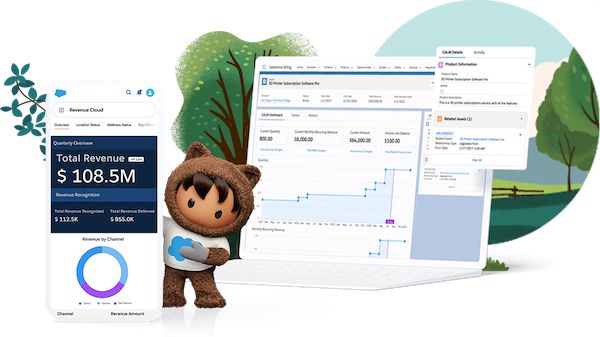
One aspect of Salesforce that makes for straightforward integration is Salesforce Billing. Salesforce Billing converts Salesforce CPQ’s lead-to-order data into transactional data. The conversion allows ERP systems to inherit matching data, which they can use for accounting functions.
Salesforce’s MuleSoft also makes it easy to integrate CRM, ERP, and other applications. The MuleSoft Anypoint Platform helps businesses integrate data and connect experiences from any system. With MuleSoft, you can bring data from any third-party system, such as SAP, Oracle, or Workday, into Salesforce. Visit our MuleSoft Anypoint Platform overview to learn more.
FAQs
What does ERP stand for?
ERP stands for Enterprise Resource Planning (ERP). It’s a system that brings your core business functions together, things like finance and accounting, human resource management, cash management, production planning, and more. This allows you to increase efficiency and run your operations more smoothly.
Does my small business need an ERP?
Not every small business needs an ERP. It really comes down to how you’re running your operations and how cumbersome it is. If you’re relying on spreadsheets, juggling disconnected systems, or spending too much time fixing data issues, an ERP solution can help by giving you a single source of truth.
This is helpful for things like project accounting, expense management, workforce management, and supplier relationships.
Where is the data from an ERP held, and is it safe?
This depends on the types of ERP you choose.
- Cloud solutions store your data securely in the provider’s data centres.
- On-premises systems store data on your own hardware.
Leading ERP providers use business intelligence, encryption, and strict access controls to keep your information safe.
What are the 5 components of an ERP?
While every ERP suite is different, most include:
- Finance and accounting
- Human resource tools
- Supply chain or material requirements planning
- Production planning or operations
- Performance management and reporting
How is AI used in ERP systems?
Modern ERPs use artificial intelligence (AI), machine learning, and generative AI to automate tasks, support better decisions, and provide real-time insights.
AI helps with things like forecasting, project accounting, enterprise performance management, cash management, and identifying risks.
Who is the biggest ERP company?
The largest ERP company in the world is SAP, followed closely by Oracle and Microsoft. These three dominate the global ERP market and provide full ERP software system platforms that can handle complex operations, advanced financial management, production planning, and large-scale data needs.