
Key Takeaways
- AI is now mainstream at work, with 66 per cent of Australians using at least one tool regularly, but usage remains fragmented across multiple platforms.
- More than half (56 per cent) of workers using AI report relying on tools not approved by their employer, reinforcing ongoing governance and security risks.
- Despite widespread adoption, even among Australian desk workers, only 9 per cent say AI is embedded in their day-to-day workflows, pointing to a gap between experimentation and real business impact.
AI is being widely used across Australian workplaces, but inconsistent tools, disconnected systems and uneven adoption might be preventing organisations from turning momentum into real business impact.
According to new Salesforce research conducted by YouGov, two in three (66 per cent) workers are already using at least one AI tool regularly at work for tasks such as writing and research to automation and customer service.
While this signals that AI has reached mainstream adoption, the independent study of 1,293 Australians also revealed this rapid uptake is happening in a fragmented way. Many workers (27 per cent) are juggling multiple tools, switching platforms depending on the task, and often operating outside consistent organisational frameworks.
Australian workers have embraced AI faster than most organisations expected, but adoption without integration is just noise.
Justin Tauber, GM Agentic Technology, Trust and Adoption, Salesforce
This points to the emergence of workplace environments where AI activity is high, but standardisation and integration are still evolving. Employee preferences reflect this split, with 39 per cent favouring standalone tools and 38 per cent preferring tools integrated into existing systems.
Fragmented AI adoption is also creating operational and governance challenges, with the data showing more than half (56 per cent) of Australian workers who use AI at work are using tools that were not provided or approved by their employer.
Rather than a standalone compliance issue, the use of shadow AI reflects a broader lack of standardisation, with employees assembling their own toolsets to meet immediate needs.
This is also reflected in how organisations are adopting agentic AI, with data pointing to a multi-agents approach with an average of 11 agents used per organisations in Australia.
Adoption is accelerating but not yet embedded
Despite widespread usage, many organisations remain in the early stages of AI maturity.
Separate global Salesforce research released this month of more than 1,500 desk workers has highlighted a gap between experimentation and true operational integration, with 40 per cent of Australian works identifying as AI sceptics in some form.
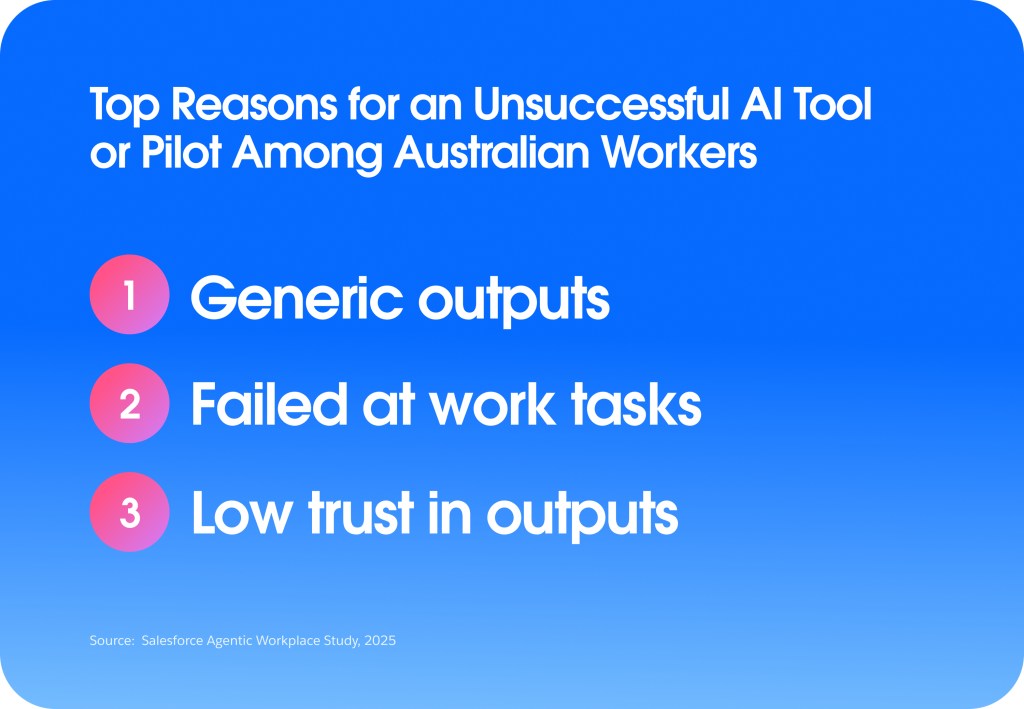
Among those Australians who are still developing trust and confidence in their AI usage, the most common challenges include:
- Poor performance in real-world scenarios (36%)
- Generic outputs (36%)
- Low trust in results (30%)
- Lack of trust in outputs (29%)
- Insufficient training (24%)
- Results lacking business context (20%)
“Australian workers have embraced AI faster than most organisations expected, but adoption without integration is just noise,” noted Justin Tauber, GM Agentic Technology, Trust and Adoption, Salesforce. “What we’re seeing now is a trust gap, with employees reaching for tools that work for them individually, without the data context, security guardrails, or workflow coherence that makes AI genuinely useful at scale.”
“Closing that gap is an organisational capability problem, and the organisations that solve it first will be the ones that turn AI activity into a real competitive advantage”
Salesforce’s global research shows organisations that scale AI successfully share common characteristics, including access to training, AI embedded into workflows, and strong trust in secure, context-aware systems.
“When we get AI fluency right, AI moves from a technology innovation into a workforce advantage. It’s the difference between deploying tools and actually changing how work gets done,” said Nathalie Scardino, President and Chief People Officer at Salesforce.
The customer perspective
For Julius Anuari, Salesforce Product Owner and Platform Lead for Eightcap, adopting agentic AI across the organisation is key to its future success. “Our business has made a big decision to become an agentic enterprise. What we really want to do is operate smart and at scale, servicing as many people as possible in the shortest time possible.”
“That’s where AI earns its trust: not in theory, but in the measurable impact. The moment you have the measurement and can present the results, you can help demystify AI and build trust internally. We’re now all using AI every day, so the question isn’t whether it will take your job, it’s how you can involve it to handle the mundane so humans can deal with the complexity.”
More information
- Find out how Australian service leaders are implementing agentic AI.
- See how thousands of Trailblazers learned about the agentic enterprise at World Tour Melbourne.
Methodology
AI Use and Preferences, Australian Survey Methodology: The study was conducted online between 18th – 22nd May 2026. The sample is comprised of a nationally representative sample of 1,293 Australians aged 18 years and older. Respondents are sourced from the YouGov panel.Following the completion of interviewing, the data was weighted by age, gender and region to reflect the latest ABS population estimates. Significant differences have been reported at the 95% confidence interval. This study has been carried out in accordance with the ISO 20252:2019 standards, to which YouGov is accredited.
Global Survey Methodology: In partnership with YouGov, Salesforce conducted a double-blind online survey among over 1,500 desk workers, defined as workers who consider their day-to-day job primarily mental labor over manual or task-based labor and were required to have at least minimal familiarity with AI, in Australia, India, Japan, Singapore, France, Germany, Italy, Netherlands, Spain, United Kingdom, Mexico, United States, and Canada. The survey was conducted from December 2025 to January 2026. The sample is representative across job roles, industries, and business size.