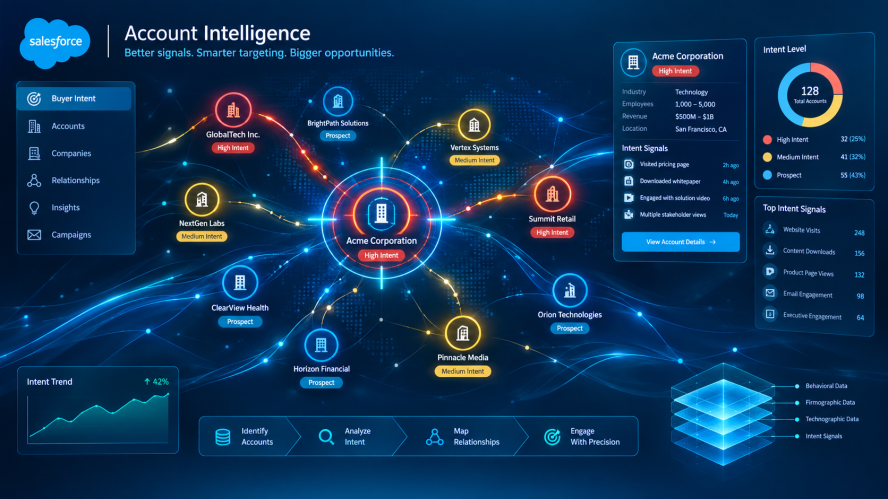



The old way of B2B lead detection is dead. For decades, marketers relied on a simple equation: form fill = sales-qualified lead. A prospect downloads your whitepaper, signs up for your webinar, or clicks your email—and boom, they’re labeled as a lead. Sales teams chased hundreds of these leads monthly, hoping some would convert.
The problem? Most of them won’t.
Traditional lead scoring misses what actually matters: which companies are actively buying right now. A single form submission tells you almost nothing. That person could be a student researching competitors, an employee checking out the market, or a casual browser. You don’t know which account they represent, what their buying stage is, or whether they fit your ideal customer profile.
As a result, marketing teams waste tens of thousands of dollars generating low-quality leads. Sales teams waste even more time chasing them. Sales cycles stretch. Close rates plummet. Everyone loses.
But there’s a better way.
In 2024-2026, the winning B2B companies aren’t the ones with the biggest marketing budgets or the most aggressive sales tactics. They’re the ones who combine intent data, account identification, and AI to find the right companies at exactly the right time—when they’re actively buying. These companies reach prospects before competitors do. They close faster. Their sales cycles are half as long. Their close rates are triple the industry average.
This article explains how. We’ll cover what intent data is, why it works, how the leading Salesforce products enable it, and how to implement it in your organization. By the end, you’ll understand why traditional B2B lead detection is obsolete—and why your competitors are already building their advantage.
Understanding B2B Lead Detection: The Foundation
Traditional B2B Lead Detection
For the past two decades, B2B lead detection worked like this: identify people who took specific actions (form fills, email signups, content downloads), assign them a score based on engagement level, and pass high-scoring leads to sales. It’s quantifiable, scalable, and simple.
It’s also almost completely broken.
Traditional lead scoring has three critical flaws. First, you don’t know who’s behind the action. One person filling out a form doesn’t tell you anything about their company, buying authority, or budget. Second, you lack context. You see they opened an email or read a blog post, but not why, or what other research they’re doing. Third, you’re always reactive. By the time someone fills out a form on your website, they may have already contacted three competitors.
Modern B2B Lead Detection: Account-Centric, Intent-Driven
Modern B2B lead detection flips the equation. Instead of focusing on individual leads, you focus on accounts. Instead of relying on website behavior alone, you incorporate intent data, firmographic data, and behavioral signals. Instead of waiting for prospects to raise their hands, you reach them when they’re actively researching solutions.
Here’s the difference: A prospect visits your website, reads your pricing page, and watches your demo video. Under traditional scoring, they’re a warm lead. Under modern detection, you know they’re from Acme Corp (revenue: $500M, tech industry, perfect ICP match), they’ve read 15 third-party articles about solutions in your category in the past week, and competitive intelligence shows they’re evaluating your top three competitors. They’re not just warm—they’re hot. Sales should call today.
The Five Components of Modern B2B Lead Detection
Firmographic Data — Company size, industry, revenue, location, growth trajectory
Behavioral Data — Website visits, content engagement, email interaction
Intent Data — Which companies are actively researching your category
Account Identification — Reveals company and role of unknown website visitors
AI & Predictive Scoring — Predicts purchase likelihood in real-time
Why This Matters for B2B Companies
You can’t reach every company. You can’t afford to spend equally on every prospect. You need to focus your sales and marketing efforts on the highest-probability accounts. Intent data tells you exactly which accounts are worth the effort—and crucially, when they’re worth it. Instead of chasing 200 mediocre leads, you reach out to 20 hot ones. Your conversion rate triples. Your sales cycle cuts in half. Your marketing ROI explodes.
Intent Data Explained: The Secret Weapon
What Is Intent Data?
Intent data is the digital breadcrumb trail that reveals when a company is actively researching a product or solution. It answers the question: ‘Which companies are buying right now?’
Companies in buying mode leave traces everywhere. They visit your website. They read third-party reviews on G2 and Capterra. They search for comparison articles (‘Monday vs. Asana’, ‘HubSpot alternatives’). They download implementation guides and RFP templates. They browse competitor websites. Intent data platforms track these behaviors across thousands of B2B websites and sources, aggregate them, and score them.
Types of Intent Data
First-Party Intent Data: Data you collect from your own website and properties. Website visits, email opens, form submissions. Most accurate but limited scope.
Third-Party Intent Data: Data from external publishers, review sites, and industry websites. Shows what companies research across the web. Broader view but less precise.
Keyword Intent Data: Search terms companies use. Reveals buying stage (‘best CRM’ vs. ‘CRM pricing’ vs. ‘CRM comparison’).
Topic-Based Intent Data: Companies engaging with content on specific topics. If you sell HR software, companies researching ’employee retention’ are prospects.
How Intent Data Works (Simplified)
Step 1 – Data Collection: Intent platforms track behavior across thousands of B2B websites. They see: Company X visits Site A, reads Article B, downloads Resource C.
Step 2 – Company Identification: Technology identifies the company using IP address, device tracking, and database matching.
Step 3 – Scoring: Algorithm assigns intent score (1-100). Higher score = more likely to buy.
Step 4 – Action: High-intent accounts are fed to your Salesforce system, triggering sales outreach, marketing campaigns, or alert notifications.
Real-World Example: Project Management Software
Scenario: Your company sells project management software.
Company A (100+ employees, tech industry) shows these signals in one week:• Visits your website 15 times• Reads: ‘Monday.com vs. Asana’ comparison• Watches 3 product demo videos• Checks your pricing page• Downloads: ‘Project Management Implementation Guide’• Reads 8 third-party articles on PM software• Searches Google for ‘project management tool comparison’Intent Score: 92/100 (VERY HIGH)
Action: Your sales team calls today with a personalized pitch. They’re ready to buy. Without intent data, you’d add them to an email nurture sequence. By then, they’d already buy from a competitor.
Why Intent Data Works
Timing: You reach them when they’re actively buying (highest conversion rates).
Relevance: You only target accounts that fit your ICP.
Efficiency: Sales focuses on right accounts instead of chasing cold leads.
Proactivity: You find them before they contact competitors.
ROI: Higher conversion rates = better marketing ROI.




How Salesforce Products Enable B2B Lead Detection & ABM
Salesforce Data Cloud (Customer Data Platform)
Salesforce Data Cloud is your customer data platform (CDP)—the connective tissue that brings first-party data, third-party intent data, and firmographic data into a single unified view.
How It Enables ABM: Without Data Cloud, intent data lives in isolation. Demandbase tells you Company X is high-intent, but how does that signal reach your sales team? Data Cloud solves this. It pulls intent scores from Demandbase, combines them with your website analytics, customer data, and company information, and creates a real-time, unified account profile. Sales can open Data Cloud and see: Company X – Intent Score 85/100, Revenue $200M+, Website Visits 20+, Pricing Page Views 5. Everything in one place.
Specific Capabilities: Real-time scoring updates as new signals arrive. Predictive insights powered by AI. Audience segmentation based on intent + behavior + company data.
Salesforce Sales Cloud (CRM)
Sales Cloud is where deals live. It’s your CRM for managing accounts, opportunities, and pipeline.
How It Enables ABM: Intent scores flow into Sales Cloud. Account records show which companies are actively buying. List views automatically surface high-intent accounts. When a high-intent lead is detected, Sales Cloud can automatically route them to the right account executive. Knowing an account is in buying mode, sales reps tailor their pitch to the company’s research stage, dramatically shortening sales cycles.
Use Case: Your target account list includes 50 high-value companies. Intent data shows Company X is actively buying. Sales Cloud creates an opportunity automatically, assigns it to your top rep, and surfaces all interaction history. Your rep calls armed with research: ‘I see you’ve visited our site 20 times and downloaded three case studies.’ Deal closes faster.
Salesforce Marketing Cloud (Marketing Automation)
Marketing Cloud powers account-based marketing campaigns. Instead of sending generic emails to thousands of leads, you send personalized campaigns to high-intent accounts.
How It Enables ABM: Traditional marketing sends the same email to 10,000 people. ABM with Marketing Cloud targets 100 high-intent accounts with personalized content. Company researching ‘implementation’? Sends case studies. Company comparing competitors? Sends comparison guides. Personalization is dynamic, based on intent data and company attributes.
Use Case: High-intent account identified. Marketing Cloud automatically enrolls them in personalized email journey. Day 1: CEO-level messaging. Day 3: Implementation case study. Day 5: Product demo. If they engage, sales is notified immediately. ABM at scale.
Salesforce Einstein (AI & Predictions)
Einstein is Salesforce’s AI engine, embedded across products.
How It Enables ABM: Einstein Lead Scoring combines intent data, historical close data, and engagement signals to predict which leads will close. Instead of manual scoring rules, AI learns from your data. Einstein recommendations tell reps: ‘This account is 88% likely to close—emphasize ROI and implementation speed.’
Benefit: Predictions are more accurate than human intuition. Sales prioritizes better. Close rates improve.
Salesforce Agentforce (AI Agents)
Agentforce uses AI agents to automate workflows and customer interactions.
How It Enables ABM: High-intent account visits your website at 2am. Agentforce chat engages immediately: ‘I see you’re from Company X. Interested in learning how we help Fortune 500 companies?’ Prospect engages. Agentforce qualifies them, books a meeting, and your sales team gets notified by morning. Without Agentforce, you’d miss the opportunity until business hours.
Benefit: 24/7 engagement. You never miss a high-intent prospect. Faster response times = higher conversion.
The Complete Stack: How It All Works Together
Detection → Unification → Prioritization → Engagement → Acceleration → Measurement → Optimization
Day 1 (Detection): Demandbase detects Company X is high-intent (researching solutions, visiting website). Intent score: 85/100.
Day 1 (Unification): Data Cloud pulls intent score (85) + company size (5,000 employees) + industry (Tech) into unified profile.
Day 1 (Prioritization): Sales Cloud updates account score to 92/100, routes to top account executive.
Day 2 (Engagement): Marketing Cloud sends personalized ABM emails. Agentforce responds to website chats. Slack alerts sales team.
Day 3 (Acceleration): VP Sales calls Company X. Einstein provides: ‘88% likely to close—emphasize ROI.’ Sales rep uses insights. Meeting scheduled.
Day 10 (Measurement): Opportunity created in Sales Cloud. Pipeline forecast updated.
Day 60 (Analysis): Company X becomes customer. Tableau dashboard shows high-intent lead closed at 45% rate vs. 20% average.
This entire flow is impossible without Salesforce + intent data integration.
Implementation Strategy: Getting Started
Step 1: Assess Current State
What tools do you use? What’s your current lead detection approach? How effective is it (conversion rate, sales cycle length)?
Step 2: Define Your ICP
Define ideal company size, industry, geography, technology stack, and use case.
Step 3: Choose Intent Data Partner
Evaluate Demandbase, 6sense, Clearbit, Terminus, ZoomInfo. Critical: Does it integrate with Salesforce?
Step 4: Implement Salesforce Foundation
Set up Sales Cloud accounts/opportunities, Marketing Cloud for campaigns, Data Cloud for data consolidation.
Step 5: Connect Intent Data to Salesforce
Set up data flow from intent platform to Salesforce. Map intent scores to account scores.
Step 6: Build ABM Program
Identify target accounts. Build targeted campaigns. Empower sales team.
Step 7: Launch & Monitor
Month 1: Soft launch. Track: # high-intent accounts, # engaged, conversion rate. Month 2-3: Expand based on learnings.
Timeline: 3-6 months to full implementation and ROI visibility.
Measuring ABM Program ROI
Key Metrics
Account-Level: # target accounts, # with engagement, conversion rate, average deal size, sales cycle length.
Program Metrics: Total revenue from ABM accounts, program cost, ROI (revenue/cost), CAC, LTV.
Example ROI Calculation
Before ABM: Sales cycle 90 days, close rate 15%, deal size $100K, CAC $8,000
After ABM: Sales cycle 45 days, close rate 35%, deal size $150K, CAC $4,000
Results: 10 deals closed (vs. 5 without) = $1.5M revenue. Program cost: $300K. ROI: 4:1 return (400% ROI).
Real-World Case Study: B2B SaaS Platform
Company Profile
B2B SaaS company, $10M ARR, 50-person sales team, 3-person marketing team. Challenge: 120-day sales cycles, 12% close rates.
The Problem
Sales team calling wrong companies. Marketing generated 200/month leads, but only 20% qualified. Sales didn’t trust marketing leads.
The Solution
Implemented Demandbase intent data. Integrated with Salesforce Sales Cloud and Marketing Cloud. Set up Data Cloud for unified profiles.
Results
Sales cycle reduced 57%. Close rate increased 133%. Deal size grew 93%. Sales productivity improved 162%. Marketing ROI improved 433%.
Common Challenges & Solutions
Challenge 1: Cost
Intent data tools can cost $30K-$500K+/year. Solution: Calculate ROI. If you close 3x faster and 2x larger deals, it pays for itself quickly.
Challenge 2: Implementation Complexity
Integrating intent data with Salesforce requires technical work. Solution: Work with implementation partner. Allow 2-3 months.
Challenge 3: Sales Adoption
Sales team may resist new process. Solution: Show early wins. Get top performers using it first. Let results speak.
Challenge 4: Data Quality
Not all intent signals are predictive. Solution: Start with pilot. Test what works for your business. Focus on highest-confidence signals.
The Future of B2B Lead Detection
What’s changing in 2026 and beyond:
AI Gets Smarter: Intent signals become more predictive. AI combines signals in new ways. Buyers identified earlier in journey.
Real-Time Everything: Intent detected and acted on instantaneously. Agentforce agents engage in seconds.
Privacy Evolution: First-party intent data becomes more valuable. Website data and engagement signals become primary.
Predictive Expansion: Not just finding new customers. Predicting which current customers will expand or churn.
Integration Deepens: Intent data visible everywhere—Sales Cloud, Marketing Cloud, customer success, product teams.
Agentforce Takes Over: AI agents handle most lead engagement 24/7. Only high-intent, qualified opportunities go to humans.
The implication: Companies that master B2B lead detection in 2026 will dominate through 2030. Now is the time to get this right.
Conclusion: The Time to Act Is Now
Traditional B2B lead detection is broken. Volume-based approaches waste money and time. Sales teams chase cold leads while hot prospects slip to competitors.
But here’s the good news: You have the tools to fix it. Intent data platforms like Demandbase, 6sense, and Clearbit reveal which accounts are actively buying. Salesforce products (Data Cloud, Sales Cloud, Marketing Cloud, Einstein, Agentforce) turn those insights into action. ABM powered by intent data delivers measurable results: 50% shorter sales cycles, 2-3x higher close rates, 2x larger deals.
Your competitors are already building their advantage. The question isn’t whether to implement intent-based ABM—it’s how fast you can.