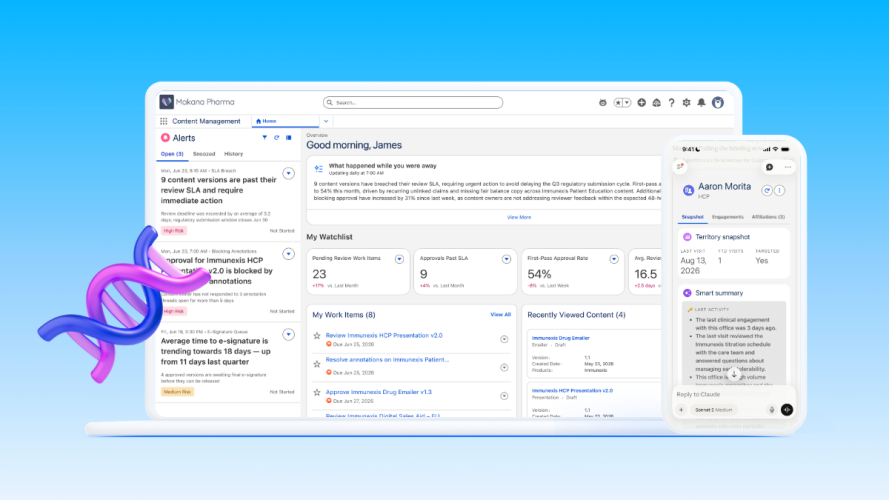



Organizations across life sciences are losing critical time across the entire business by operating reactively. Pharma teams spend months waiting for Medical, Legal, and Regulatory (MLR) reviews to clear marketing assets. Care gaps are identified too late and derail therapy adherence. Half of all drug launches underperform their pre-launch forecasts. MedTech companies also miss urgent surgical field signals that delay physician training and prolong hospital onboarding.
To help pharma and medtech organizations transform reactive operations to proactive intelligence, Salesforce today announced three new innovations: Regulated Content Management, Command Center, and Life Sciences MCP. This shift replaces slow compliance gates, missed field and clinical signals, and heavy IT integrations with proactive, enterprise AI. By embedding compliance at the point of content creation, organizations can surface operational risks before they escalate and bring governed intelligence to any channel or application.
See these innovations live at Dreamforce
See how life sciences organizations are rewriting the script across compliance, intelligence, and orchestration.

Regulated Content Management: From MLR Workflows to Compliant-by-Design
Rather than waiting until formal review to reconstruct regulatory context, Regulated Content Management (RCM) helps teams identify issues earlier and enter MLR review-ready. Compliance moves upstream, connecting claims, evidence, references and obligations across the content lifecycle. Built on Salesforce’s agentic platform, RCM combines governed compliance with agentic assistance across authoring, review, and lifecycle management while keeping human accountability at the center.
Purpose-Built Compliance Architecture
At the core of Regulated Content Management is compliance intelligence: treating claims, supporting evidence, references, market- and channel-specific obligations (such as Fair Balance or Important Safety Information), and the content that uses them as living, interconnected data. Agents can then surface changing or expiring substantiation, identify potential compliance gaps, and determine which claims and content require updates.
Embedded AI Agents Across the Workflow
Until today, agents were simply layered on top of fragmented processes and data, resulting in compliance gaps and re-work. Agents need trusted context across the business and marketing lifecycle: brand strategy, campaign objectives, audiences, and channels while being grounded in compliance intelligence.
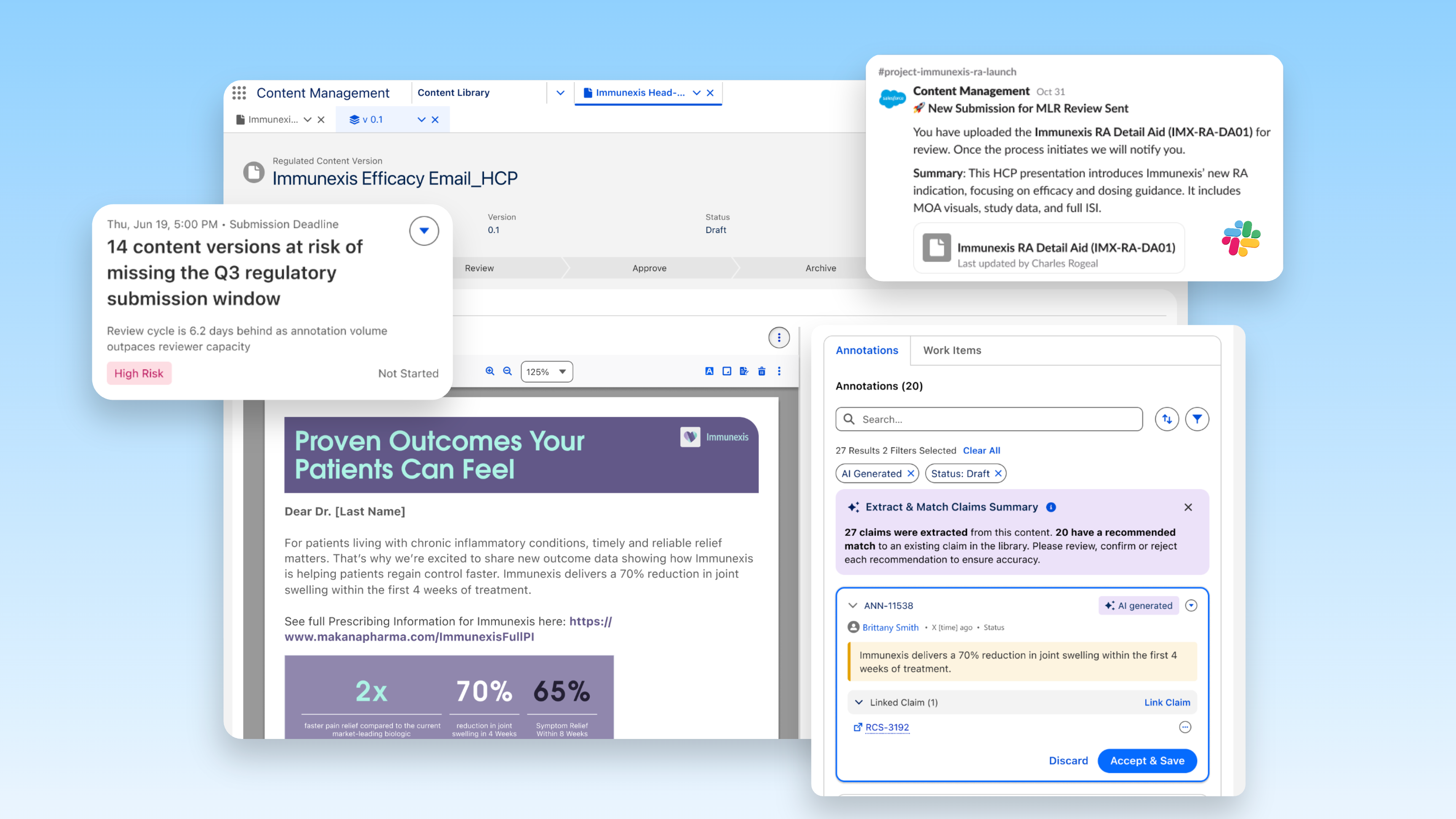
- Claims Management: Agents streamline a previously manual process by identifying claim statements in content, matching them to governed claim records, and surfacing approved claims supported by the appropriate evidence and references. Claims remain connected to approved use, market context, and downstream content throughout their lifecycle.
- Content Authoring: Generate and refine content grounded in brand strategy, campaign context, audience, and channel objectives from the broader marketing lifecycle. Together with embedded compliance and governance, teams can address brand and compliance obligations during content creation, rather than during review.
- Obligations Assistance: Agents can identify applicable market, audience, channel- and content-specific obligations, surface potential gaps, and identify downstream impacts when regulatory requirements or internal policies change.
Open, Connected Regulated Content Platform
RCM provides an open, federated compliance foundation that can work across the content lifecycle without requiring customers to consolidate content into a single repository. Salesforce-native experiences can coexist with existing DAMs, CMS, authoring platforms, and downstream channels, while RCM maintains the governed compliance intelligence and relationships behind the content.
RCM equips compliance officers, brand leads, and reviewers to scale market-ready content with complete auditability. Every change, annotation, review action, and approval is traced with an immutable audit reporting trail: Attributable, Legible, Contemporaneous, Original, Accurate, and Complete (ALCOA+). And when it’s time to sign off on content, RCM supports 21 CFR Part 11-compliant electronic signatures and approval capture appropriate to regulated review processes.
Take a deeper dive on Regulated Content Management
Learn more about the vision and capabilities for regulated content across life sciences.

Command Center for Life Sciences: Real-Time Signals and Proactive Orchestration
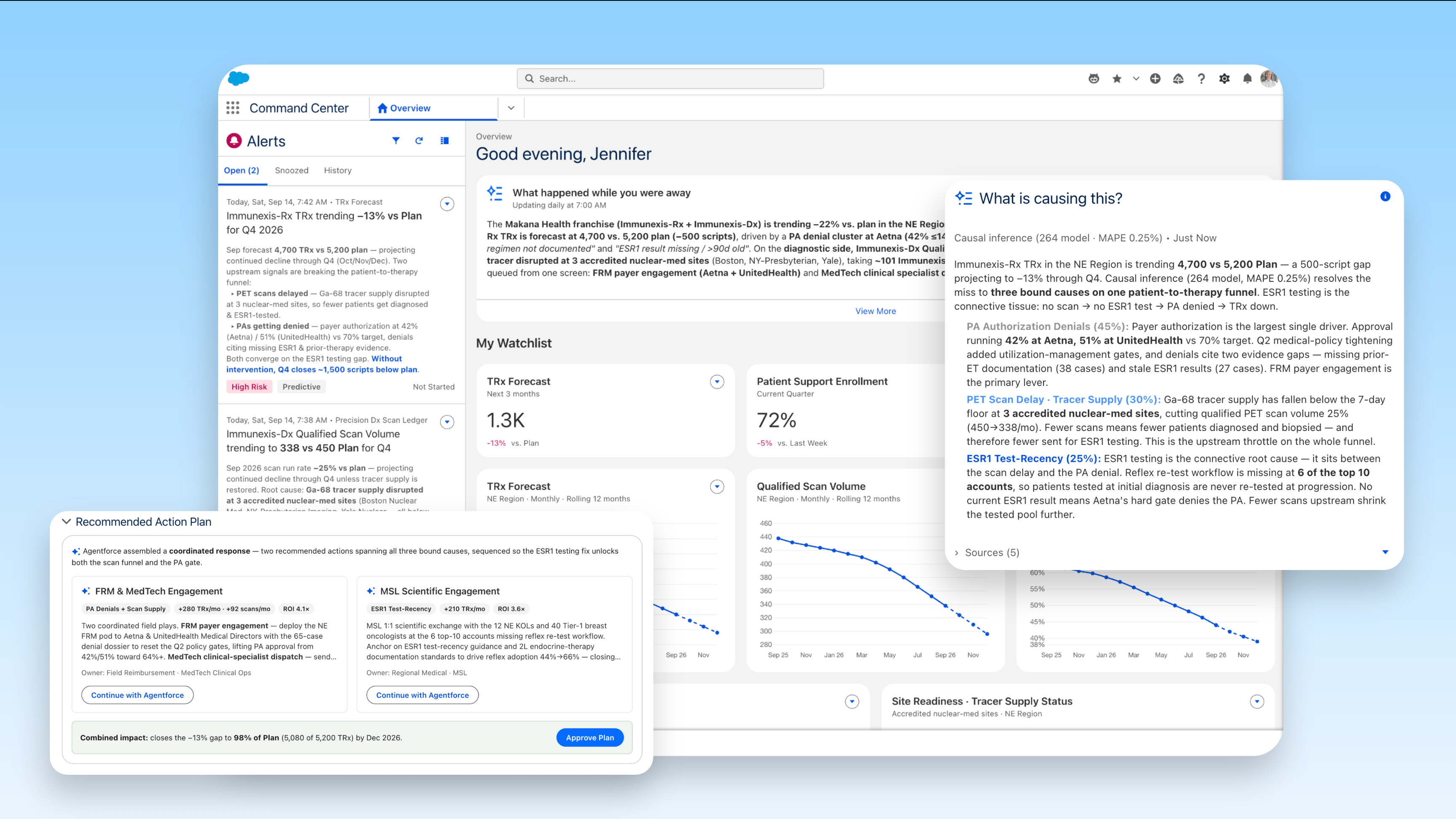
Command Center for Life Sciences operates as the nerve center of the organization, not only surfacing signals, but also providing reasoning and action.
- Customer Signals Intelligence: Consolidates omnichannel engagement, market sentiment, and revenue trends into a single operational view.
- Anomaly Detection & Root Cause Analysis: Automatically identifies operational deviations—such as safety signal spikes, medtech device adoption lags, or drop-offs in patient adherence—and links them directly to their underlying root causes.
- Recommended Mitigating Actions: Converts root-cause insights into automated tasks that can be executed directly or approved by humans in the loop, across any channel or surface with AIForce.
- Command Center Agent: Executes on resolution workflows and mitigating actions while keeping humans in the loop, both in Command Center and other surfaces, like Slack.
- Interactive Predictive Analysis: Powered by Tableau Next, leaders can model “what-if” scenarios, such as increasing medical science liaison (MSL) hours, dispatching clinical specialists to health systems, or reallocating territory field rep coverage to combat market shifts.
Every signal across clinical, commercial, patient services, and medical is unified, proactively surfaced, and addressed before ever posing a risk. For example, new evidence from medical affairs teams can be surfaced right in Regulated Content Management, with action plans for new content created by the Command Center Agent that can be executed across any surface.
Life Sciences MCP: Proactive Intelligence on Any Surface
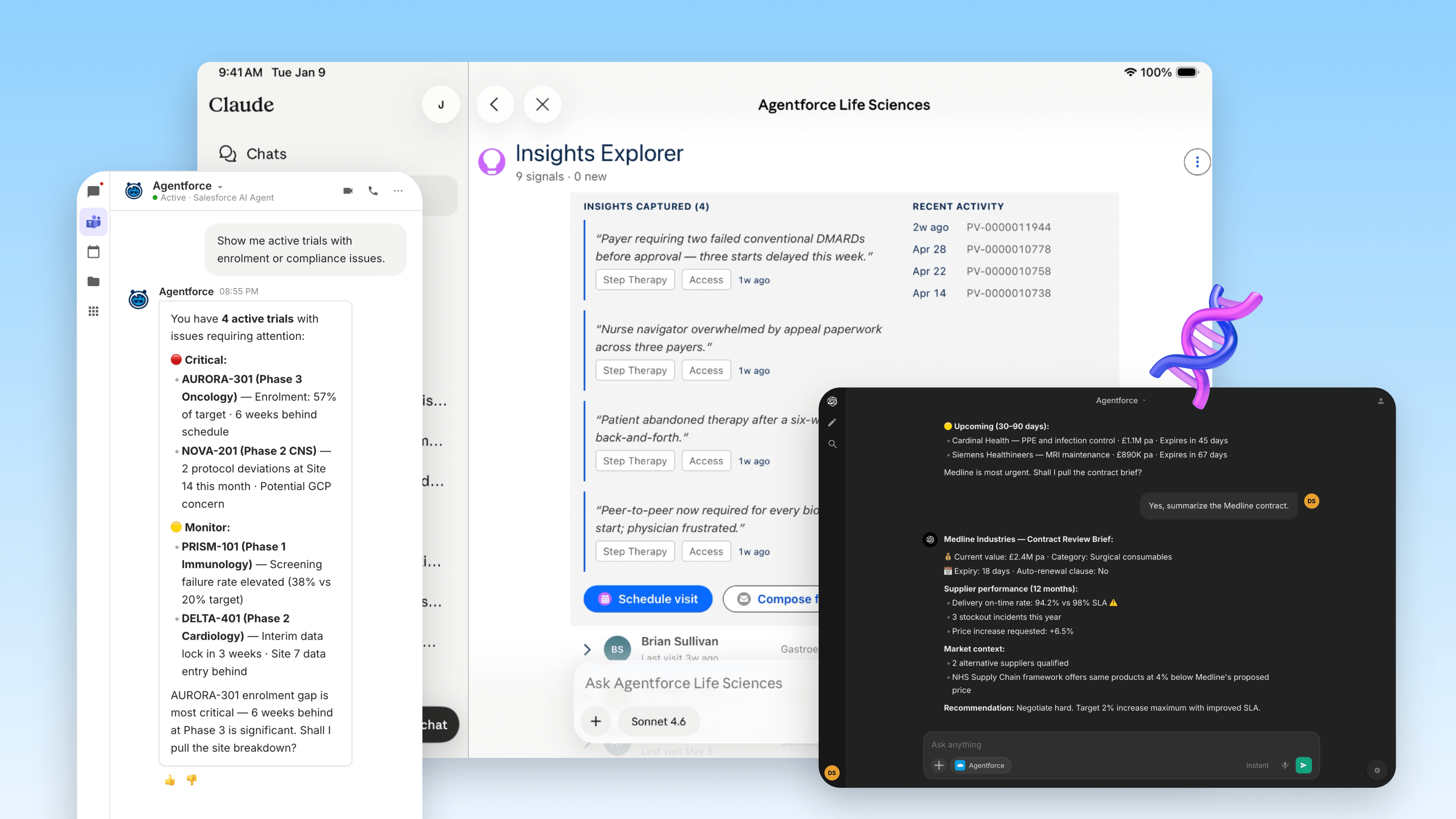
Your teams, partners, and external systems do not live entirely within a single user interface. Life Sciences MCP enhances Life Sciences Cloud by extending governed workflows and proactive intelligence beyond the Salesforce UI to any channel, app, or agent environment.
Whether your teams work in Slack, Microsoft Teams, WhatsApp, a CRO partner portal, or Claude Code, the full intelligence of Life Sciences Cloud reaches them compliantly without rebuilding compliance logic from scratch. Build once. Deploy everywhere.
Most importantly, every interaction inherits built-in platform governance—automatically enforcing PII masking, zero data retention, and HIPAA, GxP, and 21 CFR Part 11 controls across every surface.
Unifying Clinical, Medical, Commercial, and Patient Operations
| Department | Operational Challenge | Command Center Proactive Action | Channel |
|---|---|---|---|
| Clinical | Clinical trial delays | Detects missing patient data and protocol deviations, and provides site monitoring to quickly address issues that may delay clinical trials. | – CRO Partner Portals – Clinical Command Hubs |
| Medical | Knowledge gaps & KOL sentiment shifts | Identifies shifts in Key Opinion Leader sentiment and alerts MSLs to deploy targeted scientific exchange. | – Slack – Teams |
| Commercial | Formulary downgrades & revenue risks | Detects coverage changes immediately, triggering Key Account Managers (KAMs) to engage health networks and payers. | – Slack – Claude – Teams |
| Patient Services | Patient Support Program (PSP) drop-offs. | Flags patients falling below adherence thresholds and orchestrates interventions with Field Reimbursement Managers. | – WhatsApp – Patient Portals |
“Life sciences companies don’t need another app to log into — they need intelligence where their teams already work. With Life Sciences Cloud and AIforce, we’re using the open Model Context Protocol to bring real-time, trusted data and agentic workflows directly into the tools our customers already live in, whether that’s Slack, Teams, or their own systems. This is what it means to build for the Agentic Enterprise.” — Joe Ferraro, SVP & GM, Life Sciences, Salesforce
Availability
- Regulated Content Management will be available to early adopters in October 2026 and generally available in 2027.
- Command Center for Life Sciences will be available in 2027.
- Life Sciences MCP will be available in 2027; headless capabilities are generally available today.
Learn More
To learn more about how your organization can go from reactive to proactive intelligence:
- Visit the Regulated Content Management product page to view detailed feature breakdowns and demos.
- Register for our upcoming webinar to learn about the future of regulated content in life sciences.
- Attend our sessions at Dreamforce, or watch on Salesforce+
- Learn how to future-proof your content operations independent of your CRM.
This article may include references to services or features that are still in development and are unreleased. Customers should make their purchase decision based on fully released and available features.