

Most Data 360 projects don’t struggle because of technology. They struggle because organizations implement the platform before deciding what business outcomes they want it to support.
And it’s not unique to Data 360: it happens in 99% of the technology projects I know. Only once did I see the opposite, on a project in Germany where the use cases, data dictionary, and data strategy were clear and well organized.
I’ve seen this pattern so many times that I recognize it right away: leadership picks Data 360 as the centerpiece of a modernization effort, licenses get bought, a team gets staffed, delivery plans get written. Then, around sprint six, someone finally asks: “But what are we actually using this for?”
That question is free on day one. By day one hundred, it’s expensive. The tool matters, but it has to come after the strategy is defined.
Why tool-first implementations end up as technical debt
Starting with the tool is the most common and automatic choice: it’s tangible, has a budget line, and gives you a roadmap slide for the steering committee. A strategy conversation is the opposite because it forces decisions about ownership and priorities that nobody likes to discuss out loud. On top of that, there’s almost no time to define a strategy because the project date is already set before anyone has assessed what the project involves.
That decision gets paid for later, with interest. I’ve seen an entire source ingested and unfiltered, simply because the connector already existed. Three sprints later, half the team was untangling duplicate customer records that nobody had checked were actually needed. Data comes in because it’s available, not because it’s needed. And departments keep incompatible definitions of “active customer” inside the same platform, because no one forced the conversation that would have led to assessing the real need.
There’s one case that has stuck with me because it’s so typical of this pattern. A telecommunications company implemented a Customer Data Platform as an IT-led initiative, with no business use cases and no assigned owner. Around month four, a regional campaign stalled for two weeks because marketing and billing couldn’t agree on which customer list was the authoritative one. By month seven, the platform had become an underused data lake: billing and CRM were still siloed, no one owned data quality, and marketing still couldn’t activate a single audience. It took a new Director asking what the platform had actually delivered to trigger a two-month pause to define five priority use cases before touching it again.
Telecom is just one example. After seeing this over and over, I can almost guess which sprint the question “so what are we using this for?” will show up in.
What a data strategy actually is (and what it isn’t)
A data strategy sits above the roadmap, the governance policy, and the architecture diagram. It’s business decisions that need to be made clearly: which data matters, who owns it, what quality it needs, and where value gets captured.
In my experience, a strategy that holds up answers five questions — none of them technical, all of them foundational.
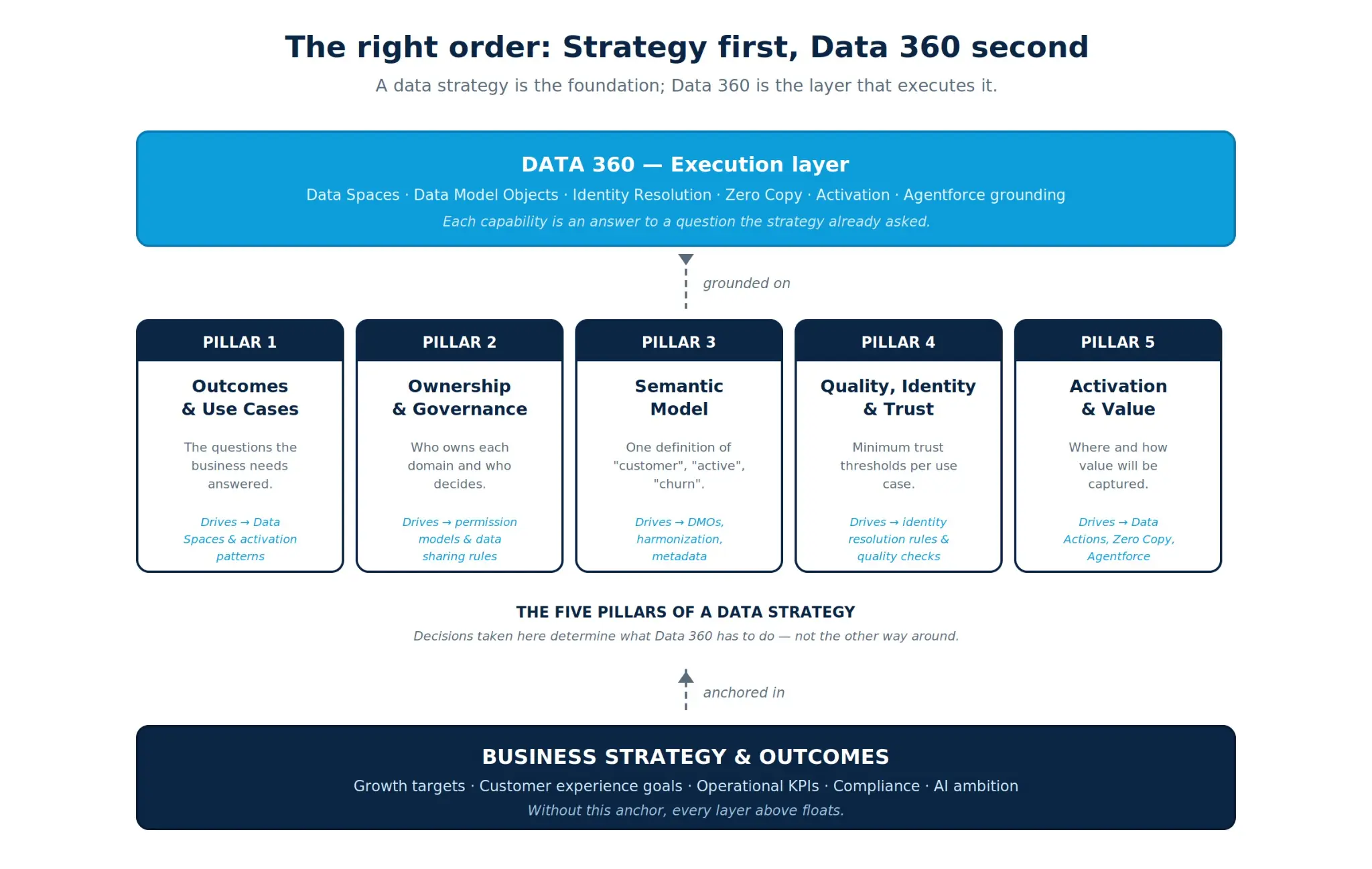
Figure 1. The right order: data strategy as the foundation, Data 360 as the execution layer.
1. Which business outcomes are we prioritizing?
Any strategy worth the name starts with a few key questions: what decisions or experiences do we want to make possible that aren’t possible today? Prioritize five to ten use cases — quantified, owned, and instrumented — by impact and feasibility. Otherwise, Data 360 becomes a repository where everything comes in and nothing gets activated.
2. Who actually owns the data?
One simple question reveals an organization’s data maturity fast: who owns “customer” data? The conversation usually goes like this: I ask a room of stakeholders who the owner is, someone says “the CRM,” another says “compliance, I think,” another says “the core systems,” and nobody gives a name. That’s the tell. Each domain needs a functional owner with real authority over what gets ingested and who gets access; otherwise, governance inside Data 360 collapses into an audit checkbox.
3. Do we share the same meaning?
This is the question I see break implementations most, usually around month six. A semantic model is the set of shared business definitions. Almost nobody argues about what a customer is, but they do argue about when one is active, when it counts as churn, or when a case is resolved. Each area has its own version, and every version sounds reasonable. Data 360 harmonizes through Data Model Objects, but only what’s already been agreed on. No DMO decides which version is right; it just makes the disagreement visible, in production.
4. What are our quality and identity thresholds?
Not every use case demands the same thing. A propensity score for a mass campaign can tolerate some bad data. An Agentforce flow that responds to, or makes an offer to, one specific customer can’t. The strategy has to define the minimum quality for each use case up front. If it’s decided mid-implementation, the technical team ends up setting it, when it’s really a business decision, and the question we should be asking is: how much error are we willing to accept?
5. How are we capturing value?
Strategy ends where activation begins: where do the segments go? To marketing channels, automated flows, agents like Agentforce, external platforms? Who is responsible for evaluating whether it works? Skip it, and Data 360 ends up unifying data perfectly that no one uses.
How strategy guides the implementation
Once these five decisions exist, the implementation stops being an open-ended project and becomes translation. Prioritized use cases define which Data Spaces get built first. Ownership translates into access policies. The semantic model feeds DMO definitions. Quality thresholds become validation rules. The activation strategy shows up in Data Actions, Zero Copy integrations, and the moments where Agentforce receives context to reason on.
The cost of inverting the order
I’ve seen the reverse pattern play out many times: at month 12 to 18, someone proposes “redoing the data model.” At month 24, a parallel data quality program shows up. Neither is really a platform problem — they’re late symptoms of decisions that were never made at the start. And by then they’re expensive, because there are already production flows, deployed agents, and users used to the model you’re now taking apart.
Research suggests that roughly 8% of an organization’s data workforce ends up on work that adds no value to the business — usually as a direct result of postponing the strategy decision. That’s the measurable cost of inverting the order.
From strategy to implementation: a 90-day path
A data strategy doesn’t need six months of consulting to be useful. With real executive sponsorship, I’ve seen a solid foundation built in 90 days:
- Days 1–30 — Use cases and prioritization. Executive workshops with business sponsors. Candidate use cases, quantified value, success metrics.
- Days 31–60 — Semantic model and ownership. Agreed definitions for critical entities. A functional owner assigned to each domain.
- Days 61–90 — Quality, identity, and activation. Thresholds per use case, matching identity resolution rules, and an activation plan with owners and timelines.
What changes when strategy comes first
That project in Germany was the version I’d like every team to get. Prioritization stops being a recurring debate because the use cases are already ranked. Data Spaces get designed in days, not months, because ownership and semantics were settled before anyone opened the platform. Quality thresholds exist before the first pipeline runs, instead of being discovered after a bad decision hits production. When a segment is activated or Agentforce reasons over customer context, it works the first time — because “active customer” was never in question.
That’s what a team gets when strategy comes first: less time re-litigating decisions, a faster path to a working Data Space, and a platform that spends its energy on activation instead of arbitration. Data 360 is excellent at unifying data, federating platforms without copying information, feeding Agentforce real-time context, and activating segments in any channel. What it can’t do is decide what to unify, why, or for whom. Those decisions belong to the strategy, and they have to come first.
Strategy first, platform second. It’s a simple sentence. It’s also the hardest discipline in the room.