


In the modern business landscape, every digital interaction, service request, and financial transaction creates a data footprint. However, possessing vast amounts of information is no longer a competitive advantage in isolation. True value emerges only when organisations can distil these massive, complex datasets into precise, actionable insights at the exact moment they are needed. This transition from passive reporting to proactive decision-making is fundamentally reshaping how companies operate, compete, and grow in today’s demanding market.
Why Data Analytics Needs AI in a Customer-centric Enterprise in India
Modern Indian enterprises generate vast volumes of data across countless customer touchpoints. However, the real question is whether that data is working for decision-making or simply accumulating. In a rapidly growing, customer-centric environment, relying on manual reporting cycles is no longer viable. This is where AI in data analytics steps in. It turns fragmented information into clear, actionable intelligence instantly.
Consider an Indian e-commerce platform during a major Diwali flash sale. Millions of users generate complex behavioural data every second. If checkout conversions suddenly drop in a specific region, waiting for a weekly performance report guarantees lost revenue. By embedding intelligent models directly into the workflow, the system spots the anomaly immediately. The analytics engine alerts the IT team to a localised payment gateway glitch, allowing them to resolve the issue in real time and save the sale.
What Is Artificial Intelligence in Data Analytics?
Within the Salesforce environment, artificial intelligence data analytics is not just a standalone dashboard or a simple reporting tool. It is an integrated capability that spans data unification, intelligent analysis, and autonomous action. Instead of functioning merely as a system that visualises historical data, it acts as a proactive team member.
It connects platforms to ensure that intelligence flows seamlessly across sales, service, and marketing departments. By shifting the focus away from complex manual data modelling, the environment allows business leaders to stop asking what happened yesterday and start responding decisively to what is happening right now.
How AI in Data Analytics Works across Salesforce Data Platforms
The foundation of the abovementioned transformation begins with unifying disparate customer data. Salesforce uses its robust architecture to connect information from external systems and internal departments into a single, harmonised profile. This prevents teams from working with conflicting numbers.
On top of this unified layer, Tableau Next automates analytical workflows. It uses intelligent agents to handle natural language queries, making data accessible to everyone, not just data scientists. For instance, a supply chain manager at a manufacturing firm can simply ask the platform, “Why are shipments to Mumbai delayed?” The AI in data analytics immediately cross-references logistics data and points to a specific vendor bottleneck. This eliminates the need to dig through five different spreadsheets to find the root cause.
AI-Powered Data Analytics for Real-Time Business Decisions
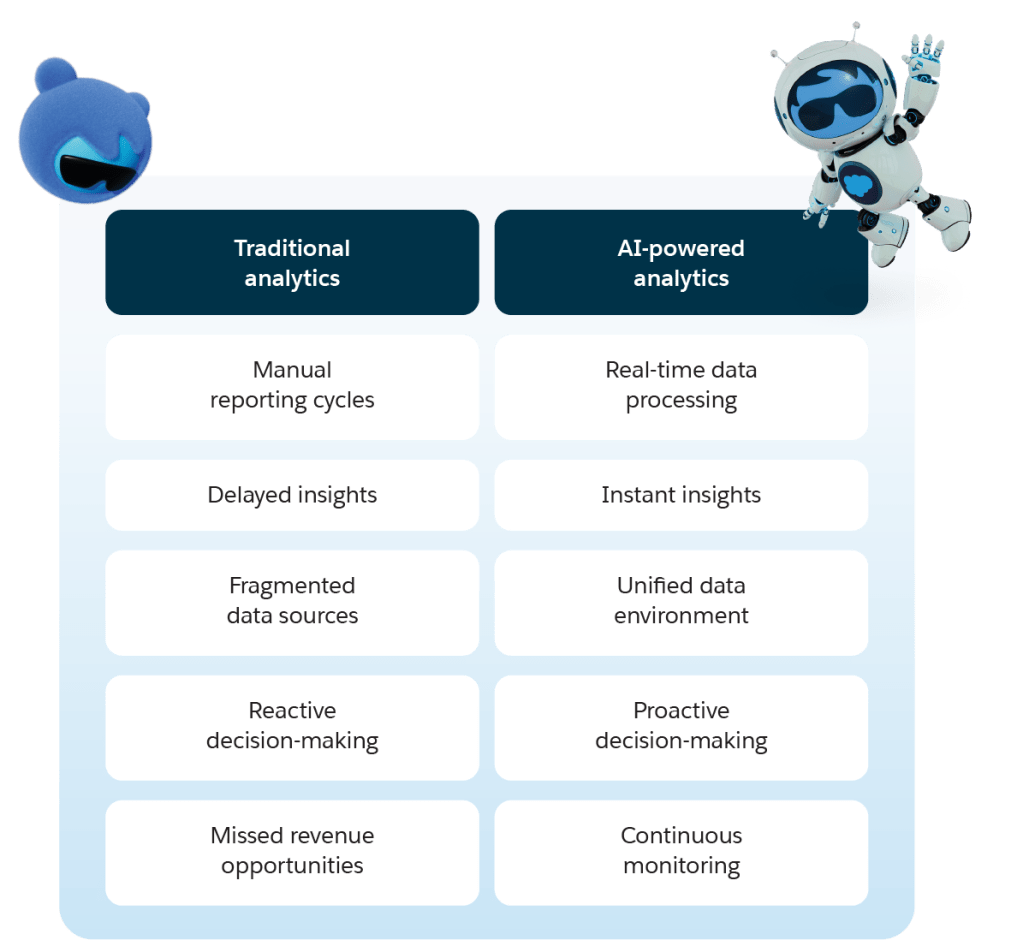
Speed is the defining factor in capturing market opportunities. Traditional analytics often present stale information, requiring users to actively seek out answers. Conversely, modern platforms proactively monitor key metrics and deliver context-rich alerts directly into daily workflows.When an organisation deploys AI-powered data analytics, the daily operational rhythm changes completely. A service leader can detect an escalation spike and address the core issue before it turns into a widespread customer retention crisis. Similarly, a regional sales manager receives a pipeline gap alert delivered straight to their phone or messaging app. Because AI in data analytics works continuously in the background, leaders have the exact information they need while there is still time to act.
Role of Machine Learning for Data Analytics
Intelligent algorithms operate quietly but effectively within the CRM environment. Salesforce’s AI framework applies machine learning for data analytics by continuously evaluating historical deal data, service resolutions, and customer engagement patterns. Over time, these algorithms learn and sharpen their accuracy.
Take a large Indian bank as a prime example. Instead of offering generic financial products to a broad demographic, the bank uses these models to identify subtle behavioural changes in a customer’s transaction history. The system detects patterns indicative of financial strain and prompts relationship managers to proactively offer a personalised loan restructuring plan before the customer defaults. This is how raw data transforms into measurable business outcomes.
Predictive Analytics Using AI to Anticipate Customer and Business Outcomes
Organisations must shift from reacting to past events to preparing for future scenarios. Predictive analytics using AI allows enterprises to create bespoke predictive models without needing to write complex codes. Crucially, these models learn from a company’s unique, real-world customer behaviour rather than relying on generic industry benchmarks.
A B2B enterprise, for example, can use these predictive tools to forecast which high-value accounts are most likely to churn in the upcoming quarter. The platform accounts for deal velocity, recent service tickets, and engagement signals to deliver an accurate risk score. This foresight empowers representatives to intervene immediately with targeted retention strategies.
Automated Data Analytics at Enterprise Scale
As data volumes inevitably grow, manual data preparation becomes unsustainable. Advanced platforms feature built-in agents that detect data quality issues, recommend structural transformations, and build models with minimal human input.
This facilitates closed-loop automated data analytics. As a result, an insight generated on a dashboard can automatically trigger a downstream action rather than just sit there. It might update a Salesforce record, initiate a customer communication flow, or alert a specific team. By removing the manual bottleneck, AI in data analytics allows enterprises to scale their operations effortlessly across multiple regions and business units.
Challenges Enterprises Face without AI-driven Analytics
The cost of inaction is severe. Fragmented, siloed data environments actively prevent intelligent models from functioning. There’s consensus in the industry that organisations will soon abandon most of their AI projects simply because their underlying data is not prepared or unified.
For Indian enterprises operating in highly competitive sectors like BFSI and retail, the stakes are amplified. Relying on manual processes introduces human error, slows down response times, and severely restricts sustainable growth. Ultimately, the absence of AI in data analytics directly impacts an organisation’s ability to compete. Those who connect their data and embed proactive intelligence into their workflows will find the lucrative opportunities that their slower competitors miss.