New Research: Patients Trust Their Doctor’s AI Agents 3x More Than Public AI
90% of patients want medical AI to have human oversight, and they're watching closely to see if healthcare providers will earn that trust.
Key Takeaways
- Patients are three times more likely to trust an AI agent built into their doctor’s secure portal than a public chatbot.
- Eighty-nine percent say a clear “escalate to human” option is essential for trusting AI administrative support; 90% expect the same for AI medical support.
- Patients’ top concerns about AI in healthcare are accuracy, followed by data privacy — worries cited by roughly 1 in 3 patients.
If you’ve ever waited on hold to make a doctor’s appointment or struggled to get a prescription refilled, you’re not alone, and new Connected Health Consumer research from Salesforce shows you’re not asking for too much. The Salesforce survey of more than 3,200 patients across eight countries found that those frustrations are real and widespread. Patients have already decided what a better system looks like, and as agentic AI moves deeper into care delivery, they are not opposed to it; they are setting clear terms. Nearly 9 in 10 say a clear path to a real person is not a nice-to-have. It is essential.

Governance is the foundation
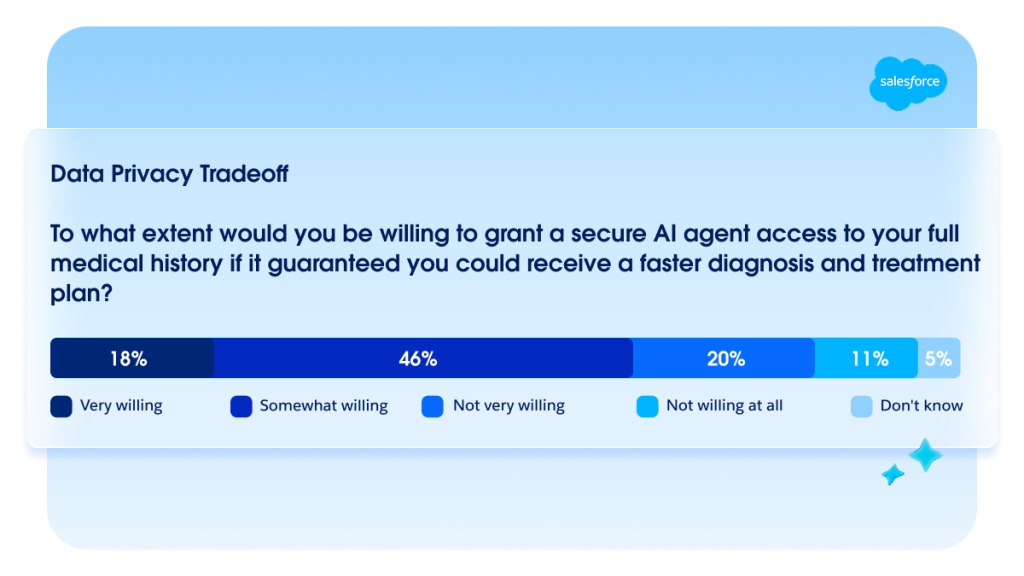
In the past two years, AI usage in healthcare has gone from something rare (just 2% of U.S. adults turned to AI for healthcare information in 2024) to being a widespread practice. Nearly 60% of global consumers now report that they use AI to ask about their personal health. Meanwhile, medical providers use it to initiate clinical workflows, manage scheduling, and create personalized treatment recommendations. Patient attitudes have followed. Today, 61% of global patients say they are comfortable using agentic AI in healthcare contexts, and 64% would share their full medical history with AI for a faster diagnosis. That openness mirrors what we are already seeing on the provider side. A separate Salesforce study found 71% of U.S. healthcare workers predict agentic AI will be essential to healthcare operations within five years. Both sides of the exam room are ready. But patients are setting clear terms for what ready actually means.
That readiness is driven by daily frustration with a system that is not working. The administrative burden alone is already eroding patient trust and care adherence across health systems. Forty-six percent of patients delay care because the digital process is too confusing, and 58% delay or skip necessary care because scheduling is too difficult. Nearly half (49%) hang up after 10 minutes on hold with a doctor’s office to seek care elsewhere or avoid it altogether. Two in three (66%) have run out of medication waiting for a prescription refill to be approved. And 90% say they wish their primary doctor was automatically notified after an emergency room visit — an expectation of basic coordination that current systems routinely fail to meet.
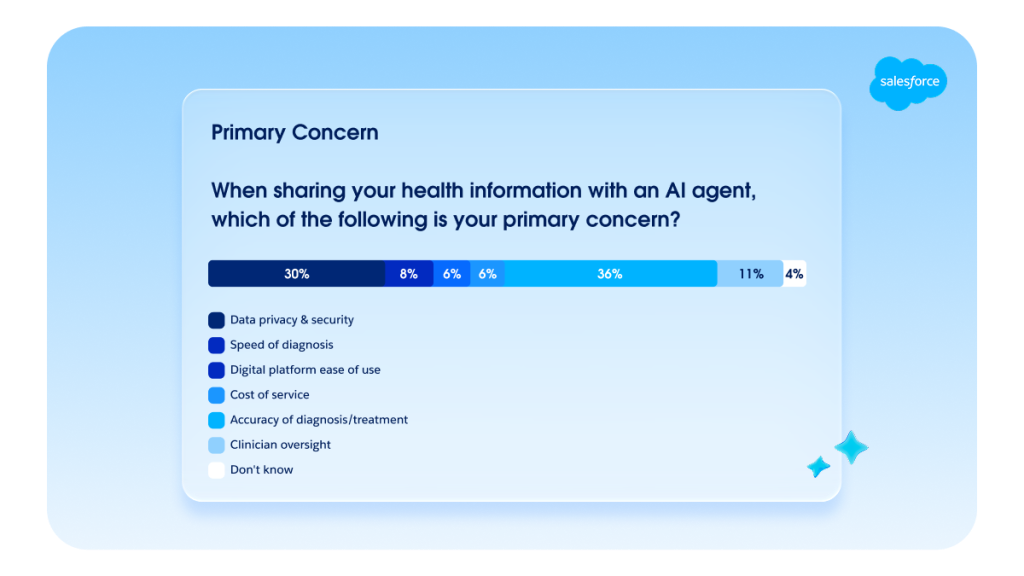
When it comes to AI specifically, patients’ top concerns center on accuracy and data privacy. Thirty-six percent cite accuracy of diagnosis or treatment as their primary worry, while 30% point to the privacy and security of their health data.
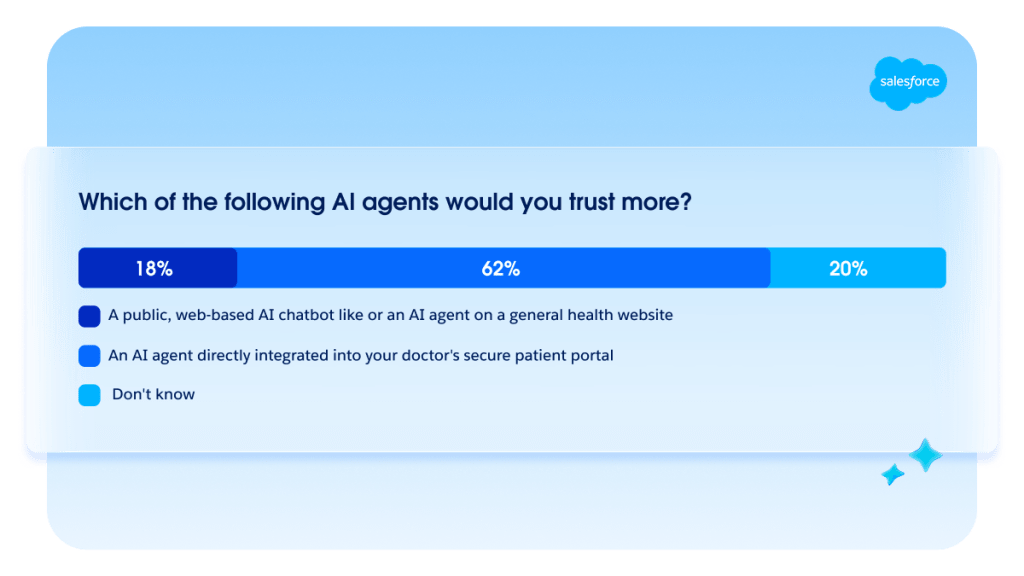
And where the AI comes from matters enormously. Patients are three times more likely to trust an AI agent integrated directly into their doctor’s secure portal than one available through a public chatbot or general health site — a clear signal that institutional accountability and provider context are central to acceptance.
Tyler Bauer of UChicago Medicine, a leading academic medical center delivering care to millions of patients across the Chicago region, highlighted how providers are echoing this consumer demand:
“Trust and transparency are at the foundation of patient experience. We’re not going to compromise on that. Patients need to know (they must know) that their information is protected and that an escalation to a live agent is always available to them.”
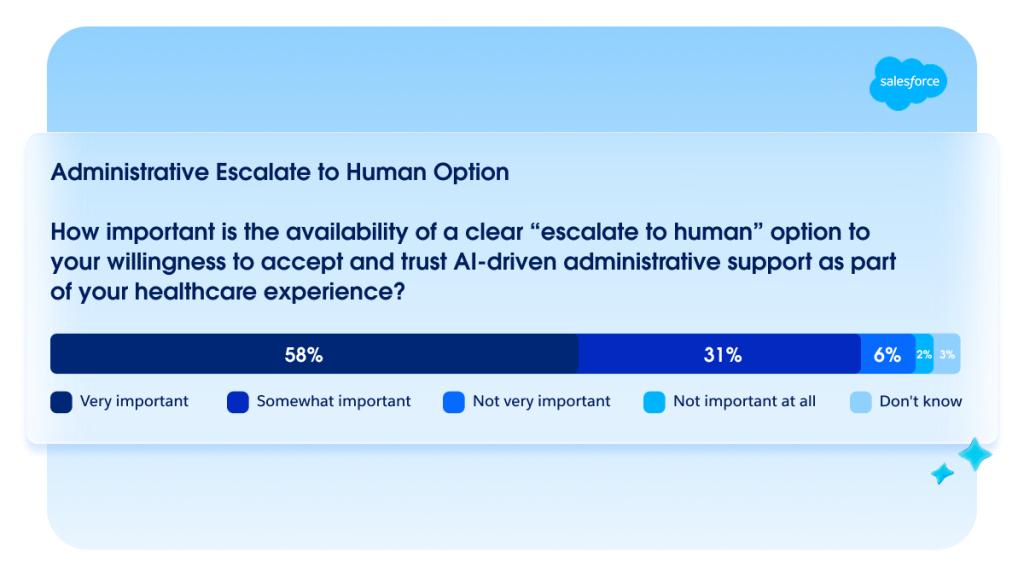
They also want reassurance that a real person is always within reach, and that access is a prerequisite for trust. Eighty-nine percent say a clear “escalate to human” option is essential for trusting AI-based administrative support, while 90% expect the same for AI medical support. And 91% say patients should have the right to opt out of AI-driven clinical recommendations entirely.
“When AI is built on a unified, governed data foundation, it earns trust where the stakes are highest. Clinicians can see how decisions were made. Patients can act on recommendations that show their work, cite their sources, and connect the dots across the full care journey. That’s the transparent AI healthcare has been waiting for.” — Amit Khanna, SVP & GM, Agentforce Health, Salesforce
Patients are clear: Efficiency without accountability isn’t enough
The data shows patients are willing to embrace agentic AI for logistical tasks like billing and rescheduling. Forty-nine percent prefer AI agents over humans to avoid wait times but only when human backup is visible and accessible. Sixty-seven percent say they would rather have 24/7 AI help than wait for someone to pick up the phone during office hours.
“Patients don’t want AI to replace their doctors. They want it to safely replace the waiting, and the friction. When technology is built on trust, healthcare can finally move as fast as we do.” — Dr. Sophia Saleem, Chief Health Officer, Salesforce
The loyalty implications are real. Forty-four percent say a 24/7 agentic assistant would make them more likely to stay within a provider’s network for follow-up care. There is a direct line between administrative trust and retention.
Patients managing chronic conditions feel the need most acutely. Sixty-five percent of patients with long-term conditions say a 24/7 digital helper would make managing their health significantly easier. Yet none of that convenience erases the expectation of human backup.
For healthcare organizations, the message from this research is consistent: Patients are ready to embrace agentic AI but only when it is built on transparent, governed foundations with clear escalation paths, audit trails, and provider-backed deployment. That is precisely what Salesforce has built: AI that earns trust because it is governed, explainable, and always connected to a human when it matters most. Learn how to bring Agentforce into your healthcare organization.
Explore further
- Read the full 2026 Connected Health Consumer Report
- See how UChicago Medicine leverages AI and unified data to help scale care
- Explore the Provider Technology Playbook
- Read more about Agentforce Health agents
- Check out the webinar: 5 Global Findings Revealing What Patients Really Want From AI in Healthcare
About the research:
The Salesforce Connected Health Consumer Report surveyed 3,200 adults across the United States, Canada, Mexico, Brazil, the United Kingdom, Ireland, Australia, and New Zealand from March 24–April 10, 2026. All respondents are health consumers ages 18 and older. Full methodology available in the report appendix.