TDX Live Blog: All the Highlights You Missed
On-the-ground reporting from the must-attend developer event for the Agentic Enterprise
Welcome to the Newsroom team’s coverage of TDX 2026, Salesforce’s developer conference that is second only to Dreamforce in size and scope. Below you’ll find session news, exclusive video of speakers and attendees, and photos straight from the campground.
An Elite Training Program, but for AI Agents
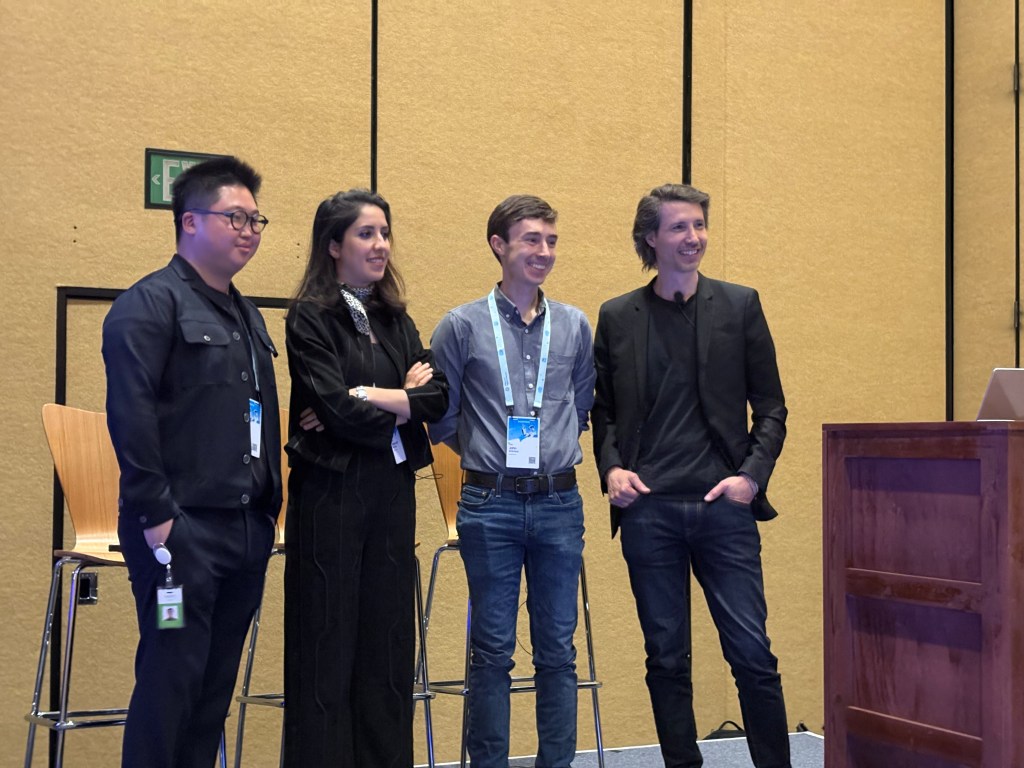
“I know this is a developer conference,” said Itai Asseo, addressing the audience at the “Where AI Is Headed: 3 Key Trends” session, “But does anyone here do any competitive sports?” Asseo, VP, Incubation & Brand Strategy at Salesforce, used an analogy of elite athletes — who require specialized coaching, high-performance facilities, and precise nutrition — to explain the next phase of AI. Just as a general athlete needs specific training to become world-class, generic LLMs must be refined into “Enterprise General Intelligence” through rigorous, specialized development. Salesforce’s AI Research team is building this foundation through AI Foundry, focusing on making agents both highly capable and consistently reliable.
Simulation Environments (eVerse)
To ensure agents can handle the unpredictability of the real world, the eVerse framework uses high-fidelity simulation and measurement. By creating detailed “user personas” that mimic human customers — complete with background noise and spotty connections — developers can stress-test voice agents in parallel and at scale. This allows for deterministic evaluation of agent performance and objective quality scoring before anything is deployed to customers.
Learning from Human Experts (Learning Engine)
While standard agents excel at simple tasks like appointment scheduling, they often struggle with complex, multi-step enterprise workflows like healthcare billing. The Learning Engine addresses this by keeping a human expert in the loop post-deployment. As the human supervisor intervenes to correct an agent’s mistake or provide guidance, those actions are captured as “learning signals.” These signals are then incorporated into a new version of the agent, allowing it to evolve and improve its accuracy.
Agent Startup
Agent Startup streamlines the often-laborious process of building specialized agents from scratch by allowing developers to steer development through semantics rather than syntax. By simply describing a use case and its required data, the system automatically generates a fully functional agent, including the necessary data models and backend logic. It utilizes an automated evaluation loop to test the agent against simulated business environments. The developer’s focus can be on agent “steering” instead of testing and debugging.
“We’re seeing that the problems that enterprise businesses are struggling with are not really being solved at the model level,” said Asseo. “So having the ability to take LLMs and creating these harnesses, these systems around them that enable us to ground them in our business data, in our enterprise data, in the tooling and the security and the trusted layer that we have, and this is a fundamental shift in how we think of things.”
Discover more Agentforce Labs.
AWS Lays the Blueprint for Building Your First Agentforce Employee Agent
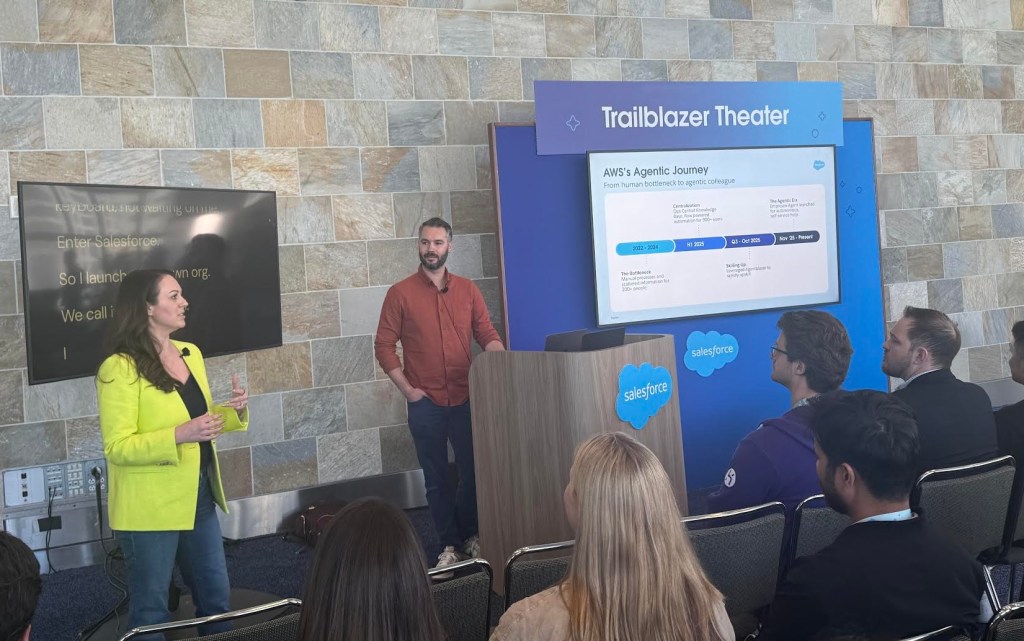
Now that everyone’s building agents, the most daunting challenges for newbies and industry outsiders are selecting which kind of agent to create and knowing where to get started. Ryan Olstad, Principal Technical Architect at Salesforce, and Brittany Argall, Sr. Program Manager at Amazon (AWS), showed attendees exactly how.
They took the audience inside a real Agentforce employee agent deployment at AWS, demystifying the intimidating process of building agents and showing exactly where to start.
The Problem: Breaking the Bottleneck
Amazon took its classic approach and worked backwards to realize they needed an agent to scale. Between 2022 and 2024, their team was severely bottlenecked by manual processes and scattered information. By the first half of 2025, they centralized their information into “Ops Central,” laying the groundwork for AI.
AI Agent vs. Automation and Chatbots
The audience learned that to unlock true agentic productivity, humans and agents must become teammates connected across data, workflows, and apps. Brittany shared that Amazon needed a solution that could actively update records, analyze data, and identify trends. A traditional chatbot simply cannot do that, which is why an AI agent was the only path forward.
The Power of the Employee Agent
The AWS team chose an employee agent as the first major step because it actively takes actions on behalf of their internal users. Launching internally first is the smartest way to kick off an Agentic Enterprise, allowing users to search, act, and collaborate safely.
The Blueprint: 5 Attributes of an Agent
Olstad and Argall delivered a masterclass on how to prep processes so anyone’s AI can be successful from Day 1. They broke down the five core attributes:
- Role: Define the exact job the agent should do. Argall emphasized that deploying an agent is literally deploying a new team member to handle business operations.
- Data: Determine the knowledge they can access. Builders learned they must spend time cleaning and prepping data, or the agent will get confused and provide bad answers.
- Actions: Establish their capabilities. Because Salesforce actions work out of the box, AWS had to make only minor tweaks, making the setup incredibly fast.
- Guardrails: Strictly define what the agent shouldn’t do.
- Channel: Decide exactly where the agent will live and work.
The Business Impact
The metrics AWS shared proved the massive value of this deployment:
- The entire build took only 40 hours, shattering the traditional 4-to-6-week implementation timeline.
- They achieved a 99% reduction in wait time, taking requests from hours of waiting down to answers in under 20 seconds.
- They hit a 90% deflection rate, meaning the vast majority of requests are resolved without any manual intervention.
- The agent recovered 250 hours of annual capacity, giving the team their time back for strategic work.
- Overall, this drove a 3x faster go-to-market speed while increasing trust and capacity.
Key Takeaways
To replicate this success, the speakers shared a final checklist:
- Validate the specific use case first.
- Treat data as the absolute foundation of the build, meaning “garbage in, garbage out,” so keep it clean.
- Carefully onboard your new AI hire just like a human employee.
- Constantly monitor and iterate—Olstad reminded the audience that the work doesn’t stop after deployment.
- Jump into Trailhead and become an Agentblazer!
A Day in the Life of the AI-Augmented Architect
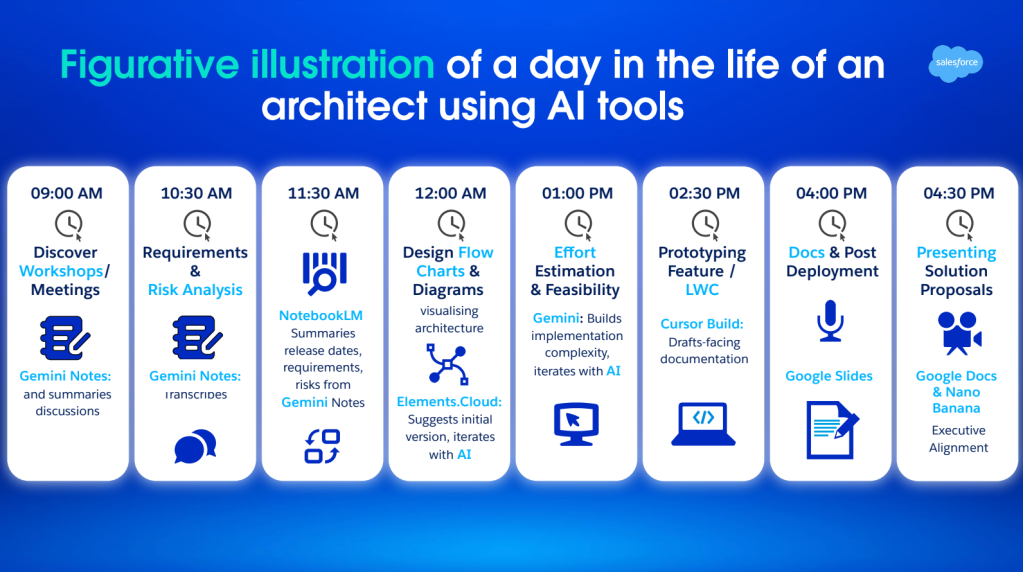
The modern Salesforce Architect is trading manual transcription and boilerplate coding for a high-octane “AI utility belt,” transforming weeks of documentation into minutes of insight. TDX attendees carved out time in their own schedules to learn what a typical day looks like for the AI-augmented architect.
For Italian native Attilio Capocchiani, who co-led the session with Tuan Abdeen, it starts with espresso. From there, the day is anchored by intelligent automation, starting with Google Gemini providing real-time meeting transcription and summaries at 9:00am. By midday, architects are leveraging NotebookLM as a centralized “architectural memory” for risk analysis and Elements.cloud to instantly generate complex process maps from simple prompts. The afternoon shifts toward execution, using Cursor for “vibe coding” to scaffold Lightning Web Components, followed by Google Slides and Nano Banana to craft executive-ready visual narratives in a fraction of the traditional time.
“AI is not about replacement, it’s about amplification,” the pair emphasized. “It’s here to make our judgment stronger.”
Row Row Row Your Boat, Gently Down the Screen Flow
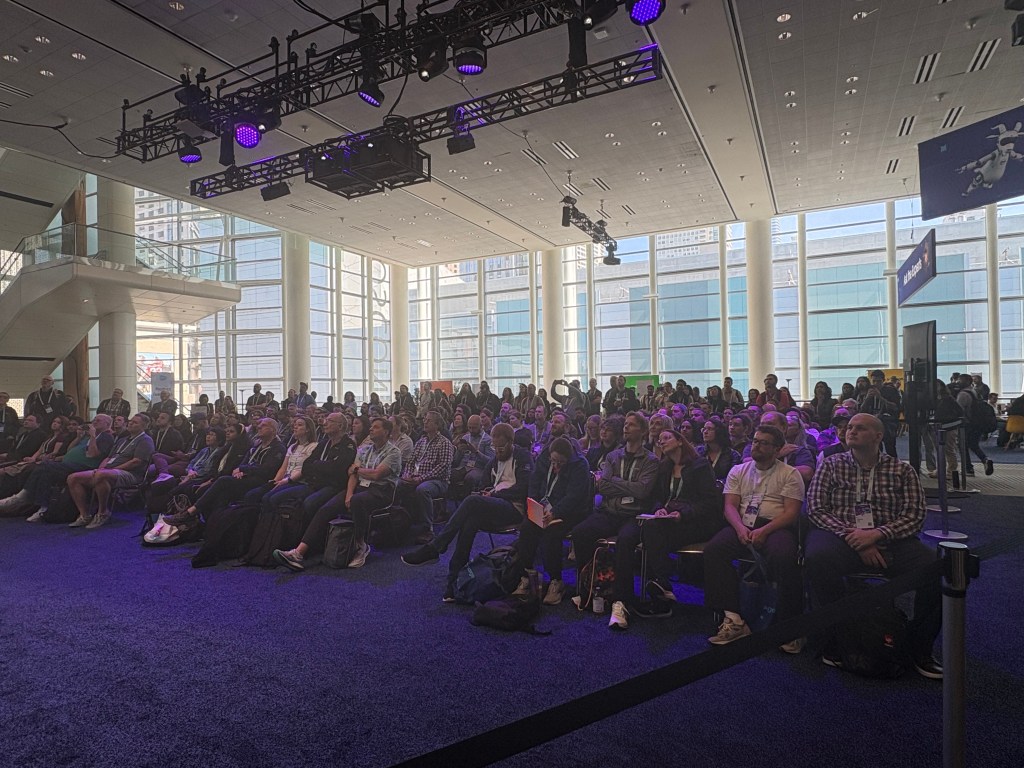

The crowd was packed and rapt for the session “Preview What’s Next for Screen Flow.” Nearby, a stuffed-fish-and-canoe photo activation kept things moving merrily merrily merrily along.
Who Doesn’t Want to Deliver Empathetic and Joyful User Experiences?
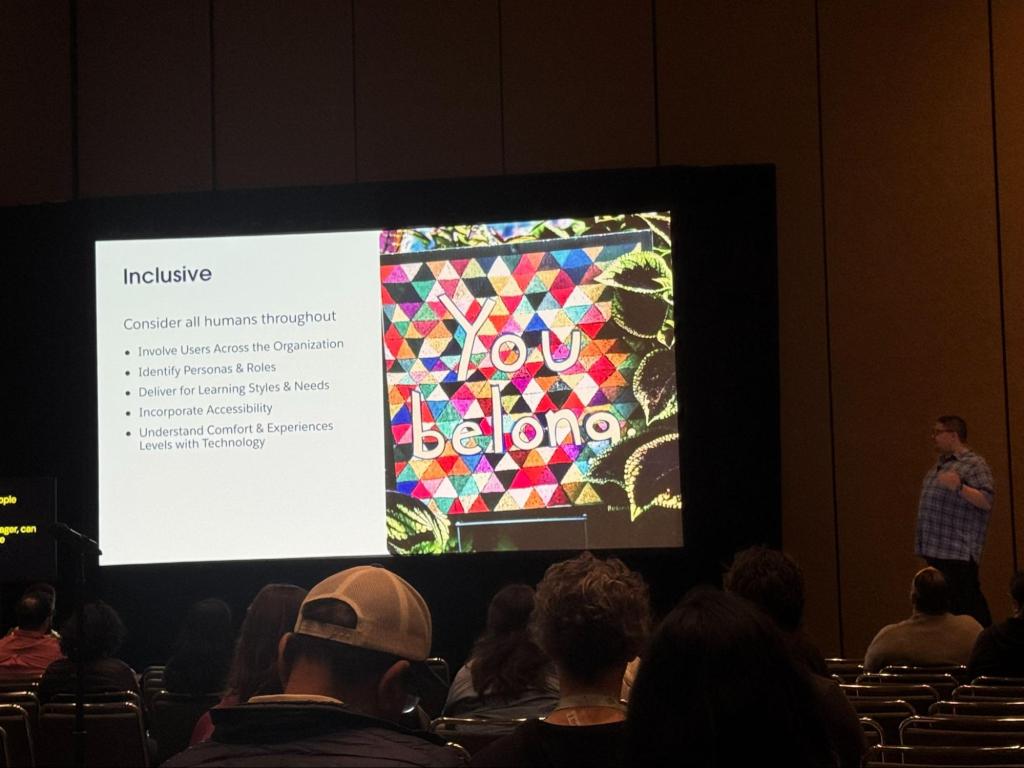
Not attendees of the Day 2 session on human-centered design, certainly. “The longer I’m in this ecosystem, over 10 years now, the more I realize I don’t know, and it’s actually humbling,” shared Daniel Gorton, a Salesforce Principal Strategist and Salesforce Architect. Kicking off the discussion, he detailed how admins can boost adoption and drive measurable business value through intentional change management.
But, ultimately, “It’s all about adding value back to people’s lives,” Gorton said, emphasizing that a great user experience requires fewer clicks, intuitive guidance, and seamless feedback.
Here are the key takeaways from the session:
- Empathy and joy are crucial for good tech. By designing systems that require fewer clicks and eliminate mundane data entry, you give people their time back to focus on the impactful work they actually enjoy doing.
- Shared vision beats top-down mandates. System rollouts are far more successful when everyone collaborates on the goals, rather than leadership simply issuing a mandate to “just do it”.
- Bite-sized, built-in training is the future. Long, boring user manuals are out; embedding helpful guidance directly into the platform and hosting casual open office hours makes learning much more digestible and effective.
- Give people their data back. If you want your team to care about data quality, embed useful charts and dashboards right where they work so they instantly see the value of the information they are putting into the system.
Loooong Lines of Vibe Code
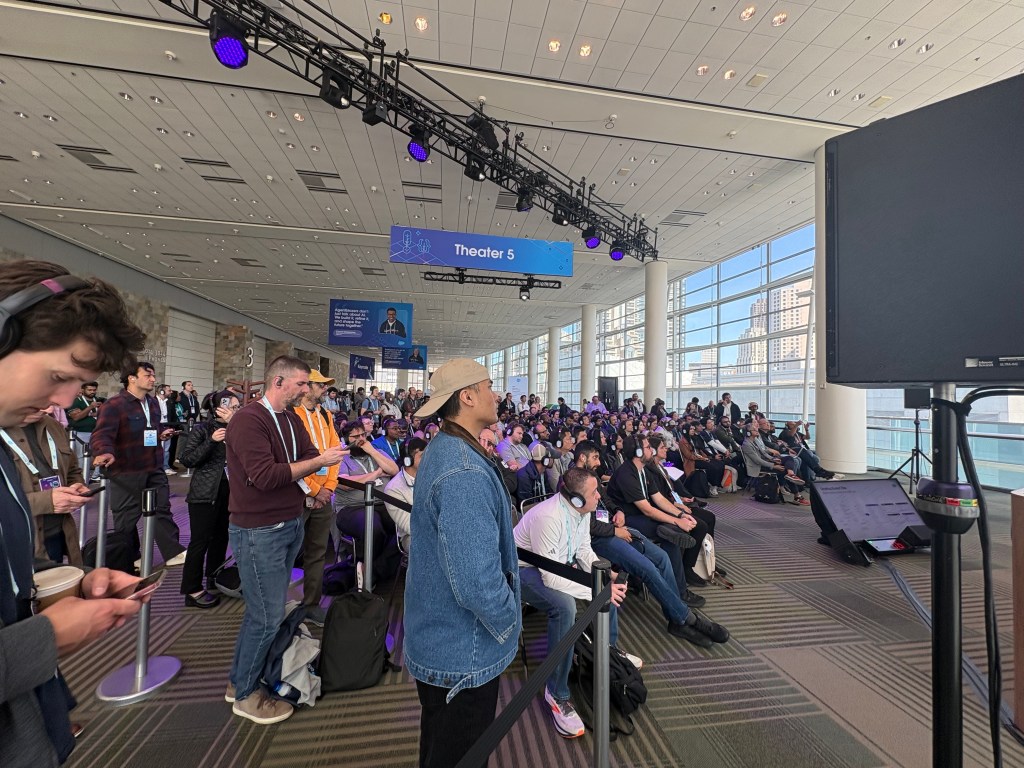
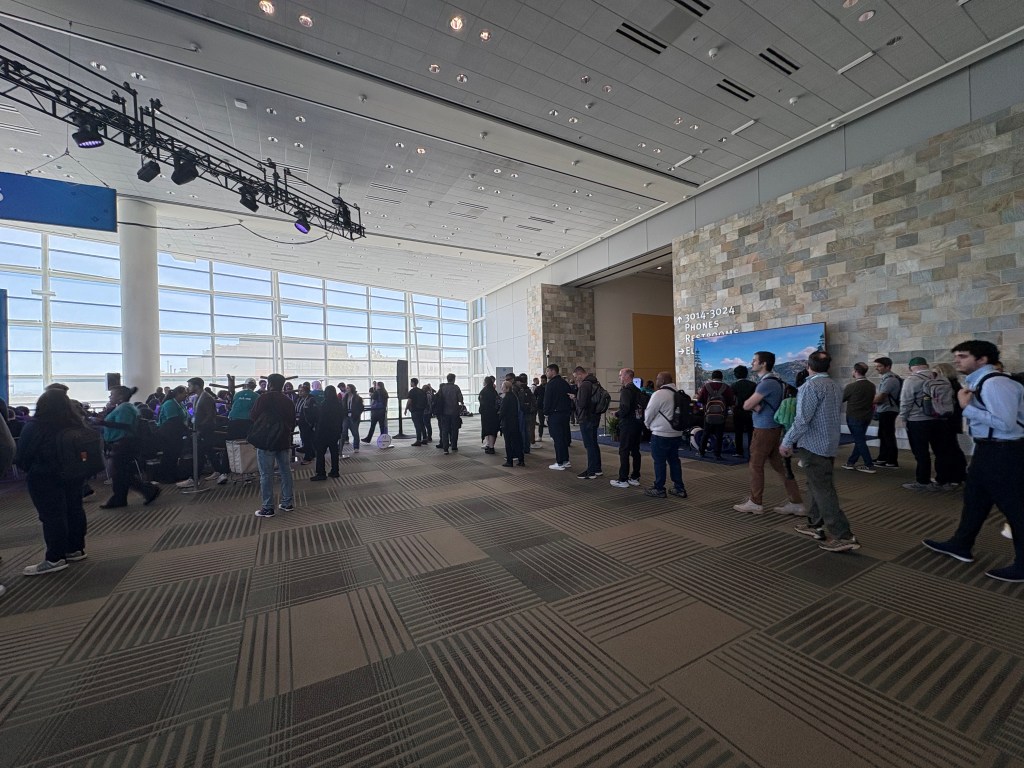
There was a massive line and standing room only for the session “Apply Agentforce Vibes’ Advanced Features.”
Don’t Wing It

Topline Takeaways from the Agentforce Vibes 2.0 Sneak Peek
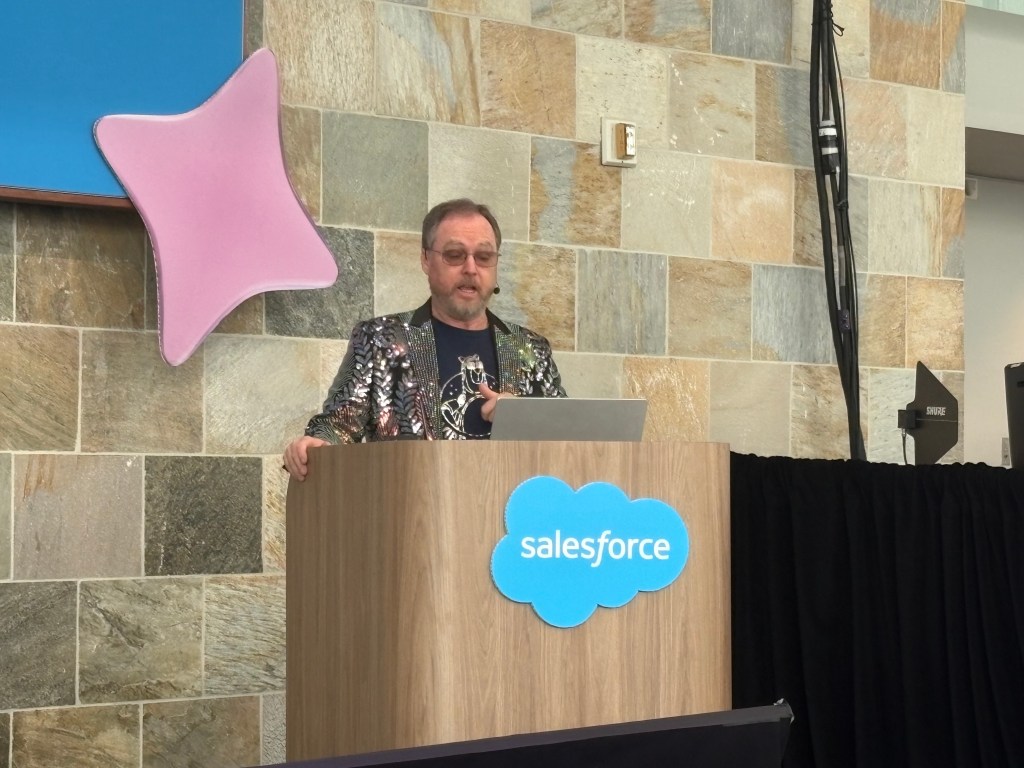
Rise and shine – or rise and sparkle rather. At 8 a.m. on Thursday, clad in a super-glittersome jacket (or, if you will, an agentBLAZER), Agentforce Vibes Director of Product Management Jeff Douglas walked attendees through some forthcoming features in Agentforce Vibes 2.0.
There are two ways to work
Chat Mode: For hands-on, back-and-forth development.
Planner Mode: For larger tasks where the agent plans and executes across multiple steps.
You can choose your agent harness
This is the Software Development Kit (SDK) runtime that connects your agent to an AI provider. It could be the Claude Code SDK, OpenAI Agents SDK, Cline, Maestra … there’s no vendor lock-in. Each one is built on the vendor’s native SDK, not a wrapper.
Different SDKs have different strengths, so pick the right one for the job. Each harness provides different features; you can have one subagent run on Claude and another on the OpenAI SDK.
Manage your tokens
This menu is where you can set your cost and execution guardrails and how you balance power against $$.
Discovery
This is where you can pick up rules, skills, commands, and subagents. “We are adding more skills almost daily,” he said, “Running evals against them all the time.”
Use different modes for different tasks
Agentic mode will go out and do things.
Plan mode is where you can have a conversation because, Douglas said, “At Agentforce Vibes we want the developer in the middle, always reviewing, approving everything that gets done.”
Ask mode is where a developer can pose questions like “How does this trigger framework work?”
Debug mode is for going out, inspecting things, and making a plan to make changes if anything is not working.
Maybe it’s what he would say, but as Douglas put it, “This is going to be the best way on the Salesforce platform to build applications with agentic AI.”
Five Lessons from Real Enterprise Agent Use Cases
Beware regional speech patterns! Forward Deployed Engineer Andre Robitaille was working with a retail customer that had deployed a customer service agent in one territory, then a state, then more states and more, only to learn that people in some parts of the country communicated with the agent much differently from people in other parts. Good thing the team had started small before going big.
It’s just one lesson Robitaille and Ben Kracker, also a Salesforce Forward Deployed Engineer, shared at a session called “See Agentforce in Action: Real Enterprise Agent Use Cases.” Here are their five key takeaways:
Start Small, Learn Big
For a residential home security provider, this meant launching to just 5% or 10% of its customers first, allowing engineers to observe the behavior of the agent and react to how it responded to customers. Over the course of a few months they scaled to 100% of the customer base.
For the retailer encountering the regional communication differences, it meant learning from the inputs and analytics, said Robitaille. “We were able to refine and tailor some of the expressions and use cases so that we could handle those conversations differently depending on where they were coming from.”
Determinism Is Difficult Without Agentforce Script
LLMs are inherently non-deterministic and vary in their responses, Kracker reminded the audience. To achieve close to 100% consistency, the home security provider team needed to implement their care agent with Agentforce Script, which provided the control and compliance necessary for high-volume customer interactions. “This was sort of foundational,” Kracker said.
Vertical vs. Horizontal Growth
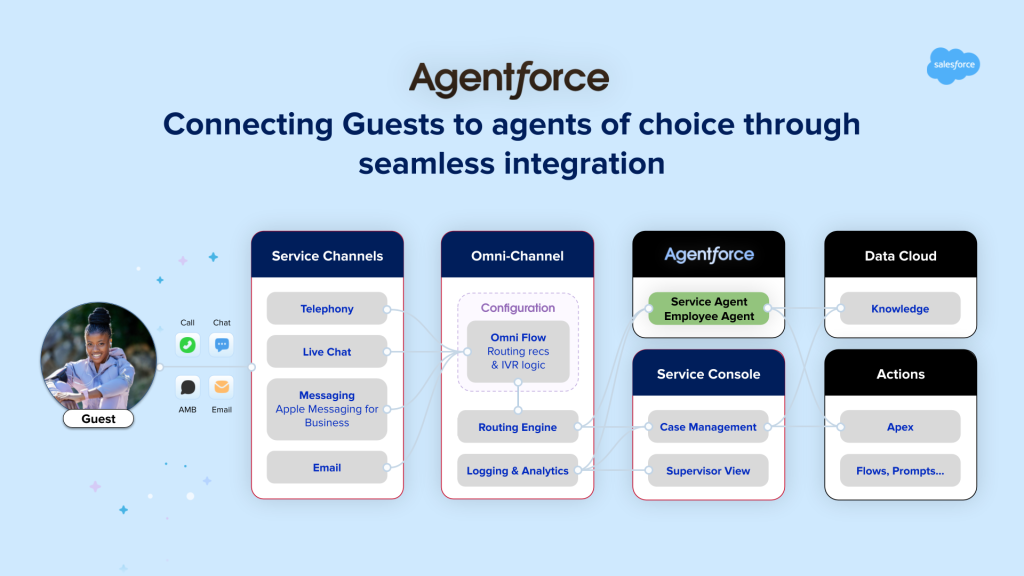
Vertical growth involves deepening the specific capabilities and skills of a single agent, whereas horizontal growth expands those capabilities across new agents or the orchestration between multiple agents. Vertical growth: upleveling an agent’s skills to handle complex returns. Horizontal: scaling to cover messages from new service channels, like Apple Messaging.
Agent Observability and Monitoring
Agent observability and monitoring is required. As Kracker said of the home security company, “If they couldn’t see how the agent was performing, if they couldn’t measure how accurately it was answering questions or assisting the customers, they weren’t going to go live with it.” Coming soon: custom scoring so users can define their own types of scores and their own criteria that need to be judged. “This provides a lot more control over what you’re actually looking for and what you’re trying to measure,” said Kracker.
Testing Is Non-Negotiable
Testing is an ongoing process that requires trying different personas and personality types and actively trying to break the agent, said Robitaille. You need a full testing strategy to provide the business buy in. It helps to build that confidence, he said.
And…We’re Onto TDX Day Two!
Flo Rida gave us that good feeling last night — and today, we’re ready to run the (agentic) world. Back to Moscone Center we go for day 2 of 2 highlights from the premier Agentic Enterprise builder conference

Salesforce Introduces Agent Script to Enhance AI Consistency
Crossing your fingers and hoping AI complies with instructions is a gamble many developers are no longer willing to take, especially as new deterministic controls now allow for the locking in of critical business logic.
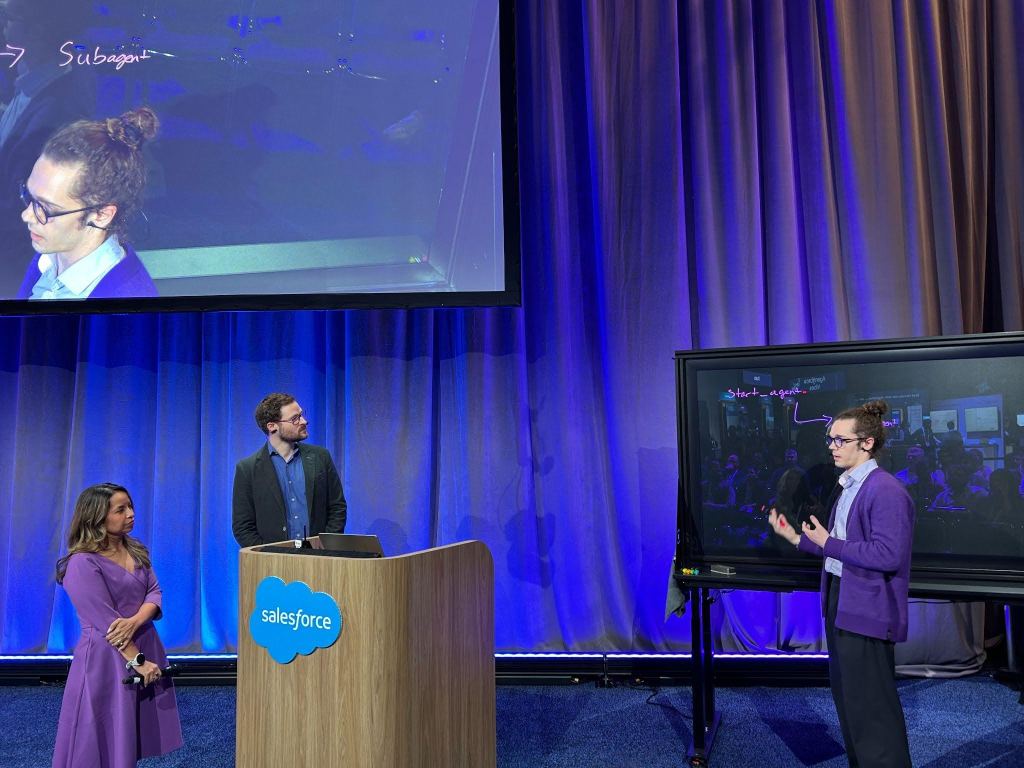
During yesterday’s TDX session “Design Hybrid Reasoning in the Real World,” Salesforce unveiled a new approach to building more-reliable AI agents through the new Agent Script tool.
The session featured insights from Salesforce employees Bret Brizee, Senior Director of AI Product; Nathaniel Price, Product Management Senior Director; and Susannah Plaisted, Director of Product Marketing.
Agent Script addresses the inherent unpredictability of large language models by blending creative generative power with rigid, deterministic business logic.
The speakers discussed how this innovation allows developers to build predictable, context-aware agent workflows that don’t rely solely on interpretation by an LLM.
By moving beyond traditional natural language instructions, developers can now enforce specific workflows, such as verifying customer data or checking the warranty status of a customer.
Key Takeaways from the Session:
- Solving the “Always/Never” Problem: The team highlighted that LLMs often struggle with absolute instructions, leading to inconsistent customer experiences. Hybrid reasoning provides a deterministic framework that executes specific logic independently of the LLM, guaranteeing that critical steps, like verifying a customer ID, are never skipped.
- The Power of Agent Script: Salesforce introduced Agent Script, a new language that allows developers to write conditional logic, manage variables, and integrate data directly into an agent’s instructions. This provides a “hard-coded” safety net for AI interactions, accessible through both a visual canvas and a direct code editor.
- Enhanced Transparency and Debugging: The session showcased a new interaction summary and expanded trace view, giving developers full visibility into how an agent processes context, evaluates script, and makes decisions. This level of transparency, coupled with an AI-powered assistant, enables teams to pinpoint exactly why an agent took a specific action and optimize its performance in real-time.
How to Build for the Agentic Enterprise: Watch the Keynote in Under 5 Minutes

TDX Hackathon Showdown
Later in Day One, it was time for one of TDX’s marquee events: the Hackathon. As attendees first entered the keynote room, they were handed plastic Salesforce-branded clappers. They were greeted by emcee Gillian Bruce, Sr. Director, Developer Marketing at Slack, who shared the tight, high-stakes agenda: three pitches, each with a five-minute window. Afterwards, the presenter(s) would be asked three questions – one from each judge – for a chance at $50K.

Onto the stage walked three judges: John Kucera, CPO Agentforce; and Leah McGowen-Hare, SVP, Forward-Deployed Engineering, Global Growth & Impact – both of Salesforce; and last year’s winner Ohad Idan, VP of Product, Rootstock.
The judging criteria were creativity, real-world relevance, capabilities and platform usage, and – this being a pitch fest – delivery. The competitors were:
- Gigi Chan (Hack: CareRoute: Referral to Care in Slack): Gigi Chan’s “Care Route” automates the healthcare referral process to quickly connect patients with the care they need. By leveraging Document AI, Agentforce, and Data 360 entirely within Slack, it efficiently parses PDF referrals, matches patients to therapists based on specific needs such as language, and automatically books appointments. The solution also proactively monitors health records to alert coordinators if a patient is at a high risk of missing a follow-up visit.
- Eleanor Spolyar and Taryn Kelley (Hack: City Pulse Agent): “City Pulse” transforms city infrastructure management from a reactive complaint system into a proactive, intelligent command center. Using Agentforce and Tableau, the solution tracks citizen 311 complaints, identifies the root causes of recurring infrastructure failures, and automatically dispatches field service teams with the necessary context via Slack. It seamlessly closes the loop by automatically texting local residents with real-time updates on street closures and issue resolutions.
- Arundathai Neelam (Hack: Knowledgeforce): “Knowledgeforce” is a self-learning agent designed to permanently capture and scale valuable institutional knowledge from customer calls. When the agent cannot answer a customer’s query, it identifies the knowledge gap and routes the question via Slack to a designated human expert. Once the expert provides the missing information, the system permanently stores the answer so the agent can instantly resolve identical queries in the future.
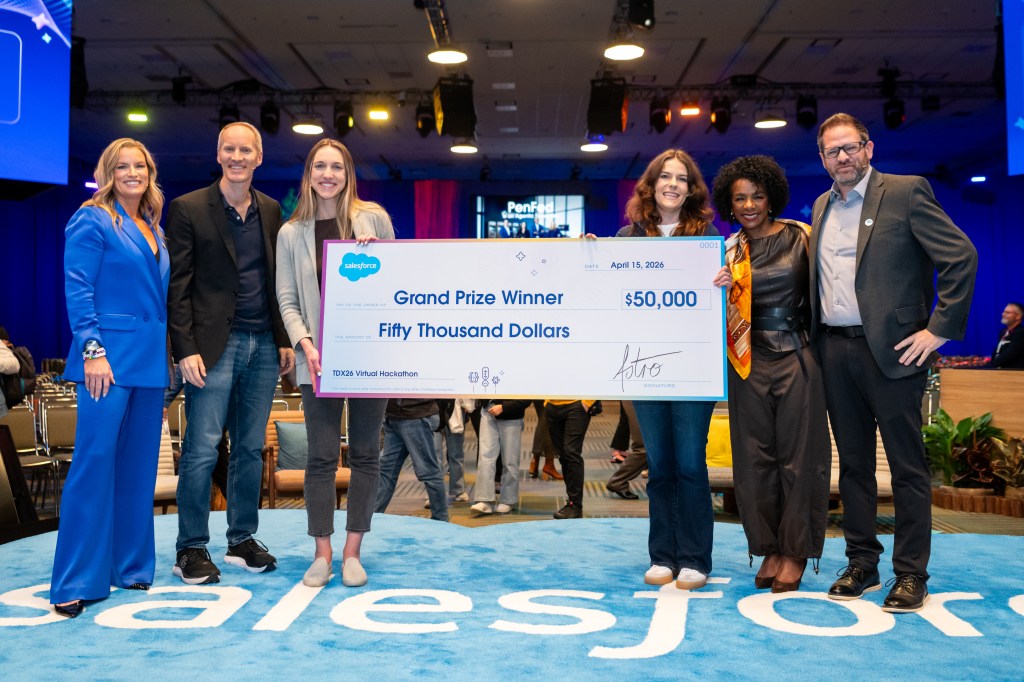
Prior to sharing the grand prize winner, the emcee announced the audience favorite, which was determined by audience votes. That went to Gigi Chan, with her Referral to Care in Slack. But at the end of the day, there could only be one winner. The judges awarded the grand prize to Spolyar and Kelley for their proactive service agent City Pulse. Huzzah to all!
Get More Done With Slack, at All Levels of the Org
“How many people have an IT team tired of telling people to turn their computers on and off?” asked Kamilla Khaydarov. Slow nods in the audience. Khaydarov, Salesforce Senior Director of Product Marketing, went on to describe how the Techforce agent in Slack independently resolves 40% of incoming IT support requests.
As part of the session “How Salesforce Gets More Done with Slack Daily,” Khaydarov and Christine Soufastai Chugh, Senior Director, Salesforce on Salesforce Technical Program Management, sketched out how Slack is changing the way Salesforce works at the company level, at the function level, and at the level of the individual.
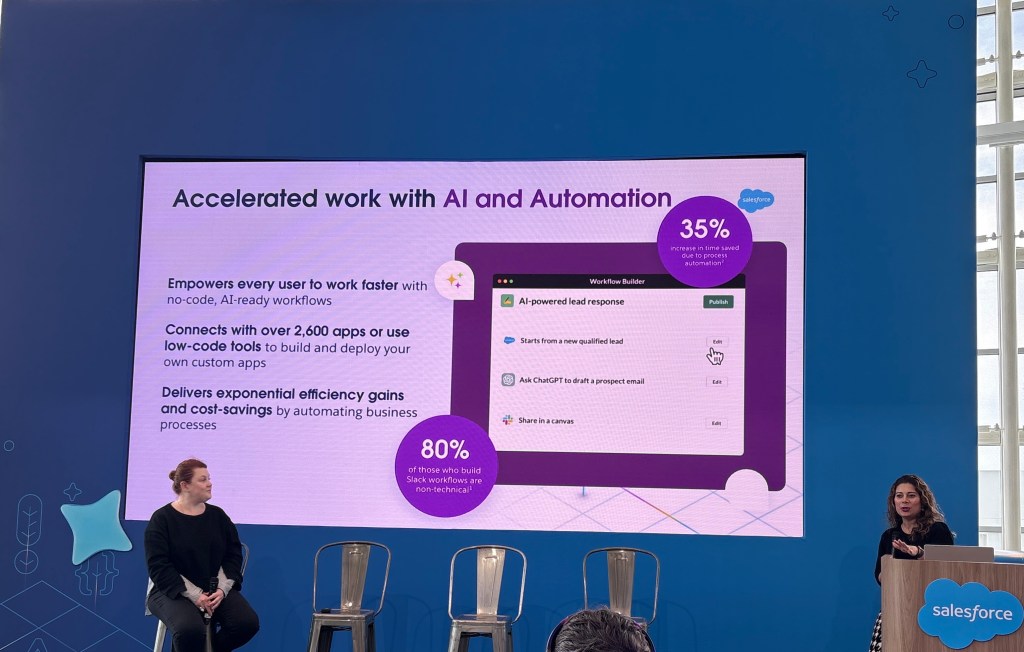
It’s possible because agentic AI is transforming the way Salesforce employees work, shifting from the terminally togglesome “apps and tabs” morass to a more conversational style in which everything is orchestrated through agents and workflows.
At the company level, the aforementioned Techforce agent handles more than 8,000 employee cases a month related to devices, tools, and software.
At the function level, the Workflow Builder helps business users automate tasks like responding to leads on their own, freeing up developer time.
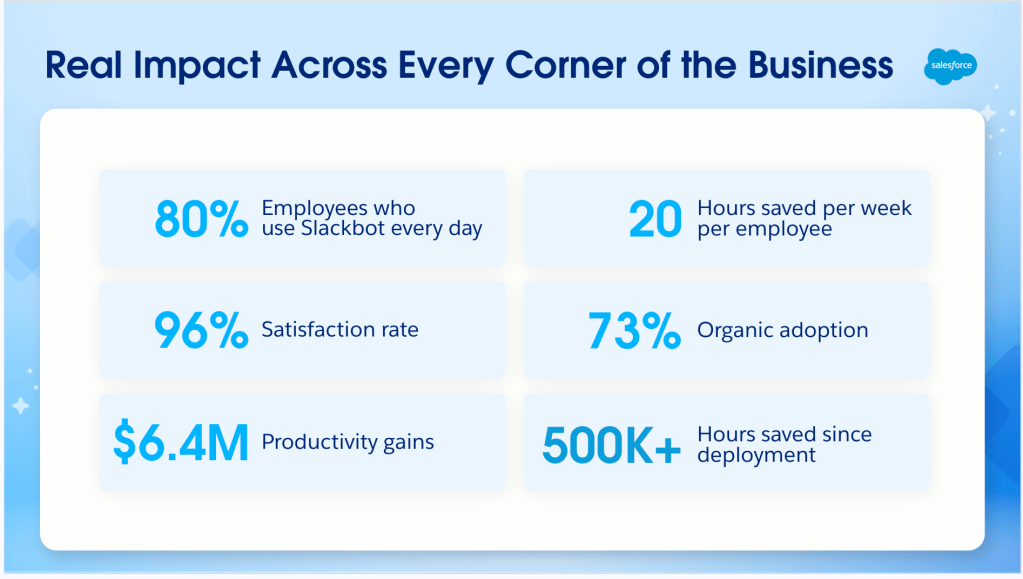
For managers, Approvals in Slack connects to third party apps like Concur and Workday, allowing them to approve requests (travel asks, reimbursements etc) without needing to swivel back and forth between other systems. “How many emails do you get?” asked Khaydarov. “Are they fun for you, because they are not fun for me.” The approvals app gives the manager a notification and shows them an image of the receipts or other elements of a request, dropping approval time from two days to just a few hours.
At the individual level, well, Salesforce has a lot of sellers. The Sales Agent will look at all of a user’s threads, channels, and canvases, including deal history, pricing, and product knowledge so the seller can walk into every meeting ready to go.
And let’s not forget Slackbot. Not only can it orchestrate all the other agents the company has running, it can make it easier for people to go on vacation: Khaydarov just asks Slackbot for help with an out of office doc, and it pulls from all her docs and channels and sources to produce a Canvas for the team to refer to while she’s gone. “It took me 10 minutes,” she said.
A couple of vignettes from the campground
The Moscone Opening

Trailblazer Trading Cards

TDX Keynote: Humans and Agents Build the Agentic Enterprise
The 10th anniversary of TrailblazerDX kicked off with a clear message: the era of the agentic enterprise is here, and the way we build software is fundamentally changing.
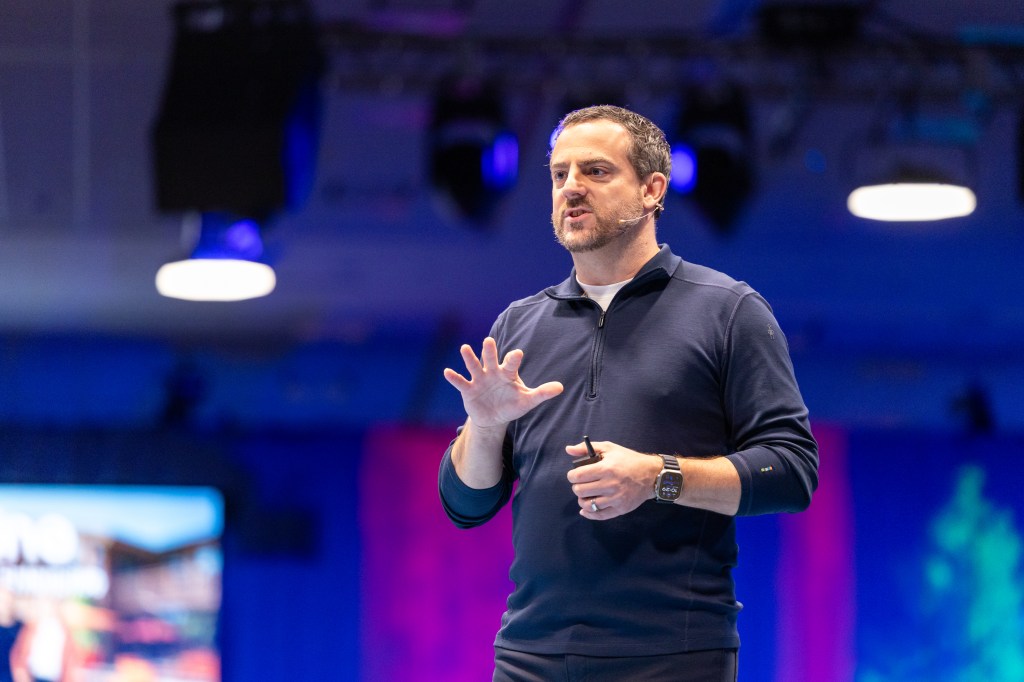
The undeniable star of the keynote was Salesforce Headless 360. As President of Enterprise & AI Technology Joe Inzerillo told the crowd, “The agentic revolution is the most impactful thing I’ve seen in my entire life.” However, because AI agents are probabilistic — meaning they won’t execute a task the exact same way every time — developers need powerful, deterministic tools to manage them. Headless 360 is the answer. It is a completely decomposed system of context and work that makes the entire Salesforce platform accessible via APIs, CLIs, and Model Context Protocols (MCPs), allowing humans and agents to work together seamlessly.
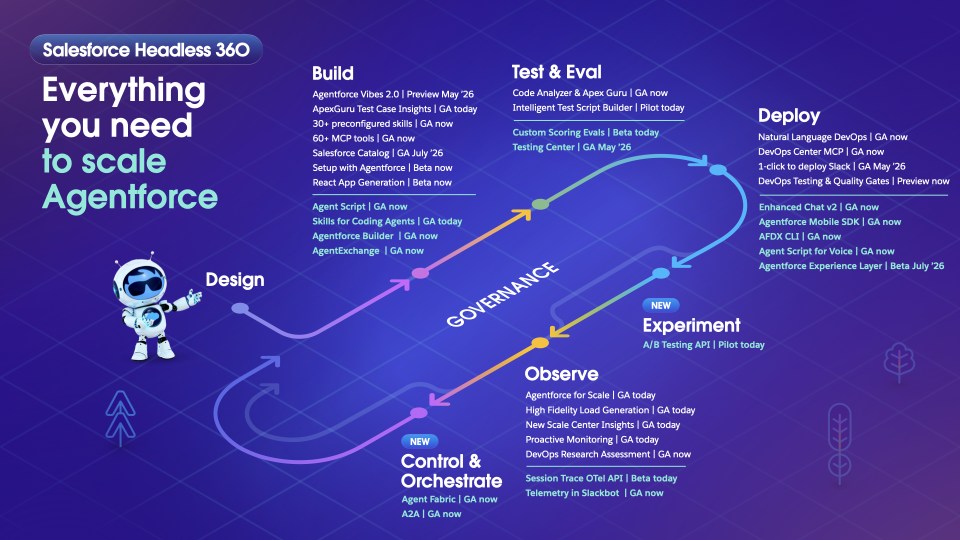
To understand the massive paradigm shift of Headless 360, the keynote broke down how it transforms the development lifecycle into three core motions:
- Build together with coding agents: Salesforce Headless 360 introduces a foundational shift in the software development lifecycle, allowing developers to plan, build, and execute projects natively alongside AI. As Inzerillo explained, “Every time you hear MCPs, just think legos: you can build whatever you want.”
- The platform leverages Model Context Protocol (MCP) tools, which act as composable, headless building blocks that developers can access from their preferred integrated development environments (IDEs).
- By utilizing tools like Agentforce Vibes 2.0 and the Salesforce Catalog MCP, developers can securely ground coding agents in their organization’s metadata, enabling the AI to accurately synthesize requirements and generate code.
- Scale Agentforce with trust: Because generative AI models often operate probabilistically, scaling an agentic enterprise requires continuous refinement and robust governance. “I used to think that when you built a piece of software, 80% was the build and 20% was refinement,” Inzerillo shared. “And with an agent, it’s the opposite. It’s 20% to get the thing out there. To make it great is what takes 80% of the effort.”
- Headless 360 equips developers with a comprehensive, continuous improvement loop to build, test, evaluate, deploy, and observe their agents.
- To ensure AI behaves reliably and securely, the platform provides deterministic control mechanisms like Agent Script, which allows teams to write highly detailed instructions and establish strict guardrails for their agents.
- Deploy on any surface: Headless 360 eliminates the constraints of a single user interface, empowering organizations to push custom AI capabilities directly to the channels their customers and partners already use. “You are not pulling your customers into your mobile app or website anymore. You’re pushing your experience and brand and meeting them wherever they are. That is the power of Headless 360 and the experience layer,” said Janani Narayanan, VP, Unified Profile & Knowledge.
- The platform’s open ecosystem allows developers to seamlessly integrate and deploy agentic workflows across mobile applications, web platforms, and third-party enterprise tools.
- By deploying custom experiences to platforms like Slack, businesses can unify their data and agents—utilizing tools like Slackbot to deliver an intuitive, highly efficient, and brand-aligned user experience.
The real-world impact of this technology was illustrated by Trailblazer stories. B2B travel company Engine shared how they used the Agentforce 360 Platform – including Slackbot – to fully handle 50% of chat cases (from routine to complex) with no human intervention.
Engine’s Senior Salesforce Administrator, Sarah Morton, who received a Golden Hoodie, the highest honor in the Trailblazer community, perfectly captured the practical magic of this shift: “We took this agent and we were able to understand the customer’s issues by looking at our data, and we found a simple use case that we could give to the AI. And once we develop that trust and confidence, we were able to scale a lot easier once that foundation had been laid.”
“It wasn’t ever like we were starting from scratch,” Morton added. We didn’t have to reinvent the wheel. We had these building blocks in place. It really helped redefine the business and what’s possible with AI.“
The keynote has begun!
In case you hadn’t heard, mind this robot.

Slackbot Saves the Day at a Session About Slackbot
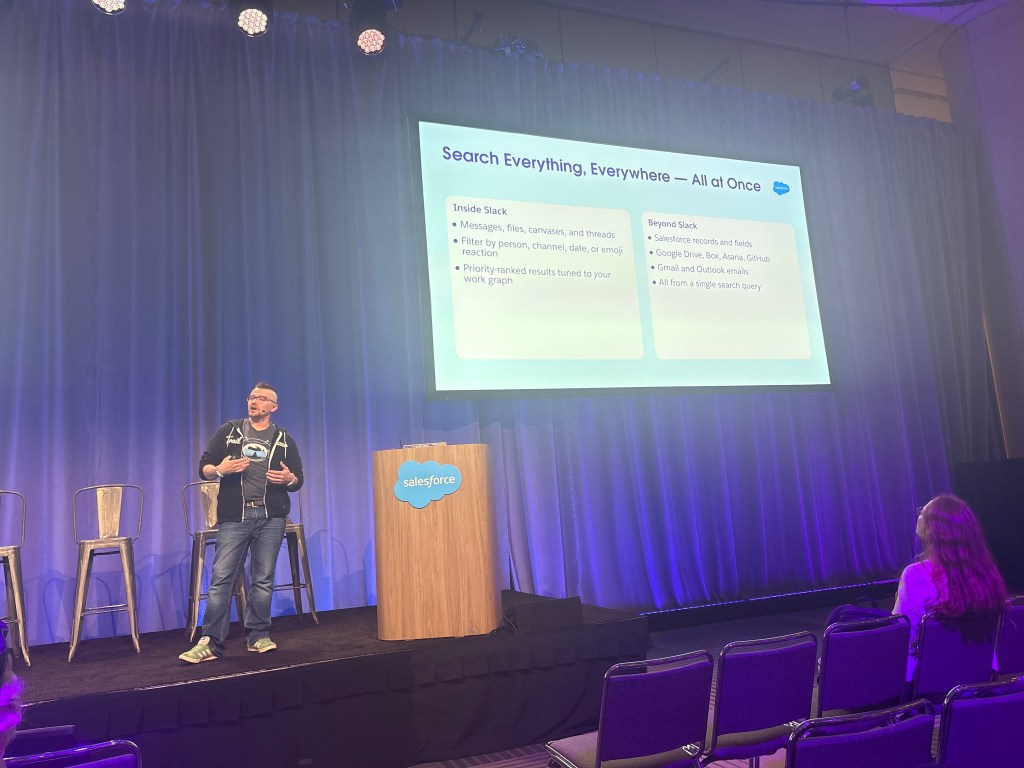
The session started out smoothly. Mike Reynolds was giving a demo of the new Slackbot. “Slackbot was actually part of Slack’s release in the initial public beta,” Reynolds, a Senior Technical Product Marketing Manager, Slack Developer Marketing, told the assembled crowd at TDX 2026. “But it was just a bot. Now it’s powered by a powerful LLM, and it respects the same level of access you have inside of Slack.”
He pattered on a bit about how Slackbot helps him stay on top of all the other agents he has access to, then paused. “This is one of the riskiest demos I have ever done,” he said. He advanced his slide deck to show … a blank screen. “Because I forgot to build it.”
Reynolds clicked away from the blank slide to his Slackbot chat where the prompt was waiting. (Maybe he didn’t reallllyyyy forget.) “I’m on stage at TDX right now,” it read, “I’ve got a section of my presentation to fill in. …”
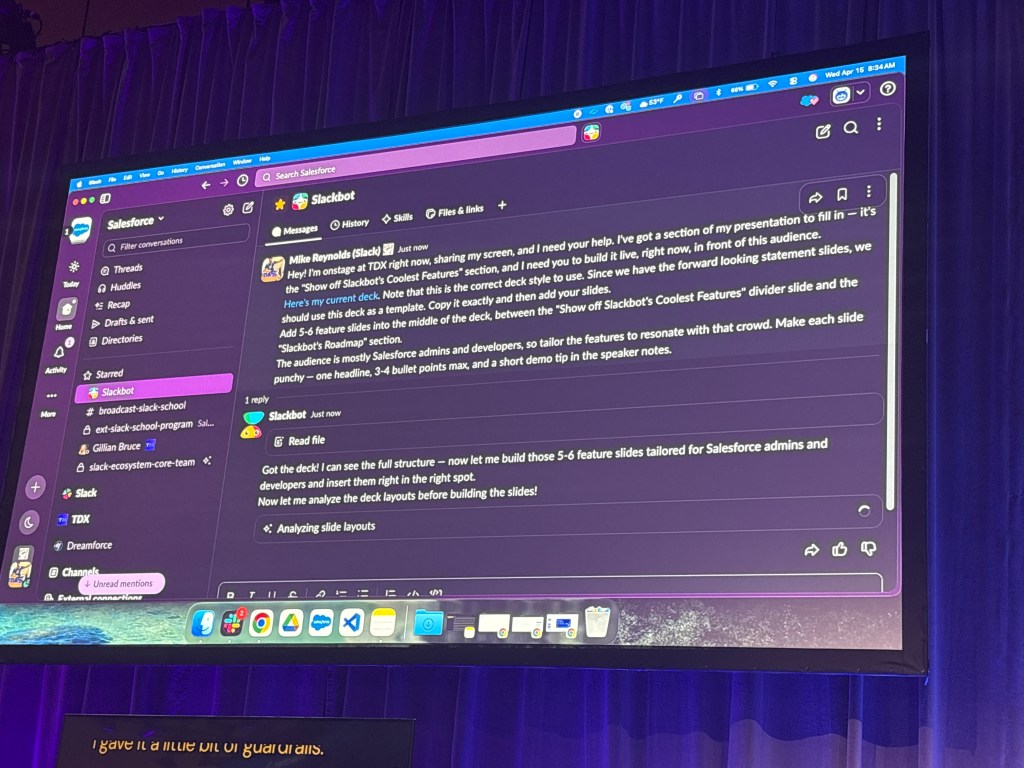
Slackbot built him a new deck, right there, those sad blank slides swiftly filled in with Slackbot’s capabilities. (One slide was extremely ugly, but as Reynolds noted, Slackbot doesn’t have eyes, and that’s why you always need a human in the loop.)
Reynolds’ favorite Slackbot capability is “searching everything, everywhere, all at once.” That’s Slackbot’s ability to search Slack, Salesforce, OneDrive, PDFs, and more. “When I ask Slackbot a question, I’m getting an answer that has been aggregated from essentially every data source that is connected to Slack. I can ask questions about my calendar. I can say, Hey, is there a deck that goes along with this meeting? And it will find that even if they’re not directly connected to each other. It’s a really, really powerful feature.”
Next up on the roadmap (insert language here about forward-looking statements) are capabilities like searching the Web (it sounds easy but there are a lot of things on the Web that you do not want inside your Slack), building workflows, Agentforce orchestration and third-party app orchestration, and AI meeting notes. That means, when you ask questions, Slackbot’s answers will be informed by the meetings you were in – or, as long as you have access to the summaries, that you didn’t even attend in the first place.
News from TDX
At TDX 2026, Salesforce is delivering a package of innovations designed to help builders navigate the agentic era:
- Introducing Salesforce Headless 360. No Browser Required: Salesforce Headless 360 delivers new MCP tools and coding skills that give your coding agent full access to your platform; a new experience layer that renders rich, native interactions across every surface, from Slack to Voice to WhatsApp; and new tools that give you control over how agents behave in production — before launch and after.
- Salesforce Advances Agent Fabric: New Guided Determinism & Governance Controls to Scale Multi-Vendor AI Faster: Salesforce announced a major expansion of Agent Fabric, delivering a trusted agent control plane for the rapidly evolving multi-vendor AI landscape.featuring expanded agent and MCP discovery, advanced capabilities for deterministic orchestration, and LLM governance.
- Introducing the New AgentExchange: One Unified Marketplace for the Agentic Enterprise: Salesforce launched the new AgentExchange, unifying AppExchange, Slack Marketplace, and the Agentforce ecosystem into a single catalog, making it easy for customers to discover, buy, activate, and manage solutions across Salesforce and Slack.
Also announced:
- Engine Powers Seamless Travel Experiences with Agentforce and Slack: Engine, a business travel platform trusted by more than one million travelers, has deployed Agentforce and Slack to build a digital command center where humans and AI agents work side by side. AI agent Eva autonomously handles 50% of customer support cases, and Slackbot cuts sales research time by 40%. By building on the Agentforce 360 Platform, Engine has decreased average traveler support time by 15% while scaling to manage over 800,000 annual cases.
- Slack is Where Your Team Works. Now it’s Where Your Agents Work Too: Salesforce is announcing new capabilities that make it easier than ever to build and manage all your agents in Slack, so agents aren’t just siloed tools, but integrated teammates that work where your team already collaborates. Now you can orchestrate work with Slackbot, build and deploy agents in minutes, manage your entire agent ecosystem in one place, and build rich agent experiences with Block Kit.
- Salesforce Launches the Forward Deployed Engineering Partner Network to Scale Agentforce Success: Salesforce is launching the FDE Partner Network, providing businesses with the engineering depth to achieve measurable agentic outcomes at scale. Launch partners Accenture and Deloitte are joined by over 30 global network leaders and regional experts — to enable customers to have access to engineering expertise regardless of location or operational model.
- Applied AI: Why Building AI Agents Requires a New Playbook: Salesforce’s latest Applied AI white paper makes the case that the traditional Software Development Lifecycle doesn’t work for AI. Instead, the paper introduces the Agent Development Lifecycle (ADLC), a closed-loop learning system of testing, monitoring, calibration, and refinement that is designed to manage the inherent drift of an evolving AI ecosystem. Developed by Salesforce’s own practitioners, it’s the new playbook for enterprises ready to move beyond “build once, ship, move on” thinking.
- Why Orchestration Is the Next (Wildly Necessary) Frontier for Agents: As enterprises scale to deploy hundreds of agents, the real challenge is making them work in harmony. This piece explores how orchestration, powered by open standards like MCP and A2A and tools like Agent Fabric, is the critical next frontier for making multi-agent AI deliver at enterprise scale.
Coming next: News from the keynote! In the meantime, Codey cookies await.