



You could have a perfect product and a stunning website, but if they don’t show up in an online search, your hard work will go unseen. For sustainable growth, you need a strategy that lets your audience find your business organically. This is where keyword research can help.
Keyword research is the process of discovering and prioritising the words and phrases your audience enters into search engines like Google. It helps you understand which terms your customers are looking for and how to appear in the results when they search for them.
Organic search accounts for 33% of overall website traffic, and keyword research is the most important lever you have for capturing that demand. This guide will walk you through how it works, explain why SEO still matters in the age of AI Overviews, and provide a step-by-step approach to uncovering the right keywords to bring sustainable traffic to your site.
What you’ll learn:
- How to do keyword research: At a glance
- Why does keyword research matter?
- Keyword research in the age of AI: Is it still relevant?
- Before you begin: Keyword research fundamentals
- The best keyword research tools in 2026
- How to do keyword research
- How to do keyword research using Semrush
- How to do keyword research using Ahrefs
- How to organise your keywords
- How to prioritise your keywords
- Summing up
How to do keyword research: At a glance
If you need the brief version, these are the core steps you’ll need to follow, whether you’re using free small business marketing tools or advanced platforms:
- Understand your audience: Know who you’re targeting and their pain points.
- Choose your SEO tools: Semrush and Ahrefs are ideal for deeper insights.
- Create seed topics: List broad themes that describe your products or related topics.
- Validate seeds: Ensure your seed keywords have the right search volume and difficulty.
- Identify keywords: Use keyword tools to find related long-tail keywords.
- Evaluate each keyword: Check intent, search volume (SV) and difficulty to evaluate each keyword.
- Analyse competitors: Where applicable, analyse competitors to find keyword gaps.
- Organise terms: Arrange keywords by intent to align them with your sales funnel.
- Prioritise keywords: Map your highest-value terms to pages and content.
- Content production: Turn your keywords into SEO-led content.
Follow this flow and refine it regularly as your keyword data grows.
Grow fast with the #1 CRM for small businesses.
Get started and scale fast with the #1 AI CRM for small businesses in any industry. Connect marketing, sales, service, and commerce on one platform. Save time with simple setup and built-in guidance. Set the foundation for growth with unified data and AI.


Why does keyword research matter?
SEO keyword research tells you which terms your target audience is searching for online, meaning you can create relevant content that includes those words and phrases. This helps you target the right terms, prioritise which topics to focus on, build authority in your niche and, ultimately, appear higher up on the results page when consumers search for relevant terms.
This matters because visibility equals clicks. On average, the highest-ranked site for a given search term gets the most traffic 49% of the time. The more you climb the rankings, the more people visit your site. And, with 43% of AI overviews (AIOs) linking back to results from Google, keyword research also lets you shape content that will be surfaced in AI summaries and LLMs.
While it’s entirely possible to guess what your audience is searching for online, there are two problems with this strategy:
- If you target a keyword that isn’t popular enough, your SEO strategies might not make an impact.
- If you target a keyword that’s very popular, you might need a way to stand out from the competition in a crowded results page.
Keyword research guides you to the perfect SEO middle ground between ‘too hard to rank for’ and ‘not enough monthly search volume’. It lets you find valuable keywords that will bring traffic to your site without having to compete with a thousand competitors. This increases your chances of targeting keywords that drive serious results for your business.
Keyword research in the age of AI: Is it still relevant?
AI has fundamentally changed what good SEO looks like. Conversational assistants, AI search and Google’s AI Overviews let users get instant answers without visiting a link. This means fewer users are scrolling through search results and clicking on sites directly.
At first glance, this may make keyword analysis seem less relevant, but this isn’t the case.
In fact, it’s never been more important. AI Overviews appear on 21% of all keywords searched, almost all of which have informational search intent. And those AI Overviews will cite high-authority sites; in fact, the top 50 domains account for 28.9% of all mentions.
This means you now need to think about visibility for both organic rankings and AI-generated summaries. As such, modern keyword research has evolved to include new tactics like:
- Identifying where AI Overviews are likely to appear and designing content to answer those queries directly
- Prioritising topics that will get your business visibility in both traditional SERPs and AI summaries
- Building a foundation for generative engine optimisation (GEO) by structuring content that AI can understand and cite
The right SEO and AI analytics platform can help you cluster keywords by intent and track demand, then predict which topics are most likely to earn citations in AI search results. From there, AI solutions like Agentforce Marketing can turn this keyword data into briefs for new campaigns, develop on-brand copy and then track results when you launch.
So, while AI has changed keyword research, it hasn’t made it less relevant. And AI tools for SEO are there to bridge the gap and simplify managing advanced strategies end-to-end.
How can your business use AI?
Get inspired by these out-of-the-box and customised AI use cases, powered by Salesforce.
Before you begin: Keyword research fundamentals
Keywords are the words or phrases people type or speak into a search engine like Google to find information, products or services.
For example, if someone searches for ‘What is CRM‘, this is a keyword. Then, on the search engine results page (SERPs), a search engine like Google will show a relevant response for that keyword. Here’s an example:
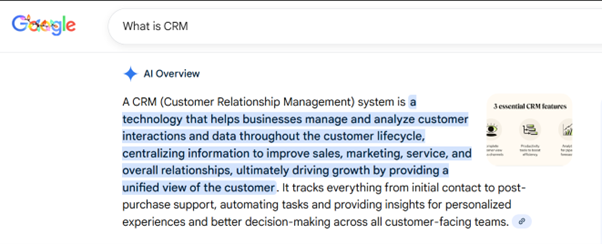
At the top of the page, you’ll often see Google’s AI Overview, where an AI model generates a summary to answer your search query and cite high-authority sources. This is why it’s so important to optimise content for AI as well as humans now.
Below that, you’ll see sponsored results, followed by the traditional search results, which are individual websites that also aim to answer the ‘CRM’ query. These are the results your content is competing with when you choose which keywords to target.
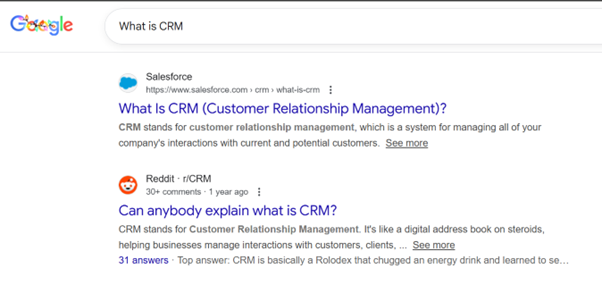
Including keywords in your content helps search engines understand what your page is about and match it with people actively looking for those topics or products.
Effective keyword research starts with finding the overlap between what your audience is looking for and what your business can provide. To do that, it helps to understand a few core elements and why they matter:
Types of keywords
It’s important to understand the different types of keywords. Each has a slightly different function:
Short-tail vs. long-tail keywords
First, let’s look at short-tail versus long-tail keywords:
- Short-tail keywords are broad, competitive keywords that usually consist of one to three words, like ‘email marketing’ and ‘running shoes’. They tend to have a high search volume and a lot of competition, and the intent behind the search isn’t always clear.
- Long-tail keywords are longer, more specific phrases, such as ‘best free email marketing software’ and ‘padded trainers for running. These keywords have a lower search volume but higher intent, often making them easier to rank for.
Most keyword strategies will use a mix of the two. Short-tail terms are great for boosting overall authority and long-term visibility, whereas long-tail keywords are best for capturing high-intent site visitors.
Both have their place. That said, long-tail keywords are often the easiest place to start because they’re easier to rank for.
Target keywords vs. semantic keywords
Most pages are built around a small set of target keywords, plus a wider group of semantic keywords:
- Target keywords are the main phrases that you want to rank for. This usually includes one primary keyword, like ‘CRM software’, plus a few closely-related secondary keywords, like ‘CRM system’, ‘small business CRM’ and ‘best CRM tool’.
- Semantic keywords are related, complementary terms you include to give the topic depth and help search engines (and AI models) understand your topic. For a CRM page, this could include phrases like ‘customer experience’ or ‘sales pipeline’, for instance.
Target keywords help search engines understand what your page should rank for, but semantic keywords help you cover the subject more naturally and in more detail. Both are crucial. Together, they build a rich page that works for customers and search engines.
Local keywords
Some keywords will also include specific locations. For instance, ‘best coffee shop Sydney’ or ’24/7 plumber in Melbourne’. These local keywords are especially important if you run a local business because they signal to search engines where you operate and who you can help.
If local customers are a priority, you should pinpoint these place-based phrases in your keyword research so you can create content that will show up for people searching nearby.
Understanding search intent
The final fundamental to understand is search intent. Behind every keyword, there’s a reason for searching. We can break this down into four key types:
- Informational: The user wants to learn about a topic (‘how to choose running shoes’).
- Commercial: The user wants to compare options (‘best running shoes for beginners’).
- Transactional: The user is ready to act (‘buy running shoes Australia’).
- Navigational: The user wants to go to a specific site (‘Nike website’).
To get accurate keywords, you need to understand the intent behind every search so you can map every keyword to the correct page, such as informational terms to educational blogs, transactional keywords to product pages and so on.
This is the key to building content strategies that guide customers down your sales funnel and closer to the point of sale.
The best keyword research tools in 2026
The best keyword research tools depend on the goal you’re trying to achieve. Some are best for deep competitive analysis, others for rapid brainstorming. Below, we’ve compiled some of the most useful options for content marketers looking to get started:
Best Keyword Research Tools
| Tool | Best for | Pricing |
|---|---|---|
| Semrush | Comprehensive keyword research, content planning, creation, reporting, project management | Limited free usage with caps on reports; paid plans starting at $199 per month |
| Ahrefs | Deep SEO insights, keyword planning, competitor analysis, backlink analysis | Free plan with very limited access; paid plans starting from $129 per month up to $449 per month for advanced SEO plans |
| Ubersuggest | Generating simple keyword suggestions, basic difficulty scores and content ideas without a complex setup | Free tier with limited daily searches; one-time paid plans starting at $490 for individuals up to $990 for enterprises |
| Google Keyword Planner | Generating baseline keyword ideas and search volumes to kickstart deeper research | Free with a Google Ads account |
*Pricing accurate at the time of writing, but please note prices may have changed.
If you’re just getting started, Google’s Keyword Planner and Ubersuggest are low-stakes ways to explore search demand and build early-stage keyword lists.
However, as your SEO efforts mature, Ahrefs and Semrush are both considered the gold standard for deeper research and ongoing optimisation. In the next section, we’ll use both of these keyword tools to walk through a step-by-step keyword research workflow you can follow.
How to do keyword research
Now that we’ve covered the basics, let’s walk through how to actually do keyword research. Here, we’ll prepare your initial keyword ideas and then use Semrush and Ahrefs to turn them into a focused list you can use to produce compelling SEO content.
Preparing your keywords for Semrush or Ahrefs
Before you dive into keyword research with your chosen tool, it’s helpful to have a general idea of what you’re aiming to find.
Create five to 10 seed keyword categories you want to rank for. Seed keywords are terms that you’ll start with to unlock a more specific range of keywords. These keywords should be broad topic clusters relevant to your business. They relate to the products or services you sell or the topics you think your target audience will engage with.
For example, if your business sells sportswear, seed keywords could be:
- Running shoes
- Athletic clothing
- Exercise
- Activewear
- Yoga pants
- Compression shirts
- Fitness
- Well-being
It’s important to be broad at this stage. These aren’t necessarily the keywords you’ll rank for. They’re a starting point (a ‘seed’) that you can use to grow your keyword strategy.
Once you have a basic list relevant to your business, choose a tool and get started. We’ll cover Semrush first, followed by Ahrefs.
How to do keyword research using Semrush
Let’s start with Semrush. We’ll use ‘running shoes’ as our seed keyword and show you how you can expand on this to build out a list of short and long-tail keywords for SEO.
Semrush’s Keyword Overview tool
Start with Semrush’s Keyword Overview to sense-check your seed keyword. You can find it on the left side of the Semrush dashboard.
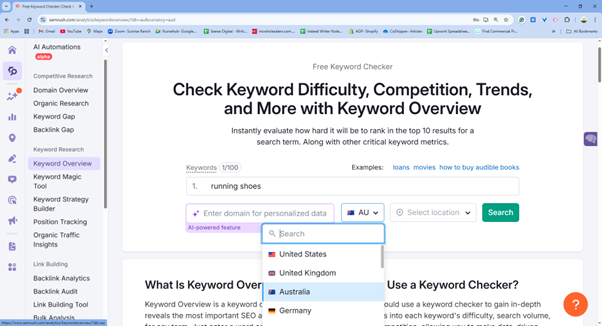
Enter one of your chosen topic buckets in the search bar. We’ll enter ‘running shoes’ and click Search. You should also localise the search to your location. We’ve opted for Australia. For personalised results, you can also enter your domain in the AI-powered search bar.
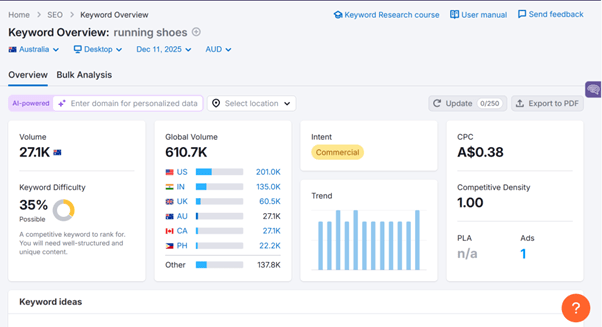
In this overview, you can see all essential information about your seed keyword on a single page, such as:
- Search volume: This number indicates how many users are searching for the keyword, both locally and globally.
- Keyword difficulty: This tells you how hard it will be to rank for this term based on competition.
- CPC: This is the cost-per-click advertisers will pay to run Google Ads.
- Intent: This identifies whether the keyword is informational, navigational, transactional or commercial.
- CPC and competitive density: These are useful metrics for running pay-per-click (PPC) keyword campaigns.
At this stage, you don’t need to focus too heavily on every metric. You simply need to answer three questions:
- Is there enough search volume for this seed keyword to be worth pursuing?
- Is the difficulty achievable for your site? (Aim for a lower KD if you’re just getting started.)
- Does the intent match the kind of content you want to create?
If the statistics look promising, you can keep the seed keyword and move to the next step.
Semrush’s Keyword Magic tool
Once you’ve validated your seed keyword, you can use the Keyword Magic tool to find related terms to your main topic buckets. You’ll find this tool on the left-hand navigation bar. Again, you can enter your domain in the AI search bar here to personalise the results.
Input one of your seed keywords, e.g., ‘running shoes’. You’ll then see a page like this:
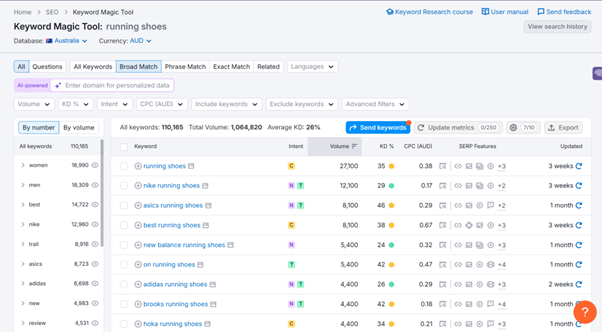
This keyword research tool lists keywords and phrases related to your seed keyword. Next to each keyword, you can check search volume, intent and keyword difficulty.
For instance, you’ll see that the related long-tail keyword of ‘best running shoes’ has commercial intent, a search volume of 8,100 and a keyword difficulty of 38.

Semrush also offers several ways to refine your search insights. These filters are located on the top bar above your keyword list.
For example, you can apply a filter to your keywords if you’re looking to write exclusively informational content. Here’s an example:
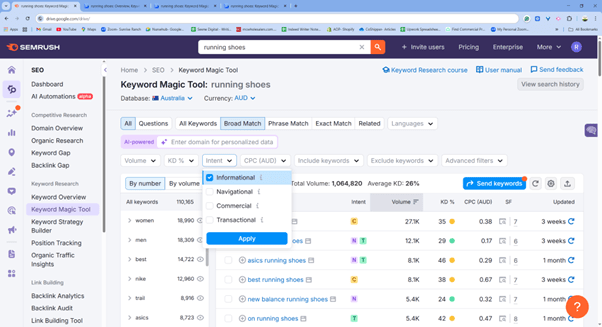
Here’s what that does to our seed keyword:
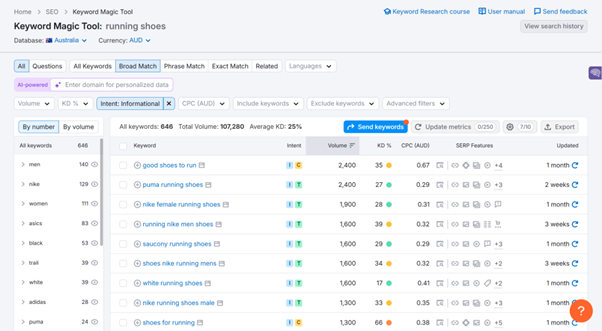
Now we’re getting somewhere. To discover keywords our new sportswear business can rank for, we can filter the keyword difficulty from lowest to highest or vice versa.
In this example, let’s choose something with a low keyword difficulty and a higher search volume to find a keyword that isn’t too competitive but still has decent search traffic.
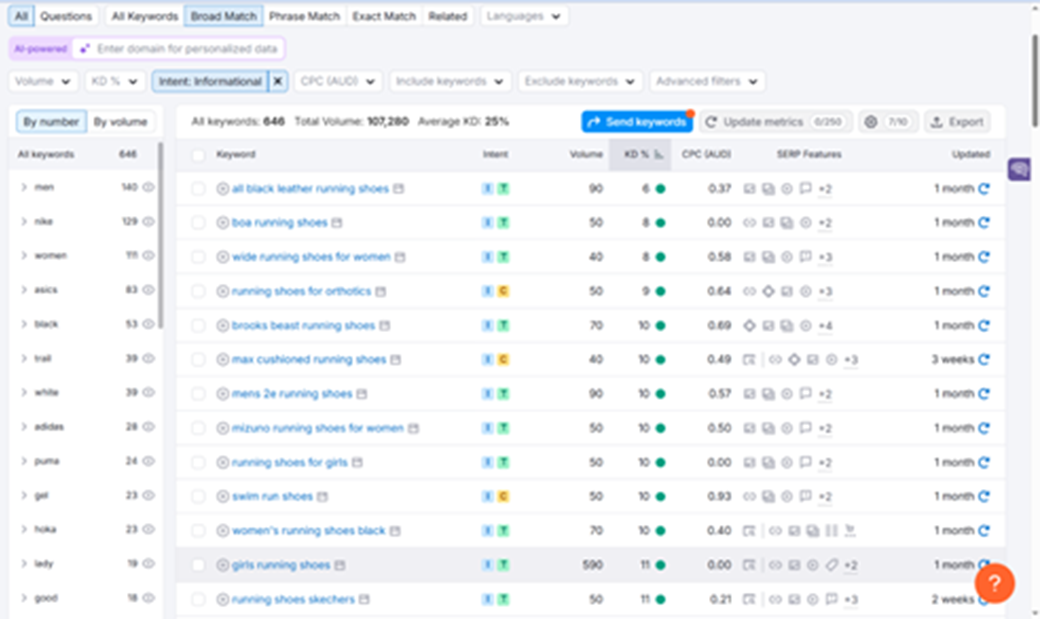
In the example above, the keyword ‘girls running shoes’ could be a potential winner due to the following data points:
- Informational intent
- 590 searches per month
- A KD score of 1
Expert tip: As a general rule, you should aim for keywords labelled ‘Easy’ and ‘Very Easy’ when you’re just starting. As you build more domain authority, you can target more difficult keywords over time, which helps you build up topical authority.
Sometimes, when you’re doing keyword research, you may run into cases where keywords are not so relevant to your business. In this case, you can also use the Exclude Keywords function to remove those keywords from your list and click Apply:
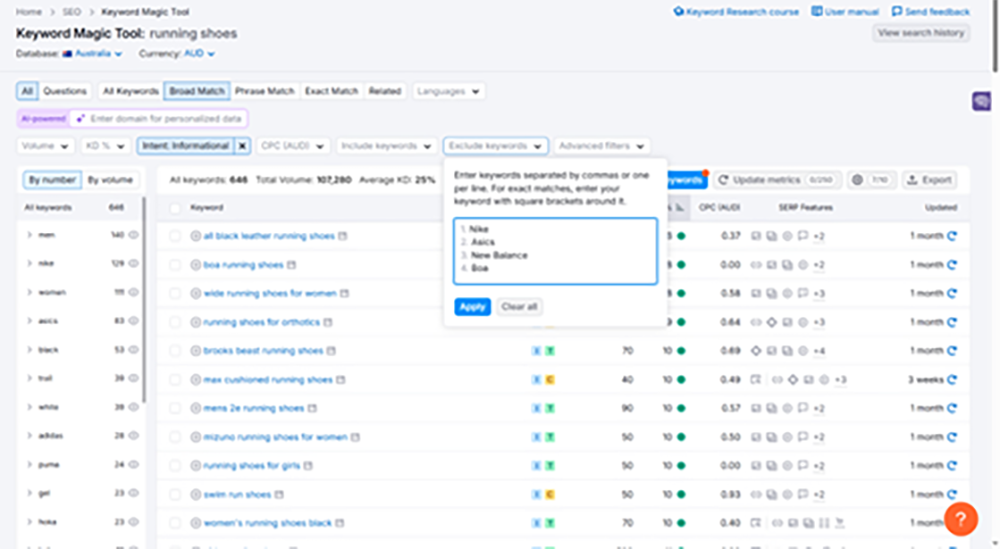
Repeat this process for any remaining seed keywords and export the data to a spreadsheet. Once you have a large list of keywords to target, move on to the section below about organising and prioritising keywords.
Semrush Competitor Analysis
Another valuable way to find useful keywords is through Semrush’s Competitor Analysis. It involves analysing your direct competition to see what your opposition is targeting.
To get started, determine who your primary organic competitors are. If you’re unsure, you could also search for the keyword alongside your location using Google Chrome’s Incognito function, like this:
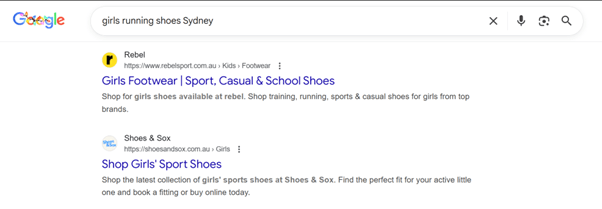
Using incognito is handy because it gives you an overview of all of your competition, including:
- Direct competitors: Businesses that offer the same service or products as yours
- Indirect competitors: Businesses that provide different products and services but compete for similar keywords
Once you’ve located a potential competitor, head to the Domain Overview section on the left-hand navigation bar and enter the competitor’s main URL. Let’s say we land on Rebel as our primary sportswear rival.
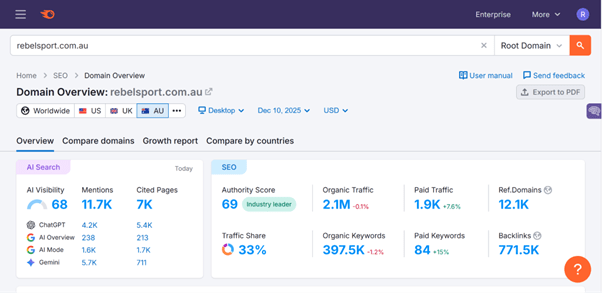
Once you search, you’ll see a wealth of information at the top of the page, including:
- AI search metrics: These indicate how many times AI tools mention or cite that competitor and which tools reference the site most.
- Authority score: This tells you how strong and trustworthy the domain is overall, based on backlinks, organic traffic and other SEO signals.
- Organic traffic: This is an estimate of how many visits the site receives each month. You can also view how this traffic has changed over time on the graph below.
- Organic keywords: This shows how many keywords the competitor ranks for in total. Again, this is also visible in the graph below.
- Traffic share: This is the percentage of total organic traffic that the domain captures compared to other sites in your niche.
You can also scroll down, and the Domain Overview will show you the Main Organic Competitors and a Competitive Positioning Map.
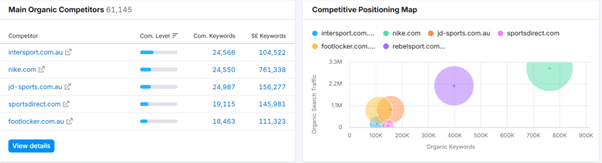
However, the real value lies in the Top Organic Keywords section. This shows you exactly what your competitors are ranking for and what terms you can compete with.
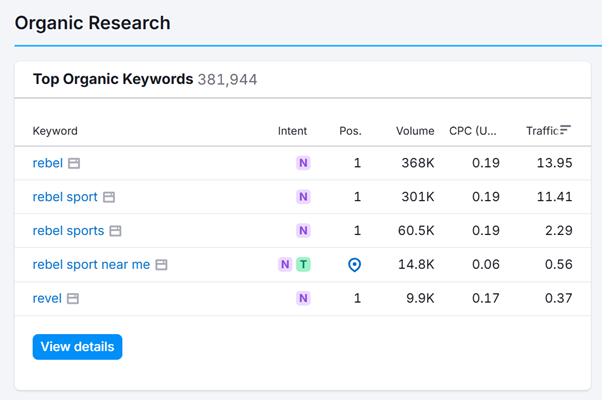
Click View details, and you’ll see every competitor keyword you can target for yourself.
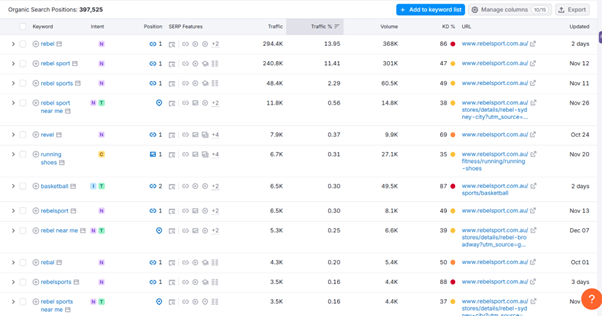
From here, you can refine your search by volume, keyword difficulty and intent to land on potential keywords to target in your own SEO strategy. You can also exclude keywords like brand names (‘Rebel’) to instantly filter out unhelpful terms.
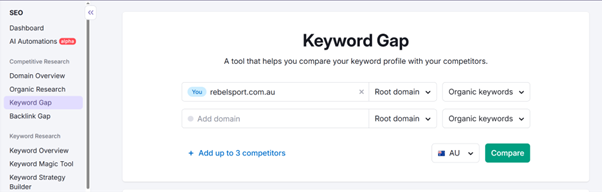
Want to go further? You could also investigate competitors more deeply by entering their website URLs into Organic Research or conducting a Keyword Gap analysis to find keywords your competitors are targeting that you aren’t:
Once you’ve uncovered a list of keywords that have a suitable search volume, difficulty and intent for your business, you’re ready to move on to prioritising and organising them.
Semrush’s AI Keyword Planner
The final option we’ll cover is leveraging Semrush’s AI Keyword Opportunities feature, which you’ll find in the AI Automations section on the left-hand bar.
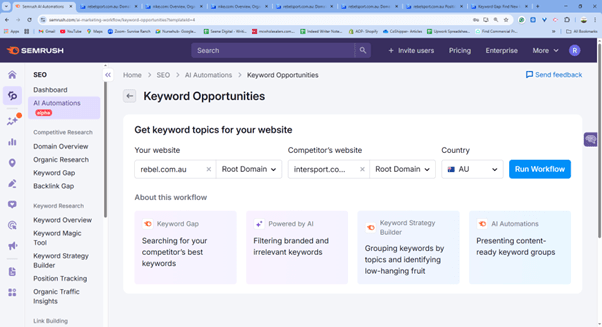
Here, you can input your website, a competitor and a location to get AI-driven recommendations on your keyword research. Let’s input Rebel, alongside one of their closest competitors, Intersport. Then, we’ll click on Run Workflow.
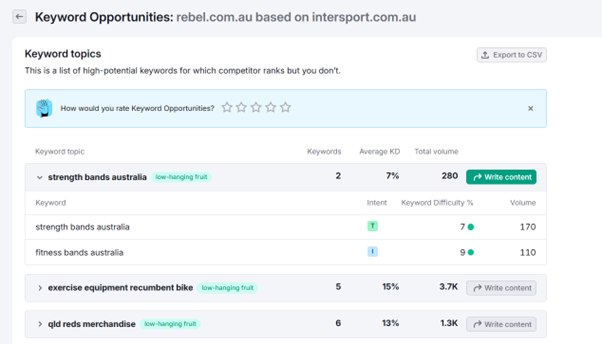
On this page, you’ll see several keywords that your competitor currently ranks for, but you don’t. This is one of the fastest, simplest ways to generate keyword recommendations instantly that align with your goals.
How to do keyword research using Ahrefs
Ahrefs also offers a tool for finding relevant long-tail keywords to target. We’ll use the keyword ‘digital marketing’ to show you how the platform works.
Ahrefs Keyword Explorer tool
First, go to the Keyword Explorer and enter your seed keyword. In our case, we’ll use the keyword ‘digital marketing’:
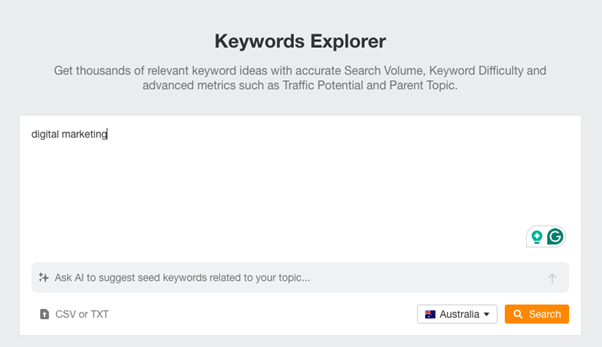
Then, click the dropdown next to the search bar to choose your location to localise your data.
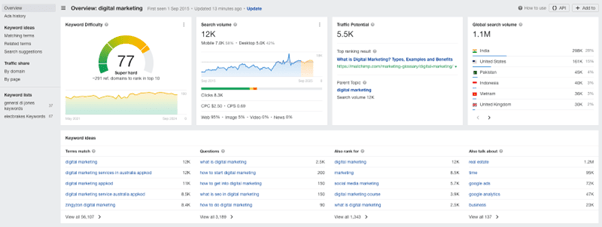
As you can see, Ahrefs shows all essential information about your seed keyword, like:
- Keyword difficulty: This indicates how hard this keyword will be to rank for.
- Search volume: This shows how many people search for the keyword you’ve provided. The higher the keyword search volume for your seed keyword, the better.
- Traffic potential: This is the total organic traffic that the number one-ranked page gets for your target keyword.
How to find niche keyword ideas using Ahrefs
Once you’ve validated your seed keyword, it’s time to find relevant long-tail keywords that are easier to rank for.
In Keywords Explorer, on the left dashboard, click Matching terms.
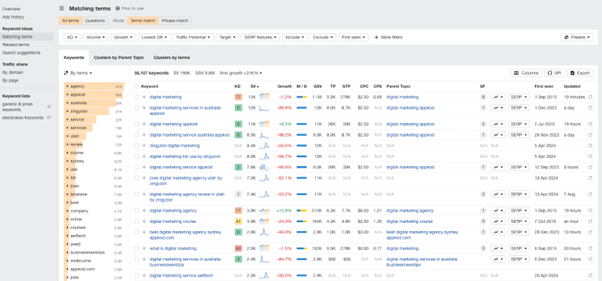
You can also click Related terms to get a wider range of matches broadly related to your seed keyword.
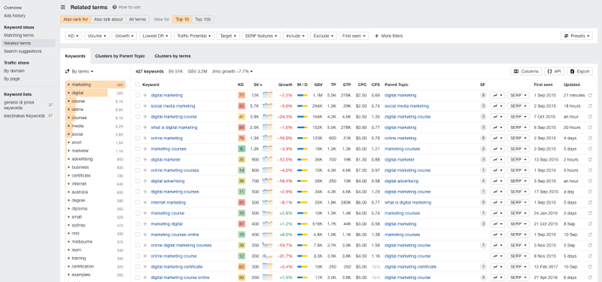
At this point, you can view a list of keywords and important keyword metrics, like:
- KD: Keyword difficulty score for ranking
- SV: Average monthly search volume data
- Growth: Percentage increase or decrease in keyword popularity over time
- M/D: The monthly search volume is divided by difficulty
- GSV: Global search volume for a keyword
- TP: Traffic potential for a keyword
- GTP: Global traffic potential estimate
- CPC: Cost per click in advertising
- CPS: Cost per sale in marketing.
- Parent Topic: Broader category for related keywords
These keywords can also be filtered by Clusters by Parent Topic:
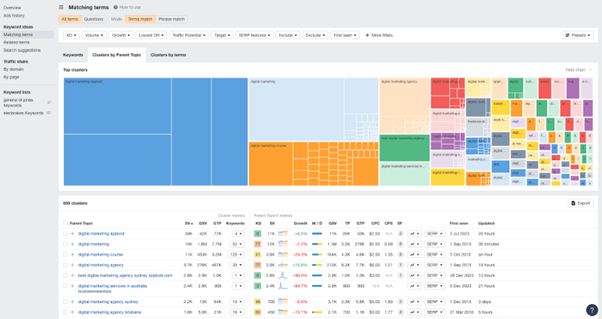
For the keyword ‘digital marketing,’ we can see a total of 12,000 searches per month.

Let’s narrow this down by using the Ahrefs DR function, which allows you to add a low DR number to find less competition. In this case, we’ll enter ‘DR 30’ in the top five like this:
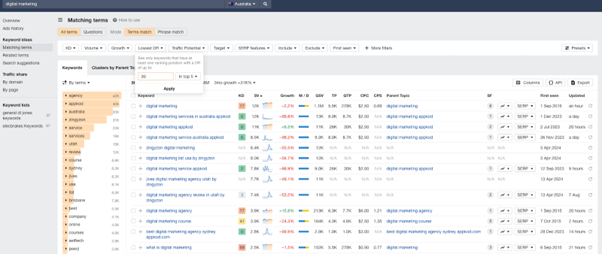
Now, it has provided a list of keywords, but this still needs some refining, as it shows some brand names and other keywords that aren’t very relevant.
So, let’s use the Exclude function to clean up this data like this:
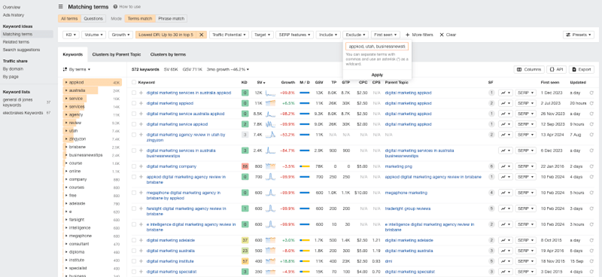
Now, you can click on the filters; for example, you can click on KD to sort by lowest KD or SV to sort by the highest search volume to see if there’s anything worth targeting. Here’s what the filtered keyword list looks like now:
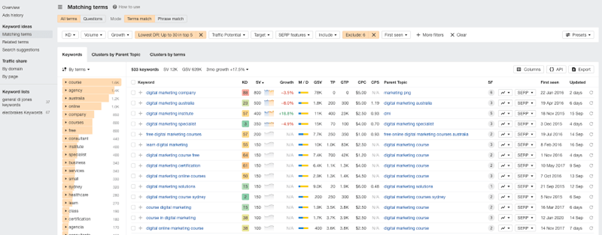
In the keyword list above, some potential strong candidates for digital marketing agencies and online course providers exist. Here are some of the keywords that stand out from this list that could be whitelisted:
Example of potential keywords after running a filter
| Keyword | Keyword Difficulty (KD) | Search Volume (SV) |
|---|---|---|
| Digital marketing specialist | 3 | 350 |
| Course digital marketing | 15 | 150 |
How to organise your keywords
Generally, the easiest way to create broad keyword clusters is to segment your keywords by intent in a spreadsheet. From there, you can further divide your keywords into predefined topic buckets. We’ll return to our running keyword research example for this. The process should result in something like this:
Informational search intent
- Running shoes (seed keyword)
- What are good running shoes [260]
- How long do running shoes last [170]
- How often should you change running shoes [90]
- Exercise (seed keyword)
- Equipment to exercise [1,000]
- Clothes for exercise [880]
- Front delt exercises [880]
Commercial search intent
- Running shoes (seed keyword)
- Running shoes women [2,900]
- Running shoes for men [1,600]
- Carbon plated running shoes [480]
- Exercise (seed keyword)
- Exercise bike [18,100]
- Exercise ball [2,900]
- Exercise bands [1,900]
Organising your keywords allows you to target a single seed keyword at every stage of the buyer lifecycle. This boosts your topical authority for these terms, allowing you to target keywords with a larger search volume (and greater difficulty) further down the line.
How to prioritise your keywords
Prioritising your keywords is perhaps the most challenging part of keyword research because there isn’t one definitive way to do it. It depends entirely on your goals.
For that reason, we’ve provided several different methods to help you choose the right keyword to target for your business:
- Relevance: Is this keyword truly useful to your business? Will it link back to your product? Is this something your audience would want to know? Prioritise keywords that will be valuable to you and your customers.
- Keyword difficulty: When you’re just beginning to target a seed keyword, prioritise words with a lower difficulty score that are easier to rank for. You can gradually increase the keyword difficulty from there as you gain more topical authority.
- Buyer journey: You can also prioritise keyword targeting based on search intent. For example, many businesses begin with informational content to build topical authority before targeting commercial and transactional phrases.
- Demographics: There’s also the option of evaluating your keywords through the lens of your target market. The more you understand your target audiences, the easier it is to determine which keywords are worth your time.
Each of these segmentation options will bring up a slightly different mix of ‘high priority’ keywords. The key is to pick a method that matches your current goals and then refine your approach over time as you see which keywords actually drive traffic and revenue.
Stay up to date on all things marketing.
Sign up for our newsletter to get the latest research, industry insights, and product news delivered straight to your inbox.
Summing up
If you truly want to master SEO and drive organic traffic to your site, you need to understand what terms your customers are searching for. To do this, you need to make effective keyword research a priority.
Keyword analysis tools like Semrush and Ahrefs will provide you with all the data you need to optimise your content creation. You can evaluate keyword difficulty scores, search volumes and search intent to determine which terms are worth the investment and which are a waste of time.
Create a list of seed keywords, refine them using tools and prioritise your keywords based on their value to you and your audience. Do all that, and you’ll be in the perfect position to create valuable content that converts consumers into loyal customers.
How Salesforce can help
Once your keyword strategy is underway, all that’s left to do is understand which terms actually drive traffic, leads, and revenue. Agentforce will close that loop by bringing together your web analytics, campaign data and CRM insights into one place, so you can see which keywords turn into revenue, where you’re succeeding and where your competitors are outperforming you.
From there, Agentforce Marketing can help you act on those insights, highlighting new keyword opportunities, recommending content to create or optimise and even building entire customer journeys based on search intent. All of this lets you guide buyers down your sales funnel, close more deals and create personalised experiences at every touchpoint.
Get ready to deliver exceptional customer experiences across every channel. To find out more, watch the Agentforce Marketing demo today.
FAQs
Every country has its own unique, relevant keywords. For instance, searching for ‘best car brands 2024’ in Australia will bring up a different list of terms than the same search in India or Singapore. Use your preferred keyword tool to set the correct country or region, then compare search volume, difficulty and intent for the same seed keywords so you can choose phrasing that best matches how local customers actually search.
Not at all. Around 43% of AI overviews reference and link back to results from Google itself, as per Search Engine Journal. If your business can increase its chance of ranking with smart keyword targeting and quality content, AIOs will reference you as a quality source, driving more traffic to your site. This means keyword research is still the foundation of visibility. It helps you identify topics and terms you need to own so you can appear in both traditional search results and AI-generated summaries.
There’s no rule. However, it’s a good idea to focus on one primary keyword and a small group of closely related secondary keywords that all have the same intent. You can then include several semantic keywords to add depth to your topic. The goal is to provide value, not cram in as many terms as possible.