



A proforma invoice is a preliminary bill of sale that a vendor sends to a prospective customer before the final sale or shipment of goods. They’re typically used when a buyer has confirmed the sale, but there are still details to iron out, such as the quantity, materials, or delivery date.
By sending a proforma invoice, the seller can show the buyer how much they’ll need to pay before they receive their goods or services. This keeps everyone in the loop, helping the sales process go smoothly while also acting as a gesture of good faith.
Proforma invoices work a little differently from conventional invoices, and they aren’t suited to every transaction. In this guide, we’ll explore what sets proforma invoices apart, how to create and amplify one with technology, and when to use one to build stronger client relationships.
Key takeaways
- Proforma invoices aren’t the same as regular or commercial invoices, and they differ slightly from quotes in terms of purpose.
- They’re used prior to a sale being finalised, and they aren’t legally binding.
- They’re a great tool for building trust between the buyer and seller and reducing the chances of disputes.
- They share many of the same features as a regular invoice, but they don’t require a final payment date.
What you’ll learn
- Proforma invoices vs. other types of invoices
- When to use a proforma invoice
- Regulatory updates for digital trade in Australia (2026)
- What are the benefits of a proforma invoice?
- What are the different types of proforma invoices?
- How to create a proforma invoice
- Proforma tips for Australian businesses
- Best practices for using proforma invoices
- How technology makes proforma invoicing effortless
- Wrapping up
- FAQs
Proforma invoices vs. other types of invoices
To better understand what a proforma invoice is, it’s best to look at how it differs from regular and commercial invoices.
Below are some key differences that distinguish the different types.
Proforma invoices vs. regular invoices
First, let’s look at how proforma invoices differ from the regular invoice you’ll be familiar with:
The Difference Between Proforma Invoices and Regular Invoices
| Aspect | Proforma Invoice | Regular invoice |
| Purpose | A proforma invoice is sent when the sale has been agreed in principle. The buyer receives a detailed breakdown of the sale prior to sending payment. | Regular invoices are sent after the sale is confirmed and goods/services have been exchanged. |
| Legal Status | It’s not a legally binding agreement and doesn’t request payment. | This type of invoice is legally binding, and formally requests payment. |
| Invoice Content | It provides a detailed, unconfirmed breakdown of the deal and a clear indication that it’s proforma. There’s no due date for payment. | It provides a detailed, confirmed breakdown of the deal. It also includes clear payment terms and a due date. |
| Modifications | It can be modified or adapted based on negotiations. | It’s typically final, unless corrections are required due to mistakes. |
| When is it sent? | It’s sent before goods and services are exchanged. | It’s sent after goods and services are exchanged. |
| Accounting | It’s not acknowledged for the purpose of business accounts. | It’s included for accounting purposes. |
As you can see, a proforma invoice isn’t a legally binding request for payment. The purpose of a proforma invoice is to ensure the seller and buyer are on the same page regarding the upcoming transaction.
Sell faster and boost sales productivity with configure, price and quote (CPQ)
We believe that business is the greatest platform for change, and success should be for everyone on Earth and the planet itself. Because the new frontier? It’s right here.


Proforma invoices vs. commercial invoices
A commercial invoice is similar to a regular invoice but is specifically focused on international trade. It serves as a customs declaration when you want to ship goods across borders, helping customs officers determine import duties, taxes, and the shipment’s contents.
For this reason, commercial invoices include several additional elements, such as:
- Details for customs clearance
- The country of origin
- Harmonised System (HS) codes (a global system for classifying goods)
- Shipping information
Unlike a proforma invoice, a commercial invoice is issued after the final sale is complete. It’s a legally binding document that contains all final transaction details and formally requests payment from the buyer. This means it can be used for both accounting and customs purposes, whereas a proforma invoice is only a preliminary estimate and holds no legal value.
To sum up, it can be helpful to think of a proforma invoice as a detailed quote sent before the sale is finalised, a regular invoice as a formal payment request for a completed domestic sale, and a commercial invoice as the finalised version for international shipments. Each has its own use case depending on your needs.
When to use a proforma invoice
At this stage, you might be wondering why it’s worth sending a proforma invoice at all. Aren’t they just a combination of a quote and a final sales invoice?
That’s partially true. But there are important use cases for proforma invoices that can help you when running your business. Here are some scenarios to consider:
- Internal purchase approval: Proforma invoices show the buyer the cost of goods or services in advance, allowing them to budget for the expense.
- Pre-payment agreements: While not legally binding, proforma invoices are more defined than quotes, making them useful for customers evaluating different options.
- International trade: Proforma invoices are often required for clearing goods in international shipping due to their clear statement of estimated costs.
Pro tip: It’s important that you clearly label the document as ‘proforma’. This type of invoice comes with certain expectations and understandings, and it won’t be attributed to any potential legal issues.
Regulatory updates for digital trade in Australia (2026)
Proforma invoicing has been around for some time. However, the way organisations approach and use proforma invoices is evolving, given recent technological advancements, enhanced commitment to global trade partnerships, and tighter legal regulations and compliance.
Australia has committed to developing and refining its digital trade strategy to scale the country’s digital economy. As part of this evolution, the Government has begun implementing several key updates that are worth noting, including:
- Faster digital trade adoption: Proforma invoices are now the standard mechanism to help facilitate communication and collaboration globally between various customs systems. The objective here is to expedite the overall customs process, particularly for goods related to free trade agreements (FTAs).
- Mandatory e-invoicing: Peppol-compliant e-invoicing is now a mandatory process for all government procurement contracts within the Commonwealth. And while proforma invoices themselves aren’t subject to the same regulations, they do still act as a precursor to the formal e-invoicing that will take place.
- Goods and services tax (GST) audits: The Australian Tax Office (ATO) will sometimes offer GST deferral on imported goods. Therefore, businesses must maintain clear audit trails that distinguish proforma invoices, quotes, regular invoices and commercial invoices. This level of organisation is also vital for carrying out successful ATO audits.
As new rules and regulations come into play, proforma invoices will be a valuable tool to keep buyers and sellers aligned, transparent and compliant throughout the trade process.
What are the benefits of a proforma invoice?
The tangible benefits of proforma invoices go beyond providing vendors with a professional appearance. Using proforma invoices as part of each transaction offers numerous advantages both for the buyer and seller. Here are some to consider:
Benefits for the seller
For the selling party, a proforma invoice streamlines the sales process by acting as the first major confirmation of what is going to be exchanged. If the seller doesn’t provide one, the sale can become disorganised, with parts being added and taken away ad hoc, resulting in inconsistent auditing. On top of this, proforma invoices:
- Facilitate customs clearance: Banks and government agencies typically require proforma invoices when attempting to ship goods across borders. They’re advantageous when securing export licences or obtaining trade finance.
- Show professionalism: Aside from the legal compliance, it presents the business in a professional light. It shows a commitment to keeping things audited and accountable. It also helps build trust with customers, which can enhance overall customer loyalty.
- Add flexibility: Because proforma invoices aren’t officially binding, they can be altered as and when required without any issues prior to sending official invoices.
- Reduce disputes: Buyers can confirm that what’s stated on a proforma invoice is what they intend to receive prior to payment. As long as the details on the final sales invoice match, there’s little room for a dispute from the buyer.
Benefits for the buyer
For the buyer, a proforma invoice clearly sets the expectations of the deal, allowing them to properly factor the costs of the purchase into things such as their cash flows and forecasting. In addition, proforma invoices can:
- Allow for purchase approval: A proforma invoice gives the buyer one last chance to evaluate everything before approving the purchase and receiving the final billed amount. It drastically reduces the chances of unexpected costs or surprises.
- Act as a negotiation tool: A buyer can use a proforma invoice to negotiate certain aspects of the deal before committing to pay.
Get the latest sales tips delivered to your inbox.
Sign up for the Salesblazer Highlights newsletter to get the latest sales news, insights, and best practices selected just for you.
What are the different types of proforma invoices?
The proforma invoice’s meaning differs depending on the variation you use.
Broadly speaking, there are three types of proforma invoices that business owners can leverage to enhance transaction efficiency, clarify billing expectations, and improve client communication: standard, service, and recurring revenue.
| Types of proforma invoices | Description | Example |
| Standard | Used for general sales transactions of products, outlining items, quantities, prices and total amounts | 100 widgets at $5 each |
| Service | Designed for billing services rendered, detailing the type of service, hours worked and hourly rates | 10 hours of marketing consultation at $200 per hour |
| Recurring revenue | Used for subscription services or ongoing contracts, outlining regular billing amounts and schedules | A monthly cloud computing service costing $10,000 per month (more commonly used with SaaS companies with enterprise customers) |
Some proforma invoices will combine aspects for some or all of these. For instance, the invoice might have a section for products and a section for additional services on one document. It’s also important to note that various proforma invoices are tailored for specific purposes, such as freight forwarding, customs, project work, down payments, estimates, and quotes.
How to create a proforma invoice
Creating a proforma invoice isn’t a complicated process, but it’s worth doing your due diligence.
Ultimately, your invoice will contain a lot of important information to verify. You will stand your business in good stead with your customers if you can deliver it correctly the first time without needing amendments. Here are the steps we recommend:
Step 1: Work out the broad details
Before you create the proforma invoice, you should have a clear idea of the costs associated with the deal. These will usually be worked out during the sales call and subsequent follow-ups, so they should be largely in place already.
For example, a videoconferencing integration company may have agreed (in principle) with a potential client to sell them 50 cameras, 50 external microphones, installation services, an ongoing support package, and a digital signage subscription. They’ll then present the costs associated with this deal under the assumption that details could still change.
Step 2: Include all key components
Using a proforma invoice template or invoice management software is the easiest way to start creating your initial document.
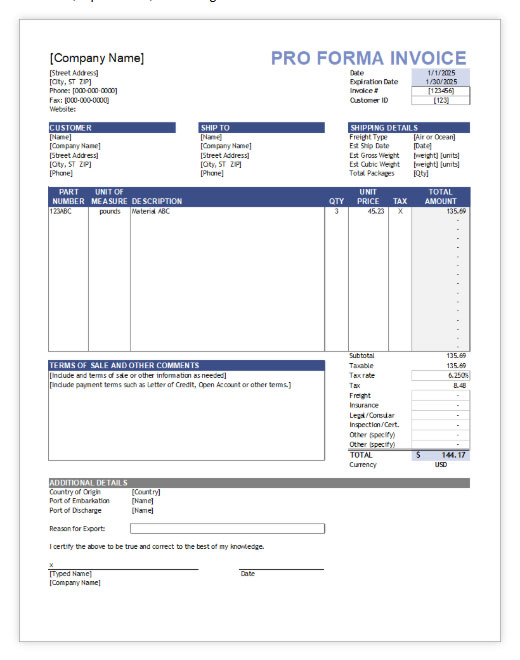
From there, you can fill in all essential details. At a bare minimum, it should include the following:
- Date of issue: List the date when you issued the invoice. Note that a proforma invoice doesn’t require a payment due date.
- Seller details: The proforma invoice includes the details of the seller, such as the company name and address, plus contact information.
- Buyer details: It also needs to include all necessary buyer information.
- Description of goods/services: Briefly outline the products or services that you’re providing.
- Total amount due: If you have a final cost, include it. If not, provide an accurate estimate for the buyer’s review.
- Shipping costs: If applicable, list the shipping costs the buyer will pay for their order.
You can see each of these in the proforma invoice example below.
Source: Vertex42
Step 3: Add terms and conditions
Add any additional terms that your buyer should be aware of. A common inclusion is a validity period for the invoice, after which time no further changes will be considered. You can also specify the payment method and their rights if you fail to deliver within a given timeframe. You should also include a cancellation policy.
Step 4: Send the invoice and negotiate
Remember that the proforma invoice isn’t set in stone. Once you’ve sent it, be open to negotiations with your buyer (as long as it’s within the validity period). This is the best opportunity to work through any remaining details and ensure the transaction goes smoothly.
In our example scenario, the videoconferencing integration company may send the proforma invoice off to their buyer, who might come back to them stating that they no longer require the installation services, as they’re getting them from another supplier at a lower cost. The business can then reevaluate its installation prices or remove the line altogether, before resending the invoice for approval.
Proforma tips for Australian businesses
Proforma invoices are relatively standardised across all industries and countries. Unless they have a very specific purpose, they’ll share most of the same features and information.
However, there are a couple of proforma invoice elements that are exclusive to Australian business exchanges. These include the following:
Australian Business Number (ABN)
Even though a proforma invoice is not a tax invoice, it still requires the selling party to include their ABN. For accounting and auditing purposes, it’s also prudent to include the seller’s as well, if you have that information available.
Goods and services tax (GST)
With a proforma invoice, you can leave the GST amount off (as long as you clearly mark that it’s currently excluded). If you do choose to include it, you may also wish to identify it as an ‘estimated’ GST amount, as you may still need to confirm the final figures, or you’ll be passing across GST-inclusive costs.
The GST amount in Australia that needs to be added is 10%. Many leading accounting and billing software applications will apply this automatically.
Best practices for using proforma invoices
While creating a proforma invoice is quite straightforward, there are still a few things you can do to help make the invoice process as stress-free as possible. Here are some invoicing tips for businesses to follow:
- Add all relevant details and check for accuracy.
- Use professional formatting and merge it with your own branding and colours to deliver a personalised experience to the customer.
- Be willing to negotiate based on your buyer’s feedback where possible. However, you shouldn’t be willing to allow their requests to affect your profit margins.
- Firmly enforce your validity period.
- Maintain each record. While proforma invoices don’t technically require a number, it’s always prudent to consider using one, as it makes them easier to track and audit.
- Apply changes thoroughly and carefully before converting to a tax invoice.
- Commit to stringent proforma invoice tracking to stay on top of all your ongoing sales.
Join the Salesblazer community
Learn new skills, connect with peers, and grow your career with thousands of sales professionals from around the world.

How technology makes proforma invoicing effortless
We’re long past the time when a business required an accountant or bookkeeper to manually input details for invoices. It’s now a quick and easy process, thanks to specialised accounting software that can automate everything.
Accounting platforms allow you to create accurate, professional documents from predefined templates. All the relevant fields are already included, so there’s very little chance of you leaving anything out. And you can automatically populate certain fields to save even more time.
Salesforce CPQ is the perfect choice for businesses looking to simplify their accounting operations. It integrates seamlessly with Customer 360 to draw out key customer information and provide accurate quotations, which can easily be turned into both tax and non-tax invoices.
For instance, REA Group, a digital media business, needed something that could streamline its sales process and move the company away from outdated spreadsheet models. Salesforce worked closely with them to create optimised workflows across the entire sales journey, including invoicing and accounting.
Wrapping up
Proforma invoices are an easy way to keep your customers in the loop before finalising transaction details. They alleviate doubt, instil confidence in your potential buyer and increase the likelihood that they’ll see the entire sales journey through to the end.
The best part about proforma invoices is that they’re easy to set up with the right invoice software. And when you link that software with your small business CRM, invoicing will become a seamless part of your sales pipeline.
Salesforce can help you manage the entire sales process from start to finish. Our AI-driven platform links all of your data and each of your teams in one place, giving you a 360 view of the customer journey. With thousands of apps that integrate seamlessly into our platform, you can guide customers to the point of sale and create effective invoices that get you paid on time.
Ready to simplify your invoicing process? Salesforce CPQ streamlines the quoting process, enabling sales teams to quickly generate accurate quotes and proforma invoices. With Salesforce CPQ, you can configure products, set pricing, and create professional-looking quotes, ensuring consistency and reducing manual errors in invoicing.
FAQs
What is the difference between a proforma invoice and a bill of lading?
A proforma invoice is a preliminary document that presents the anticipated details of a sales transaction. The selling party provides it to the buying party, and it’s a non-binding document. In contrast, a bill of lading is a document that is issued after shipping and acts as a receipt for the goods shipped. It’s a legally binding document that is initially issued to the selling party (though it’s usually passed across to the buying party once the transaction has been completed).
How does a quote differ from a proforma invoice?
A quote is usually generated during the very early stages of a transaction (often during an initial inquiry or after a first sales call). It offers an estimate of the costs of what’s been discussed to give the buyer an idea of what they’ll be paying. A proforma invoice is generally issued after the buyer has agreed to purchase. It is more definitive and largely outlines the final terms of the sale.
How long is a proforma invoice valid for?
This is usually down to the discretion of the selling party. It typically doesn’t exceed 30 days; however, for more complex deals with multiple moving parts, the validity period could be longer.
What disclaimer should I add to a proforma invoice?
It’s important that you make it clear that the proforma invoice isn’t a formal request for payment. You should state that a formal tax invoice will be issued once the details of the proforma invoice have been approved, after which the sale will become legally binding.
Can a proforma invoice be cancelled?
Yes. As a proforma invoice is just a preliminary quote, it isn’t legally binding and doesn’t indicate a confirmed sale or that payment is required. This means it can be cancelled or replaced without any legal implications.