



Medical affairs teams have a tall order. Medical science liaisons (MSLs) and medical information teams work in one of the most regulated areas of healthcare, and stakes are high. They need to give healthcare providers (HCPs) the most accurate information possible, and they need to capture key opinion leader (KOL) insights that can flag anything from patient adherence barriers to adverse events that pharmacovigilance teams need to know about. Medical affairs AI can help, but only if it’s built to meet that bar.
The need for fast answers is only growing. 93% of physicians search for medical information several times per week. A quick, accurate response can help an HCP clarify a dosage regimen or avoid an adverse event. But 58% of HCPs who skip medical information call centers say it’s because the process takes too long.
So how do you close that gap without adding risk? Medical affairs spans a lot, from MSLs in the field reviewing grants submissions, authoring abstracts and manuscripts, and evidence planning, to medical information answering HCP questions. Let’s focus on two jobs AI can help with: answering HCP questions and capturing insights.
Here are five things your medical affairs team needs to get AI right.
Reimagine your medical affairs operating model
Join Salesforce and H1 to see how unified data helps medical affairs teams scale.
1. A unified data foundation for medical affairs AI
There’s more evidence and more content per indication than there was 10 years ago. Add teams working in different systems, and answering one question gets complicated fast. Here’s how: An HCP contacts your medical information team, and the answer lives in the standard response library. Later, an MSL meets with that same HCP and has no idea the question was already asked.
Adding an AI agent to one step of that chain doesn’t fix the problem. An agent is only as good as the data behind it. With disconnected data, medical affairs AI just delivers an incomplete answer faster.
Start with a trusted foundation. Informatica, MuleSoft, and Data Cloud harmonize and connect your data, so every team and every agent works from the same source of truth.
Life Sciences Cloud then puts that data to work with workflows built for medical affairs:
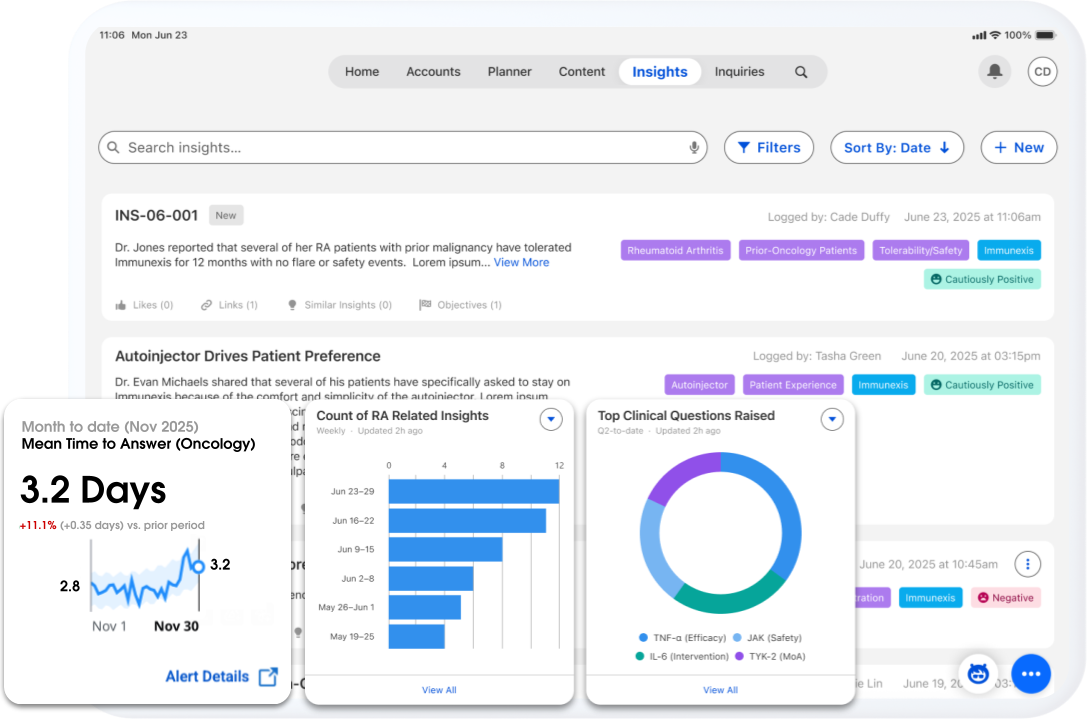
- Insight capture: MSLs log what they hear from KOLs, and those insights link to publications and KOLs so they don’t get lost.
- Intelligent content: Medical information specialists draft compliant responses from approved content.
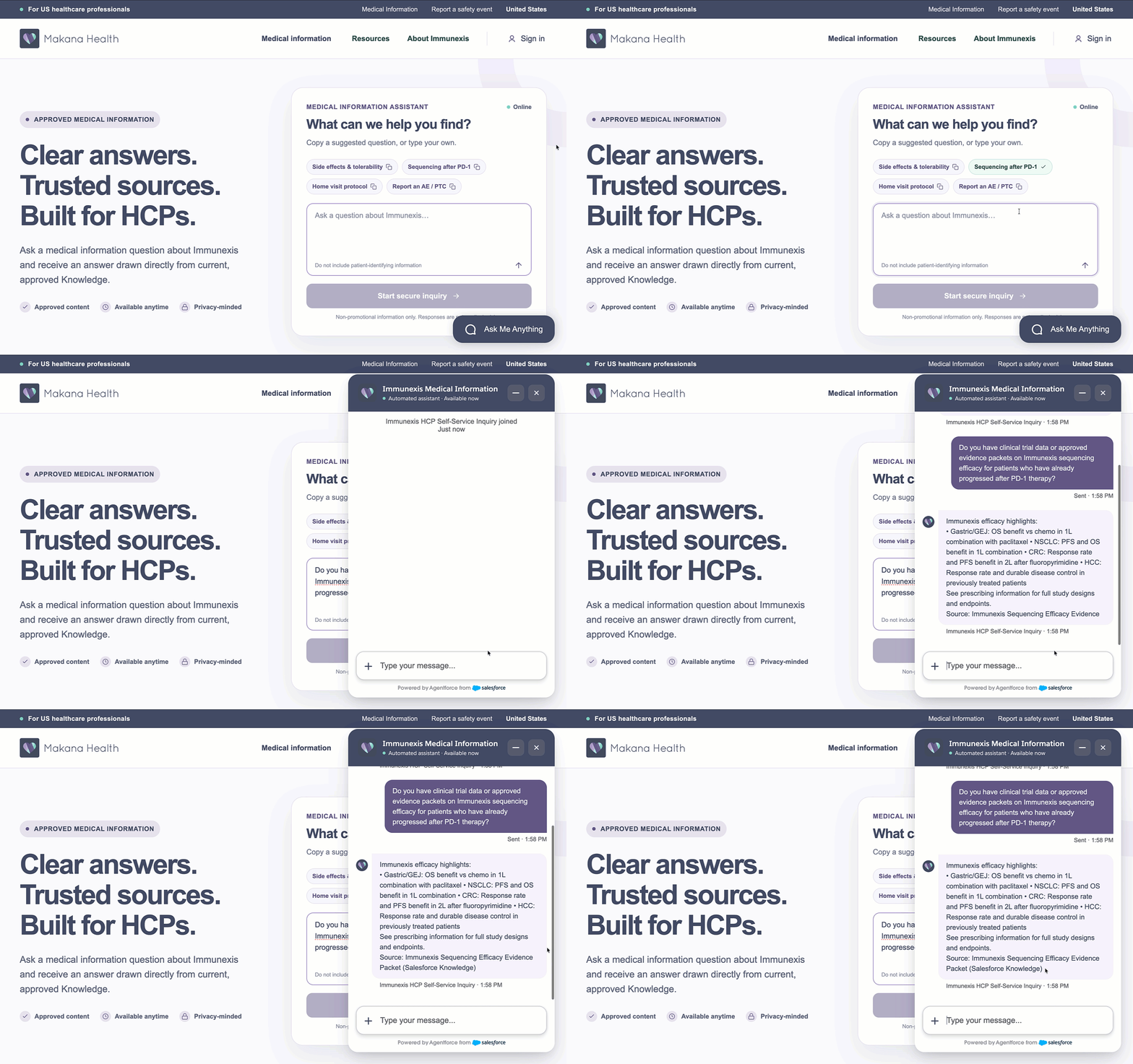
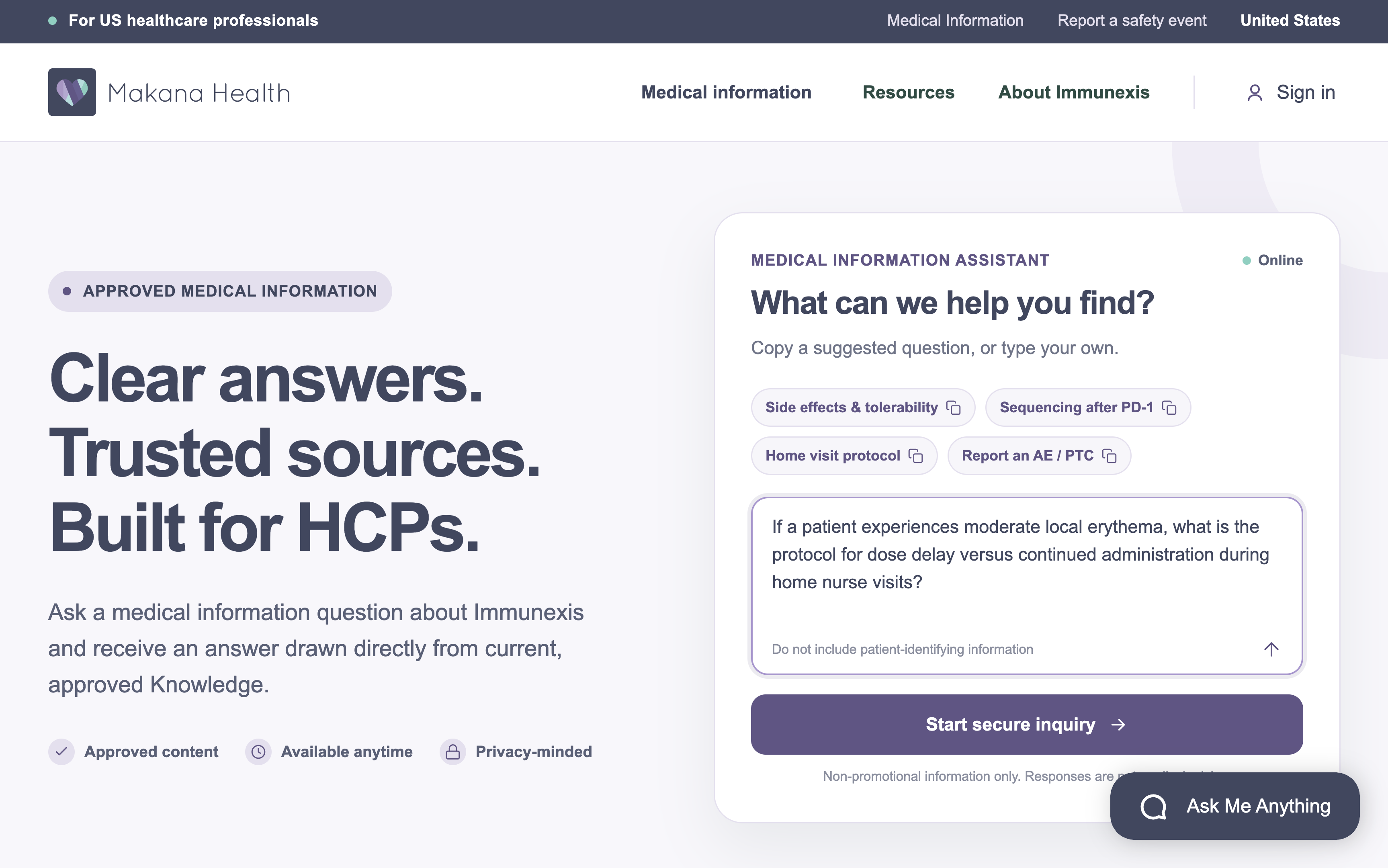
- Self-service agents: HCPs get grounded, deterministic answers on your website any time of day, with the same data behind them as your human teams.
- Inquiry trends: Leaders see what HCPs are asking about as it happens, not once a quarter.
With that foundation in place, medical affairs AI has the context it needs to get the answer right.
2. AI agents built into your workflows
AI works best when it’s part of the workflow, not another layer on top of it. With Agentforce, agents work inside the Life Sciences Cloud workflows your teams already use, on the surfaces they already work in, like Slack, Teams, and Claude, so your teams aren’t starting from scratch.
But built in doesn’t mean everywhere. The first step is mapping out your business workflows to find where the delays and friction points are. That’s where an agent can make a real difference, instead of adding noise.
Here’s what that looks like in practice: As a medical information specialist engages with an HCP, an agent surfaces and helps draft compliant, approved responses in the moment. Your specialist doesn’t have to stop and search for content, and the HCP gets a faster answer.
This approach also keeps a human in the loop. In a highly regulated environment, your people stay in control of what goes out, and the agent does the legwork of finding the right, approved content.
3. Fast medical information answers with compliance built in
Getting information to HCPs faster is the ultimate goal. But in a regulated industry, speed only counts if every answer is accurate, approved, and safe. AI has to deliver both.
Agents can support this in two ways. As we covered in step 2, an agent can help a medical information specialist surface the right approved response in the moment. Another opportunity is self-service. An HCP can ask a question on your website at 9 p.m., or during the day in between patients, and get an answer right away. They don’t have to wait on hold or for a callback.
To make this possible, strict guardrails need to be in place. Build them in with deterministic controls, which means rules that work the same way every time instead of depending on a model’s best guess. The agent responds with answers drawn only from approved medical content, with no off-label speculation.
Here’s what those guardrails look like:
- Defined topics and boundaries: You decide what the agent can and can’t talk about. Anything outside those lines is not answered by an AI agent.
- Verbatim response scripting: High-risk clinical answers match your approved medical content word for word, with citations. The agent doesn’t rephrase or reinterpret what your medical team has already signed off on.
- Safety overrides: Any mention of an adverse event, product quality complaint, or device malfunction triggers an automatic escalation. The agent stops sharing information and can route the HCP to the right process, like a live call center agent or an adverse event form. Your pharmacovigilance team gets the information it needs.
- The Trust Layer: Zero data retention and masking of sensitive PII before processing keeps your data protected.
The result is an agent that moves at the speed HCPs expect and stays inside the lines your regulators and medical team require.
Master compliant AI for medical information
See how Agentforce keeps responses grounded in approved content, with guardrails built in this Dreamforce session.
4. Capture insights before they get lost
A great answer is only the start. Some of the most valuable information in medical affairs comes from the conversations themselves: what HCPs ask, what KOLs are seeing in practice, and where patients are struggling. Too often it ends up in free-text notes that someone has to collate into themes by hand, weeks later.
Give your teams a better way to capture and use those insights:
- Capture them in the moment: MSLs log medical insights during or right after a KOL conversation that are linked to the right accounts and products. With voice-based visit logging, notes can be dictated, rather than typed up after the fact, ensuring that MSL insights are captured and tied to the correct visit and account.
- Catch what can’t wait: An insight about a patient adherence problem or a possible adverse event needs to reach the right people quickly. Insights captured in a connected system can be flagged and routed to the right teams.
- Turn questions into trends: Capture questions that come in through self-service and medical information on the same platform. Your leaders can see which topics are surging, which products or indications are driving them, and where your content has gaps without waiting for a quarterly report.
That last point is where medical affairs AI goes beyond faster responses. Every interaction becomes a data point, and AI helps you see the patterns in it. Your team can stop reacting to questions and start anticipating them.
5. Shared visibility across teams
Insights and answers shouldn’t stay with the team that captured them. When everyone works from the same data, each role gets the information they need. A 360-degree HCP record shows recent engagement, past conversations, and medical insights. Based on permissions, each team sees only what’s relevant to their role.
Here’s how shared visibility helps each of these medical affairs teams:
Medical information specialists
Instead of searching for content, they start with grounded context about the HCP and the question. They can draft compliant responses faster, with AI assistance, and spend their time on complex asks.
Medical science liaisons
Insights no longer disappear into their notes. They reach medical information and field teams, and come back as next best action recommendations.
Medical affairs leaders
They see which questions are trending as they happen so they can adjust content and plans sooner.
And their partners:
- Field sales teams: They walk into an HCP meeting knowing that the HCP has placed an inquiry and the status of the reply, so they can have more targeted conversations.
- Patient services teams: They can see select HCP details, based on permissions, such as when the HCP last engaged and whether they contacted medical information so they can better support patients on their care journey.
- Field reimbursement managers (FRMs): They get shared context on HCP and patient needs, plus Agentforce-assisted visit management and post-visit summaries.
See how Life Sciences Cloud for Customer Engagement works
Learn how MSLs, field reps, KAMs, and FRMs can bring therapies to market faster on a unified platform
Where medical affairs AI goes from here
Medical affairs is a critical part of the patient care journey, and medical information is often the front door.
When your data is unified and your agents are built into your workflows, AI can give HCPs faster answers they can trust, give MSLs and leaders sharper insights, and give patients better outcomes.