

Are you still managing your pipeline in a spreadsheet, while your customer conversations live in email and Slack? That disconnect is a bottleneck. Customers today expect quick responses and hyper-personalized service — even if you’re a startup or small business. Any lag in your process can mean a missed opportunity.
This is where Slack and sales can come together — to reduce frustration for everyone. Here are seven ways you can use Slack and CRM together to shorten your sales cycle, and not just reduce frustration but actually wow your customers. Let’s go.
Communication: A home base for small-team sales
Where do your sales come together? In a spreadsheet? In Slack, perhaps? Or in a customer relationship management (CRM)? Well, what if they were all one? This is what we mean by communication as a home base. True collaboration is when tools speak to each other easily and work gets done.
This is what Starter Suite is: one central hub where you can integrate Slack’s real-time communication with a CRM like Starter Suite’s data and automate the sales cycle. You’d turn disconnected messages and updates into leads that convert. This eliminates data silos, speeds up internal approvals, and ensures all teams have immediate, consistent access to the latest customer information throughout the sales cycle. It’s as simple as what you currently use, but structured enough to help you scale.
Try the AI CRM for SMBs and see what’s possible.
Get started with Salesforce Suites — the AI-powered CRM made to grow your ambition.

1. Real-time lead qualification with Slack and CRM
When Slack and sales are connected, leads not only get logged, they get qualified based on data. New leads are generated through marketing efforts — from a web form submission to a live chat — and it triggers a notification in a dedicated Slack channel, instantly providing a lead score and recent activity in the notification block itself. This alert cuts out the lag time of an email and allows the sales team to jump on the opportunity if it’s hot.
In the same channel, sales teams can access the lead’s full CRM record. This provides context on their recent website activity, previous interactions, and any immediate needs they’ve expressed. This real-time access to the customer journey means your sales team can qualify leads faster and approach the conversation with personalized insight. In fact, Salesforce research shows that organizations that align their sales, service, and marketing efforts see a 15% increase in profitability. This is key for those looking to make a strong first impression. And now, we have smart tools that are allowing this to happen.
2. Accelerate approvals and collaboration
One of the most common bottlenecks in a small business sales cycle is getting internal approvals, especially for custom quotes or questions requiring critical input from finance or legal. In Slack, you can set up approvals with workflows that can be set up to automate complex processes, like price exceptions, legal review, or security sign-offs. A sales rep can submit a request directly in a workflow within the appropriate Slack channel and key stakeholders receive a notification with an “Approve” or “Reject” button right in Slack, dramatically reducing approval time from days to minutes.
Slack is where business gets done.
Bring your team, your customers, and your tools together to take your business to the next level with Slack — where business gets done.

3. Enhance sales and service alignment
Connecting Slack channels to CRM records ensures that both teams have a unified view of the customer. A prospect might ask a sales rep about an existing service issue, or a service agent might need to quickly consult a sales rep about a recent product customization. It’s all connected, and so are your tools.
You can also bring your experts, customers, prospects into Slack with Slack Connect. A sales rep can invite a service expert to a dedicated Slack channel linked to a specific customer’s account to resolve a pre-sale question instantly. This information ensures the customer always gets a consistent and informed response, regardless of who they’re speaking with. For SMBs and startups handling high-touch relationships, Slack Connect is the bridge between a question and a done deal.
4. Automate sales tasks and workflows
Manual data entry and repetitive tasks are time sinks that slow down small sales teams. But when Slack and your CRM are integrated, all customer activity is logged in both places without you having to update any notes manually. When you send an email or schedule a meeting, for example, the activity is immediately logged in the CRM record and instantly updated in the deal status in Slack. It can also be automatically summarized and posted in Slack for visibility.
Try a Sales CRM made for growing teams
Try Salesforce for small business sales to close more deals and win more customers, today.

5. Eliminate context-switching with real-time data
Smaller sales teams need immediate access to a complete view of the customer, including purchase history, service tickets, and recent marketing engagement.
By linking Slack to the customer’s record, every piece of information is just a click away, available directly within the conversation stream. Your team can access purchase history, open service tickets, and recent marketing communications without ever having to leave Slack — or jumping between five different tabs. That’s a game-changer.
6. Improve forecasting and pipeline visibility
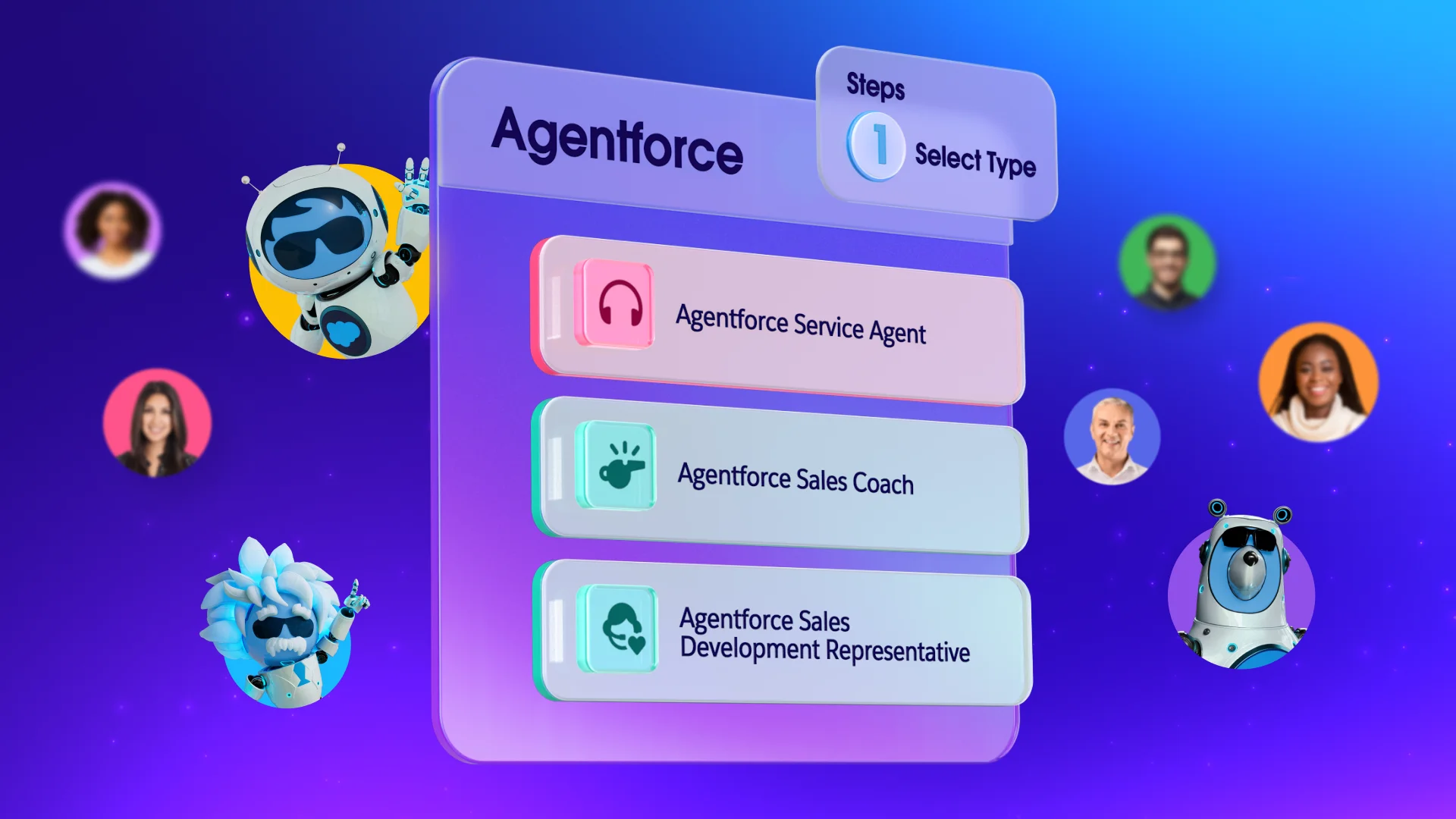
Accurate sales forecasting is critical for any growing business to plan resources and make informed decisions. When sales data is fragmented or delayed, forecasting becomes a guessing game. Integrating Slack with your CRM system ensures that pipeline updates are instantaneous and visible. This shared visibility is essential for teams using Agentforce agents: the agents rely on the instantaneous, visible updates in Slack to provide the most accurate, predictive models and next steps.
7. Shorten the sales cycle with intelligent conversations
With smart data, your teams — from sales and service to marketing and commerce — become a single, cohesive unit. Here are a few examples of intelligence working in action with Slack and CRM:
Centralized deal rooms: Automated workflows create a dedicated Slack channel for every major opportunity (the “Starter Suite” or CRM integration, like Salesforce). This channel pulls in all relevant data:
Activity logs: Alerts are posted when a prospect views a document, a meeting is scheduled, or a key field is updated in the CRM.
AI summaries: Using AI tools (often built into Slack or the Starter Suite), reps can instantly summarize long conversation threads, call transcripts, or document discussions to get the most important context in seconds.
Start shortening your sales cycle with Slack
Slack is ready for your sales, your team, and your customers. And, your CRM is ready to connect it all. Try out Slack today — free.
To get started with CRM, start your journey with a free trial of Salesforce. Already a customer? Activate Foundations to try out Agentforce today.
AI supported the writers and editors who created this article.
Frequently Asked Questions (FAQs)
The primary benefit is shortening the sales cycle by enabling real-time lead response, accelerating internal approvals, and centralizing customer data for immediate team collaboration.
Integrating Slack with a CRM, such as Starter Suite, automatically sends instant notifications to a dedicated channel when a new lead is captured. This allows sales reps to immediately access the full CRM record for context, enabling faster qualification and a personalized first interaction, which is essential for capturing opportunities quickly.
Yes, by connecting Slack channels to CRM records, sales and service teams gain a unified view of the customer. This alignment ensures fluid information exchange, allowing sales reps to instantly consult service experts (or vice versa) to resolve customer inquiries, leading to a more cohesive and positive customer experience.
Yes. For accurate sales forecasting, integrating Slack ensures that updates on key deal movements, potential roadblocks, and customer feedback are shared in real-time across dedicated channels. This transparent, instant flow of data means management can make informed decisions and intervene proactively, keeping the sales pipeline on track.
According to Salesforce, AI features like Agentforce are enhanced by the combined intelligence of Slack and CRM. The integration of generative AI automates and summarizes complex customer interactions and sales progress, providing more accurate, real-time insights for predictive sales models and boosting overall team productivity.