
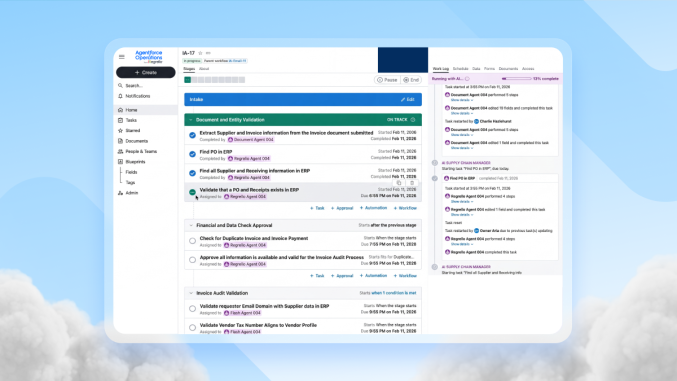



If you manage enterprise operations or back-office processes, here’s a scenario that will sound familiar. Invoices entered manually into an ERP. Manual matching between purchase orders, goods receipts, or vendor master data. Duplicate payments slipping through. Audits that depend on individual judgment rather than standardized workflows.
Every operations leader we talk to has a version of this story. The process is different, the pain is the same. The question isn’t whether these problems exist. It’s why AI hasn’t solved them yet, despite two years of promises.
Why most enterprises haven’t gotten here yet
Over the past two years, you’ve heard the same pitch from dozens of vendors: AI will automate your operations and solve your biggest challenges. For most companies, that hasn’t happened.
In conversation after conversation with operations leaders across industries, what we hear is remarkably consistent: The goal is clear, the path is not.
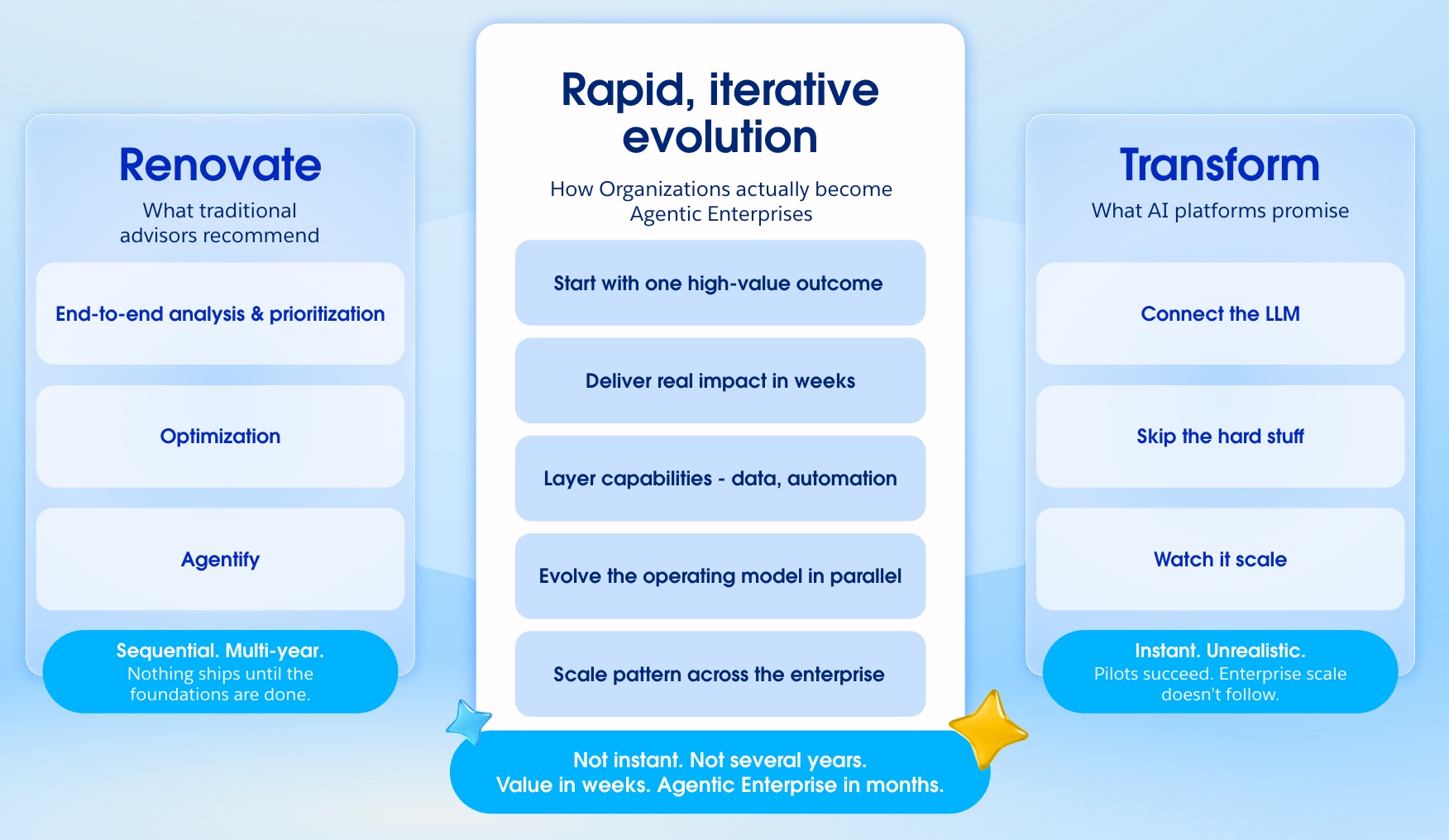
Two approaches dominate the market: Renovate and Transform.
Renovate: This is the approach traditional consultants recommend. Perform deep prioritization audits, cleanse the data, rationalize the app stack, and re-engineer every legacy process. The theory is that once your house is finally in order, you’re ready to agentify. This sounds disciplined on paper, and we have followed this model for the last twenty years. However, the problem is that it’s strictly sequential and multi-year – you don’t actually get started with AI for quite some time.
Transform: On the other end of the spectrum, next-generation AI platforms suggest you can simply throw your desired outcome into an LLM and press go to deliver the answer. While that narrative is incredibly compelling and instant, it’s often unrealistic, frequently leading to the dreaded POC purgatory, where pilots fail to survive in production.
Both approaches are relevant, but one is rooted in the past while the other is way out in the future. Real progress lies in the middle ground: a rapid, iterative evolution.
The middle path: Rapid, iterative evolution
The path forward is pragmatic. Start with simple, high-impact processes that deliver value in weeks. From there, build specific capabilities, evolve them through real-world feedback, and scale across the organization with momentum.
The journey happens process by process
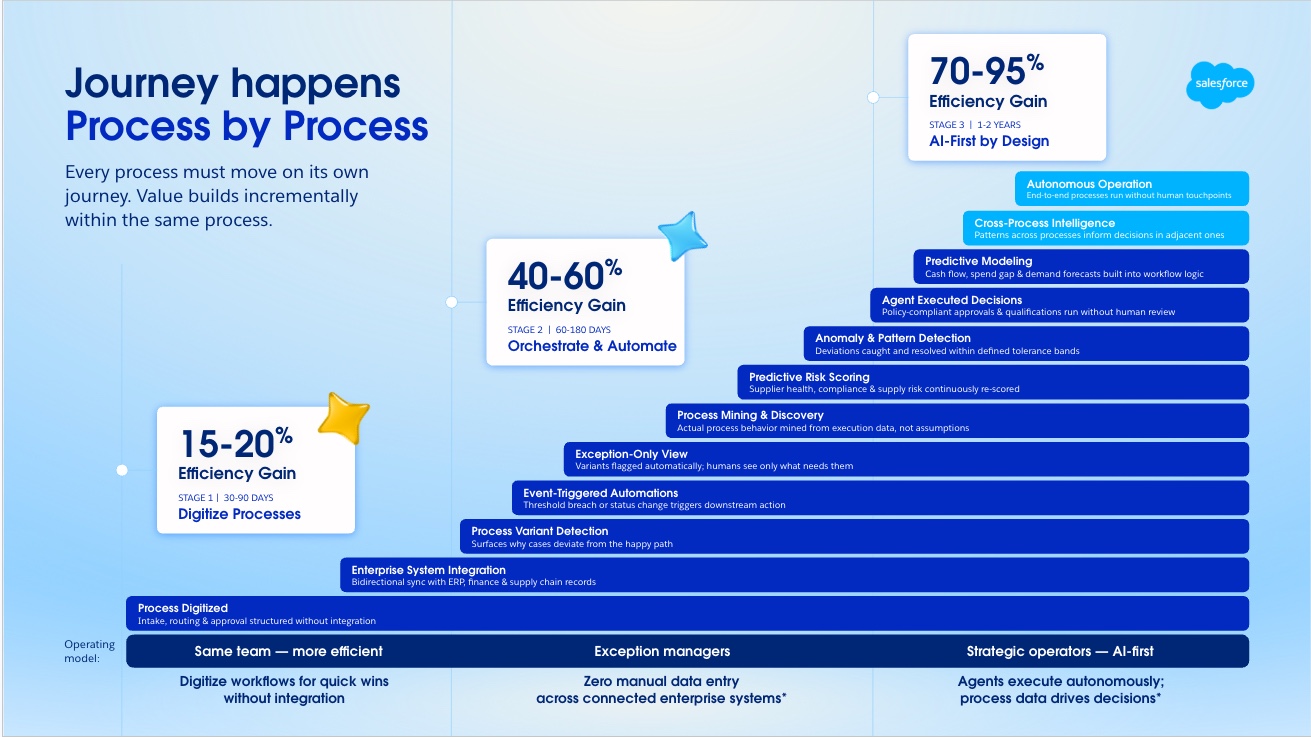
You transform one process at a time, not a whole department at once. Each process moves on its own journey from human-driven to AI-first.
Stage 1 (30–90 days): Digitize. Most companies have invested heavily in customer-facing processes, like clear documentation, structured workflows, and polished handoffs. That polish stops at the back office. Operations processes still live on whiteboards, in PDFs, in email threads, or only in someone’s mind. The first step is digitizing: structuring intake, routing, and approvals into a workflow that runs without depending on a single person’s institutional knowledge. Even this step alone delivers 15–20% efficiency gains.
Stage 2 (60–180 days): Orchestrate and automate. With processes digitized and systems integrated, you can shift from a human process manager to an agent-orchestrated model. Specialized agents handle data entry, status follow-ups, and system updates. On the rare occasion humans need to intervene, they do it within their existing tools (email, Slack, Teams); no need to log into a new portal. Efficiency gains jump to 40–60%.
Stage 3 (1–2 years): AI-first by design. Today’s business processes were designed around human constraints, like headcount, budget, and working hours. AI-first process design removes those limits entirely. You can add steps to a process and still reduce cost and cycle time, because those steps are agent-executed. Efficiency gains reach 70–95%.
What this looks like in practice
So what does this pragmatic middle path look like in practice? We built a repeatable, seven-step plan based on real enterprise customer engagements.
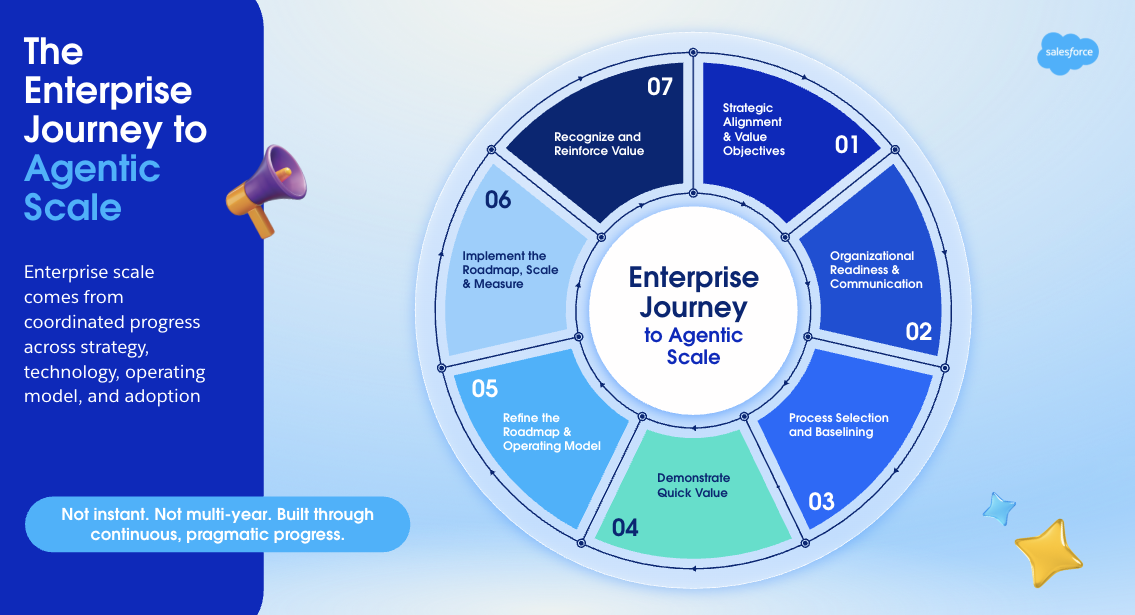
1. Strategic alignment. Anchor AI capabilities directly to your organization’s top-tier business objectives.
2. Organizational readiness. Communicate a clear roadmap and engage innovation champions early.
3. Process selection and baselining. Identify the strongest entry-point processes and establish a proof of value.
4. Demonstrate quick value. Transition from proof of value to production, delivering measurable impact within a 30–45 day window.
5. Refine the roadmap and operating model. Rethink how work flows across people, processes, and technology based on what you’ve learned.
6. Implement, scale, and measure. Expand proven workflows across the enterprise, with every expansion backed by performance metrics.
7. Recognize and reinforce value. Capture and socialize business impact to build stakeholder confidence and secure the mandate for further expansion.
The result: value within weeks, and an agentic enterprise within months. And because each process you take through the journey unlocks speed and cost gains, the momentum compounds. The first win funds and accelerates the next one.
The three stages above describe what happens inside each process as it matures. These seven steps describe how leadership rolls it out across the organization. Here’s how real customers have put both into action.
Real-world results
One of the largest energy companies in the world took their invoice auditing process on exactly this journey. They started by digitizing a process that had lived in manual spreadsheets and email threads. Then they introduced agents to perform data checks and invoice validation. Finally, they redesigned the process entirely for AI.
The result was counterintuitive: They added approximately 40 steps to the process, all agent-executed, and cut costs by tens of millions annually. More validation, more cross-checks, more accuracy. Fewer fraudulent invoices paid. Fewer overpayments. No duplicates. Full visibility across every invoice.
That’s what Stage 3 makes possible. When you design for what the process needs rather than what human bandwidth can support, more steps mean better outcomes.
Another of our customers in electronics manufacturing reduced their inventory hold time by an entire day. At their scale, every day of hold time costs millions. That’s the real ROI of operational velocity: Speed translates directly into revenue.
How Agentforce Operations makes this repeatable
The three-stage journey works. But doing it manually, one process at a time, still takes significant effort to set up and run. That’s why we created Agentforce Operations: to compress the time between a broken process on a whiteboard and agents running it end-to-end.
Agentforce Operations, formerly Regrello, was born during the COVID-era supply chain crisis, when governments assembled a task force that brought together AI researchers, supply chain executives, and the team that would become part of Salesforce. Years of R&D later, it’s delivering material value to some of the world’s largest enterprises.
It works in three layers:
Digitize processes in minutes, not months. AI reads your existing process artifacts, like documents, emails, and SOPs. It builds a digital blueprint that assigns work to specialized agents and humans. The process is no longer dependent on one person’s institutional knowledge.
Orchestrate and automate across humans and agents. Work flows between your people and specialized AI agents trained on industry best practices. Agents handle complex reasoning, data entry, follow-ups, and system updates, reading and updating data across spreadsheets, ERPs, and other systems. Humans review and approve where needed, within email, Slack, or Teams.
Rapidly improve without code. Business users iterate on their processes without waiting for IT. As performance data accumulates, processes evolve incrementally from human-first to AI-first.
See Agentforce Operations in action in this demo video.
Where to start
The breadth of processes Agentforce Operations handles can feel overwhelming: supplier onboarding, procurement, quality management, contract management, inventory, finance. We recommend starting with the highest-ROI processes: Supplier Qualification, Request for Quote, PO Rescheduling, Claims, or Invoice Auditing. From there, the pattern repeats. Every process that completes the journey becomes a proof point that accelerates the next one.
Your first win starts here
The enterprises seeing the biggest results right now picked one painful process, digitized it, let agents take over the repetitive work, and used the momentum to transform the next process. Then the next.
Your back office is ready for its first win.
Learn more about Agentforce Operations.