



Salesforce Architects use the platform to design scalable solutions that meet business requirements, comply with best practices, and play well with related enterprise systems in the organization’s ecosystem. At the same time, many companies struggle with adoption, tech debt, and adapting to the rate of change of AI.
This can also hold true after an initial implementation of Salesforce. How do you, as an architect, ensure that work on the platform is sustainable over the long term and continues to deliver the expected value and ROI for the technology investment?
A well-planned Center of Excellence (CoE) can create the structure to meet the ongoing needs of the company, rein in and pay down tech debt, and do this at the rate of change of business and AI. This post walks through how to design a CoE built to support the rate of change that the Agentic AI era demands.
Design a Center of Excellence that keeps pace with the Agentic Age
If your Salesforce org is like many systems out there, it probably has accumulated technical debt that grew through a hundred decisions that made sense at the time. Each of these was reasonable in isolation, but collectively they are hard to reverse. These include installed applications that are no longer used, fields that are unused and cluttering up the page, or the ever-present black-box managed package or Apex that was implemented long ago with no documentation. Tech debt degrades user experience and the ability to easily evolve as new processes are introduced and new users need to be trained. This has a direct impact on adoption and gives rise to offline systems (“Hello, spreadsheets”).
AI exposes the cost of the backlog of tech debt. Agents can’t reason reliably over unused fields. Automations that are no longer needed or heavily built-out create unexplained and potentially unwanted changes to data. The lack of governance that could have been put in place when you had time is now the bottleneck between your organization and the next wave of capability.
Recognize what a lack of governance costs
Organizations don’t skip governance intentionally. When a Salesforce org is new, a small team, a single admin, and a trusted partner are enough to keep things moving. Communication happens in email threads and hallway conversations. Priorities are obvious. Change is fast.
Then the business grows and the Salesforce org grows with it. The informal processes that worked for ten employees don’t scale to a hundred or more. By the time the problem becomes visible, it looks like this: schema changes that can’t be undone without breaking downstream reports and automations, duplicate fields with conflicting definitions, and automations that no one wants to touch because no one is sure what they do.
The business cost is significant. Poorly designed or overly complicated pages degrade the user experience and reduce adoption. Users think it’s easier to manage information offline rather than go into Salesforce. Time is spent on features and functions that do not align with the organization’s strategy.
This waste creates tech debt and reinforces the perception that the investment is not delivering the original expected ROI. Often, the functionality and features that get added to Salesforce are chosen because they were requested most loudly rather than through a systematic evaluation process requiring business alignment.
These are signals that it is time to put into practice a CoE that enables the business to manage its backlog, communicate its strategy, and allow its IT team and Salesforce Architects to execute at a predictable cadence.
Understanding the purpose of a CoE
A CoE is a decision-making structure designed to keep larger organizations moving forward by ensuring governance rules are in place and consistently enforced.
A Salesforce CoE prioritizes any incoming change requests to the metadata in Salesforce and manages governance by ensuring that architectural standards are defined and followed, while supporting change management and adoption. The CoE is also responsible for data strategy, including defining required fields, duplicate management, and managing data across the enterprise.
An entire CoE is not required if good governance is already implemented. However, having a CoE ensures that the business and its technology stay connected, especially when handling complexity such as multiple orgs, complex applications, or global implementations.
Salesforce CoE Reference Diagram
Learn how functional and technical leadership capabilities are central to a CoE.



Prepare the CoE
As you consider assigning roles, it is important to think about the questions and decisions for which the CoE will be responsible:
- Who approves changes (and are you keeping track)? This includes new fields, renamed objects, and deprecated picklist values, or any update that modifies metadata that a downstream automation or AI model might depend on. Each role will contribute their expertise to determine the level of effort and alignment with business priorities.
- Who owns the business backlog and priorities? Clearly define who has final authority when two competing priorities arrive at the top of the backlog and are competing for the same sprint.
- Who decides when tech debt is resolved or simply worked around? This is the question most CoEs avoid. Make it explicit or it will be answered informally, and inconsistently, every time.
- What business metrics are measured to determine the ROI of added features and functions? Establish the metrics of success as part of the governance process. If this is done upfront before making changes, then the CoE can assess how each change impacted the business objectively.
These questions, and subsequent decisions, will help prepare the CoE for the tasks required to review, assess, and justify what projects get done, delayed, or denied in order to meet the strategic needs of the business.
Staff the CoE
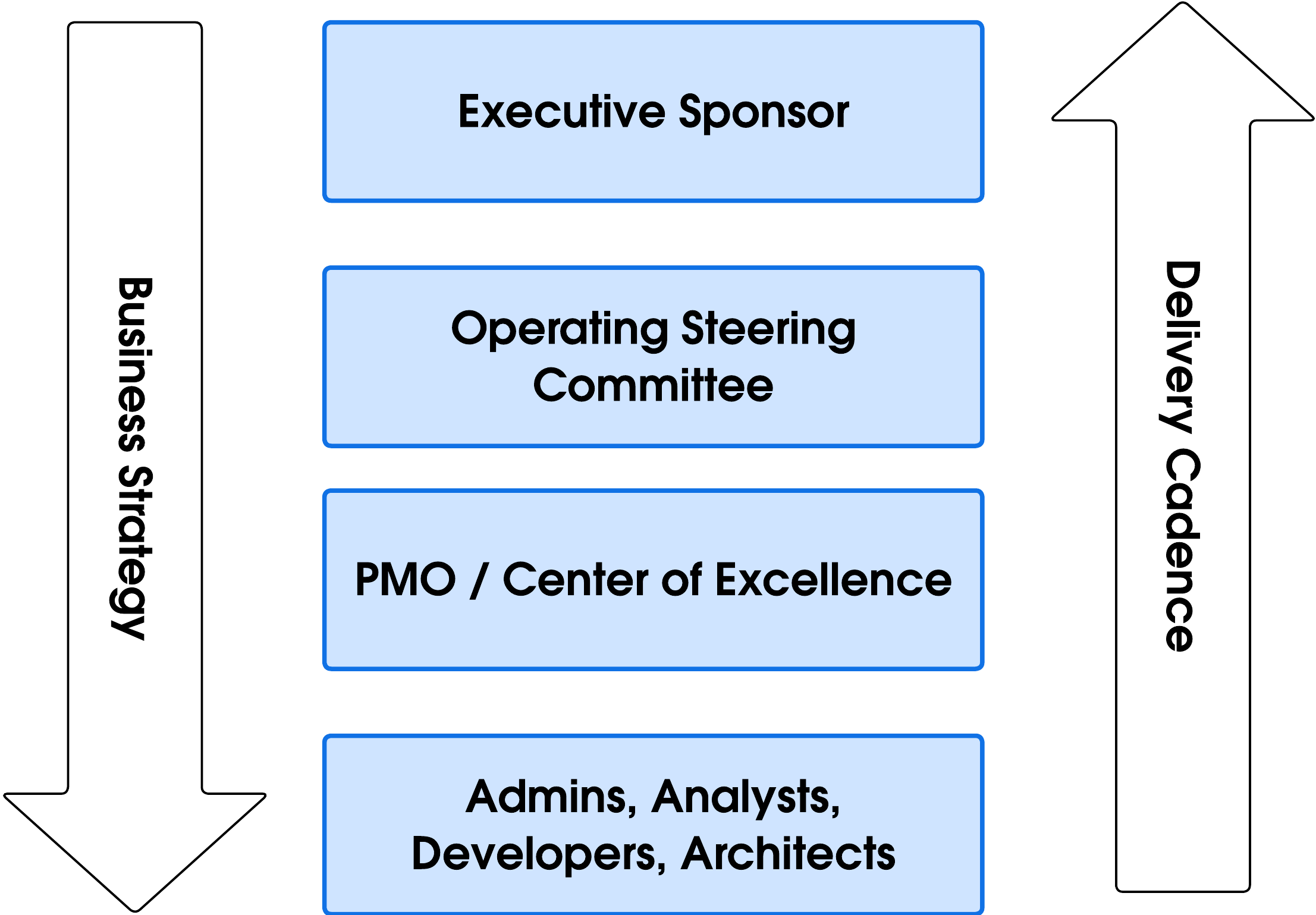
The following diagram shows a typical CoE governance structure from executive sponsorship to the delivery roles.
Understand the role of executive sponsor
The executive sponsor is not a figurehead but a key role in the support of the CoE. This role clears organizational blockers, ensures the CoE has a standing meeting that doesn’t get cancelled, and holds the line when short-term pressure pushes against Salesforce org health and business priorities.
People in this role should be senior enough to have budget authority and direct access to the business strategy. This role is filled by someone from the C-suite or directly reporting to the C-suite.
Establish an Operating Steering Committee of Business Leads
Each major business unit with a Salesforce footprint should have a named representative on the CoE to act as the cross-functional voice of the business. Their job is to translate business strategy into Salesforce org priorities and own the business backlog. By determining the priority and validity of the incoming requests, this role makes sure only necessary and appropriate changes are worked on.
This role is usually filled by department heads so they can confidently speak for the business and make decisions for it. Business Leads will pull in SMEs from the business as needed to ensure there is a bridge between business needs and the implementation of those changes. This protects the day-to-day operations, while ensuring functionality is delivered efficiently.
Include the Project Management Office or existing CoE
If your organization has a Project Management Office (PMO) or Program Management Office (sometimes also abbreviated as PMO) group or leader, make sure to include them. Their job is to connect the Salesforce changes with other changes across the business.
Data stewards are part of this role as well and serve to assess security and data integrity across the organization. No changes should be made without reviewing the impact to the organization’s data. Since Salesforce is connected to other systems throughout the enterprise, this role is mandatory in the CoE.
Represent IT and Salesforce roles
Admins, developers, and architects are responsible for maintaining the Salesforce org and running a consistent delivery cadence. These team members are also responsible for surfacing technical constraints to the business.
An architect on this team should own the data model governance, the integration patterns, and AI readiness assessments. If a requested change introduces risk to a data structure that an agent depends on, this team raises the flag before the sprint starts, not after. This role will assess the time and effort required to implement each change.
Run governance at the accelerated cadence AI demands
Traditional governance often runs quarterly, which made sense when change was slower.
In the Agentic AI era, however, review cadence must increase to enable the pace of change required. As AI features are rolled out continuously and agent capabilities expand with each release, a CoE that meets only quarterly will always be reacting to decisions that were made without it. The question isn’t whether governance is still needed; it’s how to govern without slowing delivery.
The recommended governance cadence has three tiers:
- Ongoing async. Transparency will help all members of the CoE to stay up to date and weigh in on discussions when needed. Set up a Slack channel for all the CoE members and regularly post progress and unexpected obstacles. This practice will help the meetings go faster and stay focused.
- Weekly operational sync. Admins, developers, and architects review the delivery queue, flag any Salesforce org health concerns, and confirm that in-flight changes don’t conflict with active agents or integrations. The meeting notes can also be shared via the same Slack channel to document decisions.
- Monthly strategic review. Business leads and the executive sponsor review the backlog against current business priorities. This is where tech debt retirement decisions are made and where AI adoption readiness is assessed against the current data quality baseline.
AI can also support the CoE. You can assess change requests using AI. Slackbot can summarize, plan, and make recommendations to help make CoE administration easier and more efficient. AI can also help individuals in the technical roles plan as well as execute. This working plan and recommendations can be shared with the SMEs to make sure the plan is consistent with what they need to make their jobs more efficient.
Because AI will accelerate the volume and frequency of changes to your Salesforce implementation, your new governance model has to be faster and more responsive than a traditional model. Meeting this accelerated cadence requires a CoE with well-defined roles, clear governance processes, and AI-enabled tools to help manage the increased workload.
Know when your CoE is ready for agentic workloads
Not every CoE is ready to govern AI. Use this table to evaluate readiness before your organization deploys its first agent:
| Readiness check | Assessment A (ready) | Assessment B (prerequisite needed) |
| Data quality baseline | Documented and reviewed quarterly | Unknown or never audited |
| Schema change approval | Named owner, formal sign-off process | Informal, ad hoc, or undocumented |
| Tech debt register | Maintained, reviewed at monthly strategic review | Does not exist |
| AI governance policy | Defined; covers data access, agent scope, audit trail | Not yet in place |
A CoE that meets all Assessment A criteria is ready to govern agentic workloads. Any Assessment B result is a prerequisite for deploying AI agents; addressing these prerequisites should not be treated as work that can happen in parallel.
This table can also be an extremely useful checklist as you are setting up a CoE. It can help you review your progress as a governing body and identify process gaps to prepare for AI.
Building an efficient Salesforce CoE
How to create a reliable Center of Excellence to guide your digital transformation.
Evolve your Center of Excellence with the business
A CoE should evolve as the business, its priorities, and its Salesforce implementation evolve. The cadence, processes, and role assignments can and must change to continually meet the requirements of the business. Start your CoE with your current governance practices and build from there. Continue learning and sharing to improve your CoE, and keep in mind that a CoE is not a lone undertaking by a single architect. As you continue refining governance practices, your CoE will evolve alongside your organization.
Next steps
The following resources will help you architect your organization’s governance, whether you are starting a CoE or continuing to build on the existing governance practice. To learn more about CoE and the Agentic Enterprise, check out the Establish the Agentic Enterprise Trailhead module. Also, prompt AI with “Salesforce Center of Excellence” to get other points of view on setting up and running a CoE.
Subscribe to the Salesforce Architect Digest on LinkedIn
Get monthly curated content, technical resources, and event updates designed to support your Salesforce Architect journey.