



Everything says it’s business as usual.
Your calendar says you have a presentation at 10 a.m. It doesn’t say you’ve been wide awake since 3 a.m.
Your Slack status shows you as active. It doesn’t show the brain fog making you read the same message three times.
The conference room is set to 72°F. Your internal thermostat strongly disagrees.
This is menopause at work. The workday may seem normal, but what you’re carrying through it is anything but.
The invisible experience of menopause has another consequence: We don’t talk about it nearly enough, especially at work. Nearly half the workforce will experience menopause, yet its symptoms don’t keep business hours (so inconvenient, in our opinion). They can affect sleep, energy, memory, concentration, mood, and so much more, often during pivotal phases of a person’s career.
Revathi, Global VP, Slack Success, knows that silence well. She went through perimenopause “quietly, without a name for what I was feeling,” which made her realize “how much I didn’t know about my own body.”
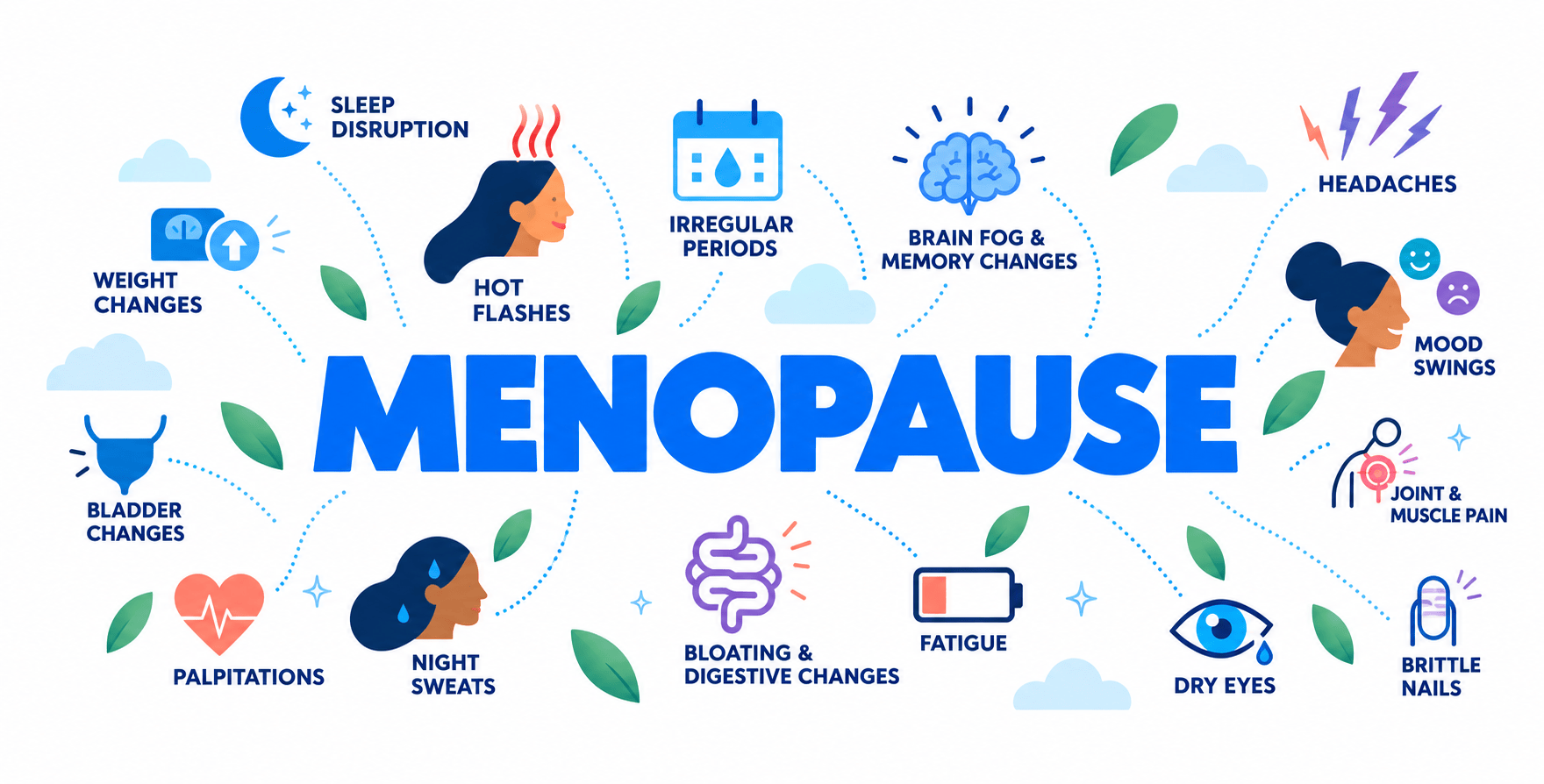
But even when something is shared by so many, that doesn’t mean everyone experiences it the same way. How it shows up, when it starts and what someone needs vary widely from one person to the next, and support should make room for those differences. That same thinking shapes how we approach benefits at Salesforce, recognizing the whole person behind every employee.
And for something that can already be pretty uncomfortable, we think it’s time to get more comfortable talking about it. So pull up a chair, grab your personal fan, and settle in. Let’s talk about what supporting people through menopause should really look like.
Menopause support starts with understanding
There’s a lot we can’t control about menopause, but how openly we talk about it isn’t one of them. According to the Society for Women’s Health Research, only 31% of women felt comfortable talking about their menopause experiences at work, while 59% felt uncomfortable asking for accommodations.
Those numbers are a reminder that having the right benefits is only part of the picture. Creating a culture where people feel encouraged to speak up and ask for help matters just as much. It’s also an important part of how our value of Equality comes to life at Salesforce.
Deise, Senior Solution Architect, knows how disorienting menopause can be, because three years ago it “snuck up on her.”
“The most difficult, invisible struggle was the profound sense of feeling lost in my own body,” she said. “The coping mechanisms I spent my life building to manage stress or maintain focus simply stopped working.”
Deise already had an open dialogue with her manager and felt comfortable sharing what she was experiencing. He wanted to help, but neither of them knew exactly what that support should look like. “He told me, ‘Whatever you need from me, you will have,’ but I didn’t even know what to ask for,” she said.
“I had to start researching and learning things on my own, which is the story of many women going through menopause. We all, seemingly, go through it alone even though we don’t have to.”
Deise’s experience is a reminder of just how personal and complex menopause is, and why Salesforce has long invested in benefits to care for employees through it. Abigail Hollingsworth, SVP, Global Benefits, Wellbeing & Mobility, said menopause support had “gone largely unaddressed in workplace benefits for years.” And for Salesforce, the reason to address it was simple: “ignoring a stage this common and this impactful isn’t good for our people.”
What’s changed everything for me is how openly I’ve been able to influence this conversation and discuss it with peers.”
Employees also play a role in shaping how that commitment evolves. “What’s changed everything for me is how openly I’ve been able to influence this conversation and discuss it with peers,” Revathi said. The continuous employee input allows Salesforce to evolve the support needed and be “thoughtful about the needs across different regions.”
Making menopause support part of the culture
Finding people who understand what you’re going through can make it easier to open up. And the more we talk about it, the easier it becomes. Across Salesforce, these conversations are finding their way into big gatherings and small connections, giving everyone different ways to join in.
- Employee communities: There’s something special about building community across countries, cultures, and experiences, and that’s exactly what our 16 employee-led Equality Groups do. Through celebration and education, they foster connections and understanding among our teams. In particular, Salesforce Women’s Network (SWN) and Genforce, which champions inclusion across ages and career stages, are putting both into practice through joint events that encourage more open dialogue about menopause.
- Educational workshops: When you’re trying to make sense of changes in your own body, having an expert explain what’s happening can be reassuring. That’s what SWN EMEA and U.K. chapters brought to the most recent session of Empowering Your Menopause Journey. Outside experts discussed the physiology of menopause, why perimenopause may be missed, diagnosis, and hormone replacement therapy (HRT), then had a live Q&A.
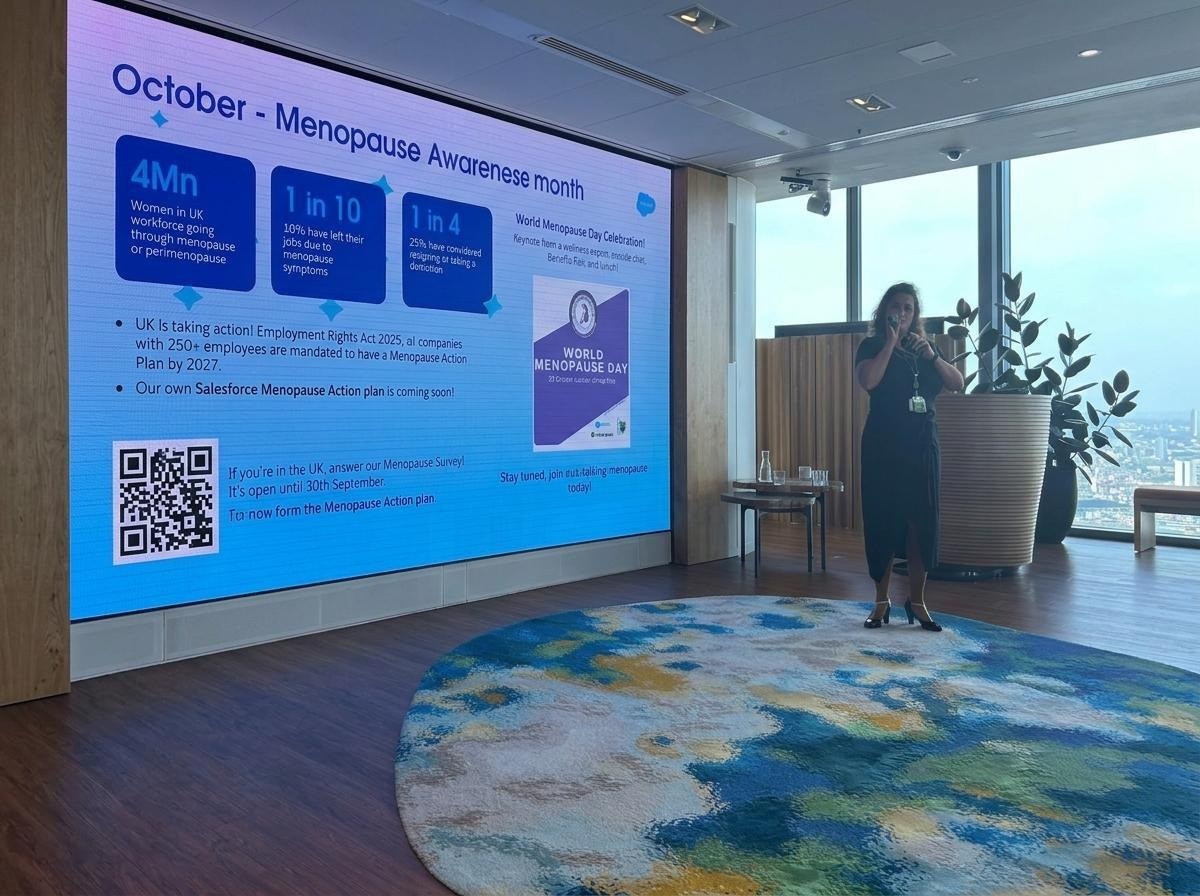
- Menopause Talks: Sometimes the best resource is someone who says, “Yep, me too.” Menopause Talks is a monthly virtual gathering where people going through menopause swap tips, compare experiences, and maybe even have a few heated debates (pun slightly intended) about which symptom is truly the worst.
- Always-on conversations: Menopause doesn’t exactly stick to meeting hours, so neither do the conversations. Dedicated Slack channels make it easy to ask “Has anyone tried this?” and get advice from someone who’s been there, while our menopause toolkits make key information easily accessible whenever you ask Slackbot for help. It’s a supportive space to find answers and share new discoveries along the way.
- Menopause Champions: Some employees in the U.K. are going a step further by independently training as Menopause Champions. These volunteer peer advocates help colleagues navigate menopause resources and benefits at Salesforce and beyond without providing medical advice.
Having navigated so many questions herself, Deise decided to become a Menopause Champion. She now hosts awareness events in her area and leads the U.K. Talking Menopause Slack channel. She’s grateful that colleagues across the company feel comfortable reaching out to her. “The more we talk about it, the better,” she said.

Benefits for all your menopause eras
We hate to be the ones to tell you this, but there’s more to menopause than menopause. It may get most of the name recognition, but its younger sibling, perimenopause, can begin several years before menopause, sometimes as early as your late 30s or early 40s. And just when you think you’ve met the whole family, there’s post-menopause. While these phases naturally unfold over time, we also know medical or surgical circumstances can bring them on sooner.
Now that we’re all acquainted, you may be realizing this is a lot of years to spend together. Good thing support sticks around, too. From the first “Wait, what is this?” to the inevitable “And this too?” you can start tapping into benefits early and keep turning to them along the way.
Benefits and availability vary by country. Visit SalesforceBenefits.com for details. Salesforce employees can also visit Basecamp or ask the Employee Agent in Slackbot.
Available globally
Personalized menopause coaching
- Connect with Cleo for personalized 1:1 support to better understand symptoms, navigate the stages of menopause, find medical providers, and manage work-life needs. Each person is matched with a dedicated Cleo Guide, with access to 60+ types of specialists, classes, and science-backed offerings.
Mental health and emotional wellbeing
- Lyra Health offers confidential mental health sessions for anxiety, stress, mood changes, and other emotional challenges that can come with menopause. Employees and dependents have access to up to 12 no-cost counseling sessions per calendar year, with in-person, virtual, phone, and chat-based options.
Sleep, nutrition, and lifestyle coaching
- BetterUp offers unlimited 1:1 coaching with sleep experts, dietitians, and lifestyle coaches. Coaches can help employees develop practical strategies for managing sleep, nutrition, stress, and other wellbeing goals.
Time off and leave
- If menopause symptoms, appointments, or treatment require time away from work, employees can review local time-off and leave programs to understand the options available to them.
Availability varies by country or plan
Medical care and menopause treatment | varies by country
- Depending on the country and medical plan, coverage may include menopause medications such as hormone replacement therapy, mental health counseling, nutrition services, pelvic health care, and more.
Virtual menopause medical care | U.S.
- Through providers like Midi Health, virtual care and personalized treatment plans are offered from trained clinicians for people navigating perimenopause and menopause. It’s available to employees with UnitedHealthcare (UHC) or Aetna coverage.
Menopause education and specialist access | varies by country
- Carrot offers employees outside the U.S. menopause education, expert-led sessions, coaching, and connections to a specialist network. Peppy provides U.K. employees enrolled in Vitality medical insurance with menopause specialist consultations and personalized coaching.
Pelvic health care | U.S.
- Pelvic health is an important but often overlooked part of menopause care. Hormonal changes can contribute to bladder leakage, urinary urgency, pelvic discomfort, and more. Eligible plan members may access Hinge Health at no additional cost, with a pelvic floor physical therapist, health coach, and personalized exercise plan.
Treatment guidance and provider referrals | U.S.
- Have questions about treatment or where to find the right provider? Our healthcare partners – Aetna, United Health Care, and Kaiser Permanente – offer resources for employees and dependents to understand their options and connect with high-quality providers who fit their needs.
Care navigation and coordination | U.S.
- Sometimes the logistics of care need a little attention, too. Wellthy handles details like finding providers and peer groups, navigating prescription coverage, and locating in-network services, all at no cost. Eligible family members, including parents, in-laws, spouses, children, and siblings, can use it too.
And menopause doesn’t have to be happening to you to be part of your life. Some of these programs also help you better understand and show up for someone you care about who’s going through it.
Marie Rosecrans, SVP, Industries Marketing, knows both sides of that. Cleo prepared her for a more informed conversation with her clinician about hormone replacement therapy.
Support on two fronts, exactly when I needed it.”
She also used Cleo to navigate care options for her 90-year-old mom following a recent surgery, including how to support her at home instead of in a care facility. “Support on two fronts,” Marie said, “exactly when I needed it.”
Looking for more resources? Here’s another great read:
Menopause and Mental Health: Finding a Helpful Mindset
Explore this helpful read from Lyra Health



More support for more of real life
Menopause may be having its moment here, but it’s only one part of a much bigger story. And since a career at Salesforce can span many chapters, our benefits are designed to meet employees and their families where they are today and keep pace with where life takes them next.
“We’re committed to offering benefits that support every phase of life,” Abigail said, “so our employees stay healthy, engaged, and doing their best work.”
Here are a few more ways that commitment comes to life:
Growing your family
- Deciding to grow your family can be exciting, deeply personal, and not always straightforward. Whether the path includes fertility care, pregnancy, adoption, or surrogacy, Salesforce offers coverage and guidance along the way. Parental leave also makes room for time together when someone new arrives.
Caring for the people you love
- Sometimes the people we love need a little more of our time and attention. From raising children to caring for aging parents or other loved ones, caregiving resources can help employees with the practical pieces while they’re there for the people who need them.
Planning for what’s ahead
- The future comes with big goals, everyday decisions and plenty of possibilities. Financial planning, education and personalized guidance empowers employees to make informed choices now while preparing for whatever they’re working toward next.
When life takes an unexpected turn
- Life doesn’t always give us time to plan. When a health issue or personal challenge arises, our dedicated CAREforce team helps employees understand their options, find the right resources, and focus on what matters most.
Because life doesn’t check your calendar
Menopause certainly doesn’t. Neither do most of the things life throws our way. We may not be able to put hot flashes on Do Not Disturb or ask brain fog to circle back tomorrow, but we can make support easier to find when it matters, even at 3 a.m. And at Salesforce, there’s probably a Slack channel for the 3 a.m. crowd, too.
Looking for a workplace that makes room for everything life brings? Explore careers at Salesforce and discover what’s possible. Not ready to make a move? Join our Talent Community to stay connected and learn about future opportunities.
AI supported the writers and editors who created this article.
Blaze your trail to Salesforce!
At Salesforce, we’re not just shaping the future. We’re turning big ideas into breakthroughs. Want to join the #1 AI CRM that’s leading the digital labor revolution? Explore our open roles today!