Adecco Interviewed 100k+ Job Seekers With Agentforce — Now They’re Teaching It To Speak



Adecco connects with tens of thousands of job applicants daily with a little help from Agentforce Voice.

As one of the world’s largest human resources firms, Adecco staffs an astounding 2 million associates each day and partners with more than 100,000 clients around the world. The company’s mission is to provide sustainable and lifelong employability for its workers, helping job seekers learn new skills and navigate a labor market that’s rapidly changing in the face of AI. To make that possible, Adecco maintains a complex candidate pipeline, evaluating tens of thousands of applicants every day while continually updating profiles with new skills, availability and experience.
For Adecco’s recruiters, managing that kind of scale and complexity presents a daunting operational challenge. The company impacts more than 2 million careers every year, but recruiters are only able to engage with about 10% of candidates. Additionally, many applicants have existing jobs during the day, so as many as two-thirds of candidate interactions take place outside of business hours. This creates a significant barrier to connecting with a recruiter.
To address these challenges, Adecco turned to Agentforce. Since April, its human recruiters have worked side by side with a tireless AI-powered prescreening agent available through a text-based web app. Now, with more than 100,000 agent-led screening conversations already under its belt, Adecco is rolling out voice support. Here’s how they got here.
Screening a global talent pool … autonomously
Adecco’s application process begins when a recruiter posts a new opening. With the help of Prompt Builder, they can quickly generate a tailored job description and suggested screening questions based on the role specifications. From there, the system performs an “agent readiness check” to make sure the job record contains all the information Agentforce needs to conduct a prescreening. Each record receives a star rating indicating whether there’s enough information for the agent to be helpful. Once the job record is ready, the recruiter activates it and pushes it out to job boards, social media, and Adecco’s website through a native Salesforce integration.
When a candidate applies, they receive a SMS text message prompting them to select chat or voice for their prescreening experience. Depending on their choice, they’ll either go to Adecco’s website to initiate a chat conversation or receive an outbound call from Agentforce. Historically, 80% of candidates opt for a voice call, making it a vital channel for Adecco’s prescreening agent.
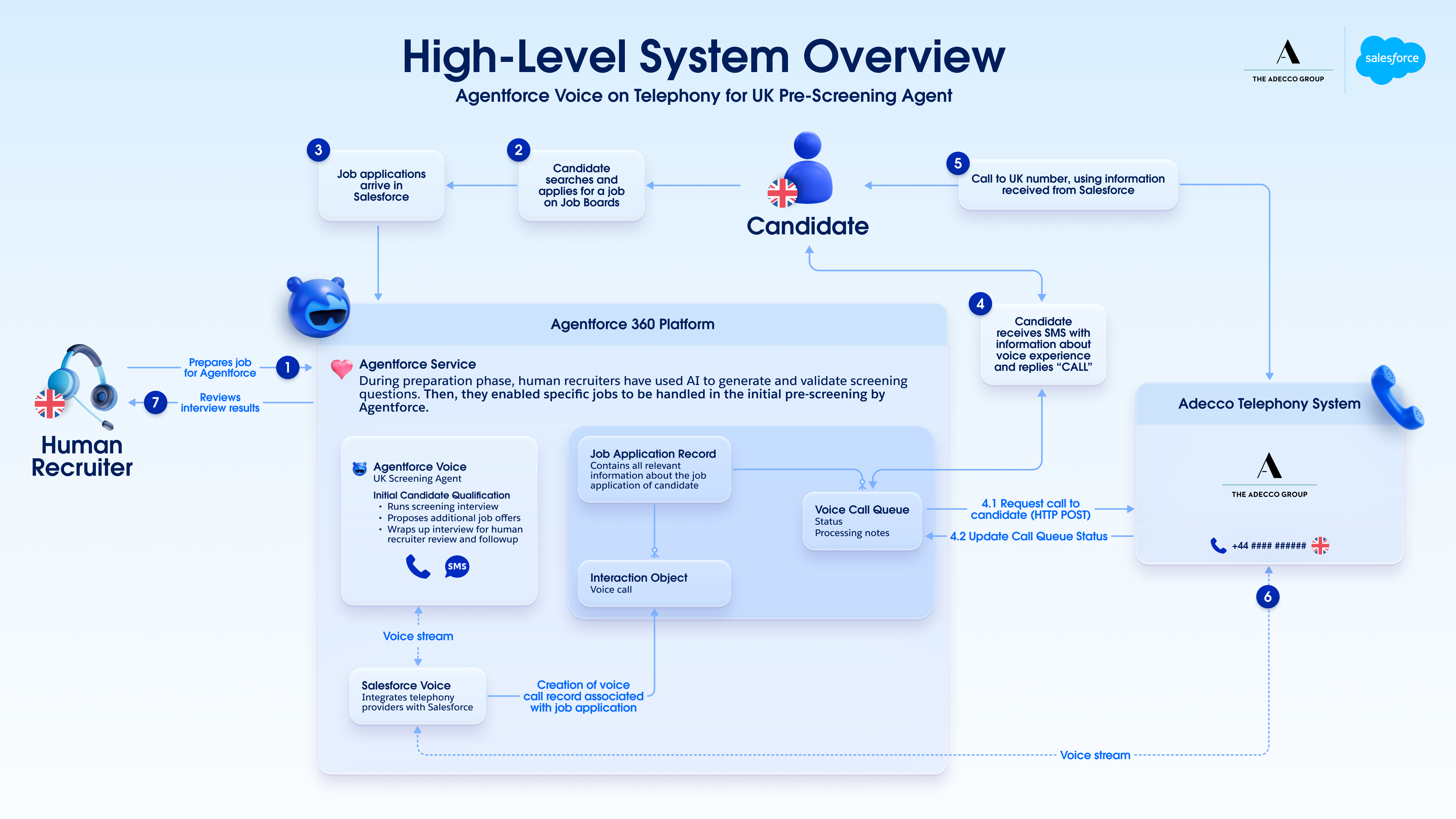
When applicants select voice, Salesforce pings Adecco’s telephony system, which initiates an outbound call from a U.K. number. When the candidate answers, the telephony system starts a conference call with a predefined Salesforce phone number, seamlessly connecting the applicant to the agent.
At this point, the Job ID is passed on to the prescreening agent, allowing it to retrieve the job description and interview questions. The agent will kick things off with a welcome message and keep the conversation flowing by proactively asking questions. In addition to job-specific information, the agent is configured with global instructions that define its tone, phone etiquette, and other voice-specific rules. It’s also versed in local privacy laws like GDPR, and can respond to general FAQ questions. If a candidate asks something off-topic or inappropriate, it will politely redirect the conversation back to the interview or provide instructions to get in touch with Adecco via the website.
As the call progresses, Agentforce uses custom actions to log the candidate’s answers directly into the job application record in Salesforce. Once the interview concludes, the recruiter is notified and a wrap-up summary is automatically generated. Every candidate’s answers are personally evaluated by a recruiter, who also has access to the full conversation transcript and will decide whether to move them on to the next round.
Going global
Adecco plans to launch an updated version of its voice agent later this year. With Agentforce Voice becoming globally available in Q1, the company will be able to operate on 100% EU-based infrastructure, further reducing latency and improving reliability. The addition of Agent Script for Voice will enable more granular control over the agent’s behavior, while future roadmap releases will add observability tools for testing and evaluating voice agents.
“Agentforce has completely changed the way our recruiters connect with top talent around the world, saving as much as 15 minutes per interview,” said Niki Turner-Harding, senior vice president and country head, Adecco UK and Ireland. “This has allowed us to go from a 10% prescreening rate, to reaching 100% of our candidates. It’s truly been a game changer.”
Three essential lessons for launching an interview agent
Agentforce continues to be a productivity boon for Adecco, but like any new enterprise system, getting the best results requires some careful planning and iteration. Below are three essential best practices from Adecco’s deployment.
Good AI is grounded in good data, but don’t wait for your data to be perfect. Let AI help with data readiness.
Adecco found that agents struggle if the underlying job records they’re pulling from are too sparse. Before activating an agent, Adecco’s system scans job records and assigns a star rating (1–5) based on data completeness. This ensures the agent has enough context to answer candidate questions accurately. During this readiness check, the system also performs a discrimination check to ensure screening parameters meet legal and ethical standards.
Voice agents must account for verbal nuances.
Building AI voice agents is hard. It means having to account for unique factors like pronunciation and accents. Adecco used tailored voice instructions to prevent the text-to-speech engine from mispronouncing abbreviations or reading out long, complex URLs. Adecco also refined the agent’s personality by using specific British accents to ensure professionalism and regional relevance. To maintain conversation flow, the agent is instructed to lead by always ending with a question. Adecco also implemented summarization for long answers, giving candidates the opportunity to correct their answers in case of a mistranscription.
Feedback is a gift.
An iterative process driven by internal and candidate feedback helped ensure Adecco’s rollout was a success. The team implemented a continuous feedback loop, proactively calling candidates after their AI interviews to gather qualitative feedback. This helped inspire product improvements and new roadmap features.
To learn more about Agentforce Voice, click here.