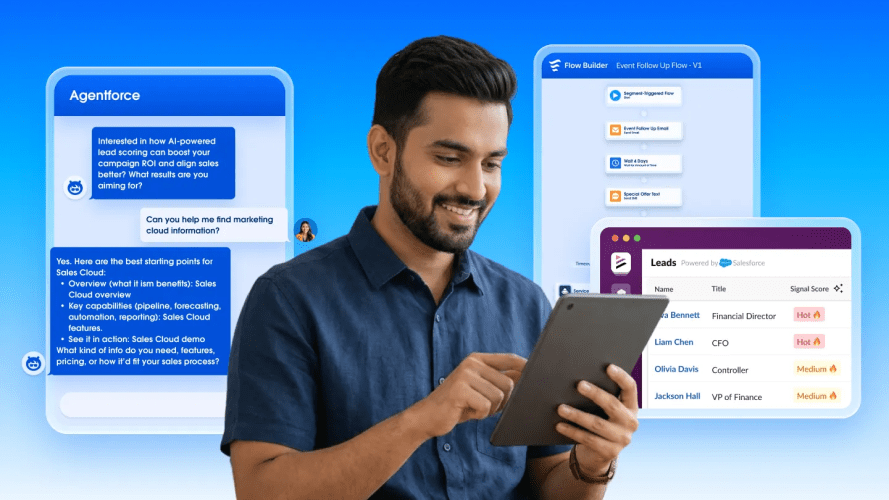



Marketing Cloud is changing what a marketing team can accomplish in a day. Agents build audiences from a plain-language brief, generate and adapt content, execute campaigns, and surface decisions from data that used to live across three systems and two dashboards.
At Dreamforce 2026,I am joining Pato Sapir and Jacob Hayesfor our roundtable, Marketing Cloud: Frameworks, Pitfalls, and Insights.
Our focus is practical: how do you turn Marketing Cloud into use cases that produce measurable results?
That means identifying the right opportunities, understanding the data and processes behind them, defining ownership, and connecting every implementation to a clear business outcome.
Start with the moment you want to improve, not the technology.
The first step is finding where Marketing Cloud makes the biggest difference. That could be a customer who has stopped engaging, a prospect showing stronger intent, a loyalty member sitting on benefits about to expire, or a team spending its week manually assembling audiences, campaigns, and reports.
We use a simple framework to structure each one:
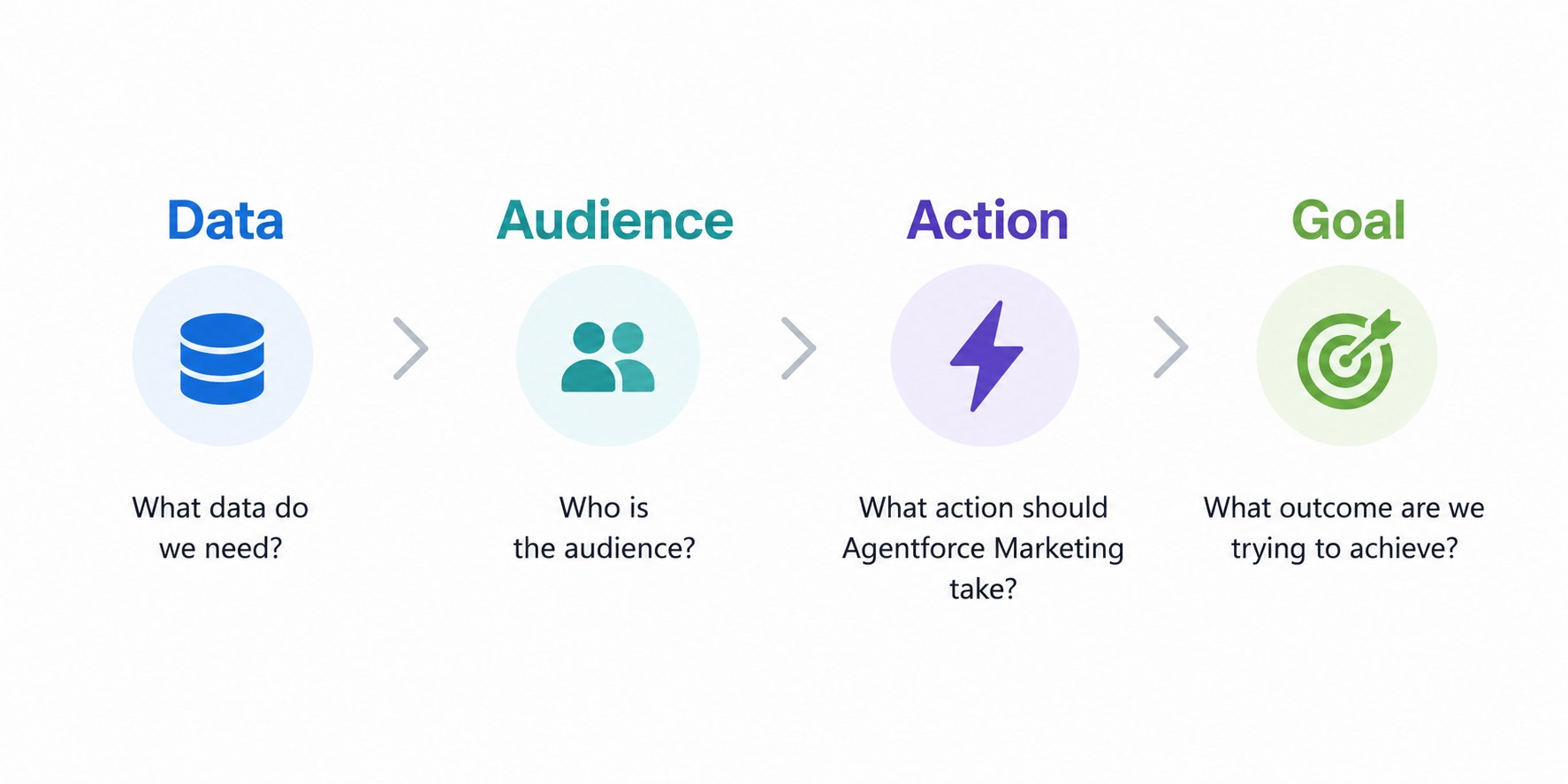
Data > Audience > Action > Goal
What data do we need? Who is the audience? What action should Marketing Cloud take? And what outcome are we trying to achieve?
Run a lapsed loyalty member through it and the shape becomes clear:
- Data. Loyalty transactions, benefit balances, and engagement history, unified in Data Cloud.
- Audience. Members with unused benefits expiring within 60 days who have not engaged in 90.
- Action. An agent builds the segment, generates messaging variants by benefit type, and launches the outreach.
- Goal. Benefit redemption rate, measured against a holdout group.
Every use case gets the same structure. It keeps the work tied to a real customer or business need instead of a capability someone wanted to try.



Define the why, the how, and the what
Once you have the use case, take it one step further.
Why? What business outcome are you trying to achieve?
How? Which Salesforce capabilities enable it?
What? What measurable impact should the business expect?
Define the KPIs before you build, and be honest about the cost of doing nothing. That second number is usually the one that unlocks funding.
A successful implementation is measured by more than whether an agent launched. It should move engagement, conversion, productivity, campaign velocity, customer experience, or another metric the business already cares about.
Check the foundations before you build
A strong use case is only part of the picture. Before you commit, work through the questions underneath it.
- Is the required data available, unified, and trusted?
- Are the right Salesforce capabilities already in place?
- Which existing processes need to change?
- Who owns the agent once it is live?
- How will marketing, technology, and data teams work together on it?
The aim is a roadmap not a backlog of ideas. Start with a small number of use cases you can defend, prove the value, learn from what happens, and expand from there.
Look at both sides of the opportunity
Marketing Cloud does more than power customer-facing interactions. The same agents work across audience creation, campaign planning, personalization, content production, analysis, and optimization.
So evaluate both sides. Ask how Marketing Cloud improves the customer experience, and ask how it improves the way your team works. The second is often faster to prove and builds the credibility you need for the first.
The framework exists to get teams from opportunity to execution with the right pieces in place: a clear business objective, trusted data, defined ownership, the required Salesforce capabilities, and KPIs you agreed on in advance.
What you will take away from the session
Pato Sapir, Jacob Hayes, and I will work through all of this live at Dreamforce 2026. Come with a use case you are considering and leave with:
- A repeatable method for identifying and prioritizing Marketing Cloud use cases.
- The foundational questions to answer before you build, and the pitfalls that derail implementations after launch.
- A roadmap structure you can take back to your team and apply immediately.
The roundtable format means you will hear from other marketing leaders working through the same decisions, not just from us.
Looking forward to seeing you there! Not currently on your schedule? Add it to your agenda today.
See how agentic AI can help your brand
Don’t miss the latest evolution of Marketing Cloud. Can’t make the event? Then join us online.