



As data has piled up and operations have become more complex, silos within organizations have naturally developed. Product owners have a specific scope of influence, and I often see divided teams with separate priority lists that can restrict each other’s ability to make progress quickly.
Marketing Cloud Next is going to change that.
Whether you’ve already bought in or are planning to in the coming years, this product is going to require organizational evolution.
Marketing Cloud Engagement (MCE) originated as ExactTarget and became part of the Salesforce ecosystem through acquisition in 2013–how I joined Salesforce myself. It was its own unique platform, and it required building connectors and processes to integrate MCE with the other Salesforce clouds.
Marketing Cloud Next, by contrast, is built on the Salesforce platform. Natively. It removes the need for connectors because it’s all in the same place. And new features and controls become available to marketers – like Flow Builder.
This is fantastic news. But it means the siloed team structures of today will not work tomorrow.
Marketing Cloud product owners need to learn how data is managed in Data 360 and how Flow Builder offers greater control of journeys and related processes. CRM product owners need to learn how to better structure and maintain data for marketing use cases, and how Flows can expand to accommodate this (without introducing risk to the CRM guardrails). More users will need to be able to access Data 360 to avoid introducing bottlenecks in the campaign process, and the Data 360 product owners–who may have been partnering with marketing already–will need to adjust to increasing demands.
The teams that transition most smoothly are the ones who start training now. Before they have a Marketing Cloud Next license.
I’ve created a role-based, step-by-step plan to guide you.
A structured training plan matters
The product owners and admins of Marketing Cloud, Data 360, and CRM–who are the existing experts–will be impacted first and be looked to for guidance. They have their own, accelerated learning track. Categorize the remaining members of your marketing team into three cohorts: 1) Ops, Analysts, and Users; 2) Strategists; and 3) Architects and Developers. Each of these has their own learning track, as well. Foundational items are shared in the first phase, then further diverge into role-based tracks from phase 2 onward.
Think of the training in three phases.
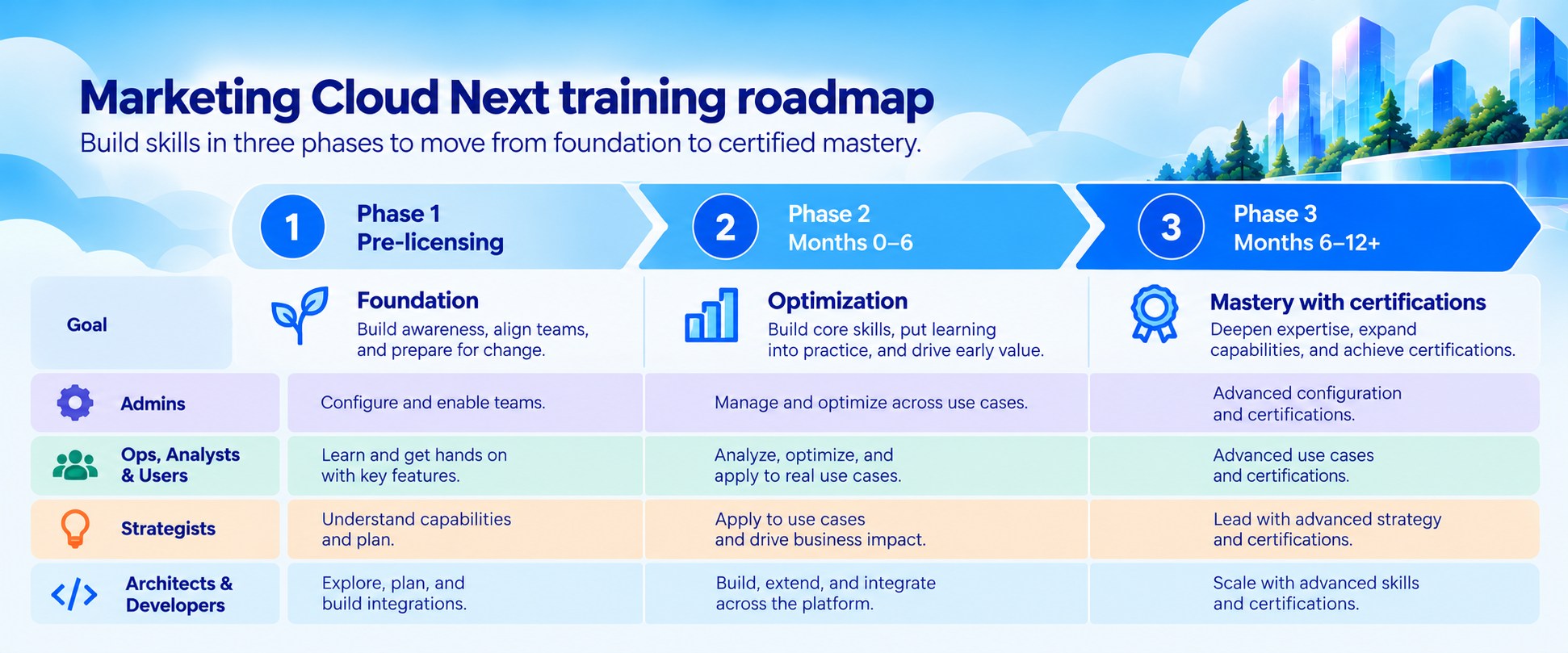
Phase 1: Foundation & Readiness
Timing: ASAP/Pre-Licensing
Establish the team’s core platform literacy and a next-gen mindset before MC Next licenses are in hand. The priorities in this phase are the basics of MC Next, Data 360, and Flow Builder. Knowledge of these three will empower your product owners to guide strategic conversations about how your organization needs to adapt to this new product integration.
Phase 2: Optimization
Timing: Months 0-6 Post-Licensing
Now’s the time when hands-on experience and optimization begin. Level-up automation logic and start deepening the cross-training across products and learning tracks.
Phase 3: Mastery
Timing: Months 6-12+ Post-Licensing
The initial adoption has completed, new processes are in place and being tested and optimized, and everyone is feeling more confident with the new toolsets. Turn all the time spent learning into formal certifications.
Also, notice that I haven’t mentioned AI until this point: while AI capabilities are the hot topic of the day, the reality is there are many other capabilities that you’ll adopt before the agentic ones–so we save the focus on AI until phase 3.
| MC Admins | Certification: MC Next Consultant Get Started with Campaign Creation & Agentforce in Marketing Cloud (MOC001) Get Started with Custom Agentforce Actions for Marketing (MOC003) |
| Data 360 Admins | Certification: Data 360 Consultant |
| CRM Admins | Certification: Platform Administrator And add the Accredited Professional certification for your industry (e.g., Financial Services Cloud, Health Cloud) |
| All Marketing Team | Certification: MC Next Consultant Get Started with Campaign Creation & Agentforce in Marketing Cloud (MOC001) Get Started with Custom Agentforce Actions for Marketing (MOC003) |
| Ops, Analysts, Users | Superbadge: Screen Flow Fundamentals Superbadge: Flow Administration |
| Strategists | No additional recommendations here beyond the ‘all marketing team’ items above |
| Architects & Developers | Superbadge: Screen Flow Fundamentals Superbadge: Flow Administration |
Get New Hires started with the basics
In addition to your current team, new hires and team members who are entirely new to Marketing Cloud will need to spend time learning during their onboarding stage. Make use of instructor-led training to get an intensive 3-5 days of learning and quickly skill up (check out MKT101 and MKT201). Then roll them into the learning track that best fits their new role.
Break this into phases to avoid overwhelm
While this may look like a lot, most of the training is self-guided through Trailhead. At most, I’m recommending two instructor-led training courses per 6-month phase for a maximum of six days of out-of-office training. If your organization has a Signature Success Plan, the courses and workshops are free and included with your plan.
It’s hard to set aside time for training when the day-to-day pressures and deadlines don’t stop. But when your teams understand better how to work with their counterparts’ products, you will see measurable operational gain and more time spent on strategic work.
Get ready to retire those operational silos and start organizing for scale.
Need more help developing an adoption plan? Check out our Success Plans to find what level will best help you get access to the resources that will help you get the most value out of your Salesforce investment.