


Every conversation about agentic AI and the future of work eventually gets personal: What does this mean for me? How will my work change? What happens to my role?
It’s tempting to look for the answer in new job titles. But the work is changing faster than the titles can keep up.
Technology shifts first. New work emerges next. Then roles solidify around that work. We’ve seen this before with the cloud, mobile and data. We’re watching the same cycle unfold with agentic AI — only faster.
Technology shifts first
We’re in the midst of a technological shift that is changing what we build, how we build, and how we work.
What we build: We’re moving from software that waits for a human to operate it toward systems that can interpret context, reason and act.
How we build: AI is taking on more of the manual execution involved in building. And the pace of change is incredible. A year ago, AI helped with small tasks: write a summary, explain this code. Today, you can describe the outcome you want, and an agent will plan it, create it, evaluate it, and keep iterating for hours before it comes back to you.
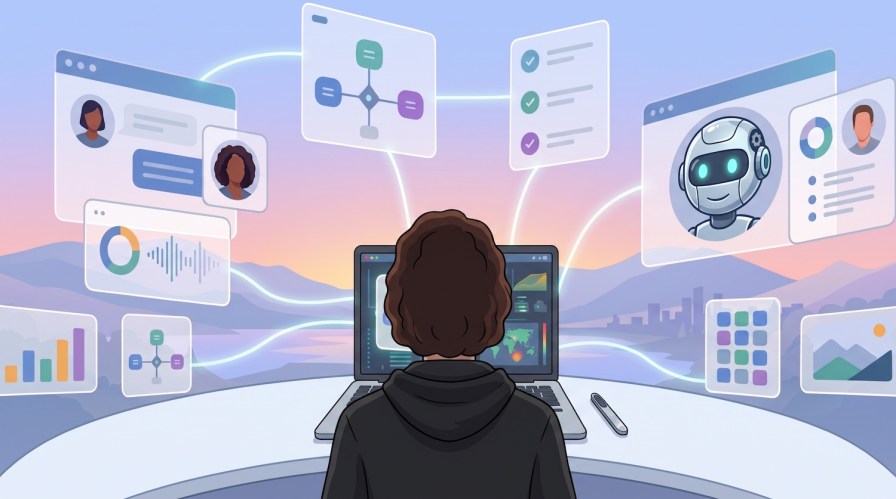
How work gets done: Digital workers are entering workflows that previously belonged entirely to humans. An onboarding agent might answer a new employee’s questions. An IT request might move between agents and humans before it’s resolved. Increasingly, work is being done by teams of people and agents together.
But AI doesn’t inherently know the business context in which it’s operating: the customers, data, policies, processes, and boundaries that determine what a good outcome looks like. Giving AI that context, defining how it should operate, and evaluating what it does creates new work for humans.
New work emerges next
Introduce a digital workforce to a human workforce and suddenly new work appears. Someone has to decide what agents should do, what information they can access, when they should hand work to a human, and how their performance should be evaluated.
We think about this new work through a simple lens: the job to be done (JTBD), a unit of work with a clear outcome. It’s a framework we use internally and one that’s widely applied across product and business strategy. New jobs to be done are emerging for humans, including:
- Write agent requirements and policies
- Design human-agent handoffs
- Test and evaluate behavior
- Observe agents in production
- Define permissions and boundaries
- Measure outcomes against cost
- Diagnose failures and improve performance
And this new human work is not trivial. Defining an agent’s permissions and boundaries may sound simple, but it’s one of the harder problems in enterprise software. Governance is difficult to get right for processes humans run themselves, let alone for an agent capable of acting autonomously and at scale.
At the same time, existing work is shifting. As AI takes on more execution, the human role moves up the stack, defining and judging the outcome, governing the system and staying accountable for what happens. As agent adoption grows, these responsibilities will become a larger part of the job.
Roles solidify around the work
So when does all of this new work become a role? Not right away. We can think of a role as a collection of JTBD, and as that work changes, the role eventually changes with it. Some roles expand. Some jobs to be done move from one role to another. And when enough new work clusters together, entirely new roles can emerge.
But that happens after the work has had time to settle. Right now, we’re still watching that work take shape.
AI is also making more of this work accessible to more people. Someone can now prototype an app in minutes using natural language. Someone can build an automation by describing the outcome they want. The barrier to execution is falling at the same time the value of judgment, integration, and governance is rising.
More builders means more applications, automations, agents, data connections, and decisions across the enterprise, all of which still have to work together securely and responsibly. AI creates enormous opportunity, but it also creates complexity.
That’s why it’s less helpful to ask: What will my job title be?
Instead we can ask: What work is emerging, and what will it take to do that work well?
What does this mean for Salesforce practitioners?
For Salesforce Developers, Admins, and Architects, the opportunity is not to abandon what you know and start over. It’s to apply your expertise to a larger surface area of work.
You bring something no model has on its own: organizational context, platform knowledge, technical expertise, and judgment. And, you know what the business wants and needs, and how to turn that into a solution, a workflow, an integration, and a governed system.
You already designed or built the engine that runs the business. Now that engine has a new interface, one where people and agents can access information, make decisions, and take action. That’s a huge shift in the user experience, but the underlying foundations haven’t changed: trusted data, permissions, business logic, integrations, and governance still make the system work. In fact, as agents take on more responsibility and act at greater scale, those foundations matter even more.
And the platform is evolving alongside the work. Salesforce capabilities are becoming available through new interfaces, natural language is lowering the barrier to building, and governance and orchestration are becoming increasingly important as people and agents work together.
Your surface area just got bigger, and so did your impact.
The opportunity isn’t simply to learn another tool. It’s to use the expertise you already have to take on the work that’s emerging.
Go first. Be a Trailblazer.
Trailblazers aren’t waiting for these changes to show up in a new job description. They’re already learning the skills to do the work.
When we asked community members this summer what skills they need in their roles today that they didn’t need a year or two ago, they pointed to new technical skills around AI, agents, automation, data, architecture, and governance — alongside increasingly important human skills like adaptability, collaboration, stakeholder management, and communication.
AI fluency is the baseline. How you apply it is becoming the real differentiator.
Selina Suarez, Trailblazer and founder of Pepup Tech, puts it this way:
Being a Trailblazer isn’t about following predefined paths. It’s about a willingness to experiment, to bring your judgment to what gets built, and to be accountable for how it’s used.
Technology shifts. Work emerges. Roles follow.
Don’t wait for the title.
Go First. Be a Trailblazer.
Trailhead Trailblazer Survey
The work will keep evolving, and we’ll keep tracking where it’s going. Take our survey to share the skills you’re seeing emerge in your role.