


Most AI projects follow the same pattern: You see a flashy demo. It works great on stage. Then it hits the real world and gets stuck in a logic loop. The pilot dies. And everyone moves on.
The problem is simple. A chatbot by itself isn’t smart enough to handle requests related to IT or HR. It doesn’t know who your people are. It doesn’t know what devices they use. It doesn’t know what they’re allowed to access. An AI without context is like a genius with no memory.
Agentic IT Service Management (ITSM) works differently. It’s not about smarter chatbots. It’s about building workflows that think AND follow the rules.
Here’s what that looks like in practice.
The Problem: Onboarding a Senior DevOps Engineer
In most companies, this is chaos. One ticket for hardware. Another for software. Another for security clearance. Each one needs a human to sign off. If anything deviates from the script, everything stops.
What it actually costs you
Your new Senior DevOps Engineer shows up on Monday, excited. By Tuesday, they’re waiting for a laptop. By Friday, they still don’t have production access. They’re reading documentation. Watching training videos. Doing busy work. They’re not contributing. And neither is the person who’s supposed to be onboarding them. That IT support team member is now babysitting tickets instead of doing actual work.
Three weeks later, when everything finally comes through, you’ve lost momentum. Your engineer’s frustration is real. Your team’s bandwidth is gone. And you just spent 60 hours of labor moving paper around a system that should have taken a few minutes.
Now multiply that by every hire. Every contractor. Every access change. Every device refreshes. Your IT team isn’t managing infrastructure anymore. They’re managing a broken process. And your best people are leaving because they’re tired of doing work that a machine should have done years ago.
The future of IT service is agentic
Learn how AI agents deliver frictionless IT service with automation, intelligence, and security.


The real problem isn’t what you think
You think your IT team is slow. But they’re not. They’re buried. They’re doing work that machines should do—and they know it. The moment you automate the stuff that doesn’t require judgment, your team stops being a bottleneck and becomes an asset.
How it works differently
A new hire shows up in your HR system. The AI sees “Senior DevOps Engineer” and figures out what this person actually needs. AWS production access. A high-spec machine. GitHub permissions. It doesn’t wait for someone to write a rule. It just knows.
But here’s where it gets smart. Before handing over production access, the system checks your security policy. It sees that AWS requires multi-factor authentication and manager approval. So it stops. It sends a Slack message to the hiring manager. It verifies the security token. Only then does it trigger the provisioning.
Everything else happens automatically. Hardware ships. Software gets installed. Compliance logs get updated. The ticket closes. Your new engineer can actually start working.
Why this matters
The system does three things at once:
1. It thinks. Instead of following a rigid script, it adapts to what actually needs to happen. Every onboarding is different. The workflow figures it out on the fly.
2. It knows what’s real. It’s connected to your actual systems. Your employee database. Your security policies. Your hardware inventory. It doesn’t guess. It knows.
3. It never breaks the rules. You set the guardrails. The AI respects them. Always. If something requires approval, it asks for approval. If something is forbidden, it stops.
Read the latest in customer service research.
Top service teams are using AI and data to win every customer interaction. See how in our latest State of Service report.

One Door, Many Paths
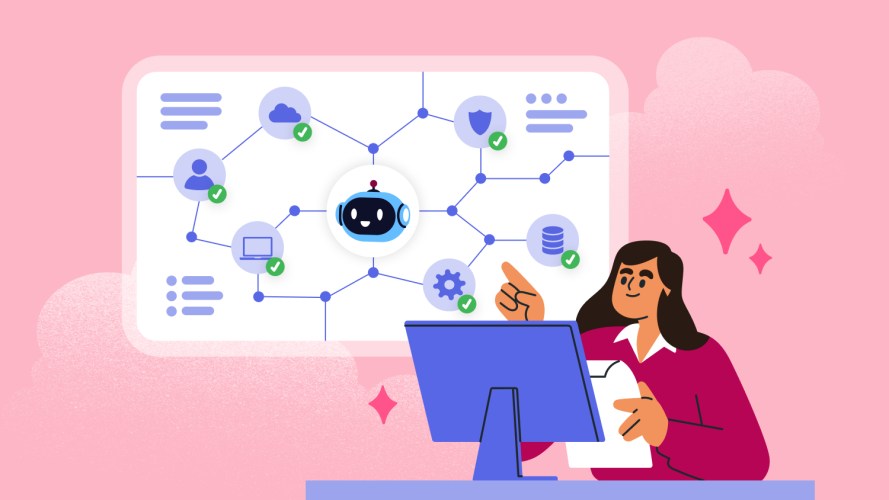
Your employees shouldn’t need five different portals for five different problems. One interface. Slack, MS Teams, email—wherever they are. Behind the scenes, specialized agents talk to each other and coordinate the work.
One agent checks if you have the right software licenses. Another manages your access permissions. A third logs everything in the IT ticketing system and closes the ticket. They work together without anyone orchestrating them manually.
The reality
This isn’t magic. It’s architecture. The platform has to be open. It has to connect to your existing systems—your legacy apps, your databases, your APIs. It has to be flexible enough to handle your unique business. And it has to be built on a foundation that never compromises on security or control.
When you get that right, automation becomes something real. Not a chatbot that sounds smart, or a static portal. A system that actually does the work.
And your IT team gets their time back.
See IT Service Cloud in action
This is what IT Service Cloud does. It handles the thinking. It knows your systems. And it never breaks the rules. See how it works.
Stop chasing IT tickets
Your IT team was hired to innovate, solve problems, and move your business forward. IT Service Cloud gets them back on track.