





Over the past decade, sales organizations have invested heavily in data science. Many have built sophisticated machine learning models to predict which reps are most likely to hit their quota, which customers are ready to buy, which accounts are at risk, and which product opportunities are ripe for expansion. These models are valuable. They work on paper. They often perform well in testing and deliver high predictive accuracy.
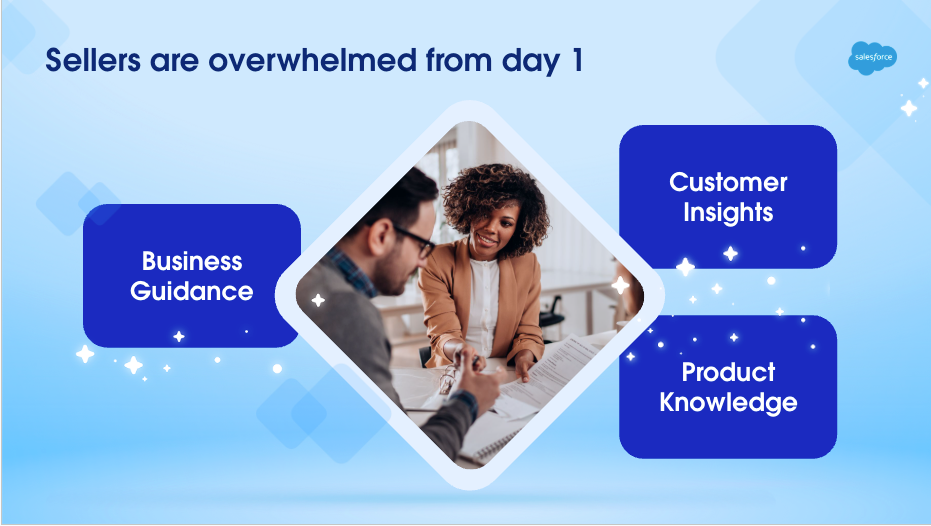
But as we learned firsthand during our journey as “Customer Zero”—the internal pilot team using our own technology before releasing it—there’s a growing disconnect: even when these models exist, they often sit unused. Sellers are overwhelmed with dashboards, buried in alerts, and often don’t even know these models exist. Managers don’t always trust what they can’t explain. And despite all the predictive power, these systems fail to change behavior. Insight doesn’t equal impact.
Our challenge wasn’t to build more models—it was to operationalize the ones we already had. This is where our vision of an “agentic enterprise” came into play. Instead of creating another dashboard or static report, we built a system that proactively delivers personalized, context-aware, and action-driven guidance to sellers in real time. And we did it using the same tools our customers have access to: Salesforce Data Cloud, Slack, and Agentforce Sales Coach. We set out to answer a fundamental question:
What would it take to turn our existing AI and analytics into something that sellers actually use?
The answer turned out to be worth more than $37M in combined pipeline and revenue impact over just four months. Here is how we built the system that delivered those results.
Enter a new paradigm: Making conventional AI agentic
What we built was not just an orchestration layer, but a living, learning system that brings together analytics, strategic playbooks, real-time communication and enablement. We refer to this as an agentic system—AI that collaborates, adapts, and supports human action at scale.
To get there, we followed four major steps:
- Creating a unified view of intelligence with Data Cloud
- Capturing institutional sales strategy and encoding it as reasoning logic
- Connecting models to actions
- Delivering guidance through Slack and Agentforce Sales Coach, enabling practice and coaching
Each of these layers builds on the one before it, and each layer brought its own set of challenges and best practices. Let’s walk through how it worked.
Step 1: Creating a unified view of intelligence with Data Cloud
Like many enterprise organizations, we already had a strong foundation of analytics and conventional ML models in place: skill assessments, enablement history, quota attainment predictions, lead scoring, propensity to buy, customer success scores, open pipeline health, cross-sell readiness, territory analysis and more. But they lived in silos across BI dashboards, spreadsheets and different teams.
Using Salesforce Data Cloud, we consolidated all of these models and signals into a unified layer. This gave us a centralized, normalized view of every seller’s activity and potential, organized not just by rep, but by rep + product. That structure was key. One AE might be ready to upsell Tableau but still ramping up on Slack. Treating them as a single entity would’ve flattened that nuance.
With this product-level granularity, we created a long-format table where each row represented a rep-product pair, and each column held key predictive signals. That became the foundation for everything that followed: generating context-specific next best actions, aligning those actions to enablement content, and delivering coaching experiences in the flow of work.
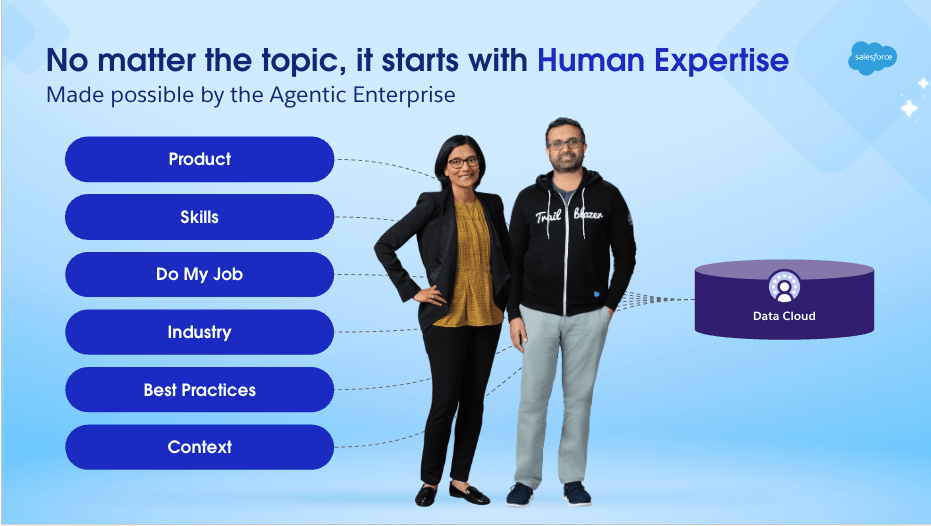
This level of granularity gave us the resolution needed to drive specific actions like which product to pitch, which account to focus on, and which stage to intervene in.
Step 2: Capturing institutional sales strategy
Once we had the data in one place, we needed to make it meaningful. Predictions alone don’t tell you what to do—they just describe what’s likely. To turn insight into action, we needed sales strategy. We needed to understand what great reps already know: how to respond when a deal is at risk, how to upsell a satisfied customer, how to revive a stalled opportunity.
This step is where the human in the loop becomes critical. We recognise that humans are the tastemakers. AI doesn’t inherently know the difference between good and great the way that our subject matter experts do.
We didn’t just write code, we sat down with sales leaders, enablement teams, and high-performing reps across the organization. We asked them: what works? What plays do you run when you see risk? What messages resonate in expansion conversations? What’s your instinct when you see certain signals in a CRM? The goal wasn’t to replace human judgement, but to democratize access to the best judgement in our company.
What emerged was a set of decision patterns. If CSS is high and PTB is strong, go for an upsell. If quota coverage is low and pipeline is stagnant, focus on rescue. If cross-sell is possible, prioritize it when the account shows strong usage.
We translated these patterns into a structured framework—like a playbook meets a logic tree. These became the rules and prompts that would later feed into our reasoning engine.
This also created an opportunity to bring institutional knowledge to scale. For example, some of the best tactics used by top sellers—like when to involve customer success, or how to position certain product benefits—were added to the logic so they could benefit every seller, not just the ones lucky enough to work with a seasoned manager.
Step 3: Connecting models to actions
Now that we had clean, consolidated signals from Data Cloud and a strategic playbook from our sales teams, the next challenge was to connect the dots.
Agentforce allowed us to combine the flexibility of large language models with the predictability of code. It functioned like a digital strategist—taking inputs from models and playbooks, and returning a specific recommendation for what the seller should do next.
For example, Agentforce might receive this:
- AE: James Lee
- Product: Tableau
- Likelihood for Renewal: 89
- Customer Name: XYZ Inc.
Based on our logic, it would output:
“Recommend an upsell motion. This account is highly satisfied and showing strong buying intent. Would you like me to help draft a pitch?”
Agentforce didn’t just label something “at risk” or “high opportunity.” It prescribed a move, with reasoning and resources. It also helped sequence multiple actions across products, allowing sellers to prioritize what matters most.
This logic layer represents the social contract between the organization and the agent. We aren’t letting an LLM hallucinate a sales strategy, we are enforcing strict guardrails defined by leadership.
This builds trust, allowing revenue operations, enablement leaders and sellers to sleep at night knowing that the agent is only recommending actions that are aligned with their organisational definition of excellence and tried and tested methodologies, ensuring the agent operates as an extension of the enablement organization.
Step 4: Delivering intelligence where sellers work
With personalized recommendations in hand, the final piece was delivery. If you bury insights in dashboards, they won’t be used. That’s why we integrated with Slack and Sales Coach Agent.
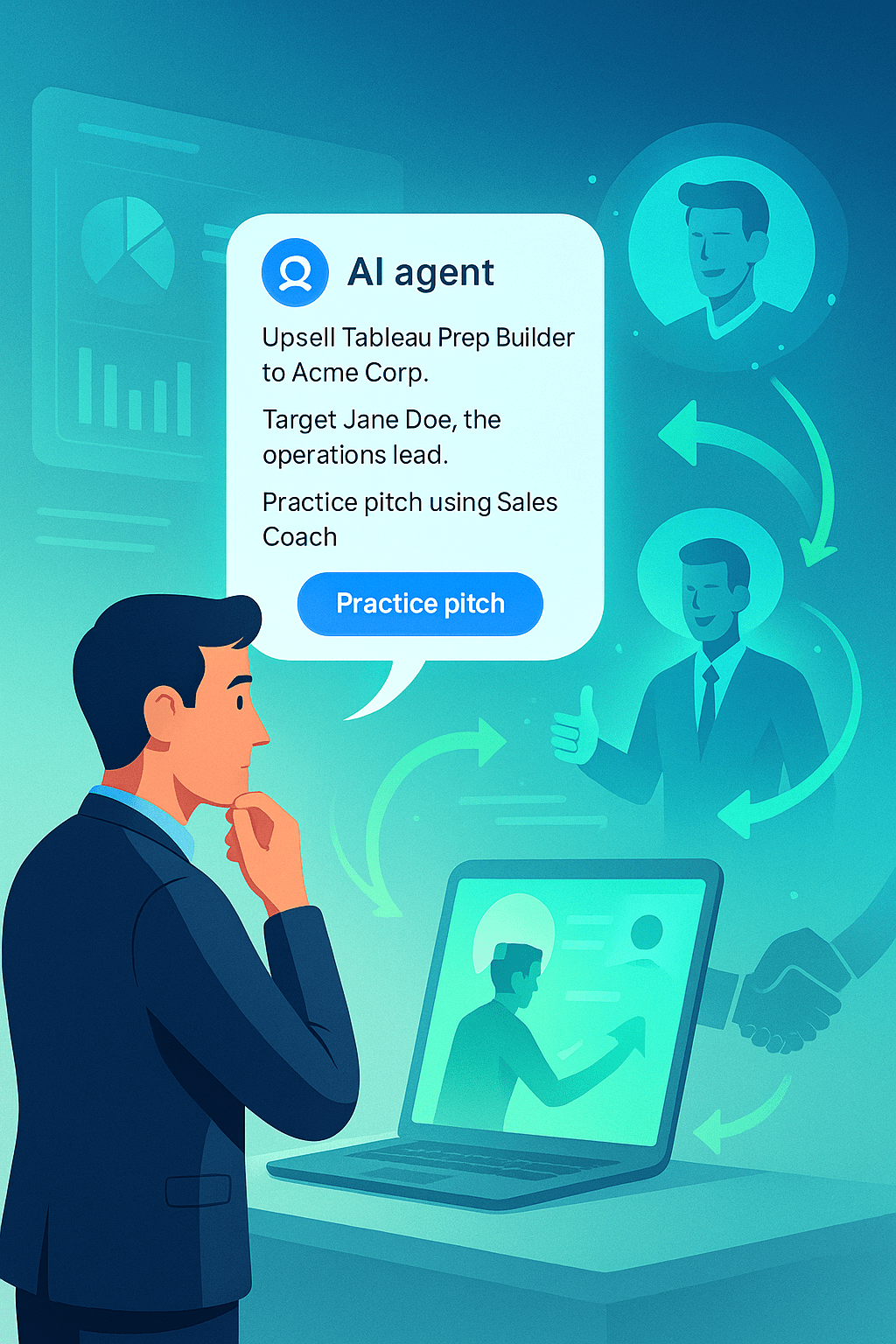
Sellers receive tailored Slack messages based on their book of business and their current priorities. These aren’t generic nudges—they’re curated actions. One example:
“Hey James, you have a Tableau renewal coming up with Cengage Learning. Practice your pitch using Agentforce before calling. Your last contact was Pat Griffith. Renewal is due Nov 15 for $150,000.”
That’s not a reminder. That’s a moment of clarity. And the seller doesn’t need to guess—they can click straight into Agentforce Sales Coach to practice the pitch in a safe and private setting. Traditionally, they might have role played with their sales leader who’s already stretched thin. But now with Sales Coach Agent, a seller can refine their pitch as many times as needed with dynamic AI generated feedback. The pitch simulator isn’t just a quiz—it listens and evaluates the seller’s readiness. An AE would receive real-time coaching feedback that looks like this:
“Great delivery. Consider emphasizing Data Cloud cross-sell potential. This account shows high DCE model overlap.”
It’s enablement, embedded. And the data shows that sellers prefer this method. While standard dashboard-based requests typically see an 8% completion rate, our agent-delivered recommendations achieved a 38% action completion rate. When guidance is personalized and delivered in the flow of work, sellers don’t just read it, they act on it.
Behind the scenes: A platform for the agentic enterprise
This system works because each layer reinforces the others. Data Cloud gives you one unified, clean foundation for all predictive signals. Agentforce applies strategic reasoning and connects intelligence to action. Slack brings recommendations into the flow of work. And Sales Coach Agent ensures that sellers not only know what to do, but how to do it.
The system is also modular and scalable. You can plug in new models as they become available. You can add new decision rules as strategies evolve. You can expand the agent to include new roles beyond AEs, like sales engineers, customer success, or solution consultants.
Perhaps most importantly, this system respects how sales actually happen. It doesn’t replace the rep or the manager. It augments them. It brings together the best of data science, enablement, coaching, and platform integration into a single agentic layer that drives real behavior, in real time.
The impact: Driving action and revenue
We didn’t just build this system to be smarter, we built it to drive outcomes. The results from our initial rollout prove that when you pair predictive insights with agentic coaching, seller behaviour changes. Between February and May 2025, we ran 14 pilots across various sales motions, delivering over 24,000 personalized recommendations. The difference in engagement was stark. In traditional enablement initiatives, we typically see an action completion baseline of around 8%. With this agentic approach, action completion jumped to 38%, a nearly 5x lift in seller engagement.
Most importantly, this engagement converted into tangible business value. In just four months, these pilots contributed approximately 28M in generated pipeline and 9M in closed ACV. By moving from passive dashboards to active agents, we didn’t just predict success, we helped secure it.
From demo to deployment
Everything we’ve shared isn’t just a demo. It’s live. It’s working. And it’s scaling.
We’ve gone from sending generic messages like “Your top growth factor is pipeline generation—here’s a video,” to saying: “Pick up the phone. Call this customer. Here’s the pitch. Here’s the coach. Let’s go.”
We’re not just predicting the future. We’re shaping it in partnership with sellers, in real time. By taking an agentic approach, we haven’t replaced the role of the sales leader or enablement practitioner. We have augmented them by giving them a way to be in the room with every seller, on every deal to guide them towards the next best action and best outcome. This is how we make conventional machine learning operational. Not by building more. By connecting better.