




In standard customer service deployments, AI agents operate reactively: a user initiates the interaction with a specific problem, such as stating, “I am looking for technology to expand or modernize my factory,” and an agent attempts to resolve it.
But what if you want to use AI to actively drive your sales pipeline? One of the most powerful applications is autonomous sales qualification: having an AI agent independently engage, evaluate, and nurture early-stage leads. This requires the exact opposite approach. To qualify a lead effectively, an AI agent cannot just sit back and wait; it must proactively drive the conversation, progressing through a specific sequence of inquiries while gently constraining the user to the topic at hand.
Crucially, when an AI agent initiates these conversations, your brand’s reputation is on the line. The agent must operate flawlessly to establish a relationship built on trust from the very first interaction.
Here is how Salesforce’s EMEA Central Product Forward Deployed Engineering team used Agentforce to build a dynamic, autonomous lead qualification agent for and with Siemens that drives the sales funnel while protecting their customer relationship.
Siemens x Salesforce: Redefining the Industrial Sales Funnel with Agentforce
Siemens, a global industrial technology company, is entering a new era. With offerings spanning physical hardware like HVAC valves to digital solutions like IoT drivetrains, the 175-year-old company is pursuing one clear ambition: combining the digital and real worlds like no other.
But ambition needs execution. Siemens was managing up to 3,000 inbound leads per week. At this scale, timely follow-up and consistent qualification become increasingly important. The challenge was to improve conversion potential and ensure efficient lead handling across seven business units, a large global sales organization, and thousands of partners.
Partnering with Salesforce, Siemens uses Agentforce for dynamic, autonomous lead qualification agent to qualify, route and convert leads, giving sellers the right context (budget, authority, needs, timeline) at the right time.
The Limits of Email and Reactive Bots
In the project, the joint objective was to construct an autonomous qualification and nurturing agent. Traditionally, early sales outreach relies on static emails. However, email lacks the dynamic, multi-turn capability required to clarify ambiguities. For example, if a lead replies that they want to implement a solution “soon,” an email can’t instantly clarify whether “soon” means next week or next quarter.
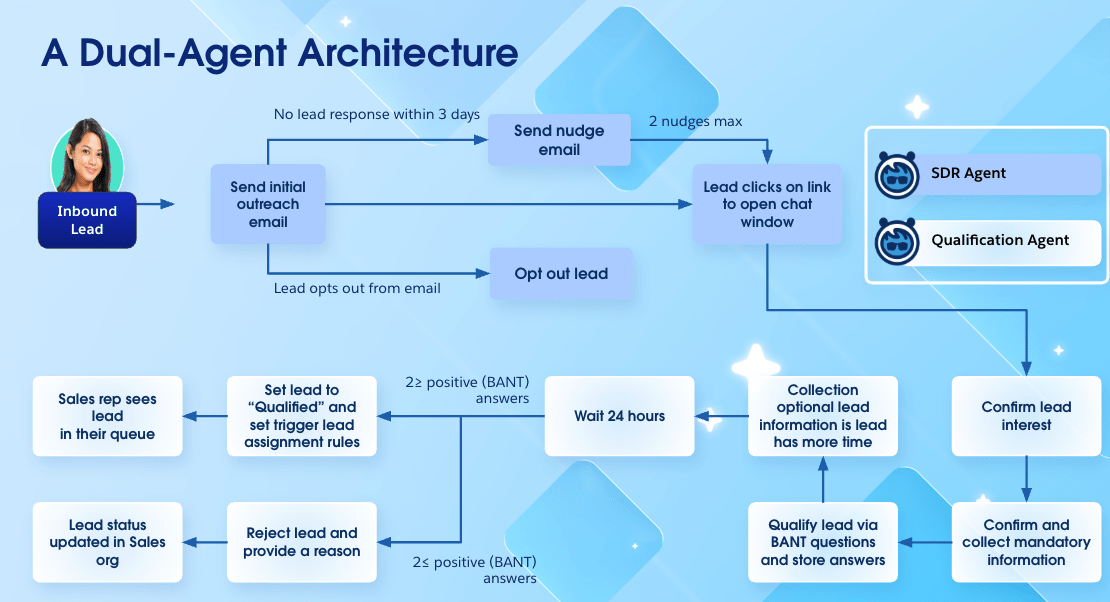
To solve this, we decoupled the initial outreach and the complex qualification into a specialized single-org multi-agent (SOMA) architecture.
- The SDR Agent: Responsible for the initial email outreach campaign, nudging unresponsive leads, and handling opt-outs.
- The Qualification Agent: Once a lead engages and clicks an embedded link, they transition to a chat interface managed by the Qualification Agent, which serves as the logical engine driving data collection and qualification.
The Native Salesforce Advantage: Simplicity and Scale
A critical factor in this architecture’s success is that Agentforce and Agent Script are built natively on the Salesforce platform. There is no need for complex middleware or fragile API integrations to stitch the experience together.
The agent instantly has context on existing Lead data and historical interactions. When a lead is successfully qualified, the agent seamlessly utilizes out-of-the-box Salesforce capabilities, like Flow and Omni-Channel routing, to instantly assign the lead to the correct sales representative. Because Agentforce is built natively on the Salesforce platform, the solution can operate within Siemens’ cybersecurity, data protection, and governance requirements while avoiding unnecessary complexity.
The Business Imperative: Determinism is the Foundation of Trust
In early iterations of our Qualification Agent, we relied heavily on standard generative AI orchestration using the agent builder. While adequate for some users, production usage revealed that relying on a Large Language Model to simply “figure out” the next step based on prompt context led to occasional inconsistent data collection.
Specifically, the generative approach would occasionally bypass necessary qualification questions, leading to incomplete CRM profiles and unpredictable outcomes. Furthermore, if a lead deviated from the conversation or went off-topic, the agent struggled to maintain context and redirect the user back to where the conversation had originally diverged.
In a sales context, consistency is key to a positive user experience. If an agent skips a logical step, fails to handle an edge case gracefully, or loses conversational context, it can disrupt the lead’s journey. Providing a seamless, logical conversation is essential to building confidence in the interaction.
This highlighted a fundamental requirement for autonomous sales: determinism. To trust an AI with leads, you must have absolute control over its reasoning process.
To solve this, we migrated our qualification agent to Agentforce Agent Script. Unlike the legacy builder, Agent Script allows organizations to define explicit multi-turn logic and use explicit transition commands rather than letting the AI guess when a task is finished. This ensures the agent follows a deterministic sequence to qualify a lead, executing business rules with programmatic precision and guaranteeing a reliable, trustworthy experience every time.
Proactive Q&A: Keeping the Conversation on Track
Armed with Agentforce Script, our Qualification Agent employs a “Driven Q&A Pattern”. The agent retains conversational initiative, guiding the user strictly through the trusted BANT framework: Budget, Authority, Need and Timeline.Because of the strict state orchestration, the agent acts as a logic anchor. If a user asks an unrelated question or gives an unclear answer, the agent catches it. It provides a brief, helpful nurturing response to the diversion, but immediately loops back to the unresolved question (for example: “That’s a great question. To get back to our timeline, when were you looking to start?”).
Maximizing Conversion and Leaving No Lead Behind
To keep leads engaged and prevent them from abandoning the chat, we prioritized brevity. Asking a lead for a massive list of details right away causes frustration. Instead, we split the questions into two distinct phases: core qualification first, BANT questions and optional details later.
As the agent evaluates the lead’s answers against the core BANT criteria, it looks for positive responses. However, we recognized that B2B buying isn’t always instantaneous; a lead might need to check with their team about a timeline or budget before committing to an answer.
To accommodate this and build further trust, we implemented a 24-hour “tolerance window” after the initial conversation finishes. During this grace period, the lead can return to the chat to update or change their answers. We don’t immediately lock the record or force a premature outcome.
Once this 24-hour window closes, the final evaluation occurs. If the lead has provided at least two positive BANT answers, they are officially categorized as “Qualified”. At this moment, the agent triggers lead assignment rules and queues the lead for a human sales representative. (Secondary, optional details are only collected after the core BANT criteria are met). Conversely, if there are fewer than two positive answers after the window closes, the lead is not classified as qualified at that stage, and the CRM is automatically updated.
Beyond improving the conversation itself, this autonomous approach enables highly scalable lead handling. Many companies simply don’t have the human bandwidth to follow up on every single top-of-funnel inquiry, meaning valuable opportunities slip through the cracks. The Qualification Agent ensures comprehensive lead coverage, guaranteeing that every lead receives immediate, personalized engagement without wasting valuable seller time on unqualified leads.
The Future of Autonomous Sales
Transitioning from a reactive service model to a proactive, goal-oriented AI changes the game for sales teams. The result for Siemens is a smarter sales funnel: less time spent on unqualified inquiries, more time closing deals that matter, and a strong example of how global technology companies can connect customers, partners, and portfolios at scale. By utilizing Agentforce Script, organizations like Siemens can ensure rigid adherence to qualification frameworks autonomously, keeping CRM data pristine while maintaining the fluid, natural flexibility of human conversation.